
Are the Bennett Girls Ok?
A post-modernist feminist version of Jane Austen's "Pride and Prejudice" focusing on the five sisters and their mother.
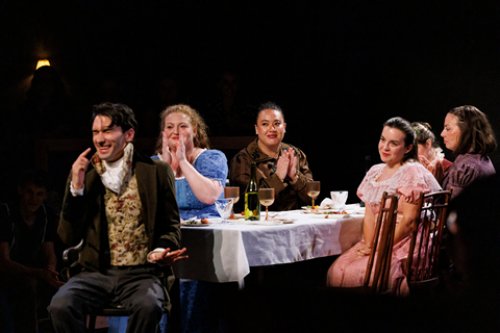
Edoardo Benzoni, Elyse Steingold, Deychen Volino-Gyetsa, Caroline Grogan, Violeta Picayo and Zuzanna Szadkowski in a scene from the Bedlam production of Emily Breeze’s “Are the Bennet Girls Ok?” at the West End Theatre (Photo credit: Ari Espay)
The latest Jane Austen adaptation is Emily Breeze’s Are the Bennet Girls Ok?, a post-modern version of Pride and Prejudice that focuses entirely on the women, the five sisters and their mother, Lizzie’s friend Charlotte and Darcy’s sister Georgiana. (All the five men depicted are played by one actor who changes his coat for each character.) You are probably better off if you have not read the novel as there are a great many plot and character changes including the ending. Leave it to Bedlam, the theater company which became famous with their brilliant stage version of Sense and Sensibility, to offer Pride and Prejudice as a modern farce but dressed in Regency costumes.
Among the changes that will bother Janeites are the fact that Mr. Darcy is relegated to a minor, weak character and Mr. Wickham is elevated to a major dynamic character, including marrying Lydia with her mother’s permission. Mr. Bennett, the father of the five girls, is off stage dying throughout, leading to Mr. Collins his heir getting ready to take over the house in which they live. Petulant Georgiana Darcy is now a grown up young woman who is very much in love with Wickham but as a result of a fight we do not witness she loses him. Mr. Collins is not pretentious and a social climber, nor a minister of the cloth, but nerdy and intellectual. Strangest still is the elimination of Darcy’s aunt and Collins’ benefactor, Lady Catherine de Bourgh, as well as Caroline Bingley, Charles’ sister, a social snob who in the book separates her brother and Jane. Lizzie no longer has any reason to dislike Darcy except for the overheard remark at a ball with which this version begins but which we do not witness.
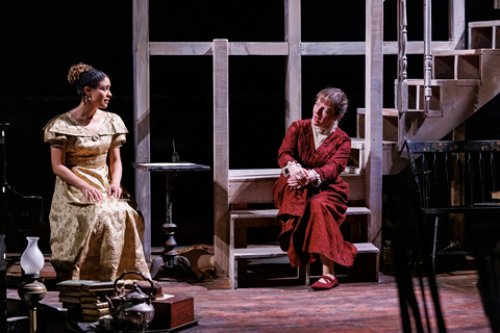
Shayvawn Webster and Zuzanna Szadkowski in a scene from the Bedlam production of Emily Breeze’s “Are the Bennet Girls Ok?” at the West End Theatre (Photo credit: Ari Espay)
The style and tone of Are the Bennet Girls Ok? has been updated to contemporary language with the women using “like” and multiple curse words including the F-bomb so that although we see women dressed in Mariah Anzaldo Hale’s clothing from 1811 what we hear is 2025 language. And while the jokes suggest this is now a farce, none of it is very funny, with the men getting the worst of it. Both Charles Bingley (nicknamed “Bing Bong” by the Bennet sisters) and Fitzwilliam Darcy are figures of fun so that we do not see what the women see in them. While the original novel was a social comedy, the serious problem that the Bennet women must marry as they will be evicted from their house on the death of their father is no longer a consideration today: entailment to the oldest male heir was discontinued in England in 1925. Also unlike in 1811, women can now work and earn their own money.
Under Eric Tucker’s raucous direction and Breeze’s new interpretation, the sisters are entirely different than we know them from Austen. Elyse Steingold’s Lizzie (she is never called Elizabeth here) is no longer the heroine but an immature, self-centered young lady who is not the least interested in men, but reading, her friend Charlotte who she dominates and her sisters who she enjoys arguing with. Shayvawn Webster’s Jane, in the book the reticent, beautiful sister, is now given to expressing her feelings and telling people off. Mary has become a central character. And while she still lacks social graces, Masha Breeze (sibling to the playwright) walks away with every scene she is in, falling in love with Mr. Collins, writing songs at the piano, etc. Kitty who is the youngest sister in the book, as played by Violeta Picayo is a woman who seems more mature than her sisters. Caroline Grogan’s Lydia is not as flighty as originally created by Austen but still falls for Mr. Wickham on a very short acquaintanceship.
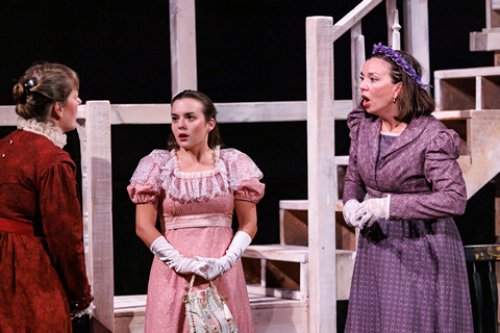
Zuzanna Szadkowski, Caroline Grogan and Violeta Picayo in a scene from the Bedlam production of Emily Breeze’s “Are the Bennet Girls Ok?” at the West End Theatre (Photo credit: Ari Espay)
Zuzanna Stradkowski’s Mrs. Bennet adequately captures the gossipy, socially ambitious woman whose only aim is to get her daughters married but often is guilty of many faux pas. Here, she can’t hold her liquor and is often drunk when wine or liquor is available. She is aware of the situation she and they are in if they don’t marry as Mr. Collins will inherit their house and belongings. It is she who invites him to visit hoping he will choose one of her daughters for his wife.
Both Charlotte, Lizzie’s best friend, and Georgiana, here a friend of Jane’s, are quite different from Jane Austen’s interpretation. Deychen Volino-Gyetsa’s Charlotte, who does not expect any marriage proposals, sees Lizzie as a fair-weather friend who is only interested in her if it is convenient. She gets to give Lizzie a good dressing down when she becomes engaged to Mr. Wickham, something Lizzie doesn’t like because of Mary’s interest in him. Caroline Campos’ Georgiana is asked to be hysterical and emotional. We are never told that she is a great heiress and that her brother (Mr. Darcy) has had to keep gold-diggers and gigolos away, including Mr. Wickham. Edoardo Benzoni has the thankless job of playing all of the men by changing a piece of clothing (Collins, Wickham, Bingley, Darcy and the elderly Mr. Bennet who is given exactly one line.) Unfortunately we don’t see any of them long enough to get to know them, but he is not that different playing each of the suitors.
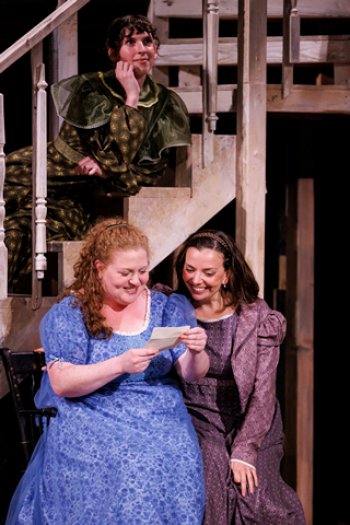
Masha Breeze, Elyse Steingold and Violeta Picayo in a scene from the Bedlam production of Emily Breeze’s “Are the Bennet Girls Ok?” at the West End Theatre (Photo credit: Ari Espay)
John McDermott’s minimal scenery allows for the many scenes mostly in and around the Bennet mansion, though there is very little period atmosphere to set up the time period. The lighting by Eric Southern and Cheyenne Sykes suitably sets the mood for various scenes, while the 19th century costumes by Hale put each woman in a different color, appropriate to her character (Lizzie in light blue, Jane in gold, Lydia in pink, Mary in green, Kitty in purple, Charlotte in brown, Georgiana in silver and Mrs. Bennet in red.)
It is not surprising that this version of Pride and Prejudice has had its name changed to Are the Bennet Girls Ok? as it has so little connection to the Jane Austen novel. Except for the character names and the plot of trying to find husbands for them, this version has very little to do with the original. Considering the author’s approach, it might have been better to play it as a contemporary comedy or even an outright farce, showing how far women have come since Austen’s time. While Tucker’s production is completely consistent in its approach, it does a great injustice to the original Jane Austen novel, a classic all these years, but the new play is not funny enough to be a veritable parody.
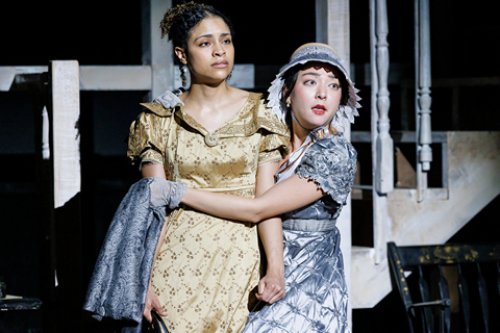
Shayvawn Webster and Caroline Campos in a scene from Bedlam’s production of Emily Breeze’s “Are the Bennet Girls Ok?” at the West End Theatre (Photo credit: Ari Espay)
Are the Bennet Girls Ok? (extended through December 21, 2025)
Bedlam
West End Theatre, 263 W. 86th Street, in Manhattan
For tickets, visit http://www.bedlam.org
Running time: two hours and 30 minutes including one intermission


Interesting that Mr. Gluck offers up one of the few negative reviews of this production. He seems perturbed by the fact that the adaptation is not close enough to the book… And since it’s not a production of Pride & Prejudice (the title is a hint), it’s not enough of a parody of the book to be very funny. Could it be that an *original* work, inspired by the exploration of female relationships — somewhat novel in Austen’s time — were simply over the head of an aging, male theatre critic?
Thanks for weighing in, Wilson. Victor’s review reflects a seasoned critic’s honest response to how this adaptation works — or doesn’t — onstage. You may disagree with his take, but reducing it to age or gender misses the substance of his argument. We stand by his perspective as part of a wide range of critical voices.
Thanks for contributing thoughtfully to the conversation.
Jack Quinn, Publisher