
The Picture of Dorian Gray
Kip Williams’ stage adaptation of the Oscar Wilde novel starring “Succession” ’s Sarah Snook as all of the characters is a unique theatrical event not to be missed.

Sarah Snook as Dorian Gray in a scene from Oscar Wilde’s “The Picture of Dorian Gray” as adapted by Kip Williams at the Music Box Theatre (Photo credit: Marc Brenner)
The Sydney Theatre Company production of Kip Williams’ adaptation of The Picture of Dorian Gray by Oscar Wilde is a unique theatrical event not to be missed. In it, Australian actress Sarah Snook, known here for her Golden Globe and Emmy Award winning performance in HBO’s series Succession, plays 26 or 27 roles (depending on how you count the butlers,) often in pre-recorded conversations and appearances with herself. The technique of the video design using five camera operators (clew, Luka Kain, Natalie Rich, Benjamin Sheen and Dara Woo) to follow Snook around the stage at all times during the performance suggests that we will not see a great many other stage adaptations handled this way. The technical coordination to put this show together must be quite phenomenal.
However, it is not just the remarkable video design which uses sometimes up to six screens to convey the action of the story plus live action, but we get inside of the head of protagonist Dorian Gray in ways not possible before. Also seeing or hearing Snook as all the characters in different voices is quite a remarkable feat. Andrew Scott only plays eight in his Vanya one-man show, but here Snook also changes costumes repeatedly before our eyes and emerges as someone else. Beginning as the narrator, she slowly becomes Dorian Gray who eventually takes over completely. We also see her as Lord Henry Wotton, painter Basil Hallward, actress Sibyl Vane and later her brother James, the Duchess of Harley, and former friend and Oxford classmate Alan Campbell.

Sarah Snook as Lord Henry Wotton in a scene from Oscar Wilde’s “The Picture of Dorian Gray” as adapted by Kip Williams at the Music Box Theatre (Photo credit: Marc Brenner)
The adaptation is extremely faithful to the 20 chapter full-length version of the novel published in 1891, leaving out only one chapter, Chapter 5, in which Sibyl and James go for a walk in the park. All of Wilde’s famous lines are intact – remarkable how many there are. In late Victorian London, profligate man of leisure Lord Henry Wotton known for his often shocking witticisms visits his artist friend Basil Hallward to find him finishing a full-length portrait of a beautiful young man. Lord Henry worms out of him that his name is Dorian Gray but Basil prefers to keep him all to himself. At that moment Dorian is announced for his sitting. Lord Henry and Dorian are very much taken with each other, eventually to become fast friends. However, Lord Henry’s philosophy of living life entirely for pleasure will be the undoing of Dorian, a very impressionable young man.
Marveling at the finished painting, Dorian makes the wish that his face can remain untouched while the painting ages. (Beware what you wish for.) After the painting is delivered to Dorian’s mansion, he discovers that each of his debauches is reflected on the canvas as the corrupting influence of Lord Henry and Dorian’s own egotistical and hedonistic nature takes over. Over the next 18 years, he destroys a great many people, the young actress Sybil Vane, many young men he introduces to opium and seduction, both through suicide and even murder. Eventually the painting and his own excesses get their revenge.

Sarah Snook as both Sir Henry Wotton and Dorian Gray in a scene from Oscar Wilde’s “The Picture of Dorian Gray” as adapted by Kip Williams at the Music Box Theatre (Photo credit: Marc Brenner)
Among the remarkable moments are Dorian talking live with Lord Henry on video (incredible design by David Bergman) and then joined by Basil, Lord Henry putting his hand on Dorian’s shoulder (which is the real one?), Lady Agatha’s dinner party in which Snook plays all seven characters in costume with Lord Henry live at one end of the table. Using an IPhone, Dorian shows us his deteriorating soul in twisted video. An exciting chase through the woods as Dorian tries to avoid Sybil’s brother James (playing both) is quite thrilling.
Except for the central huge screen, the initial empty stage is joined by various pieces of scenery (set designer Marg Horwell),becoming more and more elaborate, which are also filmed by the onstage team: a corner of Dorian’s sitting room, the theater at which Sibyl performs, Dorian’s estate Selby Royal. Aside from the chase through the woods there is also Dorian’s furious carriage ride in order to replenish his supply of opium and his descent into this den of depravity. Snook changes on stage in Horwell’s costume design becoming Basil, Lord Henry, Dorian, Sibyl, James, all of whom we see live on stage. Nick Schlieper’s moody lighting design creates its own foggy London. Clemence Williams’ original music and witty sound design includes such disparate elements as Donna Summer’s “I Feel Love,” Mahler’s Resurrection Symphony and Bock and Harnick’s “Gorgeous” from the musical The Apple Tree, at appropriate moments.
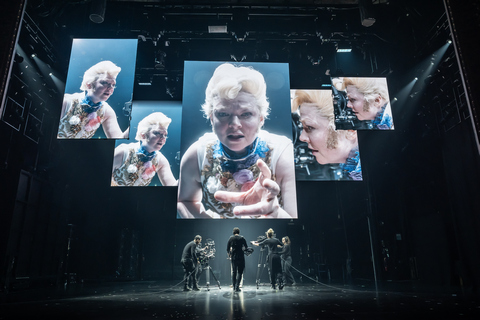
Sarah Snook as Dorian Gray in a scene from Oscar Wilde’s “The Picture of Dorian Gray” as adapted by Kip Williams at the Music Box Theatre (Photo credit: Marc Brenner)
Under the author’s assured direction, not only is Sarah Snook tremendously convincing as the blue eyed, blonde somewhat androgynous Dorian, but she is believable as the aging Lord Henry as well as the many other characters, helped by the uncredited wig and hair design. The video elements must be seen to be believed. One quickly forgets that Snook is often seen and heard in prerecorded moments, but eventually it all comes together in one theatrical presentation. We never do see Basil Hallward’s painting of Dorian Gray but that, like much of the show, allows us to use our own imagination.
The Picture of Dorian Gray (through June 29, 2025)
Sydney Theatre Company Production
The Music Box Theatre, 239 W. 45th Street, in Manhattan
For tickets, call Telecharge at 212-239-6210 or visit http://www.doriangrayplay.com
Running time: one hour and 55 minutes without an intermission


Leave a comment