News Ticker
- December 13, 2025 in Off-Broadway // BUM BUM (or, this farce has Autism)
- December 12, 2025 in Musicals // The Faggots and Their Friends Between Revolutions
- December 12, 2025 in Cabaret // Mary Foster Conklin — Mirrors Revisited (50th Anniversary)
- December 11, 2025 in Cabaret // Kathy Kaefer — Kiss Me Once: Stories from the Homefront
- December 11, 2025 in Off-Broadway // The American Soldier
- December 9, 2025 in Off-Broadway // This World of Tomorrow
- December 9, 2025 in Cabaret // A Noel Coward Celebration — Steve Ross & Friends
- December 7, 2025 in Off-Broadway // Diversion
- December 5, 2025 in Off-Broadway // Meet the Cartozians
- December 5, 2025 in Features // Tom Stoppard: An Appreciation
- December 4, 2025 in Off-Broadway // Practice
- December 4, 2025 in Cabaret // Eddie Bruce — The Magic & Music of Tony Bennett
- December 3, 2025 in Interviews // Interview with Ty Jones, Classical Theater of Harlem
- December 2, 2025 in Features // Gingold Theatrical Group’s 20th Anniversary Gala at The Players
- December 2, 2025 in Interviews // The American Soldier – An Interview with Douglas Taurel
Archive
The current staging of "Our Lady" at The Pershing Square Signature Center, directed by Phylicia Rashad, magically now comes across as an addled, profane sitcom. It’s entertaining and at times moving, but the real magic is that the very same words can be tended by a solid director—this one obviously experienced in sitcoms—and refresh a theatrical experience so completely. Rashad has shown that scathing can be scathingly funny. This time I left laughing.
[more]
While "Brokeback Mountain" impresses in its sincerity, it does not move which is a serious problem considering the romantic and tragic plot. Director Jacopo Spirei’s cast is in fine form as singers though the music and its libretto fail to fulfill this story’s potential. Daniel Okulitch and Glenn Seven Allen as the two doomed lovers make indelible impressions of men in a repressed society which does not allow them freedom of expression - even though they are not given the kind of music that can move the heart to tears. Brokeback Mountain which is fine as far as it goes offers the same disappointment of many new modern operas in that its writing falls short of its high-reaching intentions.
[more]
The Cast of “Stage Life” (Photo credit: Courtesy of Creative Arts Lab) [avatar
[more]
Mr. Cruz realizes his scenario with his patented style. There’s rueful humor, Chekhovian reveries and a sense of the mystical all with a demonstrative Latin sensibility. The dialogue is filled with passionate eloquence and is made even more pleasurable by experiencing it in Spanish. Some sequences have characters reciting their letters which allows for reflective ruminations. The play takes place in the contemporary United States with several of its figures having been born in other countries.
[more]
The nine pieces on this program differed tremendously from each other in style, tone and effect. However, two important qualities unified all the performances. First, the composers all caused their music to emerge from their chosen texts: they did not impose sound arbitrarily unto the words. The organic coherence of word and musical sound resulted from both the composers’ innate gifts and their consummate skill. Competent choral composition is difficult; really successful choral compositions are very rare. Second, the music was superbly performed: not merely does C4 sing well, but because the C4 singers are all themselves composers, they inhabit each work’s intentions with particularly keen intelligence.
[more]
Director Shira-Lee Shalit provides breakneck pacing, swift scene transitions and compelling stage compositions that include the presence of the violinist. The visual and the verbal are in enthralling unison as Ms. Shalit achieves momentum, raucousness and sensitivity with her vigorous staging. A fully clothed sex scene is powerfully erotic as it visualizes the dynamics of the charatcers. Shalit masterfully guides the cast’s volcanic performances.
[more]
Tagaq makes music with her whole body: it is an act as fundamental as consuming, excreting, orgasm and birthing. She can make any sound – whisper and howl, caress, growl and grunt – and use it to summon, condemn, invoke or bless. Tagaq’s fellow musicians stretch out their own instruments and created sounds to meet hers in developing a constantly changing, expanding music-world.
[more]
Packed into Theodora Skipitares’ "There’s Blood at the Wedding" are multiple takes on how authorities have abused their powers, too often killing innocent people. By theatricalizing and stylizing their stories, Skipitares zooms past the political and digs deeply into the emotional debris left over after a series of brilliantly staged traumatic scenes.
[more]
While "The Beast in the Jungle" is a musical for our time it contains a message that was dear to the heart of writer Henry James, that of the unlived life. Ultimately very moving when the story reaches its conclusion, the exquisite Vineyard Theatre production is for elite tastes but all dedicated theatergoers, not the casual entertainment seekers, should see it. It may well start a new trend in theatre musicals, one in which the emotional sections are danced rather than sung.
[more]
Standing in the way of the show’s success is the workshop-like production. Some of Pellegrino’s melodies are pleasant but musical director Michael Wittenberg’s piano playing drowns out many of the weak voices. The lyrics tend to be very thin and extremely repetitious. The uncredited set is actually that of another show with unnecessary portions covered over in brown cloth, giving the look of the show no atmosphere whatever. The uncredited costumes are mainly coordinated in bland brown and white which does not help recall the period one bit. Stone’s choreography is extremely basic and not very decorative. If you sit on the left side of the theater, you are likely to be blinded periodically by designer Christina Verde’s two spotlights aimed right into the eyes of the viewers.
[more]
We learn a great deal about hospice, possibly more than one might want to know in a play. While most death watch plays like Edward Albee’s "All Over" and Scott McPherson's "Marvin’s Room," take place in another room from where the elderly person is dying, Mary Frances alternates between the downstairs living room/dining room and the upstairs bedroom of her split-level house. Unfortunately, this 21-scened play with at least a dozen more scenes which switch between Mary Frances’ bedroom and the living room where the rest of the family eat or watch television requires endless jump cuts like a film and endless lighting cues from designer Tyler Micoleau.
[more]
Bit and Otto recall tomboy Frankie Addams and Berenice the maid from Carson McCullers’ "The Member of the Wedding" while Pigman and Missy parallel Pozzo and Lucky from Samuel Beckett’s "Waiting for Godot." There’s an arctic sequence out of Tony Kushner’s "Angels in America." The dialogue contains a lot of contemporary academic jargon and it all could be interpreted as some sort of Millennial exploration.
[more]
In many ways Dominique Morisseau’s "Paradise Blue" shares similarities with August Wilson’s brilliant, if long-winded, Pittsburgh based plays. "Blue" is part of Morisseau’s Detroit Project, a three-play cycle that takes place in three different eras. Blue, developed with the aid of the Williamstown Theatre Festival, the Public Theater and the McCarter Theatre is a snapshot of desperate people occupying a part of Detroit on the verge of vast changes—read gentrification.
[more]
While director David Mercatali has them continually circling each other like boxers in a ring--sparring emotionally, if not physically--Sophie and Tom never really connect or even touch each other, except late in the play when they hold each other’s hand for but a moment. Though they remain somewhat aloof and distant from each other no less than from us, they are given vivid life by the actors who portray them: Lisa Diveney as Sophie and Paul Rattray as Tom.
[more]
Played as older than either Viola or Sebastian, Elizabeth Heflin is charmingly eccentric as the strong cougar who becomes lovesick and yielding at the sight of Cesario and then Sebastian. In the role of the melancholy Duke Orsino who is often played as dull and sluggish, tall handsome Matthew Greer is both dashing and athletic, seen both coming from hunting and athletics. Surprisingly Susanna Stahlmann as Viola/Cesario is very bland and colorless, but this may be intentional: it allows the other characters to read into her/him what they wish. As her twin brother Sebastian made up to look like her mirror image, John Skelley is both avid and keen, willing to go along with a seeming jest though he does not know where it will take him.
[more]
Unlike many of the recent New York stagings, Eyre’s production makes it clear that the thrust of this four act play is an attempt for the Tyrones to exorcise their demons in one alcoholic infused night. Before it is over, each and every character will have bared his or her soul in one night of regret, guilt, despair and anger. So much gets revealed, there does not seem to be anything left unsaid by the final devastating curtain. He also has staged the first two acts (before the one intermission) with the characters talking so fast that it as if they do not want to have to stop and notice what they are running away from. Although Rob Howell’s bright and airy set (at least until night falls and the darkness creeps in) seems huge, all of the characters seemed to be caged animals pacing back and forth in forced confinement.
[more]
Conceived by Carrie Heitman and written by Cynthia Babak it was developed in workshops over the last three years by the Hook & Eye Theater company. According to Chad Lindsey’s director’s note, “I wanted to let the performers create characters and situations that answered some of our creative questions and satisfied their curiosity about themselves and the historical women at the play’s core. What emerged is best described as a rhapsody….”
[more]
The new work, “Microburst,” was a quartet performed to classical Indian music composed and played live by Avirodh Sharma. Brilliant and audacious, “Microburst” took the four dancers, all wearing black, fringed outfits—by Barbara Erin Delo— through complex rhythmic patterns that magically fit together as if the four were having a hyperkinetic conversation with their feet. The agility of the four dancers—Geena Pacareu, Eoghan Dillon, Zoey Anderson and Justus Whitfield—was breathtaking and entertaining.
[more]
In the spirit of the loquacious Winnie in Samuel Beckett’s "Happy Days," the animated Yuki Kawahisa beautifully portrays Honoka with sunny depth. Maho Honda as Arisa, the play’s unifying figure, is brilliantly wistful. Veering from low key to emotionally volatile Kensaku Shinohara richly conveys Kazuki’s angst and anguish. This trio’s rapport and chemistry is palpable and is integral to the production’s success.
[more]
Hodges’ play is quite lively with each scene dramatizing one point and the cast of characters made up entirely of real people, not all of them still famous. The real problem is with the unsubtle and one-dimensional acting of the mostly deficient cast. The play also assumes that the audience is familiar with a great many Elizabethan names and personages like poet Michael Drayton and courtier and literary patron Sir Thomas Walsingham. "Marlowe’s Fate" dramatizes the “last nights” of both first Marlowe and then Shakespeare 23 years later, plus a spirited "Punch and Judy" interlude between Marlowe and Shakespeare for credit to the plays published under Shakespeare’s name.
[more]
"Hercules Didn't Wade in the Water" is the winner of the Negro Ensemble Company, Inc.’s 2017 Emerging Playwrights Competition and this is its premiere. Michael A. Jones’ passionate eloquence and the strong performances compensate for the production’s limited presentational values.
[more]
Every once in a while the exactly right actor is matched with the right role and magic occurs. Such is the case with Juan Francisco Villa as the 34-year-old Tennessee Williams (before he became famous) in Philip Dawkins’ "The Gentleman Caller." Looking exactly like the playwright did at that age and sporting Williams’ well-known Southern accent, Villa is so ebullient, irrepressible and high-spirited that one has the feeling one has met the playwright himself. With perfect timing for Williams’ verbal comeback, many of which are taken from his own letters, quotes and diaries, Villa gives an extraordinarily three-dimensional performance in a role that has been depicted in other recent plays and one-man shows about the author. Some of the credit must go to director Tony Speciale for helping to craft this remarkable portrayal.
[more]
While it’s meant to be helpful, a glossary of local jargon ("Operation Crucible" is set in Sheffield, England) in the program is usually a surefire sign that you’re going to have difficulty following the play. Adding to the confusion is that the often dimly lit play leaves us in the dark, in both senses of the phrase. Given the circumstances of the plot, it’s understandable that both director Bryony Shanahan and lighting designer Seth Rook Williams wanted to have many of the rapid-fire scenes unfold in utter pitch black. But it doesn’t abet in our comprehending what’s happening to Bob, Tommy, Phil, and Arthur (the last character is misrepresented as Andrew, in the program) most of the time.
[more]
Ms. Atik complements her engaging contemporary scenario with creative theatricality. Interspersed are vignettes with six performers depicting the members of a nationwide pregnancy Internet message board. Atik also has contrasting sequences set in 1790 in rural Maine between Mary, a sheltered 19-year-old woman about to give birth for the first time. Her husband is out of the way in the town’s tavern and an experienced midwife arrives to assist her.
[more]
Although the title covers part of the plot, the play is really a trenchant social history of Britain from 1925 – 1985 in four short sequences, showing the changes that take place in one house over 60 years and following the career of one everyman, Anthony Spates, known familiarly as Tony. It also follows the women in Tony’s life who help him, love him and leave him in each of four decades. While Antony Eden plays the phlegmatic Tony at four stages in his life (17, 37, 57 and 77) with equal aplomb, the rest of the cast play four characters each, a remarkable feat, as time marches on. "A Brief History of Women" has the depth of a novel and the breath of an epic.
[more]
The program opened and closed with pieces for all five musicians together. Heinrich Ignaz Franz Biber (1644-1704) and Johann Heinrich Schmelzer (1620/23-1680) both made the quartet of stringed instruments and the harpsichord into a coherent unit, even as the harpsichord is so much less loud. It is as though the harpsichord provides a ground on which the string instruments provide alternately close and extended stitched lines.
[more]
Despite the complexity of the interactions of the people of Electchester and the poor folk at Pomonok, Kraar manages to end on a promising note. "Alternating Currents," produced under the auspices of the Working Theater, is a diverting look what happens to an idyllic place after decades of reality intrude.
[more]
Aside from being a tight domestic drama, The Jewish King Lear has several other differences from Shakespeare’s tragedy. Gordin’s Lear has a wife who is sorely put upon and under her husband’s thumb, as well as the old traditions. Gloucester and his sons are eliminated and Kent and the Fool are combined as Trytel, the steward, who often “rhymes like a real wedding jester.” Taybele, the Cordelia character, gets ahead through education and science rather than marriage to a noble. Gordin’s Lear is not only an advocate for the Jewish traditions of his forefathers he is also very much opposed to scientific advances and education for women, shades of Ibsen who was writing at the same time as Gordin. Dovidl’s heath speech does not take place outdoors but in his own house, now ruled by his son-in-law who has replaced him.
[more]
Mr. Carlyle’s giddy opening is a thrilling mise-en-scène of a chorus line of servants, floating props and a grand back drop of a miniature representation of the country estate where the action is set. Act II starts with a rollicking cricket and tennis on the lawn segment showcasing cast members in gleaming casual wear and the commanding gyrations of Mark Evans who wonderfully plays a fatuous cad. There’s also a daffy number where portraits of ancestors in clothing of different eras come to life and dance.
[more]
With an enormous painted backdrop depicting London and featuring St. Paul’s Cathedral and a lamppost (the glorious sets have been designed by Michael Yeargan), the musical begins as Covent Garden pivots into view on a revolving stage. Though, from the moment that we see him in the opening scene, Hadden-Paton seems too young as Higgins in comparison to Rex Harrison, who originated the part, he is actually closer in age to Shaw’s intentions. He also sings more melodically than Harrison, who famously song-spoke his way through the role. Though Ambrose’s voice seems weak at first (“Wouldn’t It Be Loverly?”), it gains in strength and stature as she proceeds.
[more]
There’s a brilliant play buried somewhere in Caryl Churchill’s "Light Shining in Buckinghamshire," a bottom-up historical epic about the English Civil War that the acclaimed British writer developed collaboratively with director Max Stafford-Clark and a group of actors back in 1976. Fifteen years later, it premiered stateside at the New York Theatre Workshop, where it has just returned for a ploddingly drawn-out second go-around that yielded a lot of empty second-act seats on the night I attended.
[more]
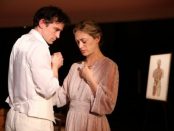
When Tennessee Williams started writing "Summer and Smoke," his working title for the play was "Chart of Anatomy," taken from a poem by Hart Crane. An anatomical chart becomes one of the very few props in the current Classic Stage Company and Transport Group revival of the 1948 play. Under the circumstances, the many players (a dozen in all) are often reduced to charades, as they describe a new gaudy hat, or a jigsaw puzzle, or gloves. For that matter there’s not really a set at all, only a large white platform in the center of the playing area, echoed by a large white rectangle hanging above--a kind of ceiling for the platform--and shortly after the prologue, six chairs, two of which will, at times, serve as a bench or a sofa.
[more]
With a Judy Collins-style mane of blonde hair and wearing jeans and suede, the sleek Luba Mason as Joy certainly looks the part. That mien is reinforced by Ms. Mason’s smoothly conversational vocal inflections and marvelous singing. Mason is totally convincing as the weed-smoking matriarch who follows her heart.
[more]
«
1
…
60
61
62
63
64
…
114
»
Copyright Jack Quinn, 2001-2023