News Ticker
- December 14, 2025 in Broadway // Oedipus
- December 14, 2025 in Interviews // Conversation with Dominick LaRuffa Jr.
- December 14, 2025 in Off-Broadway // The Surgeon and Her Daughters
- December 14, 2025 in Features // Notes Toward a One-Man Play About Scammers, Character, and Control
- December 14, 2025 in Features // A Seasonal Salon Worth Noting
- December 13, 2025 in Off-Broadway // BUM BUM (or, this farce has Autism)
- December 12, 2025 in Musicals // The Faggots and Their Friends Between Revolutions
- December 12, 2025 in Cabaret // Mary Foster Conklin — Mirrors Revisited (50th Anniversary)
- December 11, 2025 in Cabaret // Kathy Kaefer — Kiss Me Once: Stories from the Homefront
- December 11, 2025 in Off-Broadway // The American Soldier
- December 9, 2025 in Off-Broadway // This World of Tomorrow
- December 9, 2025 in Cabaret // A Noel Coward Celebration — Steve Ross & Friends
- December 7, 2025 in Off-Broadway // Diversion
- December 5, 2025 in Off-Broadway // Meet the Cartozians
- December 5, 2025 in Features // Tom Stoppard: An Appreciation
Archive
Heyman and the rest of the production team quickly turn "Space Dogs" into an exercise of quantity over quality. More lights. More noise. More projections. More props. It's theater as sensory overload, with success measured by distraction. The major problem is that it also leads to a lot of other annoyances, with Nathan Leigh's sound design doing nothing for the intelligibility of Hughes and Blaemire's lyrics, Mary Ellen Stebbins' concert lighting occasionally blinding the audience in MCC's small off-Broadway space, and Stefania Bulbarella's numerous projections just stoking the meaningless hurly-burly.
[more]
A woman’s arm falls off soon into playwright Charly Evon Simpson’s engrossing allegory, "sandblasted." Ms. Simpson’s tone beautifully mixes the comic with the wistful, her dialogue is glorious, and her characters are appealing. Structured as 18 punchy short time-shifting scenes, with duologues, trialogues and monologues, the play builds to a stirring conclusion. Simpson quotes Audre Lorde, Toni Morrison and Samuel Beckett in stage notes, their aesthetic influence is evident. The setting is a sandy landscape, the time is “now. after. future.”
[more]
A plea for understanding the pain of being Muslin-American, Sevan’s First Down at the 59E59 Theaters focuses on the plight of an adored football player who decides to kneel and pray during the national anthem rather than stand at polite attention, hand over heart. Quarterback George Berri (a handsome, well-built, sensitive Peter Romano) is a mid-westerner with pale skin and a name that doesn’t necessarily connote his Muslim upbringing. After the Star-Spangled Banner is played, Berri, a young Lebanese/American, is first seen. He is on his knees praying in the locker room well after the game is over. Soon Coach Bill Fitzgerald (Larry Bull, finding every nuance in what could have been a clichéd macho role) enters and the structure of First Down begins to manifest itself: three conversations of increasing emotional power beginning with Coach Bill, then Berri’s agent and finally his impassioned mother.
[more]
The Mint Theater Company which gave the first New York production of "The Widowing of Mrs. Holroyd," Lawrence’s best play and one of the great British tragedies of modern drama, has revived "The Daughter-in-Law" which it first staged in 2003 in an excellent new production again directed by Martin Platt. While the authentic and thick Midlands dialect (developed with specialist Amy Stoller) may be a problem for some theatergoers, not only does it get easier as the play develops but the local slang is easy enough to figure out. Unlike the other two plays in the trilogy, the engrossing Daughter-in-Law is not usually considered autobiographical (Lawrence had not married Baroness Frieda von Richthofen Weekley at the time he wrote it), but it was written at the time of his very autobiographical Sons and Lovers which has similar themes: mothers and sons, and wives and husbands.
[more]

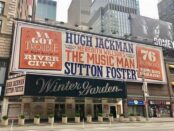
Because of changing social mores, some Broadway musicals are assumed to make audiences uncomfortable today. Take for example Rodgers and Hammerstein’s "Carousel" whose protagonist is a wife-beater. The recent revival did everything in its power to mitigate this problem but did not succeed. Now we have the long awaited revival of Meredith Willson’s "The Music Man" starring film megastar Hugh Jackman as Professor Harold Hill and two-time Tony Award-winner Sutton Foster as Marian Paroo, the librarian and music teacher. The problem the director and producers had with this classic piece of Americana, set in 1912, is that the hero Professor Hill is a con-artist and a serial seducer with whom we are supposed to be sympathetic. However, in 2022 this is an obstacle in an era when lovable rogues are not acceptable as heroes. As a solution, Jackman has been directed by Jerry Zaks to play Harold Hill as low-key and muted as he possibly can. What this does is straitjackets Jackman’s personal charm and charisma which he normally has in spades. The result is an undercooked Music Man even though it has been given a big, expensive production – six Tony Award winners on stage and six in the production team - maybe the starriest cast in New York right now.
[more]
I want to be clear. "The Music Man" is such a masterfully written musical that making some changes here and there can’t really ruin it; but changes are not needed in this show and they certainly don’t help. I believe in the old saying: “If it ain’t broke, don’t fix it!” I also believe, as Tommy Tune once told me years ago in discussing a different show, many producers and directors feel a need to tinker with shows, making changes for the sake of making changes, even when the wiser choice would be to simply leave things alone. There’s just that desire to “improve” things, whether or not the changes actually improve anything.
[more]
Lisa and The Other Lisa are the two characters in acclaimed Irish playwright Enda Walsh’s haunting short play, "The Same." The conceit that The Other Lisa is Lisa 10 years ago is soon discerned. That’s achieved through Mr. Walsh’s alluring dialogue and stirring reveries which combine the poetic, the mundane and the cryptic. By the end of 47 entrancing minutes, one has experienced Lisa’s life in Ireland with its high points and disappointments.
[more]
"Black No More," the new musical inspired by George S. Schuyler’s 1931 Afrofuturist novel, is the most exciting and inventive new show to be seen so far this season in New York though it is still in need of work. With a book by Academy Award-winning screenwriter John Ridley (12 Years a Slave), the stage version drops Schuyler’s scathing satire of Harlem Renaissance and Depression figures as well as its political election hijinks for a more direct story about race and racism in the United States. As brilliantly staged by Scott Elliott for The New Group, Black No More is also a play of ideas and will keep you thinking and debating long after the final curtain in this story of the sacrifices people have to make to change the world.
[more]
It's just that, as the fictional Eva supplants the non-fictional Ann onstage, the play reverses course and sacrifices its human scale back to the rhetorical, with pro-life Eva and pro-choice Michael's gentle discord eventually turning toward the upcoming 2018 Irish referendum to repeal the Eighth Amendment. Actually, the far more spirited debate is being held in Eva's own head as her religious upbringing wrestles with a sense of culpability for a recent tragedy that has cast doubt on her previously rock-solid convictions. Unfortunately, the much too-on-the-nose parallels between Ann's fate and what is tormenting Eva's conscience amount to a bundle of contrivances that touch off a cascade of underwhelming revelations not nearly as thought-provoking as the play's beginning scenes involving Ann and Mikey.
[more]
Arin Arbus, resident director at Theatre for a New Audience, staging her tenth classic for them took a great risk with her new production of Shakespeare’s The Merchant of Venice: not only putting this 1597 play in modern dress, she has made Venice diversely multicultural as well as having the Jewish Shylock played by an African American. All of these things might have backfired and looked out of place. Surprisingly it all works, due to her spare, stripped-down direction, her fine cast, the nearly bare stone setting by Riccardo Hernandez which suggests an elegant Greek amphitheater, and her star, John Douglas Thompson with whom she has worked four times before in an assortment of classics. Along with the work of voice director Andrew Wade, the diction is crystal clear and Shakespeare’s verse sounds conversational and newly minted.
[more]
De Niro’s goal is to lure more film and television production from Hollywood to New York, and that can only be a plus for New York-based actors. A brand new studio, created for the needs of the industry today, with state-of-the-art digital-production capability, will make New York more competitive in the world of film and television. De Niro hopes that this new studio, along with the nearby Kaufman Astoria Studios and Silvercup Studios (which are also based in Queens), will mean more work for actors, writers, directors, and all sorts of support personnel. And producers will find it easier to complete films in NYC.
[more]
Hansol Jung’s "Wolf Play" is a fantasy on several levels but it is also rather confusing in its details. Inspired by the true case of an Asian adoptee who was “re-homed” on the Internet when his new American parents no longer wanted him, the play also conflates this with the idea of the lone wolf who does not assimilate into a society of like animals. In addition, the Korean adoptee is played by a puppet that is manipulated by a character called “Wolf.” The author who is particularly interested in the families we choose makes the new parents a queer entity, adding another level of complication to the storyline.
[more]
Mandell’s costume and wig design are exquisite, perfectly defining each character in their own distinct look and style with numerous fabrics and colors and without overlap. Each of the actors’ performances are as unique as their costumes. Grastorf gets many laughs from her wide-eyed, innocently naivety (or just plain dimwittedness), and Mark Jaster’s puffy bravura and expressive face are delightfully campy. Mandell’s cantankerous bawdiness is perfectly chosen for her character, and Thomas plays the narcissistic Dauphine with laughable presumptuousness. Vernon’s pretentious, foppish roguery is spot on for his role, and Caleb Jaster as the simple musician interacts perfectly when called upon. Each actor’s facial expressions, gestures and gaits are very distinct and in line with their characters.
[more]
In her selection of the movements and structure of "Four Quartets," Tamowitz chose to ignore the depth and imagery of the poems, producing a cool Merce Cunningham-like ballet that glided along beautifully on the surface of Eliot’s heavy, sometimes distasteful, imagery. Movements were balletic, full of arabesques, skittery connecting steps, soft leaps and jumps. She built the work upon a series of steps and phrases that are repeated in various ways: jumped, turned, performed alone, performed in unison and performed in reverse. One salient image was that of a dancer jumping into the arms of another. Other than that there was very little touching. The barefoot dancers often mimicked each other or performed side by side. Only two duets occurred, one quite long near the end, watched by the other cast members gathered at the corners of the set.
[more]
The new opera, "Intimate Apparel" is a very impressive, accessible work. If it has a fault, it is completely humorless but then the original play did not include comic relief either. Unlike Ricky Ian Gordon’s last opera, the recent Garden of the Finzi-Continis, the music here is not only beautiful but suitable and appropriate as the singers and the music are one. Lynn Nottage’s libretto is a masterpiece of economy, though her play was too. Will the opera supersede the play? Probably not, but it should certainly do well in other intimate opera houses where its charms can be fully appreciated.
[more]
Wheeldon and Pulitzer Award-winning playwright Lynn Nottage make every effort to hide the fact that MJ is a jukebox musical, despite the fact that the first notes of every song elicited loud shouts and applause (part of the reason the show runs two and a half hours). Nottage has invented a plodding framework for the show. It is 1992 in Los Angeles. TV reporter, Rachel (a down-to-earth Whitney Bashor who acts as the play’s Greek chorus) and her hyperactive assistant, Alejandro (a charming Gabriel Ruiz) corral a reluctant Jackson to have his rehearsals for his huge upcoming 'Dangerous" tour documented.
[more]
Who knew that SPAM has figured so importantly in Korean and Korean-American cuisines? Jaime Sunwoo’s "Specially Processed American Me" tells that story and much more. "Specially Processed American Me"—check out those first letters!—uses SPAM as a metaphor to explore the huge subject of the Korean War, SPAM and her own intimate, moving autobiography as a Korean-American.
[more]
The dynamic W. Tré Davis and Tyler Fauntleroy deliver rousing performances as Tambo and Bones. Each is possessed of a limber physicality, superior comic timing and dramatic depth. Their immense chemistry is such that they appear to be long-time show business partners instead of just actors in a play. With their imposing physiques, close-cropped hair and vocal talents, Brendan Dalton and Dean Linnard are hilarious as the robots. Taylor Reynolds' fizzy staging realizes Harris’ vision with theatrical flair, each scene is perfectly presented. Lighting designers Amith Chandrashaker and Mextly Couzin and sound designer Mikhail Fiksel respond to three diverse settings with resourceful artistry. Composer Justin Ellington’s delightful original music ranges from jaunty melodies to rap tunes.
[more]

Joshua Harmon’s latest play, the dense, untidy, brilliant and timely Prayer for the French Republic, is his most ambitious, epical play covering five generations of one French Jewish family with relatives in America as they negotiate the troubled landscape in a time when Marine Le Pen, president of the National Front, an anti-Semitic, xenophobic and Islamophobic organization, may win the election for president of France. Marcelle and Charles have to consider if France is still safe for their family which includes 28-year-old daughter Elodie and if not where they should go. If you think none of this has anything to do with you, Marine Le Pen is currently running for President of France once again and the Manhattan Theatre Club at New York City Center Stage I has a husky guard on watch throughout the performance in Manhattan – that is the world we live in. The play also contains the most dramatic scenes to be played on a New York stage in many years. David Cromer’s production is riveting in its intensity and as a play of ideas it is very accessible even to those who have not been following recent current events.
[more]
But, again, O'Hara does these actors no favors, forcing them to contend with incongruous historical information while also depriving them of the greatest acting benefit O'Neill's four-act play affords: time. The characters' drawn-out, if not periodically downright tedious, interactions are fundamental to establishing the family dynamic and, more importantly, necessary for giving the work it's much-needed oppressive weight. It's nice that O'Hara wants to spare us from that suffering, but it doesn't help the play.
[more]
Warning: "Shhhh," a world premiere commissioned by Atlantic Theater Company from Clare Barron, Susan Smith Blackburn Prize-winner for "Dance Nation," may just be the most visceral play you will ever see, describing all bodily fluids graphically from saliva to urine to feces and blood. It is not for the faint-hearted. "Shhhh" is meant for those who like adventurous, cutting- edge theater, performance that pushes the envelope. You may not like it but you will not easily forget it.
[more]
Let’s start with the best: The great Joshua Henry’s 11 o’clock number, “William’s Song,” a gut-wrenching revelatory song sung by the title character’s emotionally distant father. Henry endows the number with the emotional punch of “And I Am Telling You” from "Dreamgirls." Since Henry Krieger wrote the music to both songs the striking similarity is understandable. Of course, Tom Eyen wrote the "Dreamgirls"’ vivid lyrics and librettro; Robert Lorick wrote the words for the pleasant, plot-moving score of "The Tap Dance Kid." "The Tap Dance Kid"—book by Charles Blackwell, based on the novel "Nobody’s Family Is Going to Change" by Louise Fitzhugh—is a simple domestic tale now reset in the 1950’s, gussied up with the brilliant tap choreography of Jared Grimes and the keen, vivifying direction of Kenny Leon. But, even under Leon’s artful hand and Grimes’ beautifully performed numbers, "The Tap Dance Kid" remains a defiantly unimaginative story.
[more]
While Gordon has said in interviews that his model for the music was Puccini, in fact, the atonal orchestral score sounds more like operas by Gian Carlo Menotti, Carlisle Floyd and Dominick Argento. The singers are usually so loud that they tend to drown out the orchestra which is playing something different than the vocal score. Placed on the far right of the stage, the orchestra plays to the side wall muffling the sound. The orchestral score suggests background music for a film rather than music for the opera house. On paper, Korie’s text reads fairly well; however, in performance the singers are punching his rhymed couplets so hard that they seem a mistaken intrusion. At almost three hours, "The Garden of the Finzi-Continis" feels overwritten though episodes have been left out of the original novel. In the libretto provided to the press in advance, Alberto’s story deviates from that of the novel, but on opening night this was changed back to the book’s ending.
[more]
Throughout these plays there resonates an overarching message of female empowerment, a message that provides depth to the otherwise light comedy being served up. Nuns are habit forming, that’s what people say, and this viewer wanted nothing more than to run back and see this show again.
[more]
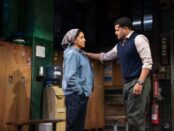
Set in the breakroom of a stamping plant in 2008, Ms. Morisseau achieves a high level of dramatic writing with this well observed exploration of Black working-class life. Each of the short scenes is perfectly crafted, imparting exposition, plot points and narrative momentum. Morisseau also has created four vivid, appealing and humane characters who speak her authentically rich dialogue and who are majestically performed.
[more]
After a grand Pippin-style introductory opening, one exhilarating number follows another in acclaimed theater maker Taylor Mac’s "The Hang." Derived from jazz and opera, this vibrant musical fantasia is inspired by the Greek philosopher Socrates’ last hours in 399 BC Athens. He’d been sentenced to death by drinking the poison hemlock for “corrupting the youth” and “impiety.” The show is based on his student Plato’s account of these events. As there’s a homoerotic strain to the Greek philosophical milieu, "The Hang" has a raucous queer vibe.
[more]
The New Yiddish Rep’s (David Mandelbaum, artistic director) production of the Yiddish language "Di Froyen (The Women)" is a bittersweet, anger-inducing portrait of modern day Chasid women caught between orthodox Jewish ideology and the rush of modern society’s laws and attitudes into their lives. Adapted by Malky Goldman and Melissa Weisz from Naomi Regan’s "Women’s Minyan," "Di Froyen," in one compact, tense hour, opens up a previously secret world to the public. Here are six women, all wearing sheitels (wigs that orthodox Jewish women must wear because showing their own hair is proscribed by religious law) and all under immense pressure from within and without their enclave.
[more]
The songs which are mainly sung by Alex Boniello (usually with a guitar) and Molly Hager as the ghostly narrators are folk ballads which though lovely sound like a continuation of the same song. While the theme of racism against Asians is extremely timely, the treatment is wedded to the 1940’s and seems to be many years late. There is a great deal we do not learn about the characters which leaves holes in the plot. The tale is very derivative of earlier stories with the same tropes: haunted lighthouse (Thunder Rock), boy goes to live with strange relatives (The Grass Harp), malevolent ghosts, one male, one female (The Turn of the Screw), etc.
[more]
Turning the plight of New York City’s homeless into a game is an iffy proposition to say the least. At best, the audience for the theatrical effort, "Addressless: A Walk in Our Shoes," learns about the daily terrors facing this disenfranchised population; at worst, the interactive game overshadows the very same awful truths turning homelessness into a superficial search for more and more points. The Zoom audience, giving advice to the actors who portray the unfortunate avatars of three luckless souls, takes the focus off of their tragic, often inescapable circumstances.
[more]
"Ectoplasm" counts among its themes and topics: poetry, women’s rights, prostitution, women’s suffrage, love, death, the paranormal, the supernatural, fraudulent mediums – and the love that dare not speak its name, except here it is openly discussed, circa 1912. Each and every character has an agenda which is too many plot devices, while the actual plot never quite resolves itself. While the play has been given an elegant physical production, the script does not entirely hang together or feel satisfying.
[more]
First presented in London in 2017, this shimmering U.S. premiere affirms its acclaim. The Australian-born Ms. Kalnejais’ writing is highly crafted, imaginative and affective. Kalnejais was inspired by a 2016 museum exhibition containing W.W. II-era film footage to create this entrancing historical tale during a sense of worldwide political chaos. “I wanted to write something hopeful and delicious and gorgeous and put something gorgeous out into the world,” she has said in an interview.
[more]
Her nine years on SNL would seem excellent preparation for "Search" which requires her to portray ten different characters alternately. However, although Strong has tremendous stage presence, she has not yet grown into all of the roles or given all of the characters (nine women and one man) distinct, separate voices. While still a tour de force for one performer, the play seems dated after 37 years with one scene using a coin pay phone and several references to the Equal Right Amendment (ERA), neither of which are in common parlance anymore. On some level, a good deal of the play takes place in the past (Betty Friedan, LSD, Rupert Murdoch, “I mean the Women’s Movement isn’t that old,” etc.) but as no years or dates are mentioned, it feels like it is taking place now which seems like a mistake. Without the intermission, the show presents too many stories to take in all at one sitting.
[more]
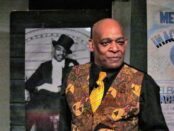
He used the gimmick of preparing to perform the very show he was performing for his audience in the Cabaret Theater of the Theater for the New City; but by the end of his fascinating and grueling life story he was on fire with his tale of his life in the theater and film. He grew up in the Sixties when the U.S. was in turmoil and it seemed that everyone was getting high. Smokey’s career began with a first prize in his Washington, D.C., high school talent show and some performances at the Arena Stage. He quit school to try his luck in California but failed and returned to D.C. where he joined an all-Black repertory theater and appeared in his first commercial which he showed on a large screen. Much later he appeared in Francis Ford Coppola’s "The Cotton Club" as a featured musical performer. His number in the film was shown proving he was an impressive dancer and singer partnered by Jackée Harry.
[more]
«
1
…
32
33
34
35
36
…
114
»
Copyright Jack Quinn, 2001-2023