News Ticker
- December 13, 2025 in Off-Broadway // BUM BUM (or, this farce has Autism)
- December 12, 2025 in Musicals // The Faggots and Their Friends Between Revolutions
- December 12, 2025 in Cabaret // Mary Foster Conklin — Mirrors Revisited (50th Anniversary)
- December 11, 2025 in Cabaret // Kathy Kaefer — Kiss Me Once: Stories from the Homefront
- December 11, 2025 in Off-Broadway // The American Soldier
- December 9, 2025 in Off-Broadway // This World of Tomorrow
- December 9, 2025 in Cabaret // A Noel Coward Celebration — Steve Ross & Friends
- December 7, 2025 in Off-Broadway // Diversion
- December 5, 2025 in Off-Broadway // Meet the Cartozians
- December 5, 2025 in Features // Tom Stoppard: An Appreciation
- December 4, 2025 in Off-Broadway // Practice
- December 4, 2025 in Cabaret // Eddie Bruce — The Magic & Music of Tony Bennett
- December 3, 2025 in Interviews // Interview with Ty Jones, Classical Theater of Harlem
- December 2, 2025 in Features // Gingold Theatrical Group’s 20th Anniversary Gala at The Players
- December 2, 2025 in Interviews // The American Soldier – An Interview with Douglas Taurel
Archive
Loaded with a bevy of strong-minded characters, "At the Table" pits lifelong friends against each other in the wake of core differences or political beliefs. At any given point in the show, expect commentary on such issues as race, gender equality or identity, abortion, legal use of marijuana, classism, or remarks on a myriad of other topics which—almost as a prerequisite—spark debate. In fact, little actually happens in terms of a plot except for the falling out a few of the friends to make way for new characters in the second act.
[more]
Certainly, the ceaseless energetic intertwinements of the Escher section could allude to his eye-popping, busy canvases and the large rectangles of white light just might allude to Rothko’s famous wide bands of impeccably applied colors. In the Bacon section, dancers kept distorting their faces and bodies in modest approximations of the bizarre images in Bacon’s portraits: unsymmetrical, shockingly colored and ugly.
[more]
Joshua Harmon, the author of the bitingly engaging "Bad Jews," is back on the boards with "Significant Other," another modern morality tale. Again he displays his incredible ear and eye for the behavior of modern twenty and thirty-somethings. Love, its frustrations and great rewards, is the subject. The pangs of loneliness, self-imposed or otherwise come in for a good going over, too.
[more]
The very talented and youthful Jonathan Groff is excellent as Gordon. His charming presence known from his work on stage (Spring Awakening, Hair) and on television (Glee, Looking) adds considerably in filling out the role of Gordon. He also has the advantage of having the most developed and sympathetic part.
[more]
His new play "Gloria" goes in another direction, a scathing satire of the media (magazine work, book publishing and television development) as well as the public’s frenzy for the details of high profile news stories. Evan Cabnet who has also piloted new plays by Theresa Rebeck and Christopher Shinn, has cast his crackerjack production with some astute newcomers to local stages (Catherine Combs, Jennifer Kim, and Ryan Spahn) as well as some accomplished New York veterans (Kyle Beltran, Jeanine Serralles, and Micahel Crane) in this always absorbing office drama. The cast is articulate and smooth-tongued as they should be playing people in the media.
[more]
Over a period of six hours, on an early summer afternoon and evening at Symphony Space, twelve choruses gave “mini-concerts” of 15 – 25 minutes, following one another with little break except an emcee's brief, efficient and entirely cheerful introduction of the next choir. Each group of singers performed pieces that, in one way or another, represented that particular group's identity. Some groups, by their very nature, commit themselves to just one kind of music – music for men, or for women; Jewish music; inspirational songs; contemporary composers' works – though a closely circumscribed repertoire rarely limits the breadth and richness from which choral directors can choose works to perform. Part of Choralfest USA's purpose, in fact, is to celebrate this richness.
[more]
Norris is interested in examining issues so often argued in black and white terms by drawing out the—pun intended—shades of grey. However, while wryly entertaining and largely incisive, his new work suffers from some of the same missteps as does his aforementioned "Clybourne Park." Namely, he paints Chris—his ostensibly well-intentioned, under-informed, straight white male character—as so downright nasty that it is almost impossible to listen to any of his arguments, however logical some of them may be. While the action of the play operates under the guise of an engaging debate that includes various different perspectives, the scales are tipped and its presentation of arguments is uneven.
[more]
The Joyce Theater Foundation is presenting a short season of the Royal Ballet at the David H. Koch Theater in Lincoln Center, the Royal’s first visit to New York in 11 years. After a gala opening night, the Royal showed its regal stuff in a program consisting of Frederick Ashton’s The Dream and Kenneth MacMillan’s Song of the Earth, two works which couldn’t be less alike. In fact, the only thing they had in common was excellent, stylish dancing.
[more]
Ms. Winkler’s writing is so simple but exquisite in its execution. In twenty minutes the sad lives of the girls are deftly dramatized with a compelling range of emotion. The direction of John Giampietro is a superb display of the art of stagecraft. The clever fantasy device of the cherry trees is skillfully blended into the narrative with boldness and precision. Lighting, sound and music are all utilized to great effect so that it is all visually quite stunning.
[more]
Hobbling on crutches and with one injured leg encased in a large boot, all due to a recent automobile accident, Sahr Ngaujah made a dramatic entrance from the wings onto the stage of The Town Hall to appear at "Broadway by the Year: The Broadway Musicals of 1991-2015." Joined by the accomplished guitarist Ricardo Quinones, the charismatic Mr. Ngaujah passionately sang “Sorrow, Tears of Blood,” from 2009’s "Fela!" In which he starred. It was a galvanizing episode that came near the end of a concert that had been packed with powerhouse sequences.
[more]
Much of the play is directed using Brecht’s so-called alienation effect in which the audience is constantly reminded that this is all a play, a poor choice for a tragedy that wants to put both awe and fear into the hearts of its listeners. Tony Strages’ set design resembles a circus or vaudeville and much of the performance is played on that level. What is sacrificed is the seriousness of the theological and moral issues. There are continual shifts in tone which simply draw attention to themselves, rather than add to the meaning.
[more]
As with all productions by the Children’s Acting Company & Academy, the cast is comprised entirely of children and teenagers—in this case between the ages of 12 and 16—and for all its innocence and simplicity, the charm in this production is its sheer authenticity. Children and teenagers are by nature unfiltered, and to have kids playing their own age on stage is the recipe for an afternoon of uninhibited fun. For the most part, this is an impressive outing for a group of young and aspiring artists, and many of the cast members have already worked professionally in TV, film, or on-stage.
[more]
Though "The Pavilion" is a play which addresses time as if it were a simultaneous occasion—past, present, and future all occurring at once—the story takes place in the present, at The Class of 1985’s 20 year reunion. Of particular interest, the story focuses on Peter (Dusty Brown) and Kari (Julie Voshell), high school sweethearts who had a storied romance which withered and deteriorated long before the events of the play. Funny at times and touching at others, Brown and Voshell have created a great on-stage relationship which is buoyed by excellent chemistry, and the different dynamics of the two actors gives way to some moments which are very sweet and others which are heartbreaking.
[more]
Rajiv Joseph’s plays are filled with emotional or physical violence as in "Bengal Tiger at the Baghdad Zoo," "Gruesome Playground Injuries" or "Animal out of Paper." His new play, "Guards at the Taj," being given its world premiere by Atlantic Theater Company, has both. Set in India in 1648, this riveting drama which works on many levels has been directed by Amy Morton, best known for her New York performances in Steppenwolf transfers to Broadway ("August: Osage County" and "Who’s Afraid of Virginia Woolf?"), and features Omar Metwally and Arian Moayed who are always commanding.
[more]
Judging from this program only, the PNB is firmly in the mainstream of the world’s modern ballet troupes, almost indistinguishable one from the other (viz. Netherlands Dance Theater, Sydney Dance Theater, National Ballet of Spain, Houston Ballet, etc.) Mr. Pastor’s ballets are part and parcel of the international ballet style which I like to call “fun house ballet,” in which classical ballet steps and poses melt into twisty, angular shapes only to coalesce into and be punctuated by recognizable classical vocabulary. William Forsythe, a real iconoclast, began this in his purposely ugly “in the middle somewhat elevated.” The watered-down copies permeate the repertories of many dance companies.
[more]
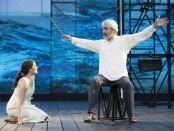
The first thing one notices on entering the Delacorte Theatre is how empty the large stage looks. In Riccardo Hernandez’s scenic design, except for a tiny desk on the right and a small pile of rocks on the left, the playing area is simply a large open expanse that is backed by scaffolding which offers a kind of balcony or catwalk and in front of which are hung curtains or screens. On this is projected dark, churning seascapes in streaming video. As the setting for the play is an island, this is initially attractive but as it continues throughout the play, it becomes both distracting and superfluous. The costumes by Emily Rebholz in black and white are also devoid of color. David Lander’s lighting occasionally turns the stage blue, green or red, but this comes as an intrusion to the rest of the concept of the production. Along with the lack of magic until almost the end of this long play, it appears as if Greif’s interpretation of the play were simply to keep things spare and unadorned. Unfortunately, this tale which calls out for enchantment and sleight of hand is not the play to do this with.
[more]
"The Tour" follows in the success of the same company’s "The Ride" that is an audience participation theatrical version of a New York City bus tour. CEO/COO Richard Humphrey has conceived, produced, directed and co-written it. His grand achievement is that of an immersive overview of New York City through a fast-paced city tour with novel elements. Touted as the tallest allowed vehicle by federal law, the motor coach used for this is awesome. With a capacity of 49 people arranged in rows of stadium seating facing out the length of the bus along on its side. The panoramic views are from huge clear windows as well as from the windowed ceiling. It is extremely comfortable on all levels and it was cool seeing a rainstorm from inside.
[more]
Brown portrays a myriad of characters including her father, siblings, mother, and other family members seamlessly – giving the audience a taste of what the family dynamic was like. She recounts the joyful moments such as her parents meeting and falling in love as well as the sorrowful ones – the children discovering their mother’s drinking problem and then deciding how to share the responsibility when it came to an intervention. There is no doubt that this Irish family has personality – but the realness and strength emerges from the ashes.
[more]
The recent national rallies to raise the minimum wage have made the Federal Theater Project’s 1936 "Injunction Granted" relevant all over again. This play created by the Editorial Board of the Living Newspaper Unit of the FTP depicting the conflict of labor versus capital in the U.S. over almost 300 years turns out to be powerful theater in this revival by Metropolitan Playhouse. The third of the FTP Living Newspapers to be revived by this theater following "One-Third of a Nation" and "Power," Alex Roe’s lively and inventive production uses six actors to play 200 characters in a vaudeville-like atmosphere.
[more]
"Office Politics" written by Marcy Lovitch is not only an insightful production, but one that is timely and hits home for today’s society. Under Aimee Todoroff’s direction, Office Politics examines the impact of a racist comment in an office setting and the fight for justice to be served. The story line and overall message extends beyond the hierarchy of a typical corporate setting – where most times, major issues are swept under the rug to avoid excess attention – and shines the spotlight on the effects that ignorance and stereotypes have on an individual and the life she is fighting for every day.
[more]
This compelling and moving solo play recounts Yoel's gradual coming out that starts in 1986 when he was ten in Caracas. Comical and dramatic incidents in his childhood, harrowing events during his high school and college years, and his arrival in New York City at the age of twenty-one are vividly presented.
[more]
As if a talking parrot weren’t magical enough, the production and costumes are truly inspired. Conceptualized by Alisa Simonel-Keegan & Jim Keegan, the set design for this production is imaginative and destroys the perceived idea of value for a show presented in a black box theater. The lighting design (Jessica M. Kasprisin) is particularly beautiful, and is so unique in that it breathes a singular life into each separate exotic location. The finishing touch in the quest for an unmistakable mysticism and adventurous spirit can be traced to the costume design (Adrienne Carlile) which sees every single pirate, sailor, parrot or person uniquely dressed.
[more]
“It’s been a rough two years,” Mr. Jackson observed. Deaths in his family, a disintegrating romantic relationship, and becoming sober, were all detailed during his heavily autobiographical patter that was integral to this presentation. This quirkily handsome Broadway performer dazzled his fans with a variety of songs and personal anecdotes during this 95 minute presentation. Being openly gay has been characteristic of his career and this fact was expressed simply during his commentary.
[more]
Tommy Tune, just walking down the aisle to his seat in the orchestra, had more style and grace and class than much of the broadcast. I couldn't help wondering how much more "Broadway" the night would have felt if Tommy Tune had been put in charge of the whole event.
[more]
St. Peter's Episcopal Church in Chelsea was used to near perfect effect as the setting for all three acts of the opera. "Tosca"'s first act, which does, in fact take place in a church was, precisely because of the narrative, “easy” to stage, but the successful transformation of the St. Peter's Chelsea chancel into first, the emotional claustrophobia of the villainous chief of police's quarters and then, for the last act, the open air witness to revenge and tragedy resulted from the imaginative, effective stage direction and set management of Chelsea Opera's co-founders Leonarda Priore and Lynne Hayden-Findlay.
[more]
Now in its fourteenth year, the remarkable Ensemble for the Romantic Century, founded by Eve Wolf, has been presenting musical programs of intellectual coherence and imagination, examining themes and subjects central to the development and character of the “long” nineteenth century, from the Enlightenment to the end of the Victorian Era. ERC's most recent production, The Sorrows of Young Werther, represents the best of this kind of production. Rich and subtle interdisciplinary critical and creative thinking informed the careful merging of a dramatic presentation of Goethe's novella, The Sorrows of Young Werther with Robert Schumann's Dichterliebe. The result was an evening of considerable artistic beauty and intellectual rewards.
[more]
Swedish modern dance choreographer, Pontus Lidberg is a master of the quietly eerie. His works invade your brain slowly with their deliberate pacing and strange imagery. Mr. Lidberg showed his mastery of mood and the nuances of relationships in his recent program at the Joyce Theater.
[more]
Although he was probably Hollywood’s most famous tough guy, James Cagney’s life story is not as well-known as that of many other legendary movie stars. The York Theatre Company’s new musical, simply called "Cagney," hopes to do something about that. Created around the obsession of actor Robert Creighton who looks a great deal like the red-headed Irish star, this entertaining show business musical also reveals the difficult times he had both on the streets of New York and at Warner Brothers in Hollywood which typecast him and wanted him to go on making the same picture over and over.
[more]
A simple message is at the center of Sheldon Bull’s new play" Mallorca." As timeless as the theme may be, this doesn’t necessarily mean it is self-evident. Surrounding the dysfunctional friendship of four men, in some way every character in this play has left an important aspect of his life unattended.
[more]
“Don’t step on the sand,” cautions the usher as she hands out programs and directs patrons to the their seats at The Gym at Judson. Indeed, the stage and floor is filled with sand that’s been artfully arranged into a barren vista of mounds and dunes. There is a concrete staircase leading to the roof of a small structure. Above is a rectangular screen where later images of the sky and a forest are projected. There is a concrete block with a pole in it on stage. Unfortunately Raul Abrego’s impressive set is the most outstanding feature of playwright Daniel Talbott’s cryptically titled and exasperating 90-minute War Is Hell fantasia, "Afghanistan, Zimbabwe, America, Kuwait. "
[more]
In recent years, there have been many Off Broadway attempts to musicalize the works of Thomas Hardy. The latest is composer Christopher Beste and writer David Willinger’s ambitious, "Casterbridge," a very engrossing version of Hardy’s novel "The Mayor of Casterbridge." While some of the lovely music proves to be too difficult for some of the singers, under the direction of Willinger with musical director Bob Goldstone at the piano, the almost all sung-through stage version is an impressive and faithful retelling of the Hardy story.
[more]
The Cedar Lake Contemporary Ballet has had the good fortune to have had financial security during its twelve-year existence; that is, until this year when its patron withdrew her support. The troupe’s short season at the Brooklyn Academy of Music was its swan song, but a spectacular one. Alexandra Damiani, CLCB’s artistic director, assembled two programs, the first of which I attended. It was typical of the work identified with the company: slick, technically demanding and impeccably danced.
[more]
As a follow-up to their musical based on Fitzgerald’s This Side of Paradise, lyricist/composer Nancy Harrow and writer/director Will Pomerantz have turned their sights on Nathaniel Hawthorne’s 1860 novel, "The Marble Faun." Renamed "For the Last Time," this new jazz musical has changed the setting from Rome in 1860 to New Orleans, circa 1950, and uses an all-Black cast to tell the original story. The show’s glory is its magnificent score, a combination of jazz and blues ballads, wonderfully sung by its cast of seven. The problem is that the show started as a concept album and to some extent hasn’t progressed very far from there: the book by Pomerantz and Harrow remains too thin to deal with the plot’s very deep themes.
[more]
«
1
…
98
99
100
101
102
…
114
»
Copyright Jack Quinn, 2001-2023