
The Silent Serenade
Famed Hollywood composer Erich Wolfgang Korngold's only operetta receives its US debut in English as it was always intended.
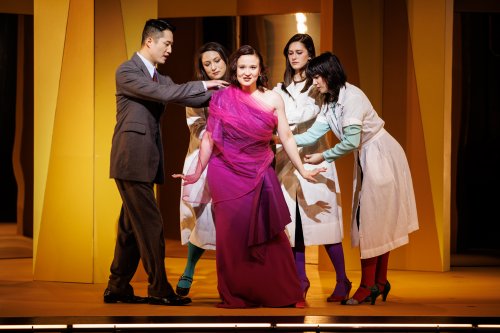
Sean Cha, Mia Farinelli, Dasha Tereshchenko (center), Zoe Brooks and Elise Martinez in a scene from Mannes Opera’s United States premiere of Erich Wolfgang Korngold’s “The Silent Serenade” at John Jay College (Photo credit: Maria Baranova)
Mannes Opera had the honor of premiering the United States debut of Erich Wolfgang Korngold’s only operetta, The Silent Serenade (Die Stumme Serenade) which it presented in English as originally intended. After his two years stint adapting and conducting Johann Strauss’ Die Fledermaus for Broadway as Rosalinda starting in 1942, Korngold who had not written an opera since 1937’s Die Kathrin decided to write his first operetta. As his celebrated career as the leading composer and conductor at Warner Brothers was winding down with his contract expiring in 1946, Korngold was looking to get back into theater music.
Based on a comic short story by Viennese writer Raul Auernhimer, first Hungarian playwright Rudolph Lothar and then Hungarian playwright Victor Clement was asked to write a libretto. Translated into English, Korngold then had the original short story writer translate it back into German. Whether this was a problem, in any event, J.J. Shubert heard about the operetta in 1946 and after an impassioned audition played by the composer, he agreed to produce it on Broadway. However, the negotiations did not go well and the project was dropped. In 1954 Korngold was part of the production team that gave the work its European stage premiere in Dortmund, Germany, but the days of operetta were over and the work failed to impress. Then, during the 50th anniversary of Korngold’s death, Die Stumme Serenade was given major productions in first Munich in 2007, and then Freiberg in 2009 and this last production was recorded.
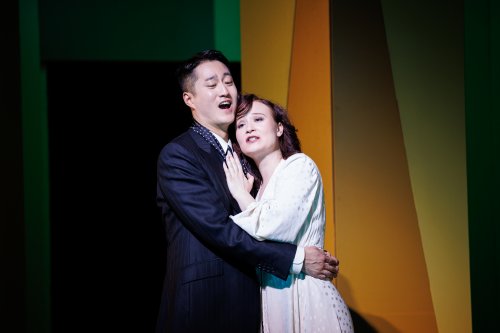
Sean Cha as Andrea Coclé and Dasha Tereshchenko as Sylvia Lombardi in a scene from Mannes Opera’s United States premiere of Erich Wolfgang Korngold’s “The Silent Serenade” at John Jay College (Photo credit: Maria Baranova)
Mannes Opera’s production of The Silent Serenade now seems retro with its lilting score, a combination of Johann Strauss II and Jerome Kern who was working in Hollywood during Korngold’s tenure. This may be why the frivolous plot seems like that of a Fred Astaire/Ginger Rogers movie. (Ironically, Korngold’s romantic operas sound Puccini-esque and his orchestral film scores sound influenced by Wagner.) While the libretto for the operetta is set in 1820s Naples, its anachronisms like a fashion house with models, tabloid newspapers looking for gossip, and references to Hollywood actresses make the updating to the 1950s (suggested by Terese Wadden’s beautiful costumes, literally a fashion show in itself) much more believable. Although Korngold was used to huge orchestras both for his operas (Die Tote Stadt, Violanta, etc.) and at Warner Brothers, he scored his operetta for ten instruments and Mannes music director Cris Frisco gave it an excellent reading. He may have been hoping that its small scale might make it more attractive to theater impresarios.
The lighthearted plot begins with two events in the Kingdom of Naples happening simultaneously: famous actress Sylvia Lombardi wakes in the middle of the night and believes that a masked intruder has kissed her and attempted her abduction, while at the same time her fiancé unpopular Prime Minister Benedetto Lugarini has had a bomb placed under his bed but fortunately he was out gambling. Sylvia’s beloved dress maker Andrea Coclé is accused of the alleged assault on Sylvia and he confesses to having been in her garden that night but having done no more than sung a silent serenade, but is hauled off to jail by Chief of Police Caretto who cannot find anyone to pin the bombing on. Lugarini is furious that Sylvia’s break-in is in all the newspapers but not the bomb attack and demands that Caretto find the culprit or he will be fired.
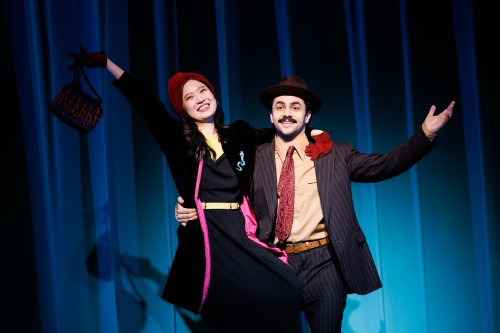
Gaeun Song as Louise and Thomasluke Flórez-Mansi as Tony Borza in a scene from Mannes Opera’s United States premiere of Erich Wolfgang Korngold’s “The Silent Serenade” at John Jay College (Photo credit: Maria Baranova)
When an emissary from the king of Naples tells Caretto that the king would like to pardon the bomber as an act of mercy, Caretto convinces Andrea to confess to both crimes and then be pardoned. When Sylvia visits Andrea in jail, Caretto convinces the two of them to enact the events of the night before and afterwards Sylvia announces she is convinced that it was Andrea in her bedroom. Innocent of both crimes, he agrees to plead guilty. At his trial Andrea is found guilty and sentenced to death.
At his trial Andrea sings of his “silent serenade” revealing that he is in love with Sylvia. However, he is sentenced to death but Sylvia gets him a reprieve for his last night by offering to make him dinner in her apartment. At this banquet, as they declare love for each other, Caretto arrives with the bad news that the king has died and that Andrea will be executed on the next day. In the interim, the people have staged a revolution and Lugarini has been deposed and Andrea has been declared the new prime minister. While Andrea is mourning his old life which he was better suited, Sylvia arrives and declares her love. At this moment the famous bomber Carlo Marcellini breaks in, admits he put the bomb under the bed of the previous prime minister and deposes Andrea. Andrea and Sylvia are at last free to live out their lives.
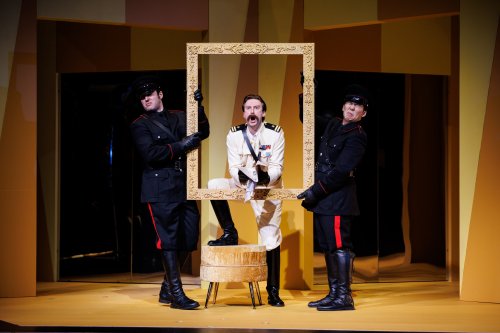
Zak Ketcham, Dima Mironov as Prime Minister Lugarini and Theodore Chang in a scene from Mannes Opera’s United States premiere of Erich Wolfgang Korngold’s “The Silent Serenade” at John Jay College (Photo credit: Maria Baranova)
While the cast made up from the Mannes Opera program have glorious voices, too many of the foreign students have thick accents which are impenetrable in English. That also meant that much of the comedy which still works after all these years did not land as it could not be understood. In addition, the supertitles, an extremely good idea for this unknown property, at the Gerald W. Lynch Theatre were so dimly lit that they were difficult to read. Director Emma Griffin allowed the performers to mainly face the audience throughout rather than each other which was quite disconcerting. Amy Rubin’s eye-catching unit set in orange and yellow geometrical pillars on the bias suggested Soviet Objectivism from the 1930s rather than Italy in the 1950s. However, it did allow for swift transitions between the 11 scenes in the two acts.
As the leading characters mezzo-soprano Dasha Tereshchenko as actress Sylvia Lombardi and baritone Sean Cha as dress designer Andrea Coclé made beautiful music particularly in their love duets “The Silent Serenade,” “Lovely Night” and “Melodrama.” Tereshchenko also impressed with her solo arias “When You’re Dressed by Coclé,” “Don’t Let Happiness Pass You By,” “Please Call My Heart Your Own” and “Till Tonight,” the latter three which should be better known. Cha had two plaintive solos that he poured his heart into: “Andrea’s Song” and “Reminiscence.” In the secondary love story, soprano Gaeun Song as Andrea’s head model and Thomasluke Flórez-Mansi as tabloid reporter Tony Borza had much fun with “You’ve Got It!” and “Interview” in which they also danced.
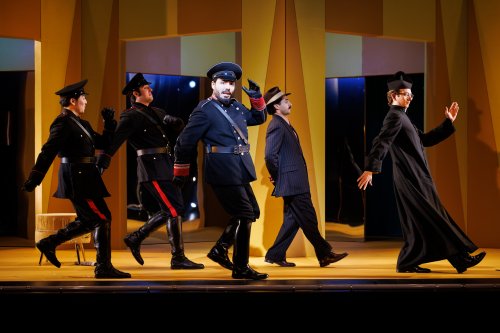
Theodore Chang, Zak Ketcham, Enes Pektas as Chief of Police Caretto (center), Thomasluke Flórez-Mansi and Sam Morton Morris as Pater Orsenigo in a scene from Mannes Opera’s United States premiere of Erich Wolfgang Korngold’s “The Silent Serenade” at John Jay College (Photo credit: Maria Baranova)
As the gloomy Chief of Police, Enes Pektas had a wonderfully fast patter song in the style of Gilbert and Sullivan, simply called “Caretto’s Song,” in which he recounts his depressing life in service and wishes he were retired. As the volatile and short-tempered Prime Minster Lugarini, Dima Mironov has no number of his own but was always seen inside of a gold picture frame. In small speaking roles Sam Morton Morris as Pater Orsenigo, father confessor of the king, and Jack Gustafson as the famous revolutionist Carlo Marcellini have fun with their exaggerated comic roles.
Although the operetta does not allow for a great deal of dancing, choreographer Camden Gonzales’ work was in evidence both for the two couples and the marches and fashion parades of the models and other characters. Among the memorable production elements costume designer Wadden offers two fashion shows while dressing Sylvia in a series of sumptuous monochromic gowns. Masha Tsimring’s lighting was able to turn the orange-yellow set blue-green for the night time scenes, creating an entirely different mood. This is not the definitive production of The Silent Serenade but it is to be hoped that this lovely score with many winning songs gets another hearing sometime soon.
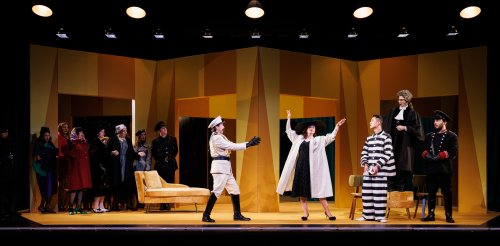
Dima Mironov as Prime Minister Lugarini, Dasha Tereshchenko as Sylvia Lombardi and Sean Cha as Andrea Coclé (center in white) with full company in a scene from Mannes Opera’s United States premiere of Erich Wolfgang Korngold’s “The Silent Serenade” at John Jay College (Photo credit: Maria Baranova)
The Silent Serenade (March 13 & 14, 2026)
The New School, College of Performing Arts and Mannes Opera
The Gerald W. Lynch Theater at John Jay College, 524 W. 59th Street, between 10th and 11th Avenues, in Manhattan
For tickets http://www.newschool.edu
Running time: two hours and ten minutes including one intermission


Leave a comment