
Tom Stoppard: An Appreciation
A moving tribute to Tom Stoppard’s life, genius, and plays, with insights from TheaterScene reviews of his most iconic works.
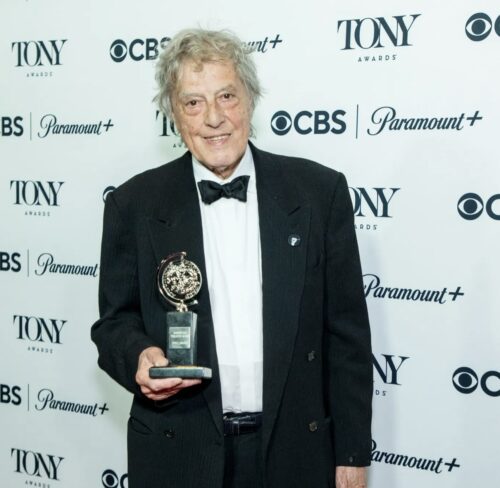
Tom Stoppard. Photo by Tricia Baron
Appreciation by Jack Quinn, Publisher
When the news broke on November 29, 2025, that Tom Stoppard had died at 88, the theatre world seemed to pause. Stoppard’s work didn’t merely populate stages — it expanded them. His plays stretched the possibilities of language, time, mathematics, memory, and human longing, all while keeping one foot grounded in the quiet absurdity of being alive.
Entering a Stoppard play meant entering a chamber where intellect sparred with emotion, where jokes landed like little grenades, and where time often bent in on itself just to show how fragile our certainties always were.
His legacy is written across modern theatre — and on TheaterScene.net, we have spent years chronicling the brilliance that made him singular.
ARCADIA — “Stoppard’s conceits flow smoothly”
In Joel Benjamin’s July 25, 2017 review of Arcadia, he wrote that the Potomac Theatre Project’s staging offered
“a good-natured, easy-going production that allows all of Tom Stoppard’s conceits to flow smoothly.”
Full review:
Benjamin went on to note:
“There are pleasures when early conundrums are resolved in a charming and warm ending.”
Stoppard’s architecture of ideas — from chaos theory to unrequited desire — glows most brightly when it collapses gently into emotion. Few playwrights lead the audience through such dense intellectual forests only to arrive at such clear, aching human truths.
LEOPOLDSTADT — “A powerful achievement… a history of our time”
In Victor Gluck’s July 14, 2022 review of Leopoldstadt, he declared the work
“a powerful achievement, a history of our time as well as a cautionary tale.”
Full review:
Gluck wrote that Stoppard’s final major play
“has the depth and sweep of a three-volume novel or a high-profile television mini-series.”
Leopoldstadt represented something rare: a playwright turning toward the trauma he had avoided for decades. Born Tomas Straussler in Czechoslovakia, Stoppard discovered only later in life the extent of his family’s annihilation during the Holocaust. The play is not simply a reckoning — it is an act of witness.
TRAVESTIES — “A joyous romp… a dazzling intellectual vaudeville”
Joel Benjamin’s February 22, 2017 review of Travesties called the work
“a joyous romp… a dazzling intellectual vaudeville of ideas, arguments, and theatrical hijinks.”
Full review:
https://www.theaterscene.net/plays/offbway-plays/travesties/joel-benjamin/
Benjamin captured the essence of Stoppard’s early style: a brilliant collision of history, parody, formal games, and philosophical play.
Even at his most antic, Stoppard understood where every thread was leading.
THE REAL THING — “Literate, sensual, emotionally adult”
In Stan Friedman’s June 29, 2014 review of The Real Thing, he wrote:
“Stoppard’s writing is so literate, so sensual, and so emotionally adult that audiences lean into its honesty even when the characters cannot.”
Full review:
https://www.theaterscene.net/plays/offbway-plays/the-real-thing/stan-friedman/
For all the reputation of cool brilliance that followed him, Stoppard’s core was emotional. He understood the treachery of love and the disguises we use to survive it. His intelligence sharpened the drama — but his tenderness gave it weight.
The Stoppardian Condition
The Oxford English Dictionary eventually adopted the adjective “Stoppardian.”
But long before academics formalized it, audiences recognized its contours:
- razor-sharp language
- philosophical play
- dazzling structural invention
- emotional restraint that makes the quiet moments land with devastating force
His characters think fiercely and feel reluctantly — which is why, when their emotions surface, they hit like revelations.
The Final Curtain
As TheaterMania noted in its obituary, Stoppard spent his later years finally confronting the Jewish identity he had long kept in the margins of his life.
He once said he had lived “a charmed life,” and Leopoldstadt reveals the ache beneath that charm — the weight of history carried and forgotten, remembered and reclaimed.
He leaves behind plays that redefined theatrical possibility, characters who lodge themselves in the mind, and language that refuses to sit still. He also leaves a lineage of audiences who were changed — quietly, intellectually, emotionally — by the worlds he shaped.
Tom Stoppard exits with the elegance of a man who spent his life refining thought into art.
The silence after his passing is not empty.
It is full — of echoes, of argument, of longing, of laughter.
And of gratitude.


Leave a comment