
Rashid Johnson’s “The Hikers”
Performed beneath Rashid Johnson’s "A Poem for Deep Thinkers," "The Hikers" unfolds inside the Guggenheim rotunda, where architecture, elevation, and live music shape a restrained duet by Lloyd Knight and Leslie Andrea Williams. The building becomes an active partner in the choreography, guiding how the encounter is seen and felt.
Review by Jack Quinn, Publisher
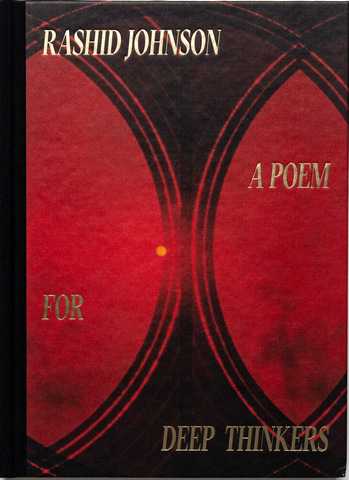
Cover of the catalogue to the “Rashid Johnson: Poem for Deep Thinkers” exhibition at the Guggenheim Museum
Rashid Johnson’s The Hikers
in association with the exhibition Rashid Johnson: A Poem for Deep Thinkers (April 18, 2025 – January 19, 2026)
Presented by Works & Process at the Guggenheim Museum
Choreography by Claudia Schreier
Featuring Lloyd Knight and Leslie Andrea Williams
Pianist: Aku Orraca-Tetteh
December 17, 2025
The Guggenheim Rotunda is active before the performance begins. People move along the spiral ramp, leaning forward over railings, then settling back. Sound disperses upward rather than returning. The building feels less like a container than a condition.
Frank Lloyd Wright’s architecture never recedes, and here it shapes how everything is read. The ramp curves continuously upward, resisting a clear sense of beginning or end. Daylight filters through the glass dome, flattening shadows and cooling the space. Suspended above the floor, Rashid Johnson’s A Poem for Deep Thinkers hangs in deliberate imbalance—plants lifted off the ground, roots exposed, life held midair. Nothing feels neutral. Everything feels slightly displaced.
The audience lines the rotunda at multiple levels, bodies stacked in rings. There is no single vantage point. You are always watching through other people, aware of being watched yourself. Looking becomes part of the experience.
The Hikers enters quietly, but not symmetrically. One dancer slinks out from behind the piano, dressed in black, his face partially obscured by a tan mask. The other appears above, descending slowly from the second level along the ramp, also masked. They do not arrive together, and they do not immediately acknowledge one another. The distance between them—horizontal and vertical—is part of the choreography. Their eventual meeting feels earned rather than assumed.
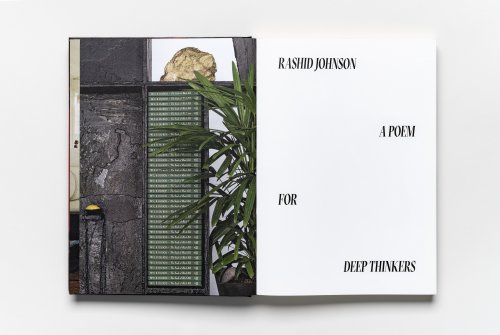
Opening page of the catalogue to the “Rashid Johnson: Poem for Deep Thinkers” exhibition at the Guggenheim Museum
The work was originally created as a film, but here it unfolds in real time, shaped by the architecture. Johnson later noted that the ramps were central to the live version: one figure hiking downward while the other climbs upward becomes legible through elevation alone. The building supplies the metaphor. The choreography does not explain it.
Claudia Schreier’s movement language is restrained and grounded. The dancers wear black sleeveless tops and leggings that read clearly against the museum’s white surfaces. The tan head coverings flatten expression and redirect attention to the body itself. Nothing in the costuming asks to be decoded. The focus remains on posture, weight, and proximity.
Movement begins with small actions. An arm lifts. A shoulder rolls. A foot adjusts against the floor. Walking, turning, bracing, resisting. The vocabulary is spare. There is no rush to establish virtuosity. The dancers take time to develop a shared physical logic rooted in tension rather than flow.
At moments they mirror one another, elbows rising together, forearms folding inward. Elsewhere the symmetry breaks. One advances while the other yields, then the roles reverse. The timing is deliberately uneven. Gestures arrive a fraction late. Weight transfers lag just behind expectation. The space between the dancers becomes active, charged by delay.
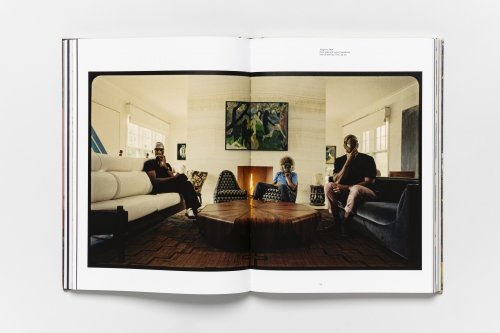
Photograph from “Rashid Johnson: Poem for Deep Thinkers” exhibition at the Guggenheim Museum
When contact occurs, it is direct and unsentimental. A lift emerges from a locked grip at the waist. The lifted body does not float; it hangs, heavy. The supporting dancer continually adjusts—feet sliding, knees flexing—to maintain balance. The labor of partnership is visible. Support is not a fixed state but an ongoing negotiation.
The Guggenheim shapes the sound as much as the movement. Footfalls register softly against the stone floor. The dancers’ breathing becomes audible in the hush. Pianist Aku Orraca-Tetteh sits off to one side, listening closely. His playing does not drive the choreography. Notes disperse upward, thinning as they rise.
As the piece develops, contrasts accumulate rather than resolve. One dancer bursts into a brief jump, arms thrown upward, cutting against the building’s horizontal sweep. The other drops low, hands grazing the floor. Elevation and collapse sit side by side. Transitions are not smoothed over.
Late in the work, the head coverings are removed. Faces appear without emphasis—sweat, breath, exertion visible. The shift feels structural rather than expressive. Identity enters only after the physical relationship between the dancers has been established. Johnson later described this progression as intentional: the work begins in a generalized body and gradually moves toward specificity, suggesting that the personal can function as an invitation rather than a boundary.
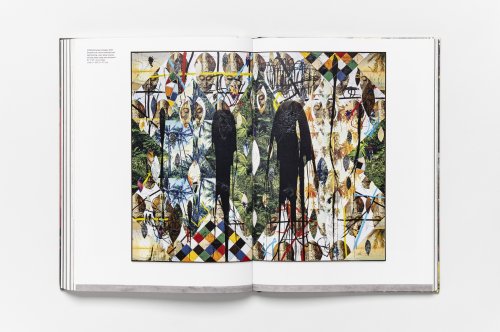
Painting from “Rashid Johnson: Poem for Deep Thinkers” exhibition at the Guggenheim Museum
The ramps continue to shape the choreography throughout. One dancer descends while the other ascends, their differing elevations clarifying emotional states without illustration. Johnson acknowledged that without the ramps, staging this dynamic would require a different approach. Here, the architecture performs explanatory work without competing for attention.
Near the end, the dancers separate briefly, returning to a more abstract physicality. The bodies feel less individualized, moving as figures rather than characters. The shift reframes what came before, suggesting recurrence rather than closure.
The final moments are simple. The dancers walk side by side, hands linked, then stop and face the audience. They do not pose. They stand, shoulders relaxed. A brief glance passes between them, reading as acknowledgment rather than triumph. Applause begins unevenly from different levels of the rotunda, arriving in overlapping waves.
Upstairs, the film version of The Hikers loops within A Poem for Deep Thinkers, creating a quiet dialogue between mediums. Image and body answer one another across floors. The Guggenheim becomes a third presence—light, architecture, and movement sharing a single rhythm.
When the performance ends, the space does not immediately reset. People linger along the ramp, slow to leave. What remains is not a single image but a spatial memory: bodies negotiating gravity inside a building that never quite resolves. In a museum that often overwhelms what it contains, The Hikers holds its ground by refusing excess, allowing simple human actions—standing, lifting, yielding—to register clearly and without insistence.
Rashid Johnson’s “The Hikers” (December 17, 2025)
Works & Process Series & Guggenheim New York
Guggenheim Rotunda, 1071 Fifth Avenue, in Manhattan
For information, call 212-423-5000


Leave a comment