
Limón Dance Company: Fall 2025 Season including “The Emperor Jones”
80th Anniversary triple bill celebrates both the old and the new: Limon's "Chaconne" and "The Emperor Jones" in revised versions and a world premiere by Diego Vega Solorza.
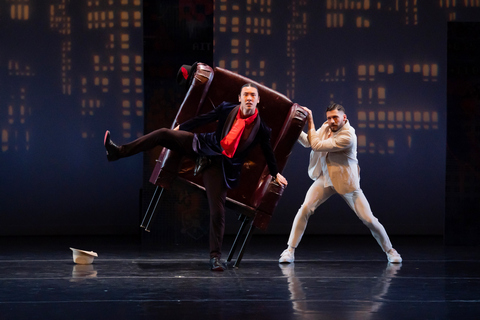
Johnson Guo and Joey Columbus in the Limón Dance Company production of José Limón’s “The Emperor Jones” as seen at The Joyce Theater (Photo credit: Hisae Aihara)
The Limón Dance Company is celebrating the start of its 80th Anniversary season with a triple bill at The Joyce Theater which in words of artistic director Dante Puleio celebrates “where we have come from and where we are going.” In this vein, the evening included “Chaconne” (1942) originally created by Jose Limón as a solo for himself, now expanded to 21 dancers including members of the Limón Dance Company, Limón2, Company Alumni, Students and Limón Family. This was followed by “The Emperor Jones” (1956), inspired by the expressionistic Eugene O’Neill play, but now updated to an urban setting in Puleio’s reconstruction. The final piece of the evening was the world premiere of “Jamelgos” by Diego Vega Solorza, who actually was born in the same region in Mexico as Limón and counts him as one of his mentors. The season is dedicated to the late Carla Maxwell who helmed the company for almost 40 years and died on July 6 of this year.
Set to J.S. Bach’s “Chaconne” from his Partita #2 in D Minor, the Limón ballet was conceived as a showpiece for one male dancer. A chaconne is a musical piece built on a repeating harmonic progression. Its theme and variation often creates a powerful emotional impression. In recent years, the Limón piece has been used for larger and larger groups of dancers. The current production is a tribute to the Limón Dance Company legacy in which dancers, alumni and students all appeared together, covering seven decades of performers.
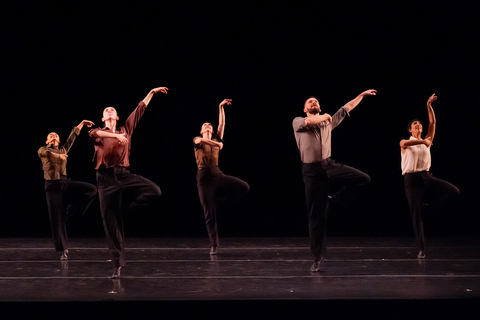
Frances Samson, Savannah Spratt, Lauren Twomley, Joey Columbus and Natalie Clevenger in the Limón Dance Company production of José Limón’s “Chaconne” as seen at The Joyce Theater (Photo credit: Hisae Aihara)
Not surprisingly, all the dancers, dressed similarly, perform the same steps, though sometimes they are broken up in groups of anywhere from three to ten dancers. At times they all face in one direction, at others, the stage is as if divided in half and one group faces the other. There is a great deal of wide spread arm gestures and leg extensions. Periodically they all look upwards as though worshipping some sky deity. This ten minute version suggested a harvest festival dance as the performers continued in unison. Violinist John Marcus played the beautiful somber and mellow Bach music live.
Eugene O’Neill’s The Emperor Jones is an expressionist tragedy first performed in 1920, and famous as O’Neill’s first hit and the first major American play to star a Black actor. It recounts the adventures of Brutus Jones, an African American Pullman car porter, who kills a man in a dice game and escapes to a West Indian island from a Southern prison. There he works for Smithers, a white Cockney trader, but eventually makes himself emperor of the island subjugating all of the natives. But his greed carries him too far and the islanders revolt and bring him down after a chase through the island’s jungle. Written almost entirely as Brutus’ monologue, The Emperor Jones has its protagonist’s previous life in America come back to haunt him as ghosts as he attempts to traverse the forest and get to the coast in order to get a ship to safety.
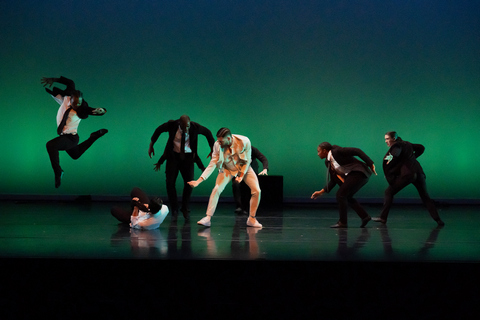
Joey Columbus (in white suit) and members of the Limón Dance Company’s production of José Limón’s “The Emperor Jones” as seen at The Joyce Theater (Photo credit: Hisae Aihara)
In the original 1956 version which is available in black and white on YouTube (as well as the 2012 revival available in color,) Limón played Jones to the commissioned score by Brazilian composer Heitor Villa-Lobos. Among the episodes from the play that are depicted in pantomime by the eight dancers are the dice game, a voodoo ceremony, a chain gang and a slave auction. Faithful to the original Limón choreography, Puleio has chosen in his reconstruction to update the sets and costumes to a more recent urban setting. He appears to have wanted to make a statement about capitalism, tyranny and masculine identity.
In Peta McKenna’s new set design, Jones’ throne is now an oversized office chair. The trees in the forest have been replaced by skyscrapers. Costume designer Márion Talán de la Rosa has put Jones in a velvet blue smoking jacket with a red ascot. The high gold boots have been replaced by Louis Vuitton shoes, and his jungle hat has been replaced by a fedora. Jones still wears a gun and gun belt which lies directly on his groin in an ultra-masculine gesture. O’Neill’s Smithers who was called The White Man in the original production is now The Man in White and is dressed all in monotone. While the initial backdrop depicts a big cityscape, Corey Whittemore’s lighting in some scenes turns the stage green or red, more suitable to the Caribbean setting than the new urban one.
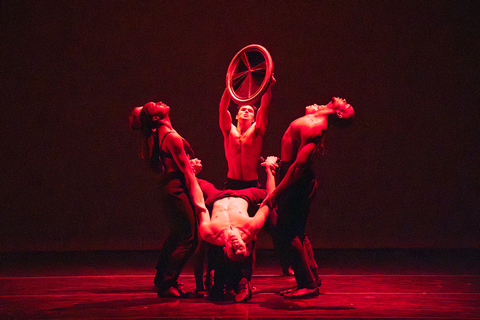
Johnson Guo (held center) and members of the Limón Dance Company’s production of José Limón’s “The Emperor Jones” as seen at The Joyce Theater (Photo credit: Hisae Aihara)
Apparently the racial component of the original is now problematic, and Puleio has chosen not to cast a Black dancer as the Emperor Jones. Johnson Guo who now dances the role is Asian American which adds its own level of complication. Now appearing as a contemporary gangster, Guo does not offer the same swagger or arrogance that Limón did in the original version. The ballet still has two men fighting for power as did the original to deal with Limon’s favorite theme of masculine identity but Joey Columbus as The Man in White seems to have been given more powerful choreography which makes this an uneven battle.
The six other dancers, originally labeled The Emperor’s Subjects, working in groups of three, seem to be henchmen for one or the other. Hiding behind skyscrapers here has a different effect from the trees in the jungle, suggesting gangsters in the big city. Ironically, now the episodes dealing with the dice game, voodoo ceremony, chain gang and auction block do not make as much sense in the urban setting. Villa-Lobos’ score resembles a bombastic film score, continuing the cinematic approach, but suitable to the pugnacious storyline. While having an interesting historic value as one of Limón’s most famous literary pieces on the rivalry between men along with “The Moor’s Pavane,” his Othello ballet, the new version does not seem to have realized its full potential. The talkback after the performance emphasized a homoerotic component in the ballet but when two of the six henchmen turned out to be female dances this idea receded somewhat.
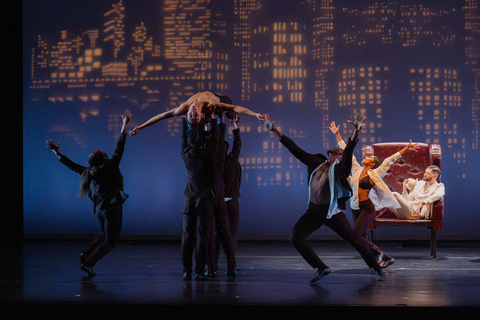
Johnson Guo (held aloft), Joey Columbus (in chair) and members of the Limón Dance Company’s production of José Limón’s “The Emperor Jones” as seen at The Joyce Theater (Photo credit: Hisae Aihara)
Vega Solorza’s “Jamelgos” was rather obscure, though the title meaning “old nags” and the six dancers dressed as horses or centaurs. “Jamelgos” began with a nude dancer facing away from the audience who drops to the stage and then walks across a prone dancer on the ground who rises to reveal a tail and then becomes the centaur’s other half. This seemed unrelated to what followed: six dancers all dressed as horses with leather dresses fitted with blond manes, leather breast plates and leather loincloths (costumes by Julio César Delgado). They first did the same steps and then broke up into groups of two who seemed to be in competition with each other.
The electronic music by Ebe Oke gave the ballet an eerie, otherworldly feeling, while Corey Whittemore’s dramatic, moody lighting was enhanced by smoke. The program notes spoke of exploring “contemporary queer masculinity and inherited legacies of gender performance in Latinx culture,” but was rather vague. At the performance under review, the cast was made up of Ian Debno, Mariah Gravelin, Ty Morrison, plus Natalie Clevenger, Johnson Guo and Lauren Twomley, appearing for the second time on this bill.
This was a well-thought out evening in the theater offering pieces from 1942, 1956 and a world premiere. Although not all of the ballets worked as they were supposed to, they had both historic import as well as a dramatic place in Limón’s career. Both “Chaconne” and “The Emperor Jones,” memorable for his work as a choreographer, were given face lifts to bring them into the 21st century. It is also notable that Diego Vega Solorza, a contemporary choreographer, was included as a path forward.
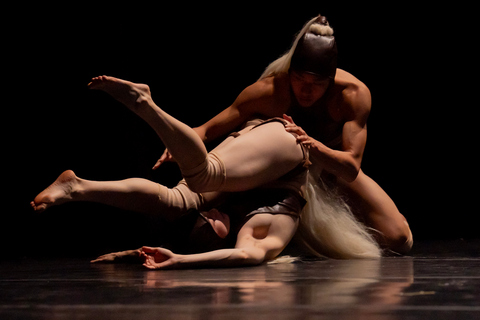
Johnson Guo and Natalie Clevenger in a scene from the Limón Dance Company’s production of Diego Vega Solorza’s “Jamelgos” as seen at The Joyce Theater (Photo credit: Hisae Aihara)
Limón Dance Company (October 14 – 19, 2025)
The Joyce Theater, 175 Eighth Avenue at 19th Street, in Manhattan
For tickets, call 212-242-0800 or visit http://www.Joyce.org
Running time: one hour and 30 minutes including one intermission


Leave a comment