
On The Town with Chip Deffaa … at “Ragtime” at Lincoln Center
Superbly cast, superbly staged, and written by masters at the top of their game, “Ragtime,” at Lincoln Center, is the most potent and powerful production in town.
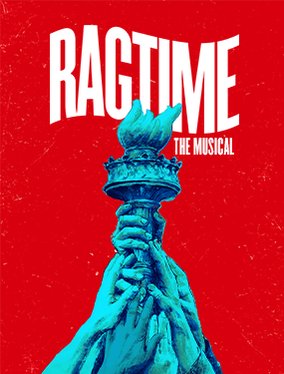 For my money, “Ragtime” is the greatest musical of the last 40 years, and the glistening new Lincoln Center Theater production is not to be missed. It is moving, thought-provoking, and inspiring.
 A year ago, I raved in this publication about the City Center Encores presentation of “Ragtime,” which I found to be about as satisfying as any Encores offering I’d seen since Encores started in 1994. I wrote then that I hoped “Ragtime” would transfer to Broadway. And now it has made the transfer, officially opening on October 16th 2025 for a 16-week limited engagement at Lincoln Center’s Vivian Beaumont Theater.
And this new production of “Ragtime”—polished to a high sheen–is even richer and more fully realized than it was at City Center. This is astonishingly good musical theater. About as good as it gets these days.
“Ragtime” is a masterwork. Over the years, I’ve seen enough performances of it to know the show inside-out. (I even attended the recording session for the original Broadway cast album.) I continue to find more in this show each time I see it. From start to finish, as I watched the musical at the Vivian Beaumont, I kept wiping away tears. It’s extremely rare for any show to move me like that.
This musical, which I’ve always loved, has never felt more timely. The struggle of immigrants, the fight for equal rights for all, the power wielded in our society by wealthy men…. All of these issues that “Ragtime” deals with are issues that we’re still grappling with today. (And the line noting that political activist Emma Goldman—a thorn in the side of the Establishment–wound up getting deported lands more strongly now than it did than when “Ragtime” first opened on Broadway in 1998.) The show takes place in the early 20th century. But we can easily relate to the characters and the challenges they’re dealing with. (And if, like me, you happen to be a child or grandchild of immigrants who had stories to tell about their experiences—and it doesn’t matter if they’re immigrants from Latvia, Syria, or Timbuktu—I suspect the show will have even greater resonance for you.)
* * *
Joshua Henry, whom I’ve appreciated since his standout performance in Kander & Ebb’s “The Scottsboro Boys,” makes an outstanding Coalhouse Walker Jr. He doesn’t just brilliantly carry off the challenging vocals–which would be impressive enough–he plays the role with just the right mix of strength, authority, and vulnerability. We feel for him. And he’s got great presence on stage. Coalhouse Walker so badly wants to believe in the American dream; he wants to be treated fairly, and with dignity. And he is pushed to a breaking point. It’s a tough role. I’ve never seen it played better. (And I’ve seen masters in that role, including Brian Stokes Mitchell and Alton Fitzgerald White.)
Brandon Uranowitz, who knows how to make the most of any role, is a most engaging Tateh. He plays the role of that Eastern European immigrant-turned-filmmaker with feeling and flair. (He is no stranger to “Ragtime,” having played the role of the Little Boy during the show’s early development in Toronto, three decades ago.) He’s a delight.
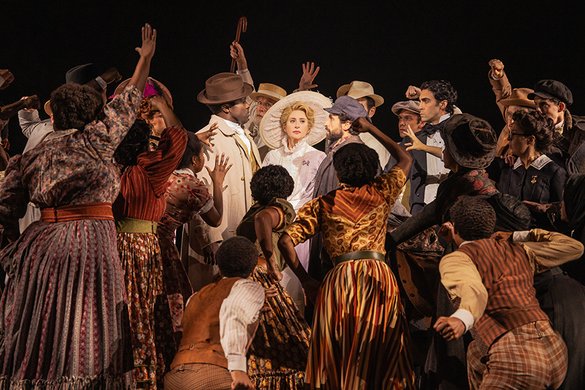
Ben Levi Ross, whom I enjoyed so much starring in Jason Robert Brown’s musical “The Connector” last year, is wonderful as Mother’s Younger Brother. He finds much more in that supporting role than actors usually do, giving a quirky, nuanced, very human portrayal. Ross is such an interesting and underappreciated artist, with a natural likeability. (If someone ever revises and revives Flaherty & Ahrens’ “My Favorite Year,” which had a book problems but an excellent score, he’d make a great “Benjy.”) Ross sings beautifully, too. (Not that his character gets a lot to sing, but I do like his voice.) And there’s an edge to him in this performance—an awkward, troubled quality that really works. He’s the best “Mother’s Younger Brother” I’ve ever seen.
Cassie Levy is sublime as the mother. A first-rate, utterly believable, and fully realized performance. What a gorgeous voice! And what a fine line she walks, portraying a woman raised in certain traditions, while gradually finding a more modern, more fulfilling way of living for herself. The producers could not have found a better “Mother.” (And I might add, Broadway theater-goers will be seeing and hearing a good bit of Cassie Levy this season, since she’s also been cast to play the female lead in the highly anticipated new musical production of “The Lost Boys,” which is set to open at the Palace Theater in the spring.)
Colin Donnell gives a solid performance as the austere and rather rigid patriarch of the family in New Rochelle, uncomfortable with changing times. And yet managing, in small but significant ways, to grow. (He refuses to shake the hand of the first Black man he encounters in “Ragtime”; when, towards the end of the musical, he shakes Coalhouse Walker’s hand, it is a welcome sign of change.)
Nichelle Lewis makes a fine Sarah. She sings well and she’s likeable. But she’s simply not as strong, overall, as would be ideal for this key role. She’s in a difficult spot, of course, competing with the memory of Audra McDonald, who originated the role nearly 30 years ago. McDonald is a once-in-a-generation kind of talent, and she brought a transcendent quality to the role that I’ve never seen anyone else equal since then. McDonald made the role of “Sarah” feel as important as any in the musical. (Now “Sarah” feels a bit more like a supporting character.) McDonald was compelling, and every inch a star—a very tough act to follow.
I enjoyed very much, too, I might add, the individual contributions of Shaina Taub (Emma Goldman) and Rodd Cyrus (Harry Houdini). Very well cast. They brought their characters vividly to life. (And I’m delighted to see that Houdini gets to make a far more impactful first appearance in this production than he did at City Center—a very wise bit of re-staging.)
But the real star, you might say, is the show itself.
“Ragtime” is far more ambitious than most musicals, telling three interweaving stories at once. Terrence McNally’s libretto preserves the key elements of E. L. Doctorow’s terrific but sprawling, densely packed 1975 novel, “Ragtime.” The score by Stephen Flaherty (music) and Lynn Ahrens (lyrics) is exceptional; it is by far their most fully realized score, and they’ve created many good scores in their partnership of four decades. I’ve enjoyed all of their shows. And I’m happy for the tremendous commercial success they achieved with their fun—and family-friendly—musical “Seussical,” which seemingly every school and community theater in America has mounted.
But their score for “Ragtime” is, by far, the most demanding and profound of any of their scores. (Composer Stephen Flaherty deserves kudos, too, for his excellent vocal arrangements.) The music is terrific, evocative of the era, and full of surprises.
The show’s elaborate prologue just might be the best, and most stirring, opening number I’ve ever seen in any musical. And it is magnificently staged here. The Vivian Beaumont Theater’s stage has greater depth than most Broadway stages, and every inch is put to good use.
It is a joy to hear William David Brohn’s original orchestrations again, played by a 28-piece orchestra conducted by James Moore. Ellenore Scott’s choreography is brilliant; she held me from the first number to last. She has a great feel for the Ragtime Era. And gives each of the three groups on stage—the well-to-do white family in New Rochelle, the African-Americans, and the immigrants—different body language.
And Lear deBessonet has staged the show with respect and understanding. This is her first production as Artistic Director of Lincoln Center Theater and it is a sensational debut. The staging here is even better than at City Center. The tweaks and changes—including very smart use of revolving stages and hydraulic lifts—are all to the good.
It’s rare for any production to get so many details just right. I liked the striking lighting design by Adam Honore. (Settings are minimalistic; but actors are positioned so well, and lighting is used so dramatically, we “see” the scenes as well as if there were full sets.) The sound design by Kai Harada is excellent—every word, every note, is clear, and feels natural. This is the way we always hope musical theater will sound (although we’re often disappointed.)
And this production boasts the best vocal ensemble sounds in town. When the people filling the stage lift their voices as one, the sound is just glorious.
I could go on. But you get my point. If you can do so, order tickets now. This is a very hot ticket. And “Ragtime” is only booked for a limited run. Go!
–CHIP DEFFAA


Leave a comment