
I’m Concerned About the Future of the Performing Arts in this Country
I've been passionate about theater for over 60 years. I love the performing arts, and want them to prosper. But everywhere I look, I see developments that are worrisome. Let me tell you about a few....
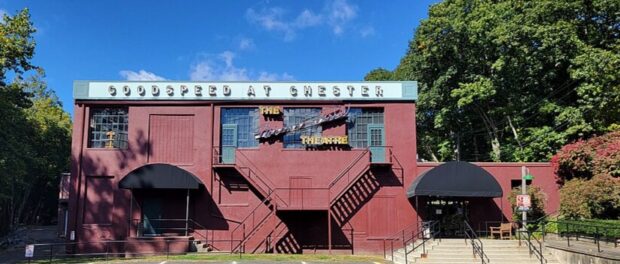
Norma Terris Theatre, Chester CT (photo by John Phelan)
By Chip Deffaa
Editor-at-Large
I love the performing arts—musicals, dramas, comedies, the ballet—you name ’em. And I’d always much rather be a booster than a bearer of bad news. But this is a very challenging time for the performing arts. Here are a few things that I find worrisome. First. Goodspeed Opera House–which has been a great favorite of mine since the 1960s–has announced it will be “pausing” productions for a year at their 200-seat Norma Terris Theater. That’s the smaller of their two theaters, the one dedicated to nurturing new musicals. (Their larger, 400-seat main theater–which offers terrific revivals of classic musicals like “Hello, Dolly!,” “Ragtime,” “A Chorus Line,” and “The Music Man,” along with some new productions–will continue operations as usual.) Goodspeed says they need to take time off and re-consider how to best use their Norma Terris Theater, in light of rising production costs and changing audience tastes.
I can’t recall Goodspeed ever cancelling a whole season like that. And we desperately need places where new musicals can try out. Nationwide, there are getting to be fewer and fewer such places. Many regional theaters are trying to reduce expenses by presenting fewer productions in a year than they used to, or by presenting shared productions (presented jointly by them and another theater); in either case, we wind up with fewer new works being produced. Since its opening in 1984, the Norma Terris Theater has been solely devoted to presenting new musicals; and a number of its productions have gone on to have subsequent Broadway, or Off-Broadway, or regional productions. I recall vividly that the very first show presented at the Norma Terris Theater, “Harrigan ‘n’ Hart” in 1984, soon transferred to Broadway.
I hate seeing Goodspeed “pausing” productions at the Norma Terris Theater. Goodspeed commented, via a press release: “While 2025 was a strong season with nearly sold-out performance runs at both The Goodspeed and The Terris, sharply rising production costs and shifting audience habits, expectations and preferences have made The Terris Theatre’s sole focus on the development of brand-new shows more challenging to accomplish.” It appears that the era of the Norma Terris Theater focusing solely on developing new works is now coming to an end. According to Goodspeed Managing Director Vanessa Logan, “Taking this pause will allow our teams to thoughtfully reimagine how The Terris can best support the organization’s overall financial health. It will give us the time and flexibility to develop an expanded operating model for The Terris, which may include educational programs and programming for young audiences and families like SummerSong, the youth theater program that we recently announced. Other options may include collaborations with other theaters and artists, community events, and additional initiatives alongside the productions of new musicals. This pause is temporary, and we look forward to updating our audience as plans take shape.”
Goodspeed’s Artistic Director, Donna Lynn Hilton, added, “In the meantime, we will produce a full season of musicals at The Goodspeed, including the World Premiere of The Snow Goose. Commissioned, nurtured and developed solely by Goodspeed, The Snow Goose will stand as evidence that our commitment to new work and the artists who create it is unwavering. It will make its debut at The Goodspeed Aug. 28 – Oct. 8.” I wish them well. But for those interested in the development of new theatrical works, this pause and change of focus for the Norma Terris Theater represents a significant loss.
* * *
Next. The Williamstown Theatre Festival—for seven decades, a major, internationally respected incubator of new theatrical works–has cancelled its summer season for 2026. This announcement just stunned me. Williamstown pausing productions? Williamstown has helped launch the careers of many playwrights, actors, directors. We vitally need places devoted to developing new work. Again, they say this is just a one-time pause, to give them time to re-evaluate future goals and such. But I’m troubled by this unexpected cancellation of their summer programing. This is a major loss, not just for theater-goers, but for playwrights, actors, directors, interns. I’ve enjoyed watching shows at the Williamstown Theatre Festival. And I’ve known many artists and aspiring artists who’ve treasured the time they spent working there.
* * *
Let’s look at some difficulties in the performing-arts world that are a little closer to home. Here’s one development in NYC that greatly concerns me. The Metropolitan Opera House–the “Grand Dame” of New York performing-arts institutions—used to routinely mount 25 productions a year. In recent years, they have been offering only 18 productions per year. And they’ve just announced they’ll cut that figure down to 17 productions next season. I don’t like the way that is trending. And—despite fierce efforts to tighten their belt—the Metropolitan Opera has been losing huge sums of money. They’ve spent almost half of their endowment trying to keep things as close to normal as possible. And that alone is alarming. They hope to bring in some much-needed income by performing several weeks a year in Saudi Arabia instead of NYC. But that idea has a kind of grasping-at-straws quality to it. Equally troubling, they’re now considering selling their world-famous Chagall’s to raise funds. (Their idea would be to sell them to a purchaser who would allow them to remain on display at the Met.) But you can only sell off your Chagall’s once. In the long run, selling valuable possessions to raise funds needed to cover ongoing operational expenses doesn’t work. It’s not a sustainable way to maintain operations.
* * *
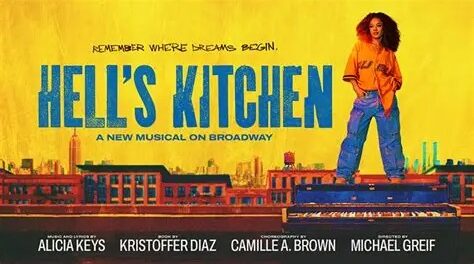
Hells Kitchen
And what about the health of musicals on Broadway? On February 22nd, Alicia Keyes’ Broadway musical “Hell’s Kitchen” will be closing. Although it has been running for almost two years—and certainly would appear to the average theater-goer to be a hit–it actually will be closing at a sizable loss, having made back only about 60% of its $22 million capitalization. And that says a lot about the state of Broadway today. “Hell’s Kitchen” has s been playing in one of Broadway’s most coveted theaters, the Shubert Theatre, on the very best block in the theater district.–the one with the most theaters and the most foot traffic–44th Street between 8th Avenue and Broadway. And after “Hell’s Kitchen” closes on February 22nd, every single Broadway theater on that block–the Majestic, the St. James, the Hayes, the Shubert, the Broadhurst–will be vacant. That whole fabulous block–which for many people practically defines Broadway–will be dark. I’ve never seen that happen before in my lifetime. And I’ve been an avid theater-goer since seeing “My Fair Lady” late in its original Broadway run, more than 60 years ago. Incidentally, once “Hell’s Kitchen” closes, only two musicals which opened in the same season as “Hell’s Kitchen”–“The Great Gatsby” and “The Outsiders”–will still be running. There’s usually a lot of excitement as we get closer to the Tony Awards, with musical-theater buffs wondering which four or five new musicals will be nominated for a “best musical” Tony Award. This year, I wonder if there will even be four or five new musicals running on Broadway when the Tony Awards are given out.
* * *
It’s a tough time for Broadway musicals. I’ve never seen anything quite like this. For decades investors accepted the reality that, traditionally, only 20% of the musicals that opened on Broadway would make a profit. But in recent years, that figure has dropped from 20% to 10%. Producing a big musical these days costs upwards of $20 million. And 90% of new musicals that open on Broadway these days are closing at a loss. I’d hate to be an investor right now. The eagerly awaited new musical “Queen of Versailles,” which opened on Broadway November 9th, 2025, couldn’t even hold on until year’s end. It closed on December 21st after just 49 performances—despite having a score by Stephen Schwartz, the composer of such hit musicals as “Wicked,” “Godspell,” and “Pippin,” and a cast headed by one of Broadway’s most beloved stars, Kristin Chenoweth. When first announced, that musical looked like a sure thing. But audiences didn’t turn out. Broadway, I might add, relies heavily on tourists to survive.
And Trump’s policies, which make America a much-less-inviting place for foreign tourists, certainly don’t help matters. And the difficulties are not just on Broadway. If you’re a theater-lover living in America’s heartland, fewer first-class Equity touring productions are coming your way these days. And more less-costly non-Equity touring productions are headed your way. “The Road” isn’t what it used to be. I could go on. There are many more examples I could cite. I love the theater. I don’t like the way things are headed. And the high prices of tickets are making a lot of people think of Broadway as something that only the rich can really afford. The average Broadway ticket-buyer these days, surveys indicate, is making more than $200,000 a year. If you want the theater to grow, you need to get more young people—who often don’t have a lot of disposable cash—to become regular theater-goers. I don’t have a solution for these problems. I tend to be an optimist by nature. But these days, I must confess, I’m worried.


Leave a comment