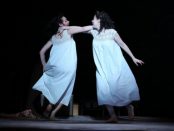
Say this for actor Hamish Linklater: he writes juicy parts for his fellow actors. He also knows how to set up a sense of community. The New Group production directed by its artistic director Scott Elliott has a fine cast led by two-time Tony Award winner Norbert Leo Butz and Zosia Mamet, just off six seasons of the recently ended HBO television series, Girls. [more]
While most of the audience remained stony-faced, my companion and I were laughing hysterically throughout much of "Can You Forgive Her?", a black comedy if ever there was one, by Gina Gionfriddo at the Vineyard Theatre. It may be that many in the audience failed to recognize it was a comedy, and took it far too seriously, which is somewhat understandable, given the seemingly earnest yet cockamamie story--or rather stories--that unfold. [more]
Director Jesse Berger’s fast-paced staging is an exuberant amalgam of physical and verbal virtuosity combined with visual flair. A highlight is a crowd of characters hurrying into a closet and popping out one by one that’s out of a Marx Brothers movie. There’s also the spectacle of a group of bearded, shabby villagers of various heights storming The Mayor’s house in their flowing garments. [more]
Unlike such political plays as Arthur Miller’s "The Crucible," David Hare’s "Stuff Happens" and the current "Oslo" by J.T. Rogers, Building the Wall is speculative political fiction. Projected into the not-so-distant future, it takes place after a terrorist attack has released a dirty bomb in Times Square irradiating two square blocks. As a result, President Trump has declared Martial Law and begun rounding up millions of immigrants for deportation. This extraordinary move which had gotten out hand has led to his impeachment and exile to Palm Springs. "Building the Wall" takes place in 2019 in a prison meeting room in a federal lock-up in El Paso, Texas. Gloria, an African American historian and college professor, has come to interview Rick, a white man, who is awaiting sentencing for his role as the former warden of a new Magnum Security private prison facility outside of El Paso for illegal immigrants awaiting deportation. It is Rick’s role in the disposal of bodies after a cholera epidemic in the overcrowded facility which has landed him in prison. [more]
Expect great things from Udofia in the future. Both plays demonstrate that she writes full-bodied, three-dimensional characters, while "Her Portmanteau" reveals that she can also write a play from the heart whose emotions will pull you in and stay with you long after the final curtain. Also keep your eye on Chinasa Ogbuagu: playing two different women 36 years apart she is totally unrecognizable, you have to read the program to discover that it is the same actress, an extraordinary feat. [more]
The opening scenes augurs well, hinting at the deeper emotional motivation for Salome’s future behavior, her decision to avoid romantic involvement. As the lights gradually rise to reveal Salome, seated at her desk, her back to the audience, she is described by disembodied voices as a contradictory figure who is loved and respected in equal measure. Then Salome, the product of a respectable, well-to-do upbringing, tells a tale of being duped by the kitchen help when she was a child. The look on Mieko Gavia’s face as Lou Salome after revealing this traumatic event makes it clear that she will never be duped again. Ms. Gavia skillfully portrays Lou Salome as a stalwart anti-romantic who, nevertheless, knows that friendships with the influential males of her time were a necessary evil. [more]
Mr. Grandbois’ engrossing scenario is in the vein of such feminist fantastical works as "Diary of a Mad Housewife" and "Up the Sandbox." An expedition to a salsa dance club, buying a puppy from gypsies behind a Home Depot, watching Clash of The Titans on television with her son and a trip to the zoo are rendered with exquisite literary detail that’s simultaneously comic and moving. Looking into an old mirror becomes a Proustian reverie of Lanie’s recollections of her dead grandmother. [more]
An import from the United Kingdom, as part of the 2017 Brits Off Broadway Festival at 59E59 Theaters, Jon Brittain’s "Rotterdam" is not based on a true story relating to events in the eponymous Dutch city. It rather focuses on a British lesbian couple, one of whom decides at the beginning of the play that she’s really a man and really wants to become transgender. The crux of the drama is between Alice and her lover Fiona, who, in the course of the play, becomes Adrian. But why the two of them moved to Rotterdam seven years ago, is never really answered in the play--rather posed as a recurring question--along with the question of whether or not they’re going to remain there. [more]
Amidst Mr. Maierson’s barrage of mechanical set-ups and punch lines, there are a few amusing jokes and insightful observations. Reprise is in the tradition of substantive romantic comedies such as several of the works of Neil Simon and Bernard Slade’s Same Time, Next Year. However, it lacks the polish and depth of those perennials, and is also mired in bathos. [more]
The adept cast is led by Zainab Jah in the title role. In the one detail in which Parks’ play matches "The Elephant Man," Ms. Jah, a shapely, lovely actress, transforms herself into Venus right in front of the audience, painfully pulling on a padded costume that leaves nothing to the imagination. Ms. Jah’s Venus is a strong figure who rolls with the punches but is no match for the hypocrisy of the powers that be. She is a strong enough actor to keep her head above the fray. [more]
It quickly becomes apparent that Brown is a master at reading body language--no less than facial and vocal expressions--to manipulate the many audience-members who participate and to read their inner thoughts. Brown’s patter is also built on an almost glib sort of false modesty, such as his saying, near the end, “This only works because we are story-focusing creatures.” Any given interaction doesn’t “work” because we’re focusing on the “story,” but because he knows just exactly how to get us all to see only what he wants us to. [more]
Director Jesse Marchese has cast the play very strangely. Ari Brand’s Bob is a good deal shorter than his younger brother so that one must continually remind one’s self which is which. As Pamela, Paton Ashbrook also is taller than Bob. Is this a subtle hint that she doesn’t belong with him? Gerald has three friends who are guests in his father’s house. Andrew Fallaize’s Tommy, an idle fellow mad about golf, and his girlfriend Letty, played by Mia Hutchinson-Shaw, seem so much younger than Gerald that it stretches the imagination that they are his close friends. Gerald’s friend Henry Wentworth, a successful barrister played by Michael Frederic, looks so much older that it also seems rather unbelievable that they are bosom buddies. A delightful Cynthia Harris plays wise, compassionate Great Aunt Harriet in such an astute manner that she highlights all the subtext of her lines, the only actor in the production to do so. [more]
The opening resembles that of Mann’s novel: a horse and buggy deliver a visitor to a tuberculosis sanitarium on a mountain top overlooking a valley, suggesting that the unspecified time is 100 years ago, prior to W.W. I. Immediately, the doctor discovers that the newcomer has T.B. and needs weeks of rest. This One Who Has Come from the City to Heal meets and interacts with the other denizens, including a healer, a mother of a degenerate child, one who is building a space ship, and one who composes sounds and visions, as well as having the ability to see those who have passed away. [more]
In the ambitious T"hey Promised Her the Moon," playwright Laurel Ollstein explores a relatively untold chapter of American history. Solidly written but unsatisfyingly structured as a clunky series of flashbacks, confrontations and historical exposition, the play snaps to life in its final scenes. There the Salieri versus Mozart-style rivalry of Peter Shaffer’s "Amadeus" that has developed between the two antagonistic central figures is heightened. [more]
The writing is poetically descriptive and moderately engrossing with plentiful profanity. It is, however, a decidedly grim scenario despite abundant humor. The conclusion is a rhetorical and optimistic rallying cry for social justice. The themes and message are all very well realized in this production. [more]
Director Weyni Mengesha’s physical staging is proficient since for 80 minutes the actors are competently placed throughout for a fluid presentation. Unfortunately, Ms. Mengesha has the sound at full blast and that’s distracting. Just as egregiously, Mengesha has the talented cast performing at full throttle, resulting in overwrought and collectively overall ineffective characterizations. [more]
At the end of this "Happy Days," it’s difficult not to be heartbroken by Ms. Wiest’s Winnie, particularly when she gets a rare glance at her significant other, Willie, who manages to crawl over the sand to serenade her with the “Merry Widow Waltz.” Jarlath Conroy playing Willie makes the most of his few scenes both behind and on top of the sandy mound. Somehow he even makes something of his slow crawl towards Winnie at the end. Seeing Ms. Wiest’s face at that moment is worth sitting through Beckett’s theatrical obfuscations. [more]
Hnath’s new story is absorbing and twisty, interestingly creating an entirely new set of ethical and social questions than was handled by Ibsen in 1879. He has handled it in a similar fashion to Bergman’s "Scenes from a Marriage" but without the painful emotional fireworks. It is 15 years since Nora had left her husband, stating he had no further claim on her. She has not been heard from since. Having become a famous feminist author with advanced ideas writing under a pseudonym, she has recently discovered due to a blackmail attempt that Torvald has never divorced her which she assumed he had done. Having lived as a single woman, signing contracts, controlling her own money, and having relationships with men not her husband, she is guilty of a criminal offense under Norway’s laws at the time and can be sent to jail. She arrives at his door to obtain her divorce to really be a free woman. [more]
Retro Productions’ 50th anniversary revival of Paul Zindel’s "And Miss Reardon Drinks a Little" put the spotlight on an almost forgotten play that is worthy of revival. Shay Gines’ production with a game cast of seven is absorbing and compelling theater with characters that are bigger than life. Paul Zindel’s semi-autobiographical play comes alive in their hands. There may be more theatrical treasures to be mined from his collected plays. [more]
All the acting is sharp, from the upper-crusters taken in by Paul (Lisa Emery, Michael Countryman and Ned Eisenberg) to their kids (Colby Minifie, Keenan Jolliff, Ned Riseley, and Cody Kostro), Chris Perfetti as Trent who, sexually intoxicated by Paul, fills him in on the ways and means of all the people he will eventually swindle, and finally, to the young lovers (Peter Mark Kendall and Sarah Mezzanotte) whose fate reveals just how psychologically damaging Paul can be. [more]
Though the printed script, such as it is, is credited to Nel Crouch, Crouch is listed in the program as only the director, and "Fossils" is rather “By” Bucket Club, described as an “associate company.” Such confusion is perpetrated throughout the production: it’s hard to say if, in the end of this extremely low-tech presentation, Vanessa has actually encountered the Monster--and/or her father--or not. "Fossils" is apparently more about what doesn’t happen than what does. [more]
That this production has such an ideal Sloane puts it into the stratosphere. With his sculpted physique, prevalent musculature and chiseled features that recall the young Malcolm MacDowell (who played the role in a 1975 London revival), Matt Baguth is mesmerizing. Speaking in a whispery, low, lightly accented voice, Mr. Baguth commands attention. Whether wearing Mod clothing or encased in black leather, and a tight white T-shirt, Baguth vividly captures the predatory nature of this youthful interloper with sly conviction. [more]
Although the play seems to have something to say about economics and political systems, it is simply a very light romantic comedy making use of elements of change during the Great Depression. Ross’ production is quite proficient and fast-paced, but the characters are generic and we don’t learn much about them. As Lord Kettlewell, Brian Protheroe is the typical crotchety but wise aristocrat, Richenda Carey is most eccentric as the impoverished Lady Knightsbridge, and Lisa Bowerman is level-headed as the previously estranged Lady Kettlewell. Carol Starks’ Mrs. Lancicourt is the manipulative upper-class woman who attempts to dominate all situations. Hugh Sachs is a raisonneur straight out of classic drawing room comedy and would have been as at home in a play by Wilde, Shaw, Pinero or Galsworthy. [more]
The clarity of this new play by J.T. Rogers does not only rely on the smart yet surefire way it’s written, but also on the masterful staging by Bartlett Sher, who, after recent productions of both "South Pacific" and "The King and I," is no stranger to directing gargantuan shows at Lincoln Center. Given its subject--the Oslo Accord or peace treaty between Israel and the Palestine Liberation Organization (P.L.O.) in 1993--Oslo is ultimately, an enormous play. But it is told in intimate terms. [more]
Provocative, startling, and theatrical, "Her Opponent" is a recreation of the 2016 U.S. presidential debates between Hillary Clinton and Donald Trump. The twist is that actors of reverse genders portray them. [more]
Every new play by Annie Baker is a marvel over the play before. It’s been nothing less than a privilege to accompany her on her journey, as she has been joining ranks with the best American playwrights. Part of what makes Baker the “best,” is that she has her own voice. Whether with "Circle-Mirror Transformation," the marvelous "The Flick," or her latest and current, "The Antipodes," Baker seems to devote a certain amount of attention to group dynamics, which is, after all, the basis of any drama. And how can I have left out reference to John, Baker’s play from last year, which was her first as part of her enrollment with the Signature Theater, and arguably the best of all? [more]
The dialogue of Ileana Alexandra Orlic’s English translation is problematic. Floating around are a few Shakespearean snippets, but otherwise it’s rather stilted. Without much verbal grandeur there’s a prevalent flatness. There’s not a compelling momentum, and so it never really rises above being a curiosity. However, overall this play does somewhat succeed as a spirited condensation, especially for those familiar with the original work. [more]
"Indecent" is, on the surface, the history of Yiddish writer Sholem Asch’s brave Yiddish play "God of Vengeance" which was—incredibly, considering its wise understanding of the Jewish demimonde—written in 1906 during the height of anti-Jewish pogroms. (Asch actually witnessed a pogrom and its ugliness tainted his life thereafter.) It is far more, though. The play is a look at the sweep of Jewish life in the twentieth century using Asch’s creation as the hook. [more]
Alternating between flavorfully humorous and darkly revealing dialogue, Mr. McLure vibrantly renders his characters’ personalities and motivations. There’s a hilarious analysis of the incompatibility of eating a Baby Ruth candy bar while drinking beer. With this sociological slice of life, McLure has created three strong roles for actors, and this production’s cast plays them with assurance. [more]
As the ageing matinee idol who never forgets to check his appearance in the mirror, Kline plays a man who is always acting, both on stage and off. His animated physicality in his roles has always been in evidence but here he outdoes himself. Using his arms, hands, head, face and body as his canvas, he is almost never still showing us what can be done on each and every line. He makes even an ordinary line into a witticism and his comebacks wither with every additional jibe. He cajoles, seduces, emotes, wheedles and at the same time suggests he pities himself. He creates a bigger than life character (is John Barrymore his model?) and watching him is a lesson in consummate acting. So completely does he make Garry Essendine his own, you cannot imagine anyone else in the role – although among other New York revivals he has been played by such stars as George C. Scott, Frank Langella, Victor Garber and Coward himself. [more]
If this all sounds a bit over-intellectual, well, so is the play. Though the intelligent script may be based on real people, they are forever describing themselves--and each other--in ways that real people never do. Think about practically any play by George Bernard Shaw, and you begin to get the picture. (Archbishop McQuaid even says, “I do find political theory most compelling.”) And although Moore, as director, has done much to compensate for the tiny stage space on which the expansive story unfolds--particularly with helpful projections by Chris Kateff and a cramped but effective set by John McDermott--she isn’t abetted very much by her actors. [more]
Matthew Montelongo is particularly effective in conveying Mitchell’s anti-marriage convictions, only to make us feel Mitchell’s subsequent anguish. Anna Holbrook is also outstanding as the self-centered Lydia, smartly dressed in Jennifer Caprio’s always dead-on costumes. But it would be an oversight not to also applaud Ryan Spahn as Daniel, Lou Liberatore as Barry, and Leland Wheeler as Trip. If Montelongo and Holbrook somehow emerge as acting victors, it may be because they have, in some respects, the two richest roles. (Mitchell and Lydia duke out their ultimate conflict offstage, in a court of a law.) In an odd way, "Daniel’s Husband" is ultimately the age-old story about THE mother-in-law, which may have given rise to many a comedian’s jokes, but, can often have lethal consequences for any married couple--whether they’ve literally tied the knot or not. [more]
The dialogue is sparse as various mundane activities are depicted, such as learning to drive, shaving and ordering food from a deli. The infants are played by adult actors. The cast wears matching wigs. Andrea Hood’s authentically simple costume design is comprised of jeans, shorts, trousers, plaid shirts, and T-shirts. The production all has a Thornton Wilder-style quality. [more]