Plays
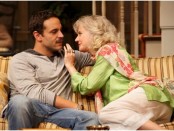
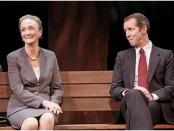
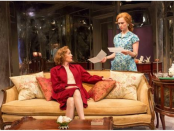
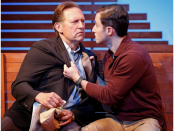
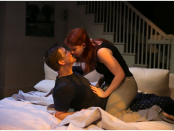
When Terrence McNally premiered Lips Together, Teeth Apart in 1991, the world was in the throes of fear over the AIDS epidemic. This long three-act play about how two straight couples deal with their reaction to it must have seemed topical and profound at the time. Unfortunately, 23 years later, in Peter DuBois' revival for Second Stage Theatre, the play now seems dated and talky without the emotional heft to make it still seem important. [more]
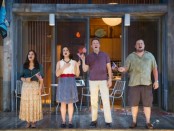
Father Comes Home from the Wars (Parts 1, 2 & 3)
Underlying all of the storytelling is the archetype of Homer's Odyssey, the story of another journey in another time of war. Many of the characters (Penny, Ulysses, Homer, Odyssey pronounced "Odd-see") take their names from this work. What may be most unusual about this first cycle of plays is that it is one of the few stage works to tell the story of the Civil War entirely from the point of view of African American slaves. [more]
Disgraced
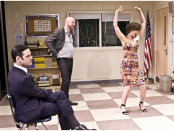
That such a devastating scramble of lives can happen in as handsome a setting as John Lee Beatty, magic set designer, manages to evoke, heightens the irony of what takes place there. The rest of the superb production is of equal caliber: Jennifer Von Mayrhauser's so right costuming, Kenneth Posner's so apt lighting, Jill BC Cu Boff's sound. But is this who we are? Where do we go from here? You don't want to miss Disgraced. How are you going to know what the title means? [more]
The Brightness of Heaven
"Almost all the families I knew were struggling to find their way forward and make sense of a way of life that was unraveling before their eyes," writes Ms. Pedersen in her author's note in the program. She has a laundry list of period-piece social issues that are superficially covered including abortion, pre-marital sex, the economy, interfaith marriage, homosexuality, Watergate, and The Vietnam War. The writing is often sharp and well observed, with zingers and jokes that effectively register. "If Irish Dementia is only remembering the grudges, than Irish Amnesia is only forgetting the food." "Excuse me, but is this twentieth century Buffalo or fifteenth century Barcelona?" [more]
Back
Set in at ill-defined Halloween party raging somewhere in the universe between life and death, Back depicts numerous formerly living Greenwich Village icons, from founding father Alexander Hamilton to Flower Power movement leader George Harris, III. Cookie Mueller—writer, muse to the famous filmmaker John Waters, and AIDS victim—leads the proceedings as this scripted Pride Parade's grand marshal. Filled with recurring mantras, bizarre non sequiturs, and gratuitous nudity, the performance under review (the rotating script allows for different variations at different performances) followed—or, more appropriately—circled around the respective, untimely demise of both poet Frank O'Hara and actress Mueller. [more]
Excuse My Dust (A Dorothy Parker Portfolio)
Most of the pieces will be familiar to the readers of The Portable Dorothy Parker: "The Garter," "A Telephone Call," "The Waltz," "Just a Little One," "The Taxi," and a few poems. This is supplemented with bits from more ephemeral work, such as her book reviews. [more]
Billy & Ray
Mike Bencivenga's Billy & Ray is the story of Wilder and Chandler's famously contentious collaboration. The lighthearted comedy drama includes an insider's view of Hollywood and a good many famous anecdotes about their fighting over the Double Indemnity screenplay. While it will probably be enjoyed most by those who know the movie and/or the original novel, the play does clue the audience in to what they need to know about the original material as well as its eventual screen treatment. [more]
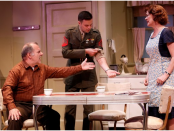
Danny and the Deep Blue Sea
Nairoby Otero as Roberta is a wondrous feisty spitfire, whose energy never subsides and deeply conveys the character's poignant sense of despair. Michael Micalizzi hauntingly captures the essence of a hotheaded, lost soul as Danny. They each expertly deliver Shanley's identifiably unique dialogue, getting all of the laughs while achieving pathos. Their chemistry together is tremendous and a huge asset.
[more]
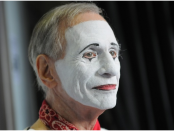
Deliverance
This outstanding cast of seven is all perfectly in synch with each other and are a true ensemble of the highest caliber. The highly successful artistic collaboration of all the creative talents involved makes this Deliverance a boldly striking work of uniquely theatrical storytelling. [more]
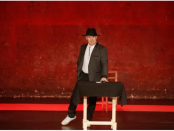
The Curious Incident of the Dog in the Night-Time
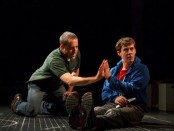
"The Curious Incident of the Dog in the Night-Time" is the sort of very special play that only comes along once in a very great while. It is a play that will not only astonish you while you are in the theater but will also stay with you for a long time after you have left. In addition, you will come away with a much greater understanding of people with autism and how their minds work. [more]
You Can’t Take It with You
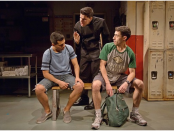
This new production of "You Can't Take It with You" proves that not only has the comedy passed the test of time, it also remains a wonderful evening in the theater. It may be set in the 1930's but America in 2014 needs to hear its message all over again. And it is still joyful and uproarious as it shows up real human foibles of which people are still prone. [more]
When January Feels Like Summer
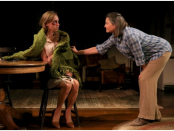
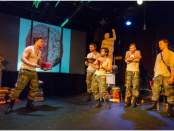
Romantic comedies often collapse under such contrivances, but in practice this play holds up beautifully. Nirmala's struggle to accept that she has a right to tenderness in her life is sensitive without being preachy, and Ms. Kakkar is frankly fantastic in the part. She finds an exceptionally quiet and truthful center for her characterization, and as a result Nirmala's breakthrough moments feel absolutely real and not at all melodramatic. [more]

Written in Sand
This was my first in-person experience of Finley's work, and unfortunately it was a shambles. What could have been forty intense minutes of poetry and music was padded with rambling introductions and mostly aimless patter to more than twice that. The night I attended she was nervous and flustered, repeatedly losing her place in the program, and allowing herself to be distracted over and over again by a leaky water pitcher. (Why didn't the stage manager just replace it?) [more]
Signal Failure
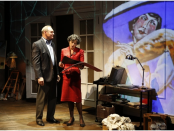
Wildly painted panels with words and images such as Big Ben, Keep Calm, and a Union Jack, simply and concretely establish the locale during the opening scene. The actors on either side of the small bare stage are at large, movable, gray wooden cubes that are resourcefully used as scenery. Sounds and announcements of the London Underground are heard as well as song clips from time to time, adding to the sense of place.
Director Peter Darney's staging is tremendously forceful, fluid, acutely visual and very well serves the material. In addition to creating a vibrantly watchable piece, he has gotten finely pitched performances from the very appealing cast who for a good deal of the show address the audience with their thoughts. [more]
This Is Our Youth
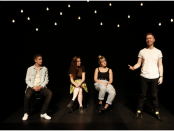
details a specific subset of affluent, privileged, urban teenagers with no concepts for independence or ambition. In the larger context, the characters' problems are mostly petty and self-inflicted; consequently, the subject matter is difficult to relate to. I cannot speak for everyone, but the careless spending, rampant drug use, and overinflated egos presented in Lonergan's play were certainly not characteristic of my youth. [more]

Six Passionate Women
Structurally, it is a collection of vignettes that all end in a blackout, punctuated with the sounds of composer Nino Rota’s lively music used in many of Fellini’s films. Here, it comes across as a bunch of connected, superficial comedy sketches, many of which fall flat. The actors, though all are talented, in some cases don't quite fit their roles but commendably do their best. The overall effect at times is of awkwardness and pacing that is less than comic. [more]
Riding The Midnight Express
During 70 engrossing minutes on a bare stage with only a tall stool as a prop, he vividly recounts these long ago incidents with great detail. Youthfully complaisant during his three prior drug runs, his fourth turned nightmarish with a dramatic arrest by armed soldiers at the airport. Four harrowing years in various oppressive prisons were made endurable by his strength and the aid of his benevolent father who provided money for bribes. Then the incredible escape, "catching The Midnight Express" to freedom.
[more]
The Country House
"The Country House" is an old-fashioned drawing room comedy about theater and film people inspired by the plays of Anton Chekhov. From Donald Margulies whose track record includes "Time Stands Still," "Brooklyn Boy," "Sight Unseen," "Dinner with Friends" and "Collected Stories," we have come to expect something more emotionally satisfying. Blythe Danner, Daniel Sunjata, David Rasche and cast are good company but do not make a very convincing case for this new play [more]
Indian Ink
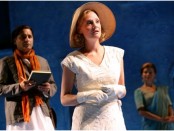
the relationship between Eleanor Swan and Anish Das is flirtatious from the outset. As the 75-year-old Mrs. Swan, Harris is a joy, making even her unfinished sentences perfectly obvious as well as her very English prejudices. Bhavesh Patel plays the younger Das with matinee idol suavity. As Captain David Durance, the British army officer who falls in love with Flora at first sight, Lee Aaron Rosen is suitably stiff, stalwart and handsome. [more]
The Killing of Sister George
The writer's narrowness of view is a temporary problem, of course. As the play's historical moment recedes from memory, we will once again read the story for what the characters are, rather than what they aren't. On the other hand, the same kind of claustrophobia exists in the work of Tennessee Williams, though the latter digs deeper to find the root causes beneath the limitations, pain, and just plain weirdness of his people. [more]
Selma ’65
Viola Gregg (1925 -1965)was an activist Michigan housewife who drove to Selma, Alabama, in March of 1965 to participate in the Civil Rights marches there. She was later shot and killed, from a car with four Klu Klux Klansmen. One (Tommy Rowe (1933-1998) was an informant for The Federal Bureau of Investigation, used for infiltrating the KKK. He testified against the other three, and was put in The Witness Protection Program. [more]
A Walk in the Woods
As the sophisticated, experienced Irina Botvinnik, Chalfant is utterly delightful. She makes Irina’s tactic of changing the subject into a fine art. Her charm is evident even when she is disagreeing with her opposite number. Her Irina’s wry sense of humor is conveyed in all her remarks, but it is often difficult to know when she is kidding and when she is serious, another calculated tactic. And Chalfant’s timing is impeccable making the most of both her banter and when she is deadly serious. [more]
The Money Shot
Lanky, animated, and with his characteristic twang, Fred Weller is very lively and appealing as the dim franchise star Steve. Elizabeth Reaser winningly captures the insecurity and self-absorption of the fading female star Karen. With physical sight gags to work with, such as a bizarre cheerleading dance inspired by Arthur Miller's "The Crucible," and overindulging in hors d'oeuvres, GiaCrovatin makes the most of the proverbial blonde bimbo Missy. [more]
Icebound
Up until now when the name of Owen Davis' 1923 Pulitzer Prize winner "Icebound" comes up, the response is likely to be a head shake that the year's prize did not go to a more worthy candidate like Eugene O'Neill, Elmer Rice, Sidney Howard, Philip Barry or George Kelly. Now with the Metropolitan Playhouse's revival of "Icebound," theatergoers can see for themselves what a trenchant and engrossing drama this actually is. [more]
Love Letters
Under Gregory Mosher's subtle and assured direction, the two performers always seem age appropriate to their characters. While they do nothing to disguise their real ages, it is as though two older people have gotten together to review the letters that they have written to each other over a lifetime. [more]
Scenes from a Marriage
The three couples are played with fierce conviction, total commitment and great talent by a corps of strong actors seemingly also cast for their individuality. Alex Hurt and Susannah Flood are the young couple. Dallas Roberts and Roslyn Ruff are the middle-aged couple. Arliss Howard and Tina Benko are the older couple. They appear to have been cast for their differences rather than any similarities. [more]
Daughters of the Sexual Revolution
n suburban Westchester, 1976, we meet three couples. Lively, free spirited and just turned 40, Joyce Horowitz is married to the older, cantankerous W.W. II veteran Ed. They have a rebellious 18-year-old daughter Staciawho has recently become involved with her earnest, good-natured, 18 year-old college boyfriend, Simon Davies. There is also the Horowitzes' new neighbors in their 30's, the Prescotts, anxiety ridden Judy and her pompous psychiatrist husband, Liam.
[more]
Uncle Vanya
Aside from his light touch which keeps the play from seeming gloomy, Brooks has an uneasy hold on the play's rhythms which seem erratic – we are never sure what kind of play we are watching. Schmidt's translation goes a long way to blowing off the cobwebs on Chekhov's 19th century Tsarist Russia but his occasional use of a contemporary word like "freak" draws attention to itself. While Simms' unit set suggests a summer retreat with its green walls covered with vegetation, he makes little distinction between indoors and outdoors and the claustrophobia which the characters are feeling is never real to the audience. [more]
The Fatal Weakness
Kristin Griffith and Victoria Mack in a scene from The Fatal Weakness (Photo credit: Richard [more]
Almost Home
Almost Home Joe Lisi, Jonny Orsini and Karen Ziemba in a scene from Almost Home (Photo [more]
The Valley of Astonishment
Jared McNeill and Kathryn Hunter in a scene from The Valley of Astonishment [more]
My Mañana Comes
José Joaquín Pérez and Jason Bowen in a scene from My Mañana Comes (Photo credit: [more]
Culture Shock: 1911-1922
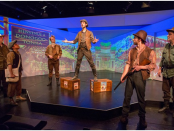
The framing device is that we are in a bunker or a trench, and the plays are being presented by five soldiers (De Mussa, Wes Hager, Will Hardyman, Wilton Yeung, Josh Wolonick) and a nurse (Joyce Laoagan), as if whiling away the time between barrages, and in a semi-improvised fashion. This is a good idea, and provides a nice unity to the evening. The scenic design (Joseph Kremer) and lighting design (Daniel B. Barbee) supported this well, too. There were also projections and pre-recorded music tracks, which I assume should be credited to multimedia programmer Aristides F. Li.
[more]
Bootycandy
Throughout the play there are many visual and spoken references to Michael Jackson, showing how large the presence and influence of The King of Pop in his heyday loomed in the consciousness of many growing up and living in that era. This symbolism adds greatly to the detailed specificity of this passionate, suspenseful and bold work. [more]
Bauer
The relatively unfamiliar cast of this West Coast production could not be better. Howard is distinguished and forceful as the once-famous artist now reduced to nothing and aching for a fight with his greatest enemy; Ross is imperious and elegant as the once-powerful curator used to always having her way, now seeking out her greatest love. Their scenes together strike fireworks. [more]
Boys and Girls
Through a series of intertwining monologues, Boys and Girls follows four young Dubliners before, during and after their respective sexual encounters. Though the characters never interact, their stories weave through one another, forming fascinating juxtapositions. While one of the boys fails to seduce his love interest at a bar, the other laments his passionless, anonymous alley hookup. While one of the girls describes the thrill of a first-time experience, the other wonders if her committed relationship is physically fulfilling. The result is a comprehensive, truthful account of adolescents learning to understand male-female dynamics. [more]
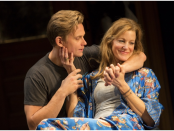
Poor Behavior
Katie Kreisler and Brian Avers in a scene from Poor Behavior (Photo credit: James Leynse) [more]
The Good and The True
Strands of barbed wire run across the stage and remain so throughout the performance. The stage is divided by a train track. The walls are bare brick. The lighting often shifts to varying shades of darkness. Luggage is strewn around. Smoke flows briefly at one point. Scenes are punctuated by the sound of Czechoslovakian singing. The actors wear basic black clothes. Director, scenic and costume designer Daniel Hrbek masterfully creates powerful images. Horrors are conveyed by imaginatively utilizing very simple elements. Mr. Hrbek also succeeds in staging and pacing the action arrestingly along with the actors. [more]
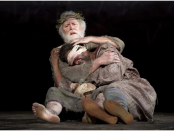
King Lear
While Sullivan does not seem to have turned his company into a coherent ensemble, the production is always easy to understand and unambiguous. The diction is always clear, though at times the sound design by Acme Sound Design seems to be at the wrong level. King Lear is a difficult play to bring off with its unrelieved outsized tragedy, and using actors not practiced in interpreting Shakespearean roles may not be the best casting. It is also possible that the production will achieve greater depth as the performers have more onstage time. This is a King Lear more than a little disappointing from such a talented group of theater artists. [more]
Sex with Strangers
The casting is superb. Gunn expresses Olivia's vulnerability and integrity with every line and moment of the play. Magnussen's Ethan, on the other hand, exudes arrogance and over-confidence having found easy success early in his life both with women and as a writer. it also takes perfect casting and acting to make such an evening both convincing and absorbing. This Gunn, Magnussen and Director David Schwimmer have accomplished in spades. Sex with Strangers is an evening not to be missed. [more]
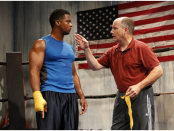
The Opponent
Guy Van Swearingen and Kamal Angelo Bolden in a scene from The Opponent (Photo credit: Carol [more]
Summer Shorts: Series B
Jack Hofsiss, the Tony Award-winning director of The Elephant Man, keeps the acting reined in while the dialogue becomes more and more blasphemous. Veteran actress Brenda Currin makes the discontented Mother Superior a believable character but the other four performers seem to be asked to posture rather than put any faith in their roles. [more]
Strictly Dishonorable
Travis Chinick's costumes are period perfect for the tail end of the Jazz Age while Liz Scherrier's two sets suitably set the mood for both the main room of the speakeasy and the bachelor apartment above. Beth Lake's sound design includes snatches of tenor arias as well as pertinent outside noises. [more]
Between Riverside and Crazy
This breakfast chat is in the opening of scene of Between Riverside and Crazy, by Stephen Adly Guirgis. In a series of plays that include Our Lady of 121st Street, Jesus Hopped the 'A' Train and The Motherf***er with the Hat, Mr. Guirgis
has become known for affectionately dramatizing the lives of passionate, off beat, New York City characters with inimitably colorful dialogue. [more]
Gertrude: The Cry
The PTP/NYC company are directed to carry on adeptly, fervently, with considerable aplomb in Mark Evanchos' monumental setting, amid some of the best and lavish costume changes – by Danielle Nieves --ever seen Off-Broadway, including Gertrude's, most of the time, that is. [more]
Summer Shorts 2014: Series A
Warren Leight's "Sec. 310, Row D, Seats 5 and 6" is the most ambitious of the three plays as it attempts to cover 20 years in the lives of three friends who share a two-seats subscription at Madison Square Garden for the Knicks games. "Riverbed" deals with the loss of a child by married couple Adam and Megan in a freak drowning accident. The theme of men's friendships when they are away from their women is also evident in the curtain raiser, Roger Hedden's "The Sky and The Limit." [more]
Pentecost
Director Cheryl Faraone knows that to keep the ideas going it is vital to have her characters be seen as human as possible so that we are not confronted with stereotypes and agit-prop, so that we become invested, begin to put our own values on the line. I particularly liked Jonathan Tindle, Alex Draper, Nina Silver, Lawrence Nathanson and Matthew Ball. A unique, priceless artifact, a creation of the finest in the human psyche, precious to the world, versus a gypsy baby, a gypsy mother, a Bosnian, a Kurd, a Palestinian Kuwaiti, an Azeri, a Mozambican, an Afghan, a Ukrainian, a Russian, how can we decide? [more]
Enter at Forest Lawn
Author Roberts plays Jack, the megalomaniacal producer/writer of a TV hit about a charming, witty, womanizing uncle who runs off the rails regularly. [more]
The Qualification of Douglas Evans
Presenting himself thus, in the character of Douglas Evans, with such vigorous, non-stop awfulness, takes courage as well as rampant ego and a chilling comment on his, the actor/playwright's own life, which might well have been written and delivered with an ironic god-awful humor and given the audience something to care about but Ahonen sticks to his guns. [more]
Picture Ourselves in Latvia
Playwright Ross Howard gives us a locked-ward play. Set in a psychiatric hospital, we meet three long-term residents, their orderly, a nurse, and a doctor. The patients' maladies are not specified. Mostly they seem merely simple, with mental ages of between roughly five and eleven, so it's not clear why they're in hospital rather than some sort of group home. Martin (Christopher Daftsios) in particular seems an innocent; Anna (Dana Benningfield), a recent emigrant from Latvia, is a bit paranoid; Duncan (Andy Nogasky) is intelligent but awkward like an early adolescent, and struggles with hydrophobia. [more]
The Religion Thing
The Religion Thing is set in Washington, D.C., and explores the lives of two couples who are friends and the conflicting issues they discover about their relationships after getting married. [more]
The Muscles in Our Toes
Whoever said high school reunions are a good time was sorely mistaken. The food is lousy, the music is kitschy, hairlines are higher, waists are larger, and ancient resentments are suddenly relevant again. When you think about it, these milestones are hardly cause for celebration. [more]
Donogoo
What the production does have is a ravishing scenic design made up of colorful and witty projections (sometimes animated) by Roger Hanna & Price Johnston for the play's 23 tableaux, moving from Paris to Marseilles, Saigon, San Francisco, Rio de Janeiro, & mythical Brazilian city of Donogoo-Tonka. [more]
When We Were Young and Unafraid
Yes, it's TV soap trap. Yes, it's really good movie. And yes, it's some of the best theater, because it's the purest entertainment, storytelling, the hardest and the easiest thing to do, all in one. People are endlessly fascinating. All you need is Sarah Treem to let you in. [more]
Ayckbourn Ensemble
Part of the fun of the Brits Off Broadway Festival at 59E59 Theaters each June are the new plays that Sir Alan Ayckbourn sends us periodically with the original casts from his Stephen Joseph Theatre, Scarborough, England. This year he has sent us three running in repertory – two new plays in their world premiere productions (Arrivals &Departures and Farcicals: A Double Bill of Frivolous Comedies) and a revival of his 1992 Time of My Life, making its New York debut. [more]
The Village Bike
A very visceral play, The Village Bike is not for prudes; on the other hand, it should open a conversation that is long overdue in our theater concerning men and women's sexuality as it is understood today. [more]
These Troubled Times
Director Jennifer Ortega does a masterful job of staging all of the comedy and seriousness as well as getting sharp performances from the cast. Concept designer Moira Shaughnessy's work includes the stark slides above the playing area that depict the lush Florida scenery as well as grisly situations. [more]
Much Ado About Nothing
While Jack O'Brien's production of Much Ado About Nothing is in no way definitive, it is tremendous fun. His strength here as a director is that his 20 person ensemble has become a true community, one that lives and loves together, one we can believe gets involved in each other's problems and joys. [more]