Hence: "My Life on a Diet," a comically rich stroll through her career in TV, theater and film. Written by Taylor and her late husband, Joseph Bologna and originally directed by Bologna, Diet is currently at the Theatre at St. Clement’s where a contagiously comfortable Taylor, elegantly attired (gown by Pol’ Atteu) settles down in Harry Feiner’s kitschy, carpeted set to schmooze with her audience. Taylor, now in her eighties, begins with some self-deprecating humor about aging, after showing herself at various stages in her life. [more]
Three actors—Yelena Shmulenson, Allen Lewis Rickman (Velvel in the Coen Brothers’ “A Serious Man”) and Shane Baker (“the best-loved Episcopalian on the Yiddish stage today”)—manage the feat of bringing five of Aleichem’s stories—adapted and translated by Baker and Rickman—to life under Rickman’s incisive and warm direction. Sourcing the original, nitty-gritty shtetl-soaked tales, makes "Tevye Served Raw," if possible, more passionate and involving than the musical. [more]
Built in 1904, Dreamland was considered the most elegant and ambitious of Coney Island’s amusement parks--until it burnt to a crisp in 1911. A new play by Rinne Groff, "Fire in Dreamland" is ostensibly about the disaster, in which no humans but most of the animals perished. But to add that it’s set a little more than a century later--in 2013, or some months after Super Storm Sandy wreaked havoc on the east coast--should begin to suggest that there’s more going on here than, unfortunately, ever meets the eye. [more]
A central concern of the play is detailing Wellington’s five love interests: a white guy he meets at a hilarious Brooklyn vegan party, an Indian young man, an 18-year-old Muslim food cart vendor, his older married agent and the drug dealer he’s known since his California days. Well into the show there’s a rapid bit where each of them enter as Wellington imparts factoids about them and it’s a neat theatrical device that swiftly informs us of the pertinent details. However, previously we’ve spent a lot of time repetitiously going back and forth between these figures. This thread’s deficiency is compounded by the play’s incessant non-linear structure as we get the same basic information over and over in a different order. [more]
But when things slow down a bit, especially during the musical interludes and longer dramatic pieces, Petosa’s eight performers -- four lead (Christine Hamel; Jake Murphy; Harrison Bryan; and Carla Martinez) and four supporting (Miguel Castillo; Sebastian LaPointe; Olivia Christie; and Ashley Michelle) -- are an absolute wonder, gracefully tackling a head-spinning array of difficult subjects, including xenophobia, social inequality, and infanticide. And thanks to Hallie Zieselman’s bare set, Annie Ulrich’s modest costumes, and Joe Cabrera’s vibrant lighting, they accomplish it all in a decidedly Brechtian way. [more]
If "The After-Dinner Joke"’s 66 scenes seem cinematic, that is due to the fact that it originally was a teleplay commissioned by BBC for the series "Plays for Today" examining public issues. Churchill chose to deal with the politics of charitable institutions. Selby, personal secretary to the sales manager, decides that she gets no fulfillment from her work and tells her boss Mr. Price that she is resigning to be a do-gooder. Price offers her a job at the same salary working as a campaign organizer raising funds in towns throughout Britain for one of the charities that he has founded. [more]
Its maddening structure, extraneous scenes and superfluous characters diminish but do not totally obliterate the potency of playwright Jerry Small’s romantic drama, "Before We’re Gone." What could have been a focused and poignant work in the manner of William Gibson’s duologue "Two for the Seesaw" is instead an erratic jumble. [more]
n what easily could have become a one-man show, playwright Strand has cleverly created dramatic tension by first introducing us to a second character and later a third. Set during the 2012-2013 term of the Supreme Court, the play begins with a lecture by Scalia to a law class where he explains his philosophy of being an “originalist,” that is, someone who interprets the Constitution as it was originally written and understood by its drafters in 1789. This presupposes that it is not a living document that should reflect each era, but something carved in stone which does not change but may need interpretation. [more]
As the sleek and black-clad Tanya Marquardt vigorously wraps up her self-written 60-minute autobiographical show "Stray," with her giddy dancing and hurling her ponytail around, the aimless first half has been redeemed by the more cohesive second half. It’s been like traveling back in time to Club 57, The Pyramid Club or another of the East Village performance venues of the 1980’s. [more]
Mr. Gray infuses his straightforward 70-minute interview treatment with tension, suspense and drama. A third character, Norm Hansen is a 60-year-old straight married board member of Pendarvis who is a close friend of Hellum’s. He provides skillful exposition and while present at the discussion stuffily keeps trying to steer it away from personal disclosures. The dialogue is smooth, efficient and dotted with references to figures of that time such as Frank Lloyd Wright, Syrie Maugham and Duncan Hines. [more]
The cast list in the program reads more like a medieval phone-directory--even if there were no phones in the Middle Ages--than it does a dramatis personae. And then there’s what happens to the characters during the course of the play which is as hard to say as it is to remember all of their names, let alone pronounce them. [more]
After establishing himself as one of our finest playwrights with such works as "Killer Joe" and "August: Osage County," Tracy Letts seems to have somewhat lost his way with his more recent "Mary Page Marlowe." Now playing at the Second Stage Theater in New York, "Mary Page Marlowe" premiered at Chicago’s Steppenwolf Theater two years ago. With six different actresses representing the title character at many different times in her life, it essentially relates a single, long life span, in only 90 long minutes. [more]
Structured as a series of confessional vignettes, Innit begins in the school psychologist’s office and alternates between there and Kelly’s home. Her 34-year-old mother works at a sandwich shop and is a part-time prostitute. Her absent ne'er-do-well father abandoned the family and went back to his native Ireland some time ago. Money is tight and so is hope. Kelly is combative and doesn’t really have friends. She gets free cigarettes for allowing boys in gym class to take manual liberties with her. The dialogue is earthy, conveying a youthful sensibility with “dick head” being a favored exclamation. [more]
Though designed as an agitprop exploration with one woman as “Bad” and the other as “Good,” Ms. Brennan's simple yet effective writing elevates it into a quietly powerful work. The dialogue is a skillful blend of mundane details, biographical data and expressions of world views that all strongly delineate the characters. The structure is essentially two women in their 30’s in a room talking. Brennan’s command of plotting injects suspense, surprises and momentum, all combined with emotional resonance. [more]
Filloux in collaboration with director Amy S. Green have distilled the raw data they gathered into a searing and poignant narrative containing absurdist flourishes that include a talking laboratory mouse. The play is structured as a series of short pungent scenes. Filloux’s dialogue poetically conveys the harsh realities the underprivileged face and their bleak worldview. [more]
Add to this list Mike Lew’s new witty and clever "Teenage Dick" (being given its world premiere by Ma-Yi Theater Company in association with the Public Theater), both an update and a parody of Richard III now set in Roseland High School. However, while most of these other adaptations just want to demonstrate the contemporary relevance of Shakespeare’s Elizabethan stories, "Teenage Dick" has an additional agenda: does society’s bullying lead to defining the personalities of those with disabilities? [more]
"Husband" is also receiving a sublime production this summer at the Stratford Theatre Festival in Ontario, Canada, featuring a bubbly Brad Hodder as the “good-for-nothing” Lord Goring, who “leads such an idle life” and often serves as Wilde’s spokesman. There is also a haughty Bahareh Yaraghi as the shrewd Mrs. Laura Cheveley (who knows “such pleasant scandals about all her friends,” while creating some of her own), a no-nonsense Joseph Ziegler as the Earl of Caversham, Tim Campbell as Sir Robert Chiltern and Sophia Walker as his wife, Lady Gertrude. Though she has the lesser role of Lady Markby, Marion Adler also shines whenever she’s on stage. [more]
Sixtyish Eric Miller is an angry white man, hating Catholics, Blacks, homosexuals, women, and other groups. He has also become very nationalistic. He not only wants to tell the world, he thinks he should act on it. Middle America in the age of Trump? Actually, the same problem appears to be happening in Northern Ireland according to David Ireland’s dark play, "Cyprus Avenue," having its American premiere at the Public Theater courtesy of a co-production by The Abbey Theatre (Dublin) and Royal Court Theatre (London). Problem is for all the sound and fury, Cyprus Avenue, which is a brilliant character study, outlives its welcome long before it is over in this 100 minute play. [more]
Mr. Kahn’s dialogue is a witty amalgam of up to the minute lingo, well-observed lifestyle data, psychological insights and emotional depth that all realistically and artfully conveys the characters’ Millennial sensibility. Allusions to "Friends" and "Sex in the City" abound, apps are analyzed, real estate is obsessed over and salaries are disclosed. The passage of time is connoted by Claire’s birthdays that flow from one to the next. [more]
Using a tremendously talented and versatile cast of nine actors (three black male actors, three black female actors, as well as three white performers) playing from three roles to 12, the story of the year these heroic teenagers spent integrating the previously segregated high school becomes high drama. Rasean Davonte Johnson’s unit setting with its banks of stairs makes copious use of Wendall K. Harrington’s projection design for the many locations in the city of Little Rock, inside and outside of the school and the homes of the participants, as well as historical footage of the events and the people. "Little Rock" also includes snatches of 14 songs, some sung as choruses and others as solos including “Eyes on the Prize” and “We Shall Overcome,” which add a human dimension to the often startling events depicted. [more]
With Miles Malleson’s 1925 "Conflict," being given its New York premiere, the Mint has uncovered a brilliant political and social drama which has tremendous relevance for today with its dissection of conservative and liberal points of view. It resembles Shaw and Tom Stoppard in its debate of ideas and Galsworthy and Arthur Miller in its moral integrity. Superbly directed by Jenn Thompson ("Women Without Men") with a crackerjack cast, this is not only one of the Mint’s best offerings, it is also the most satisfying play in town. Framed as both a thriller and a romantic comedy, Conflict is absorbing and exciting theater throughout, the sort of play that has you hanging on every word to see which way it will go. [more]
Harmon’s new play resembles "Admissions," his last New York offering seen at Lincoln Center this March, in that it debates a topic from many sides but then fails to give us the author’s point of view on it at the end. Like all of his four plays so far it offers a strong character who has a very big gripe with the way things are and who attempts to change people accordingly. And like the others, "Skintight" is very funny while it deals with a serious topic but ultimately seems rather superficial, though here that maybe because of the extremely wealthy milieu in which money is no object and things magically appear via live-in servants. As is Harmon’s wont, the acerbic repartee is tossed about plentifully and as directed by Daniel Aukin, the six actors get the most out of their snappy lines. [more]
For 85 minutes, we get a take on the gay male experience that includes a randy Midwestern adolescence, waitering and escorting in Manhattan, crystal meth and recovery. The writing is well-constructed, contains flavorful descriptive passages and is forceful. The personable Mr. Strothmann delivers his monologue in a charming manner that realizes its dramatic and comedic qualities while taking his shirt off and dropping his pants along the way. [more]
Jackie Sibblies Drury is a unique new voice in the American theater. Her use of metatheater is all her own. "Fairview" has a great deal to say about race in America and the angle you see things from and she is able to cleverly shift it from scene to scene. However, this new play is a bit too long for its content, with scenes overstaying their welcome. Nevertheless, Drury is a playwright well worth watching. [more]
With her honeyed and smoky Texan vocal inflections, wearing a short-haired lustrous brown wig and costume designer Rhonda Key’s gleaming trim white suit, actress Lisa Hodsoll is phenomenal as former First Lady Laura Bush in author Ian Allen’s kaleidoscopic solo play, "Laura Bush Killed a Guy." For 95 mesmerizing minutes, Ms. Hodsoll gives a smashing performance that transcends mere impersonation or campy replication. Looking and sounding like Mrs. Bush, with her twinkling eyes and beaming presence, Hodsoll’s characterization is a dazzling amalgam of comedy, emotion and depth. An only child, she and her parents went on a mission... [more]
Harrison’s dialogue is well-crafted and often in setup punchline mode peppered with plentiful pop culture references that falls flat. The overall effect is of a rote accumulation of touchstones appealing to this strata. It’s all without resonance unless one is like the characters being depicted. It’s certainly possible to dramatize the concerns of differing classes with cross-sectional interest but that is not the case in "Log Cabin." This title is most likely a play on Log Cabin Republicans who are gay and might reflect that some of the characters are actually more Conservative then they let on. [more]
Although the advance publicity for Ben Josephson’s "The Property" refers to it as a comedy, there is nothing funny about it, neither jokes nor comic situations. In fact, the heroine’s desperate need for security ends up destroying five people. The themes are relevant in an era when people are downsized after many years of work and have trouble paying their mortgages but the stilted artificial dialogue and the melodramatic events damage the serious issues at stake. While veteran director Robert Kalfin has staged the play as though it were a drawing room comedy, its content presupposed that it is a tragedy on the lines of such better plays as George Kelley’s Pulitzer Prize winning "Craig’s Wife" and William Inge’s "The Dark at the Top of the Stairs." [more]
The audience is frequently called upon to participate onstage and from their seats with one elaborate portion involving their driver’s licenses. London vacation photos of Mr. Beckman, a guard at Buckingham Palace, and Queen Elizabeth II becomes a hilarious and mystifying routine. Plastic bottles are fodder for visual conjuring. While blindfolded Beckman guesses things that audience members have selected. A Van Gogh-inspired painting exercise is performed to the booming sound of Beethoven. Less successful is a large-scale, convoluted and confusing card trick. [more]
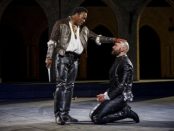
In the recent Metropolitan Opera production of Verdi’s "Otello," Otello was white which left no reason for his jealousy if he was identical to all the Venetians around him. In the current Shakespeare in the Park production, using color blind casting, Santiago-Hudson chooses to make at least five of the leading characters people of color so that Othello is no longer an outsider, nor are they. The meaning of the theme is diluted in such a reading. It may be politically correct, but in this play about race there is no getting away from its original meaning. Even The Public Theater’s artistic director Oskar Eustis’ program notes remark that Othello is only one of two explicitly black characters in all of Shakespeare, the other appearing in "Titus Andronicus." Other than this casting choice, the production offers no new interpretation of the play or characters, making it more like a staged reading than a full production. [more]
Director Lucy Gram uses six actors to play 11 roles which has worked for such companies as Bedlam and Fiasco. However, here the four actresses play both men and women, three of them never change their costume, voice or look when they return as their other characters so it is very difficult to keep the roles straight. Aleca Piper playing the roles of Calianax (an elderly man), Lysippus (a younger man) and Dula, a lady-in-waiting, first takes off her white sweater, then puts up her hair, but if you are not following this very carefully, the changes are lost on you. Her use of a loud, booming voice does not help in differentiating her roles or in understanding her lines. Erin Roché and (Ms.) Sydney Battle play men and women alternately with no changes of any kind. [more]
Noam Chomsky, Karl Marx, Ayn Rand, Elon Musk, Steve Jobs and a “Tiny” Trump all on stage at the same time, verbally jousting with each other? Pedro Reyes’ "Manufacturing Mischief" at the Tank does, indeed, throw these historic figures together in a play that is intellectually stimulating and quite witty as these giants tear each other apart. [more]
Both Kevin and Cara are single parents, which is only the beginning of the many parallels and contrasts at the heart of "Dan Cody’s Yacht." Though it might come to seem overly formulaic, both the play and the production are good enough to rise above such a criticism. If Cara lives in the middle-income, fictional town of Patchett, and Kevin in the upscale, fictional town of Stillwell--“both towns in the far outer ring of suburbs around Boston,” as we’re told in a program note--she also teaches in Stillwell. [more]
The chance to see Anton Chekhov’s first produced play, "Ivanov," not only in the original Russian (with English surtitles) but in modern dress proves to be a revelation. Staged by Russia’s State Theatre of Nations and as presented by the Cherry Orchard Festival, this is a rare opportunity to see this usually neglected Chekhov classic, seen in New York in English on only three occasions since it was first written: 1966 on Broadway with Sir John Gielgud, 1998 at Lincoln Center with Kevin Kline, and in 2012 at the Classic Stage Company with Ethan Hawke. Like the recent Australian version of Chekhov’s first written play, "Platonov" (renamed "The Present" in Andrew Upton’s update), Timofey Kulyabin’s production is not only in modern dress but updated to a drama set in our time. [more]
“This is the world of Magritte,” and indeed it is. The play opens with a young woman silently appearing and wearing a flowing white gown, a derby with a flower and a pipe. This takes place on scenic designer Edward Pierce’s gorgeous oval-shaped surrealist-themed set with sky blue walls, clouds, green grass and a large painted tree. There’s also a door, shutters and off to the sides are a piano and a microphone. All of these elements cleverly assist in fulfilling the stage direction of “We are indoors and out at the same time.” For a barbecue, a grill is wheeled out with a sign in French that says, “This is a barbeque.” [more]
Part of 59E59’s Brits Off-Broadway 2018 festival, Jessica Walker’s "All I Want is One Night" takes place in an odd combination of cabaret and antique shop. Theater B in the 59E59 Theaters complex has been done over as an intimate café with moody lighting by Kate Ashton and extraordinary period perfect costumes (uncredited). It is 1980 in Haut de Cagnes and Suzy Solidor (Walker) in her dotage is about to be painted by Lindstrom (Alexandra Mathie who plays multiple characters in Solidor’s life quite convincingly) and is being cared for by a much younger lady, Giselle (Rachel Austin who also plays Daisy, later in the play). [more]
Christopher McLinden as David and Patrick J. Ssenjovu as God’s Blessing are both personable but the material inspires their overwrought characterizations to be overwrought. Musician Farai Malianga and vocalist Sifiso Mabena are in the background smoothly providing aural atmosphere. [more]
Though A.R. Gurney chose a familiar definition of the theater as the title for his 1992 play, "The Fourth Wall" ultimately proves less about the theater than about its four characters. And although these four characters are straightforward enough as written by Gurney, director Christopher Burris does not help his cast to locate them in any way, shape or form, in the current Theater Breaking Through Barriers production. [more]
Her newest work, "Fruit Trilogy," an evening of three one acts, “Pomegranate,” “Avocado” and “Coconut,” has all of the strengths and weaknesses of her previous stage plays which include going on at too great length when the audience has already gotten the point. Directed by Mark Rosenblatt who staged the world premiere at the United Kingdom’s West Yorkshire Playhouse, the play features Kiersey Clemons and Liz Mikel who are frightening in their intensity and realism. Although the three settings are unstated, the fact that both actresses are black suggests that the plays may have been inspired by Ensler’s humanitarian work in Africa. Although it will not be immediately obvious to theatergoers, the plays move from two women enslaved, to a woman traveling to freedom, to finally a woman finding liberation through her own body. [more]
“What a dump” is the immortal opening line of Edward Albee’s dramatic masterpiece, "Who's Afraid of Virginia Woolf?". In the inane spoof "Everyone’s Fine with Virginia Woolf," it’s spoken by George instead of Martha while he is brightly lit and standing in a doorway. This instantly signifies to those who are familiar with the original work that we’re in for an irreverent ride. However, the promise of a wry send-up very quickly descends into pretentious pointlessness. [more]
Though it wouldn’t be fair to reveal it here for audiences about to see the play, the “secret” actually turns out to be one that has been widely known for some time as it is all over the Internet. The play’s assertion that Bronowski died immediately after his November 1973 television appearance is inaccurate as he died the following summer while visiting friends on Long Island. Nor is there evidence that there was ever a locked room. As Bronowski had four daughters, it is unlikely that one of them was a grandson named “Jamie Bronowski.” The frequent use of technology in the play like having actors walk on the wall as if traversing photographs has been done much more effectively by Cirque du Soleil and others. The quality of the black and white video clips leaves much to be desired. [more]
Blonde, of ample physique, and possessed of an appealing matter of fact vocal delivery that soars with range, Mollenkamp has an engaging everywoman persona. She veers from dry humor to raw emotion with flair. Costume designer Victoria Depew’s striking all-white ensemble with black fringed accents endow Mollenkamp with a spiritual glow. [more]
In the African-American Abigail, Ms. Quintana creates a complex protagonist who is sympathetic, exasperating and engaging. She is fascinated by the journalist Lorena Hickok who had a storied closeness with Eleanor Roosevelt and they appear in the play as figments of Abigail’s imagination as does former Pope Benedict. These fanciful interludes are skillfully woven into the central narrative that focuses on the conflicts of being gay in the contemporary United States with the actions taking place during the school year of 2017 - 2018. [more]
"Life Among the Aryans" is the latest work from Ishmael Reed, the American poet, novelist, essayist, and Pulitzer-Prize nominee. Directed by Rome Neal, the play’s thematic nexus lies in disillusionment and exploitation. Two white nationalists, John Shaw (Frank Martin) and Michael Mulvaney (Tom Angelo), see an America that has left the ‘white working-class’ behind in favor of appeasing the rest of society. These developments are the embodiment of their discontent, and they yearn for a return to the America of old; they want to make America great again. [more]
Unfortunately, O'Reilly’s heavy reliance on the production team is also indicative of a significant problem: the play is repetitive. Despite finding new, and often lovely, poetic ways to convey the centrality of death to life, Carr’s thoughts and arguments quickly begin to sound like the same melody over and over again, just in a different key. O’Reilly tries to distract us from this fault by giving the Gottlieb-Rumery-Corcoran trio creative free rein; the deathbed, for example, frequently looks like it’s floating somewhere in the cosmos. But the images invariably keep giving way to the words, which, though beautiful, grow tiresome by the second act. [more]
Playwright Lizzie Stern has an ear for contemporary discourse and her dialogue is well-crafted. The characters are appealing and are finely detailed. The universal focus is on the relationships of the young women, their youthful idealism and their conflicts with their mothers. Structurally inspired, there are phone calls to the mothers, voice overs and confessional asides. Ms. Stern has a good grasp of the theatrical but her plotting is faulty. [more]
The letters alternate with the musical portions played by Ji on piano, Ari Evan on cello and Stephanie Zyzak on violin in various combinations which are beautiful but it is never clear in what way the selections relate to Madame von Meck except for the Piano Trio in A minor, op. 50, which Tchaikovsky reveals at the beginning of the second act that he is writing for her. It is not stated whether the two excerpts from The Nutcracker, for violin and piano, and for solo piano were created for her. [more]
The current staging of "Our Lady" at The Pershing Square Signature Center, directed by Phylicia Rashad, magically now comes across as an addled, profane sitcom. It’s entertaining and at times moving, but the real magic is that the very same words can be tended by a solid director—this one obviously experienced in sitcoms—and refresh a theatrical experience so completely. Rashad has shown that scathing can be scathingly funny. This time I left laughing. [more]
Mr. Cruz realizes his scenario with his patented style. There’s rueful humor, Chekhovian reveries and a sense of the mystical all with a demonstrative Latin sensibility. The dialogue is filled with passionate eloquence and is made even more pleasurable by experiencing it in Spanish. Some sequences have characters reciting their letters which allows for reflective ruminations. The play takes place in the contemporary United States with several of its figures having been born in other countries. [more]
Director Shira-Lee Shalit provides breakneck pacing, swift scene transitions and compelling stage compositions that include the presence of the violinist. The visual and the verbal are in enthralling unison as Ms. Shalit achieves momentum, raucousness and sensitivity with her vigorous staging. A fully clothed sex scene is powerfully erotic as it visualizes the dynamics of the charatcers. Shalit masterfully guides the cast’s volcanic performances. [more]
Packed into Theodora Skipitares’ "There’s Blood at the Wedding" are multiple takes on how authorities have abused their powers, too often killing innocent people. By theatricalizing and stylizing their stories, Skipitares zooms past the political and digs deeply into the emotional debris left over after a series of brilliantly staged traumatic scenes. [more]
We learn a great deal about hospice, possibly more than one might want to know in a play. While most death watch plays like Edward Albee’s "All Over" and Scott McPherson's "Marvin’s Room," take place in another room from where the elderly person is dying, Mary Frances alternates between the downstairs living room/dining room and the upstairs bedroom of her split-level house. Unfortunately, this 21-scened play with at least a dozen more scenes which switch between Mary Frances’ bedroom and the living room where the rest of the family eat or watch television requires endless jump cuts like a film and endless lighting cues from designer Tyler Micoleau. [more]
Bit and Otto recall tomboy Frankie Addams and Berenice the maid from Carson McCullers’ "The Member of the Wedding" while Pigman and Missy parallel Pozzo and Lucky from Samuel Beckett’s "Waiting for Godot." There’s an arctic sequence out of Tony Kushner’s "Angels in America." The dialogue contains a lot of contemporary academic jargon and it all could be interpreted as some sort of Millennial exploration. [more]
In many ways Dominique Morisseau’s "Paradise Blue" shares similarities with August Wilson’s brilliant, if long-winded, Pittsburgh based plays. "Blue" is part of Morisseau’s Detroit Project, a three-play cycle that takes place in three different eras. Blue, developed with the aid of the Williamstown Theatre Festival, the Public Theater and the McCarter Theatre is a snapshot of desperate people occupying a part of Detroit on the verge of vast changes—read gentrification. [more]
While director David Mercatali has them continually circling each other like boxers in a ring--sparring emotionally, if not physically--Sophie and Tom never really connect or even touch each other, except late in the play when they hold each other’s hand for but a moment. Though they remain somewhat aloof and distant from each other no less than from us, they are given vivid life by the actors who portray them: Lisa Diveney as Sophie and Paul Rattray as Tom. [more]
Played as older than either Viola or Sebastian, Elizabeth Heflin is charmingly eccentric as the strong cougar who becomes lovesick and yielding at the sight of Cesario and then Sebastian. In the role of the melancholy Duke Orsino who is often played as dull and sluggish, tall handsome Matthew Greer is both dashing and athletic, seen both coming from hunting and athletics. Surprisingly Susanna Stahlmann as Viola/Cesario is very bland and colorless, but this may be intentional: it allows the other characters to read into her/him what they wish. As her twin brother Sebastian made up to look like her mirror image, John Skelley is both avid and keen, willing to go along with a seeming jest though he does not know where it will take him. [more]
Unlike many of the recent New York stagings, Eyre’s production makes it clear that the thrust of this four act play is an attempt for the Tyrones to exorcise their demons in one alcoholic infused night. Before it is over, each and every character will have bared his or her soul in one night of regret, guilt, despair and anger. So much gets revealed, there does not seem to be anything left unsaid by the final devastating curtain. He also has staged the first two acts (before the one intermission) with the characters talking so fast that it as if they do not want to have to stop and notice what they are running away from. Although Rob Howell’s bright and airy set (at least until night falls and the darkness creeps in) seems huge, all of the characters seemed to be caged animals pacing back and forth in forced confinement. [more]
Conceived by Carrie Heitman and written by Cynthia Babak it was developed in workshops over the last three years by the Hook & Eye Theater company. According to Chad Lindsey’s director’s note, “I wanted to let the performers create characters and situations that answered some of our creative questions and satisfied their curiosity about themselves and the historical women at the play’s core. What emerged is best described as a rhapsody….” [more]
In the spirit of the loquacious Winnie in Samuel Beckett’s "Happy Days," the animated Yuki Kawahisa beautifully portrays Honoka with sunny depth. Maho Honda as Arisa, the play’s unifying figure, is brilliantly wistful. Veering from low key to emotionally volatile Kensaku Shinohara richly conveys Kazuki’s angst and anguish. This trio’s rapport and chemistry is palpable and is integral to the production’s success. [more]
Hodges’ play is quite lively with each scene dramatizing one point and the cast of characters made up entirely of real people, not all of them still famous. The real problem is with the unsubtle and one-dimensional acting of the mostly deficient cast. The play also assumes that the audience is familiar with a great many Elizabethan names and personages like poet Michael Drayton and courtier and literary patron Sir Thomas Walsingham. "Marlowe’s Fate" dramatizes the “last nights” of both first Marlowe and then Shakespeare 23 years later, plus a spirited "Punch and Judy" interlude between Marlowe and Shakespeare for credit to the plays published under Shakespeare’s name. [more]