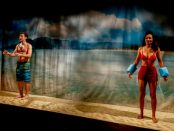
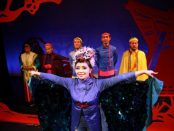
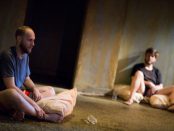
Translator Shane Baker has found excellent Yiddish equivalents for Beckett’s language. He understands that Yiddish is a minor key tongue full of sadness, quicksilver tone changes, perfect for expressing the constant complaints that fill the libretto of Godot. Of course, it is Beckett’s language that passes the time with its casually tossed off deep observations of the human condition in the guise of flippant or quasi-philosophical comments. [more]
Mr. Brader is an engaging and soulful performer with a smooth and pleasing vocal delivery. Brader is an admirer of Spalding Gray and channels that monumental artist’s impassioned sense of storytelling. As a writer, he offers a vividly candid but somewhat flawed treatment of his explosive autobiographical material. Arguably a tauter and more focused scenario would flow more effectively. Still, Spitting in the Face of the Devil ultimately achieves redemptive impact. [more]
Employing humor, documentary detail and suspense, Bachner offers an emotional detective story. Wit and whimsy meld with poignancy as the picaresque quest begins in present day New York City. It involves a gallery of characters, flashbacks. and often frustrating twists and turns, several of which are legal obstacles that impede such searches. Bureaucrats, a celebrated “adoption hunter,” the adopted parents and other key figures are all imaginatively incorporated into the narrative. Bridgforth is vocally and physically titanic as she switches back and forth between being Susan and playing the other characters with grandly distinctive characterizations. [more]
Nothing is what it seems in Jeremy 0. Harris’ startling and explosive "Slave Play" which investigates where race and sexual relationships intersect. What we have been watching in the play’s opening scenes is role playing on Day Four for Antebellum Sexual Performance Therapy, “designed to help black partners re-engage intimately with white partners from whom they no longer receive sexual pleasure.” These three couples have chosen to spend a week in this new treatment in order to deal with their "anhedonia" or inability to feel pleasure which has been a problem for them for some time. [more]
In the course of this unusual performance piece, the actor and the audience learn a bit of Farsi, the author’s native language, and actor and author share stories of their lives and likes, and become friends. There is audience participation and volunteers are called for. The playwright eventually joins the actor on stage but remains silent, communicating by pointing to the script which is projected so that the audience can see the author’s questions and instructions to the actor. The play is a series of exercises, games and tests. [more]
Some novels are more stage-worthy than others, and "C.S. Lewis’ The Screwtape Letters" is not among those that are. As adapted for the stage by Max McLean--who also directs the production with a flair for the grotesque--and Jeffrey Fiske, "C.S. Lewis’ The Screwtape Letters" is an unfortunate jumble of gibberish and gobbledygook, told at breakneck speed by Brent Harris, who is playing His Abysmal Sublimity Screwtape. [more]
Director Ivo Van Hove’s stage version of the Paddy Chayefsky cult film "Network" gives Bryan Cranston the role of a lifetime as Howard Beale, the UBS news commentator who has a nervous breakdown on air and then becomes a media messiah. The high tech production designed by long-time van Hove associate Jan Versweyveld with video design by Tal Yarden is riveting throughout its two hour intermission-less running time by putting the audience in the news studio and making us complicit in the action. [more]
A hard-edged picaresque fable is what playwright Lynn Nottage came up with in her enjoyable, "Fabulation, or The Re-Education of Undine" that premiered in 2004. A two-time Pulitzer-Prize winner for Drama, Ms. Nottage is in a lighter mood here but her comic sequences have a bracing tone and the dialogue has her customary skillful depth. We’re in the exaggerated territory of "Watermelon Man" and "Bonfire of the Vanities." [more]
That it involves the relatively new phenomenon of gay parenthood gives it an added impact. That it is written with a thorough understanding of the complexities of gay parenthood vs. conservatives-in-liberal-clothing keeps it constantly edgy. And, that it has a relatively positive ending makes it a valuable addition to this literature in a season when Michael McKeever’s popular "Daniel’s Husband" excited interest in a storyline also involving gay marriage, one with a decidedly dire conclusion. [more]
Though it was common practice centuries ago, perhaps the final take-away from "Bitter Greens"--a new play by Clea DeCrane--is that an actor should not perform in her own work. In the play, DeCrane portrays Reyna, a character that is both confused and confusing. She’s also more than a little aloof. When Reyna announces that she’s going “to go on a cleanse,” another character, Caitlin (Jessica Darrow), asks her, “A cleanse from what, vegan bites and vitamin water?” [more]
Mr. Goode’s structure is creatively simple, the eight reindeers offer their foul-mouthed sometimes conflicting testimony one by one. Rudolph is unable to appear as he is confined to a padded cell in a catatonic state. Goode’s writing is unabashedly crude, staunchly politically incorrect and often very funny. The play premiered in Chicago in 1994 and this production has assembled a terrific group of actors who each bring their distinctive comic skills to these goofy roles. [more]
Gradually, as the course of a year passes, we learn about the characters’ trouble-filled off-stage lives: Rory is coping with being part of a broken family; Bernard suffered loss early in life, and his wife now has medical issues. The growing friendship between the two opposites is obviously meant to create an occasion for epiphany. Too obviously. The drama in the characters’ contrasting lives plays out with boilerplate predictability. It’s all just a little too pat. [more]
This nonsensical, broad comedy is penned by the clever Greg Kotis ("Urinetown"). Songs and arrangements by Steven Gross are whimsical and entertaining, and costume designer Whitney Locher presents her vaudevillian best in this frothy piece. Led expertly by director Ilana Becker, the cast bludgeons, connives and wiggles their way through this slice of holiday slapstick; young and old, the actors’ comic timing is well-honed and the fun they have performing this piece is entirely infectious. [more]
In 90 minutes, Ms. Raffo packs in a great deal. We learn about Iraq’s past and present, religious lore, marital conflicts, unrequited love and the hardships of immigrants. The stiff treatment is schematic rather than polished and the resorting to soliloquies feels off. Without a defined plot, it plays out as a limp multi-character study that’s resolved with a talky and unconvincing denouement. Raffo does create appealing characters including the substantive title role which she herself plays. [more]
“Why did I marry such an idiot?!” exclaims Deanna about her goofy husband Keaton. Not only is he an inept drug dealer but he has also kidnapped a seal who is presently in human form and her vengeful relatives are now on the warpath. These are the outlandish plot points of playwright Krista Knight's charming "Selkie" where mirth merges with darkness. [more]
Tom Stoppard, our most cerebral modern playwright, has finally written a play that one would have expected from him all along. "The Hard Problem," his first play in ten years, is literally about concepts in neuroscience and its characters are psychologists, scientists and mathematicians all studying the brain. While the story and its outcome are intriguing, like many Stoppard plays, the characters are not likeable and you will find yourself not rooting for anyone. (Most likely, many real scientists aren’t lovable people either.) Jack O’Brien, who has previously directed Stoppard’s "The Coast of Utopia," "The Invention of Love," and "Hapgood," all for Lincoln Center Theater, has chosen his LCT cast without household names just as did the original London production in 2015 by Nicholas Hytner for Britain’s National Theatre. [more]
"Quicksand," Nella Larsen’s 1928 award-winning first novel, has been given an ambitious, epical stage adaptation by Everyday Inferno Theatre Company working out of the IRT Theater. While Regina Robbins’ script for this Harlem Renaissance literary work basically is an assigning of the text of the novel to a company of 13 actors, it is the work of director Anaïs Koivisto who makes this swirling production feel adventurous in creating both a community and a specific world. EITC’s mission statement is to create “adventurous theatrical productions of new or rarely produced texts that tell women's stories in a unique, entertaining, and accessible manner,” and this lives up to its goal. [more]
Overbearing nuns, eccentric priests and confusing religious tenets are detailed with stand-up comedy gusto by performer Martin Moran in recounting his Colorado Catholic upbringing during his absorbing self-written confessional solo play,"The Tricky Part." Following that familiar list of targets and lively audience interaction, the main thread of the show is disclosed. [more]
Although Chua is less interested in beauty for beauty's sake than Andersen, the look and sound of "The Emperor's Nightingale" is still stunning, drawing on a wealth of traditional Chinese art forms to both enliven and culturally ground the story. Leading the way are Joseph Wolfslau's period-inspired score and You-Shin Chen's eye-popping set, which pays lovely tribute to the art of Chinese paper cutting. Leslie Smith's lighting design nicely highlights all of the wonderful colors in Chen's set, as well as those found in Karen Boyer's lambent costumes, which do imaginative justice to human and animal alike. [more]
In a time of fake news, these timely and topical questions are raised in the delightful new Broadway play "The Lifespan of a Fact," a dramatization by Jeremy Kareken & David Murrell and Gordon Farrell of the essay/book by writer John D’Agata and fact checker Jim Fingal, both who appear as two of the three characters in this play. Stars of stage and screen Daniel Radcliffe, Cherry Jones and Bobby Cannavale are having a field day in this amusing and provocative romp in roles that they have played before and are not too taxing but are played by them to the hilt. The fact that this is based on a true story adds to the piquancy of the play – although to be absolutely truthful the original editing job took seven years while only five days go by in the play. [more]
Rattlestick Playwrights Theater is presenting a theatrical event by Idaho theater poet Samuel D. Hunter ("The Whale," "A Bright New Boise," "The Few," "Pocatello," "The Healing," "The Harvest"): a long one-act masterpiece (Clarkston), a 40-minute communal dinner served on picnic tables of what the characters would be eating and a curtain raiser, "Lewiston," which has the same themes and symbols as the later play. Taken as a whole this is a remarkable achievement, probably the best Hunter has created so far. Director David McCallum must be given some of the credit for this magnificent evening, and in particular actor Edmund Donovan who isn’t so much performing as living his character of Chris in "Clarkston." [more]
Visually impressive due to the inventive work of scenic designer Donald Eastman and director Arthur Adair’s fine staging, "Chasing the New White Whale" is playwright Mike Gorman’s muddled attempt at an epic drama of drug addiction in the contemporary United States. Herman Melville’s classic 1851 novel "Moby-Dick" is metaphorically employed and heavy-handed references and motifs abound. [more]
"Life X 3" was first seen in 2003 at the Circle in the Square. This revival is tauter and funnier. Perhaps this smaller venue refracts the play in a different way, but these four actors are more convincingly real, not to mention greater pains in the butt. As the title implies, they get three chances to reveal—and revel in—their egos and idiosyncrasies, each succeeding part bringing out both nuances and bombshells. [more]
The attempt to draw comparisons between two disparate one-act plays by Brian Friel proves forced and effortful. In a program note for "Two by Friel," now playing at the Irish Repertory Theatre, director Conor Bagley writes, “Although written over three decades apart, 'Lovers: Winners' and 'The Yalta Game' speak to each other in sacred whisperings.” In the event of seeing them performed back-to-back, those 'whisperings' prove so faint, they can barely be heard. [more]
While Alex Roe’s minimalist production is both sharp and engrossing, the play offers viewers several problems. Aside from the three main characters, the play has 23 other speaking roles with actors doubling and tripling in multiple roles. Those unfamiliar with the Hungarian names as well as the history may have trouble following the twisty drama as the events pile up. Ardrey uses the awkward device of a narrator actually called the “Author” (played by Joel Rainwater) which helps a greatly but this also leads to a good deal of excess information. At almost three hours, "Shadow of Heroes" is an investment in time but it does pay off in the end. There are very few plays since Shakespeare which attempt as this one does to dramatize such a large chunk of history on stage. [more]
Ostensibly about domestic abuse, the evidence is all offstage and we must surmise this from the defeated condition of the heroine Irene played by Ms. Daly. Her husband Gerry (John Procaccino) is involved in some shocking, nefarious business revealed to the characters on stage but never revealed to the audience, nor is the confidential project her brother Teddy (Mr. Daly) claims to be working on which will make his fortune. As such, the thrills are all a matter of guesswork, rather than actual events. [more]
Playing the developmentally challenged title character Bernie, Stephanie Gould captures the innocence and charm of this young woman, sometimes with broad strokes, but always with sincerity and commitment. A speech impediment called for in the script ultimately comes across as ‘baby talk;’ this affectation is sometimes distracting and annoying, but fortunately never for very long. By contrast, the character of Jeff Goldblum, a young man who Bernie has met in some of her development classes and pursues her relentlessly as a suitor, is revealed to be less-abled by his dialog alone; it’s by what he says, and not how he says it, that the audience understands he is mentally challenged as well. Goldblum is played with humor and disarming quirkiness by Benjamin Rosloff. [more]
In offering a window on a world most New York theatergoers know little about, Hansol Jung’s Wild Goose Dreams is a fascinating look at Korean culture. On the other hand, what appears to be a Korean obsession with the Internet and smartphones often becomes tedious as it goes on so long without bringing us much that is new. Leigh Siverman’s busy production creates a world of its own but is often overwhelming rather than enveloping. The Public Theater staging, a co-production with La Jolla Playhouse, may be of more interest to Millennials addicted to their electronic devices than the rest of the theatergoing public. However, this may be the trend of the future and older theatergoers may just have to get used to it. [more]
Hall is not helped by an over-zealous production that, for some reason, turns the Signature’s Irene Diamond Stage into a construction site, complete with drop cloths, ceiling netting and lots of ladders ringing the stage—an odd, misleading choice by set designer Amy Rubin. Jen Schriever’s lighting manages to make this set mysterious. Schriever is also tasked with following Hall/Pain in his travels into the auditorium, using houselights along with stage lights with great skill. [more]
“Hip hop gave me my name” says Peep One, a captivating young mixed race woman who is a beat maker; the one who crafts the tune for a hip hop song. This is one of numerous pertinent details imparted in playwright Idris Goodwin’s exhilarating drama "Hype Man: a break beat play." Mr. Goodwin’s vision is theatrical, his dialogue is sharp, and he crafts a clenching scenario. The title refers to the backup rapper who supports the star rapper by chiming in with his own declarations and stirring up the audience. [more]
As Michael, the soulful and animated Michael Broadhurst enthralls as he rhapsodizes about his deceased wife, philosophically opines and stalwartly copes. Jonathan Judge-Russo has shattering moments as Edward as he volcanically comes undone while otherwise exhibiting quiet force throughout. With his boyish twang and haunted eyes, Leif Steinert’s Adam is thoroughly charming. Separately and together, each of them achieves the right balance of comedy and pathos that the piece requires. [more]
Both a theatrical surprise and a very accomplished dramatic work, Patricia Ione Lloyd’s "Eve’s Song" is one of the best theatrical experiences to be had in New York at this time. With a cast led by De’Adre Aziza who is well known to Public Theater audiences, director Jo Bonney, totally attuned to the author’s unique style, delivers an exquisite and provocative evening in the theater. It is always a pleasure to herald the arrival of a new and talented writer, particularly one as masterly and sophisticated as newcomer Lloyd. [more]
"The New One," directed by Seth Barrish, is about Birbiglia and his wife’s decision to become parents, the struggles they go through to arrive at pregnancy, and his fretfulness about how becoming a family man will change his life and identity. This is familiar comedic territory but Birbiglia gives it new energy, thanks to the telling details in his stories. For instance, we’ve all heard jokes or seen sitcom bits about how clinics use pornography to help guys produce lab samples of sperm. Birbiglia’s response to the situation is unexpected: he takes the experience mostly in stride, but he is both bemused and amused by the extreme genres of porn provided at the clinic he visits. [more]
The Classic Stage Company's current revival of Bertolt Brecht’s "The Resistible Rise of Arturo Ui" is not the first to draw comparisons between the sitting president and Hitler. In 2002, or the year after 9/11, National Theatre of Actors presented an all-star production in downtown Manhattan – featuring Al Pacino, no less - comparing Ui to Hitler and President George W. Bush. [more]
As proven elsewhere, Steven Levenson is expert at depicting young people in crisis on stage. "Days of Rage" is very real in its handling of a group of people of similar beliefs living together who have forces that are driving them apart, and as such it is engrossing and intriguing. However, the play’s theme seems to be rather opaque or at least vague in its depiction of college-age radicals at the height of the Vietnam War. While some of the characters are thinly drawn, most problematic is that the catalyst to all the action is a character that we want least to hear from. [more]
“That’s it?” is likely to be one’s reaction at the conclusion of playwright Christopher Demos-Brown’s tidy topical 90-minute racial drama "American Son." Theater enthusiasts often rhapsodize about Broadway’s Golden Age, the 1920’s to the 1960’s, when straight plays filled theaters. Mr. Demos-Brown’s effort does harken back to that era by crafting a well-constructed minor vehicle for actors of the sort that could have played a season, then toured, was made into movie and was forgotten. Kerry Washington and the fine cast make the most of their choice roles under Kenny Leon’s solid direction. [more]
Kim Kardashian West, Melania Trump and Chinese popstar Bingbing Fan appear as wacky contestants on a philosophical gameshow hosted by Oprah Winfrey in the lighthearted, thoughtful and souped-up multimedia performance piece "The Female Role Model Project." It’s a breezy 90-minute exploration of existence from a woman’s perspective with audience participation. [more]
Played by Pascale Armand, known for her Tony nominated Best Performance by an Actress in a Featured Role in "Eclipsed," Angela is the heroine of Lauren Gunderson’s new one-woman play, "Natural Shocks," being given its world premiere by the Women’s Project at the WP Theater. The play has previously been given over 100 staged readings in 45 states over a period of two months. As much as one wants to admire this tour de force for an accomplished actress, in its current form the play has several problems. [more]
Antoine de Saint-Exupéry’s wondrous fairytale, "The Little Prince" ("Le petit prince"), has been filmed as a musical, a cartoon, and a musical cartoon and even occasionally staged live, but rarely as energetically and lovably as the EPIC Players Inclusion Company’s production at the Flea Theatre. The EPIC Players is “a neuro-inclusive theatre company that uses the performing art to empower artists with developmental disabilities.” [more]
Frank J. Avella’s "Lured" at the Theater for the New City practices a bit of theatrical legerdemain. Ostensibly about the perils of being gay in today’s Russia, Avella takes an unexpected turn into revenge melodrama that almost defeats his main political/social theme. Considering that Lured is based on real events, at the very least he dulls the important political and social points he is making by having the victims and perpetrators behave equally abhorrently. [more]
The play succeeds in part because it takes such an upbeat view of Steinem and her career. Early in the play, the character proclaims herself to be a “hope-aholic”—and her stalwart optimism proves contagious. Yes, challenges to women’s rights have been rife in the last couple of years. But when—at the top of the play—we see projected TV clips depicting the cultural pigeonholing of 1950's women as wives and mothers and little more, it lends our current situation a welcome perspective. “Is this what some Americans are nostalgic for?” Lahti’s Steinem asks skeptically after these clips are shown. It seems inconceivable that even the most retrogressive critic would answer in the affirmative. [more]
What begins as light comedy in Michael McKeever’s well-made play "Daniel’s Husband" becomes deadly serious in this cautionary tale. If the plot seems familiar, this is a return engagement of a successful play that appeared at the Cherry Lane Theatre in April 2017. The same engaging and proficient cast returns and while designer Brian Prather remains the same, the costume and lighting designers are now different. The play has been tweaked a bit but you will probably not notice if you have seen it before. It still packs an emotional wallop in the way events turn out. [more]
Did Blaze, a Doberman Pinscher, cause the death of Pippi, a German Shepherd-Chihuahua mix? That is the crux of Italian playwright Marco Calvani’s three-character, way-out, occasionally hilarious and absorbing drama "Beautiful Day Without You." This realistic premise’s off-beat treatment is reminiscent of Yasmina Reza’s provocative comic manner and the dialogue has the profane snappiness of David Mamet. It’s a dense 90-minutes that are often confounding but ultimately rewarding. The minimalist presentation serves the material well. [more]
There are some fine elements in the portrayal. Arrow’s Kennedy-clan dialect seems believable—though maybe slightly over-baked at points (especially when, late in the play, he sings bits of Woody Guthrie’s “This Land Is Your Land”). Happily, he is able to suggest Kennedy’s deep compassion for forgotten, disadvantaged Americans. But because we don’t see him interacting one-on-one with other characters, he’s hampered in his ability to make this quality fully evident. [more]
Playwright Jaclyn Backhaus made an auspicious splash with her adventurous and inventive 2016 play Men on Boats about Major John Wesley Powell’s 1868 Colorado and Grand Canyon expedition which was played by all women as a satire of the machismo of this all-male trip. In her new play, India Pale Ale, Backhaus, who is part Punjabi, writes of something must closer to home: the Punjabi community in Raymond, Wisconsin. While the play’s authenticity is palpable in both its writing and acting, the play in its four acts seems to be pulling in four different directions. It is not so much that the play does not have much of a plot, but that is inconsistent in its theme and message. [more]
Ms. Hynes has the cast at full speed emphasizing slapstick and employing stylized poses and gestures. There’s exaggerated choreography-like movement such as extending legs and dipping down, grabbing at each other and jumping. Movement director Nick Winston’s efforts are accomplished if overdone. The plethora of gags and set up punchline recitation gets laughs at the expense of emotional resonance. A few bits are quietly played due to the nature of those specific passages and are quite lovely. Overall, there is a lack of visceral depth to this arguably superficial treatment. The ending brings benign silence rather than communal sighs. [more]
Even with the indelible impression of Eileen Heckart’s magnificent, original Gladys intact, Elaine May overcomes any comparisons as the current Gladys. There is nothing inventive or even artful about her performance: May simply is Gladys and Gladys is May, tracing her deterioration into senility with a remarkable realism. [more]
Many comic artists have noted that great humor often comes from great tragedy, though, inevitably, sometimes the latter overwhelms the former, and all you’re left with is a lot of indignation and nobody laughing. As the late Joan Rivers once remarked, "comedy is anger, but anger is not comedy." It's a maxim that the Sicangu Lakota writer Larissa FastHorse takes to heart in "The Thanksgiving Play," as she manages to keep us smiling while four white characters attempt to turn a half-millenium of genocide into a 45-minute children's show. [more]
Purring sensually with a slight nasal New York accent, dressed in a black suit, white shirt and a black tie and handling a microphone while in front of its stand, actor Ronnie Marmo vocally and physically conjures up the presence of that monumental performer in his imaginative self-written solo show, "I’m Not a Comedian…I’m Lenny Bruce." The rascally Mr. Marmo’s haunted facial features, wild eyes and styled dark hair all evoke an accurate resemblance. [more]
Delightfully growling in a quasi-Middle Eastern accent, her head encased in a babushka, plastered with makeup, wearing a flowing robe and hobbling on a cane, Sandra Bargman is terrific as the title character and anchor of "Sycorax, Cyber Queen of Qamara." It’s playwright Fengar Gael’s cheeky fantasia that tells of this unseen witch from William Shakespeare’s "The Tempest." [more]
Sonera opens the show with Prinze doing one of his sets at the Improv Club in New York City, 1976, beginning with one of his famous lines, “Looking good!” and continuing with his sardonic comments about Puerto Ricans (“A lot of people think Puerto Ricans are responsible for cockroaches.”) and civil rights. He speaks of touring to Florida and the frustration of having to perform in front of old people and then goes on to disparage blacks and gays, all material that would be PI today, but delivered as a “nice guy” who’s just observing the world. [more]
Jane Anderson’s "Mother of the Maid" would probably not be very compelling without Glenn Close’s Isabelle Arc as the play itself is following the dots in filling in the little that is known with mostly common historic and unsurprising details. (One exception is after Isabelle has seen the unicorn tapestries at the palace, she naively asks if there were any of the animals to be seen.) However, with Close who gives a constrained and moving performance the play becomes something else: a persuasive portrait of a mother and wife who has an awakening to the ways of the world based on what happens to her daughter. [more]
"Good Grief" opens with a celestial sequence and continues with Nkechi’s narration. Sometimes incidents are replayed in order to get them closer to the truth since all are memories and not always totally accurate. There’s an early fantasy boxing match that seems out of place. The slight plot involves the death of one of the characters and the profound effect it has on Nkechi. [more]
Imported from London, with a number of the original cast members, "The Ferryman" takes place in rural County Armagh, in Northern Ireland in 1981, during a rise of violence of the IRA, right in the middle of The Troubles, the decades-long fight for Irish independence from Great Britain. Butterworth (represented previously in New York by "The River" and "Jerusalem") brilliantly relates the tension, violence and dread that rocked Ireland by focusing on a single, extended family, incisively using this domestic microcosm to illuminate the complexities of a society at war with itself. [more]
In an apparent effort to demonstrate that he’s become one of us, Mandvi arrives in the theater by walking down the central aisle at the Minetta Lane Theatre, wide-eyed, as he peers and takes in the audience, on his way to the stage. And indeed, Azgi’s had at least 20 years to become increasingly assimilated: "Sakina’s Restaurant" was originally presented at the American Place Theatre in 1998. [more]
Ms. Stephens has a substantial pedigree with her previous works having appeared at prestigious institutions and winning awards. The piffle on display here does exhibit craft, discipline and structure but to little effect as it sputters out after 70-minutes. The title is an Anthony Burgess’ "A Clockwork Orange" attempt at an invented slang. It refers to getting high and is tiresomely repeated countless times. “Look book” is another catchphrase that gets run into the ground. The dialogue is nonsensical, vulgar, often coarse and is supposed to be funny. [more]
In Kate Tarker's satiric "Thunderbodies," America is a relentlessly strange place, where people spout nonsense, act without reason, and are led by the narcissistic man-baby they've elected president. To state that the playwright has hit the nail right on the head might sound like a compliment, but it's not, mostly because Tarker accomplishes this small feat with very little wit and even less insight. Substituting outrageousness for both, she tosses the play down a Rabelaisian rabbit hole, desperately trying to hold on to our attention at the cost of anything that might demand just a little bit more. [more]
Elegantly inhabiting the small Triad stage, Holland’s Linda is clearly a class act, with a smooth, rich, dark voice. Hearing her tale of their days in the twenties cruising the high points of Europe, the culturally historical figures they carouse with—including Diaghilev, Chanel and Stravinsky—and Cole’s early successes are fascinating: cue “Ours,” “I Love Paris,” “Miss Otis Regrets” (written for the legendary Bricktop in whose boîte the Porters hangs out with their fun-loving, rich friends) and the adorable “Scampi,” the triumphant tale of a mischievous shrimp. [more]
Although Donja R. Love describes his new play "Fireflies," his second world premiere in New York in 2018, as a “surrealistic voyage through Queer love during pivotal moments in Black History,” this riveting play is about a great deal more than that: racism, faith, homophobia, domestic abuse, women’s roles, alcohol addiction, infidelity, women’s right to choose, and sexuality. As sharply directed by Saheem Ali, the problem is that until the very end it is difficult to know where the play is going and what its real message is. [more]
Christopher Plummer’s guest appearance on a 1987 episode of "The Cosby Show" giving a Shakespearean mini-recital in the Huxtable living room had a profound effect on writer and performer Orlando Pabotoy. That clip is a highlight of Mr. Pabotoy’s marvelous solo show, "Sesar" that recounts his relationship with his heroic father. Opening with a furious recreation of a storm and closing with an enchanting visual surprise, it’s 65 theatrical and emotionally resonant minutes taking place in the family bathroom [more]