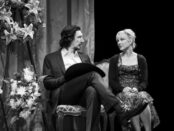
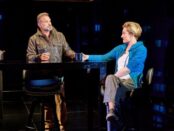
Arthur Miller has always been our major playwright of moral ambiguity, never more so than in his 1968 drama "The Price," now receiving its first Off Broadway revival. The metaphoric title refers both to the value of an attic of old furniture to be sold as well as the price paid by the choices that the characters have made. The fifth New York revival and the first production by the newly formed Village Theater Group directed by Noelle McGrath is both uneven at times and weakly cast, but Miller’s ultimately powerful play still makes its point. [more]
While Dickson’s production is elegant and pitch-perfect for its 1914 era, the characterizations are partly satiric and off base. While Daniel Marconi is fine as the designing, unprincipled and power-hungry Peter, he seems to be playing him as a comic character with a wink in his eye though there is no evidence in the play that Brighouse intended this. Madeline Seidman’s Margaret is rather bland, failing to show us what Peter first saw in her. As his mother, Amelia White is almost as ambitious and designing a social climber as her son. The most problematic characterizations are those of the aristocrats who are all played too broadly, rather than true to the period. As Lady Mottram, Melissa Maxwell is almost a gorgon out of Oscar Wilde rather than simply a high class snobbish member of the gentry. Sara Haider’s Gladys fails to give off the kind of signals that would tell Peter she is interested in him, while Avery Whitted as her brother Freddie is practically one of the those silly-ass men of leisure out of P.G. Wodehouse. [more]
Bess Wohl’s latest play is the ambitious and engrossing "Liberation," her attempt to investigate the roots of the Women’s Liberation Movement back in the 1970s from a decidedly contemporary point of view. Calling it a “memory play,” she uses a narrator “Lizzie,” who tries to recreate the consciousness raising group her mother started back in 1970 in Ohio where she lived at the time. Complicating things for the viewer, Lizzie also plays her own mother (who also seems to be named “Lizzie”) in the flashbacks, showing us seven meeting from the many the group had in their weekly encounters back in the seventies. She also interviews the survivors now in the present about what they recall of those days as her mother has recently passed away and she is sorry she didn’t ask her more questions. [more]
Doyle’s storytelling skillfully blends didactic commentary with humorous anecdotes, holding the audience’s attention throughout and resulting in a thoroughly satisfying evening of entertainment. Whether you are a chess person or not, it is a show worth seeing. Afterward, you can hang around in the "Soho Chess Lounge," the Huron Room performance space skillfully transformed by set designer and chess consultant Charles “Chuck” Matte. [more]
Conceived, written and directed by Elizabeth Hess, "No Reservation" is a celebration of "the lost feminine to give voice to all who have been discarded, silenced and overlooked.” The performances by members of The Hess Collective are very intense and the language rises to the level of poetry. At a brief 60 minutes, the play does not overstay its welcome or become agitprop. While "No Reservation" has no solution or answer to the question of the female power overtaken by the patriarchy, it remains a tribute to women over the centuries. [more]
"Night Sings Its Songs" by Norwegian author Jon Fosse (pronounced FAH-suh), the 2023 Nobel Prize-winning playwright, explores alienation and emotional disconnection by a couple in a dysfunctional marital relationship. Fosse's works are often compared to those of Henrik Ibsen and Harold Pinter. His minimalist style fits into the Norwegian existential and psychological drama tradition. Fosse is one of the most performed contemporary playwrights globally, but he is not well-known in the United States. The play, directed by Jerry Heymann from a translation by Sarah Cameron Sunde, never engages the audience in caring about the characters' emotional struggles. There is a feeling of "so what” or “why should I care” rather than one of concern or empathic understanding. [more]
Dakin Matthews’ "Henry IV" is a consistently engaging gift to the theater season. Shakespeare scholars may quibble about the extent of the cuts from "Henry IV, Part II," but the reality is the original in its entirety can be a bit of a slog. Eric Tucker’s company treats us to the sheer thrill of witnessing a rarity executed to perfection, its invigorating energy palpable in every precise detail. [more]
In reading the script, I didn't see how the story made any sense or could have been given a reasonable life on stage. I was very wrong on both scores. The four actors of the ensemble breathe life into each of the characters, creating a compelling narrative even given the minimalist sets used. Director Hayes did a superb job blending reality with the fantastic, delivering a compelling story of love found, lost, and found again. [more]
The play is not very consistent with life in 1949. It is unlikely that middle class married women cursed, smoked marijuana, quoted Simone de Beauvoir or engaged in affairs with other women. While the program notes by the playwright describe "Mrs. Loman" as a “feminist critique” of the Arthur Miller play and reveals that the author feels that the original “does not provide for a full female character,” Linda’s studying philosophy at Brooklyn College does not make for a feminist statement. In fact, Beauvoir’s "The Second Sex" which Linda quotes from was not published in English until 1953 which means Linda could not have been studying it in an American class in 1949. [more]
Joy Behar and a rotating cast of female celebrities find humor in divorce in "My First Ex-Husband," a new show at the MMAC Theater. Directed by Randal Myler, the evening chronicles tales of failed relationships through a series of hilarious monologues. The cast of four trade off, each delivering two vignettes about men who turned out not to be “the one.” "My First Ex-Husband" is witty, quick and ceaselessly funny. [more]
Foreman's dramatic structure feels like an audacious attempt to stage the tumultuous workings of the mind itself. Neurons ignite, voices both internal and external whisper, scream, and echo through the chaos. Like a pinball careening through an ever-shifting machine, the sensory overload flashes, buzzes, and swirls, pulling you in with distractions that both enthrall and devastate. Yet, amidst it all, you may find yourself trying to self-convince that it somehow all makes sense…not perfect sense, but even nonsense has a layer of sense. [more]
The modern verse translation reasonably maintains a semblance of the Elizabethan iambic pentameter form supported by the ensemble's solid delivery of the lines. People familiar with Elizabethan dramatic poetry may be put off by the change in the wording but not necessarily by the presentation of the text. Overall, it is an enjoyable show worth spending time on whether or not one is an admirer of Elizabethan drama done to a modern beat. [more]
Playwright/actor Braulio Basilio may appear prophetic when we sit in horror today watching the news as a returning president maps out how he plans to deprive immigrants of any and all freedoms in this new administration. Created and conceived by actors Basilio, Ursula Tinoco, Gilberto Gabriel, and their fellow Teatro 220 colleague Andrés López-Alicea, "Building My Casa" is a timely piece of theater that desperately needs a wider audience. In "Building My Casa," they do not give us any surprises nor are we ever expecting any; they give us a tale of three endearing individuals who each in their own way are strangers in a strange land. [more]
Forrest Malloy’s "Nina" follows five women in their last year of acting school figuring out their lives while preparing for their final production together: "The Seagull." The on-the-nose Chekhov is luckily relegated to the background until the very end – this is a play about a friend group before it’s a play about theater. "Nina" is at once funny and emotionally compelling, all on the strength of a great cast. [more]
"Sheltered" by Cate Wiley is a story about what it is to be a homeless woman in a city in the United States. As directed by Liz Peterson, this play tells the stories of these women trapped by circumstances in systems of neglect and half-measures that are often beyond their control. In some cases, homelessness is a choice to escape something in the home, usually an abusive partner or spouse. Drugs, alcoholism and mental illness play a role as well. All of these things are depicted by a hardworking cast who effectively delivers a snapshot of the day-to-day reality of homelessness. It is an emotionally powerful play with an important story to tell. It is not a blockbuster play, but it is a play that should be seen for the compelling story it tells. [more]
Written in 1917, shortly after the U.S. entered World War I, "In the Zone" shows how group hysteria can build, as the various crew members decide that one of their own, Smitty, must be a spy. The play is a tribute to the heroic merchant seamen who served in both World Wars (and before and after), ferrying supplies and personnel across the oceans. Swept up into a conflict that made their difficult jobs even harder and more dangerous, they put their lives on the line every day. [more]
When the audience enters the theater, they are asked to fill out a slip of paper with one word that has been on their mind. Part of the show is made up of audience participation and these slips of paper come into play. Another part of the show written by DePonto and Josh Koenigsberg recounts DePonto’s life with mentalism, his childhood, his memories, his studies and his discoveries about the mind. He begins by discussing the “memory palace,” the way in which the mind catalogs our memories. The remarkable set by Sibyl Wickersheimer which is revealed when a curtain is opened is a wall of 146 lockers which resemble the way the mind works. DePonto opens some of these and removes items while some of the lockers seem to have a mind of their own and open without his doing anything. [more]
Not only are the paintings massive but they also cover all sorts of modern periods of art without Kissajukian having known their work (abstract work by Picasso, Matisse, Joan Miró, Jackson Pollock, Franz Kline, Basquiat, etc.) After the show the audience is invited to experience his recent art work on display in four galleries in the theater while he remains available to answer questions. Not only are the paintings a kind of therapy for him, he also titles them with witty names and explanations, often having little to do with actual images. [more]
"January" presents a story about the emotional impact of the killing of one child by another by weaving together the thoughts and actions of the two single mothers involved and how the national media treats the event. There are scenes blending memories and dreams with reality, presenting the protagonists' thoughts as if they existed in real-life moments with an almost hallucinogenic quality. These dramatic devices work most of the time. Still, there is a critical point in the play where what is being presented goes on for too long, almost to the point of losing the story thread. The projections used are effective but sometimes come very close to being propagandistic. Even with some of the unevenness of the production, it does present an important story that needs to be told. "January" is a heavy lift emotionally but ultimately worth the effort. [more]
While they credit the eight puppeteers textually, “with help from the ensemble,” Warnock and Waage are also credited as executive producers along with set and costume design. Mr. Waage is given solo credit for the sublime puppet design and construction. All in all, the parts make for a rather resplendent whole. Starting with the puppeteers dressed in sparkly black fabric that bring a deserved attention to the constant manipulation of the puppets and a set that constantly morphs between scenes. The initial “lights-up” has a large chunk of sparkly “glitter basalt” that dissolves into the individual puppeteers. The look is reminiscent of Adrian’s classic sequined pantsuits for Judy Garland in concert. Kudos to lighting designer Daphne Agosin for capturing every sparkle in those costumes as well as to the projection designer Erato Tzavara for creating surreal space within the confines of the Baruch’s venue. Thor Gunnar Thorvaldsson’s original music and sound design underscore the fantastical display on stage. [more]
The fun is in the technological achievement of the piece, which is impressive. Gelb performs center stage while his image is broadcast to screens on either side of the theatre. What happens on those screens is extraordinary – Gelb, as Tichy, interacts with himself flawlessly in perfectly choreographed scenes. You kind of feel like you're on a ship roaming the space-ways. The screens make things feel cramped, in a good way, and it's surprisingly believable when a wrench floats in outer space. [more]
Charlotte Bennett directs an exquisite cast of three in an exploration of these themes. Nicole Sawyerr solidly leads the ensemble in the lead role of Abigail Waller, a working-class playwright. Sawyerr is supported by Samuel Armfield, who perfectly embodies two characters: an unnamed theatrical director with a class-based condescending attitude and Darren, Abigail's brother. The third member, Debra Baker, skillfully takes on a number of other characters, the two most important of which are Abigail's mother and an actress portraying the character of a mother in a play written by Abigail. Baker gives distinctly different presentations of these two pivotal characters. She also takes on a number of other ancillary characters who voice supporting elements to the overall story. [more]
Typical of Singer stories about 19th century Polish Jewry, these three dramatizations combine Jewish mysticism and demonology with Baker as the narrator of two of the stories while also playing the demons in both (“The Mirror” and “The Last Demon.”) The third story published in English as “Cockadoodledoo” but here renamed “Thus Spake the Rooster” is performed by Seigel in two parts as the title character who seems to have supernatural powers. The evening is both directed and designed by Moshe Yassur and Beate Hein Bennett, both of whom worked on the Yiddish versions of Waiting for Godot and Death of a Salesman seen in New York under the auspices of The New Yiddish Rep. [more]
There are a number of problems with these vignettes, ranging from the individual characterizations of the men involved to the superficial nature of the historical details of the events being discussed. Sheppard overacts in portraying O. Henry as a barely coherent alcoholic. It is not credible that a person as "drunk" as O. Henry would be engaged in any serious discussion with the likes of Mark Twain and William Hearst, let alone Teddy Roosevelt or even Schiff. The performances don’t engage the viewer to care about who the character is and what he has to say. In a number of the scenes, the dialogue seems contrived to present a particular socio-political viewpoint without any explication or depth. [more]
Jenny Lyn Bader’s "Mrs. Stern Wanders the Prussian State Library" has moved from a successful run at the 59E59 Theater to the intimate WP Theater on the Upper West Side. This is fortunate for those who missed it. Mrs. Stern shines a light on a dark moment in the life of a major cultural figure of the twentieth century whose career was nearly short circuited. [more]
Girelli’s lyrics provide wonderful support to Willett’s choreography. A motif for the song “Valentine” has the dancers in tango movements covering their hearts with their palms. The playfulness of musical chairs takes over another song where chairs are left empty so prospective partners can sit in each other’s laps. The song “Tonight You’re Mine” provides for a very athletic, relentlessly physical duet danced by Marissa Nielsen-Pincus and the bare-chested Ryan Wuestewald. A passionate duet for Devika Chandnani and Noah LaPook is performed to “King of Tears,” a song that confronts the deep emotional pain from heartbreak, emotional vulnerability, and personal struggle to recover from a relationship that has ended. [more]
Director Shira Milikowsky keeps increasing the tension as the 85-minute play peels away revelation after revelation. Each man has a guilty secret and may have betrayed a friend which is eating him up. Although there are never more than two men on Lawrence Moten III’s pitch perfect set for the rather shabby blue and white hotel room which suggests a dorm, we eventually witness and learn about two other stories that they are both stewing over: what happened between Teddy and Ed before Ed stormed out and Jeremy’s encounter in Uganda with Nicholas, a gay man in need of more than medical help. [more]
Director SuzAnne Barabas takes a muted approach, choosing to emphasize the intimacy of the narrative. Mags and Bernie are the only two characters in the play, and both are on stage nearly the entire time. There is little in the way of action, as the 80-minute runtime consists almost entirely of Mags and Bernie reading the letters they send to each other. Day and McKeon spend long periods sitting down and reading their letters out loud, and set designer Jessica Parks arranges the stage as two living rooms, separated by an invisible barrier that neither can cross. Maintaining the physical distance between the characters, the set and directing evoke the feeling of being in both living rooms at once, listening to Bernie and Mags casually read their letters out loud before mailing them. [more]
Sarah Blush directs a cast of five in the story of a father and daughter on a road trip from New York City to a storage unit in California. It is a trip that is both se in the present and past, and it is filled with a flow of information that mixes reality with fantasy in a liminal space between sanity and insanity. This story operates from a different dimension the moment one walks into the performance space. The set is a large orange square, shag-carpeted pit with no clues as to the staging. The two principal characters making this trip by car never sit as if they are in a car but casually walk the raised outside edge of the box. It is an element of this stagecraft that adds beautifully to the edginess of the production. [more]
If one did not read Laura’s extensive program notes in the Playbill given out at the Jeffrey and Paula Gural Theatre at the A.R.T./New York Theatres, it would not be until three quarters of the way through that the play’s real theme becomes clear. In addition, the family tree is so complicated that the script uses two pages and lists almost as many off-stage characters as appear in the play. Of course, this is not available to audience members or to critics before they see the production. [more]
Walking into the Peter Sharp Theater we have no hint of what is behind what look like opaque vinyl shower curtains from one end of the stage to the other. Within moments of her appearance, decked out in a black suit and tie like the kid who hates to dress up to go to Grandma’s for Sunday dinner, we know Francesca D’Uva just doesn’t want to be here. At the end of 80 minutes, we are so glad she came. She breaks the ice by letting us know how sensitive she is to mouth sounds telling us about a high school teacher who smiled so hard you could hear it. On the count of three, we all try to copy the smile noise. “I love bringing people together like that. That will be the only piece of crowd work I do tonight. So hope you enjoyed it. You’re done.” [more]
"Tender Napalm" is a poetic play that doesn't so much tell a story as it does evoke feelings. What is love? What are relationships between men and women really about? Set (sort of) on a desert island, the play contains powerful language memorably brought to life by Ahlers (Man) and Pedretti (Woman). Both actors are young up and comers and it's a pleasure to see them in the intimate TheaterLab space. With seating on both sides and staging that takes full advantage of the intimacy of the room, there isn't a bad seat in the house. [more]
The success of this play and our ability to navigate the ride relies heavily on the flawless cast led by Troyano herself. She shepherds us through every turn of the script and we willingly follow her everywhere she takes us. One of the standout moments is when Branden is whisked away to the Havana nightclub El Pescadito in Phantasmagoria. Alina as Carmelita entertains at the piano dressed as Bola de Nieve, a legendary Afro-Cuban cabaret artist. “Bola” performs a song “Messie Julian” containing lyrics “Yo soy negro social, soy intellectual, y chic” with modified references to Branden. When he asks what the song is about, Carmelita reveals herself to be half-bear ready to attack him. [more]
Katori Halls’ "The Blood Quilt" is fine as a family drama about warring sisters who both love and resent the mother who has just died. However, as a story of secrets and revelations it takes a little too long to get where it is going. It could use more incidents and exposés to warrant its length which seems padded. Don’t blame the fine actresses who seem to be living their several roles. [more]
There is much rewriting and updating plus uncalled for interpolation like speeches from 'Romeo and Juliet" for Jessica and one of Shakespeare’s sonnets (“My Mistress’ eyes are nothing like the sun") as a rap for Lorenzo added to Act V, Scene 1. The play begins with T.R. Knight on mike as the host of “The Antonio Show” and then he sits behind a desk as the merchant of Venice, and interviews his friend Bassanio seated on a sofa as though this was The Tonight Show. With only eight actors, there are not enough to play all of the parts despite doubling, so that Antonio uses two red hand puppets to stand in for his colleagues Salarino and Salanio. [more]
How can you make a new play about a couple on a blind date in a bar interesting for today’s jaded audience? In "Strategic Love Play," British playwright Miriam Battye makes them play games as well as dislike each other as soon as they meet. Under Katie Posner’s direction Heléne Yorke ("The Other Two," "Masters of Sex") and Michael Zegen ("The Penguin," "The Marvelous Mrs. Meisel") are able to keep up the startling interactions between them for the 90 minutes of the play. The play covers several arcs from dislike to interest to boredom to acceptance to disbelief. [more]
"Woman on a Ledge" is an adaptation by Hershey Felder of harpist Rita Costanzi’s writings about her life. Ms. Costanzi is a world-renowned harpist whose life experiences have been woven into a fascinating and highly engaging theater piece. As directed by Lissa Moira, this one-woman production beautifully integrates Ms. Costanzi’s superlative playing with her solid storytelling. One does not have to be a harpist or classical music fan to enjoy this production. Her storytelling alone is worth the time spent, and it becomes exceptional when coupled with her exquisite playing, used to underscore elements of her story. [more]
Ako's portrayal of Izumo no Okuni combines traditional Japanese dance movements with Western-style acting. The nature of the script limits the impact of her performance. The dialogue is simplistic, verging on a museum presentation. The story being told is too small for someone who is such a large character in the folklore of Japan. It is a story that calls for a larger cast to show the impact her dance and performance style could have on audiences. Okuni certainly did not dance alone, so what needs to be added is the pageantry and bravado of a fully engaged dance ensemble. Ako also portrays Lady Yodo, the mistress of the late Toyotomi Hideyoshi, credited with the unification of Japan that led to the establishment of the Tokugawa shogunate. [more]
Can the tale of two families living in Palestine just before the partition that created the State of Israel shine a light on the current status of affairs? Playwright Tom Block’s "Oud Player on the Tel" does just that with a combination of wit and empathy. The play, currently at HERE Arts Center in SoHo, is part of HERE’s SubletSeries. [more]
Firstly, the play has been shortened to two hours without any intermissions, when most recent productions have been three and a half hours with one intermission. This makes all of the events seem to take place too soon, one on top of the other, so that the sense of a world turned upside down is never felt in the production’s rush to the end. There is little sense of turning “the wheel of fortune” spoken of several times in the play. All the actors including the 63-year-old Branagh in the title role seem too young for their parts. While Lear describes himself as “a very foolish fond old man,” in fact, in this production he is a very vigorous and hearty leader, though capricious in his decisions. The supporting cast though excellent in their diction and authoritative in their roles seem lacking in technique to make the roles both interesting and their own. The low-key characterizations damage the play’s violence and viciousness. [more]
Director Scott Ebersold works wonders with the double-edged sword of the audience knowing full well these performances are colored by the play taking place close to 20 years ago when girls this age didn’t have the benefit of understanding their gender identity as girls do in 2024. Social media and sexual education have made great strides in these decades yet we don’t for even a moment feel that Mr. Ebersold’s concept gives us a museum piece. Ebersold gets vibrant heartfelt performances from each of the three actresses. [more]
"Café Utopia" by Gwen Kingston and directed by Ashley Olive Teague tells the tale of a juice bar that, on the surface, appears to be socially progressive, but behind the scenes, is a different story. Based on real stories from workers involved in the current efforts to unionize juice bars and coffee shops, this play lays bare the corporate behavior that puts profits before workers. During changes in some scenes, different characters read statements collected from workers about their work-related experiences. These moments are important in underscoring the overall content of the show as it relates to the plight of workers who lack union protection. [more]
As long as you come to John Yearley’s "Triptych" with the understanding that grief is a deeply personal and complex emotion and that just because two people are married doesn’t mean they will experience a traumatic event exactly the same way, then you will understand the plight of Joe and Blanche. It goes without saying, although it’s always said, nothing is sadder than the loss of a child; the parent is “supposed to go first” and the children are expected to grow older and have children of their own but life and unexpected tragedies have a way of getting in the way. [more]
Nevertheless, the play is one of several interesting takes on climate change in the theater recently like "Deep History." As the play evolves we are more and more immersed in the problems of climate change that are now only distant possibilities. The actors are compelling but do not entirely inhabit their roles. Making her Off Broadway debut, Rossum, best known for her work in the Netflix's series "Shameless" and film version of "The Phantom of the Opera," is suitably conflicted as one who has given up her chosen career and taken the opposite path. Winters, known for her breakout role in the HBO series "Succession" as well as many major Off Broadway roles, is more controlled as the current astronaut who is confused by her sister’s current choices. However, both sisters are a little too similar to make them dramatic opposites. In the underwritten role of Bryan, Foster is quite appealing though he can’t fill in the gaps that are missing. [more]
Haller has created a world where robots have conquered all of humanity through the ability to copy, with precision, the technical aspects of a functional society. The lack of understanding of human artistic creation keeps them from destroying a particular element of human culture: creative artists. The missing element in the totality of their superior nature is the spark of artistic creation. It is an aspect of humans they do not fully understand. So, they keep alive those humans considered to be creative artists in an attempt to understand and replicate the human ability of singular artistic creation. [more]
As both playwright Harry Teinowitz and his co-author Spike Manton spent time in rehab, they carry us through the epiphanies as well as the relapses by injecting humor in every “shot glass” of this play. This is most evident when George returns from a drinking binge with the front wheel of his bicycle mangled into a pretzel. The roommates focus on the “falling off the wagon” rather than the falling off the bicycle. The highlight of their days (and nights) is getting together to watch reruns of "Cheers," with the episode where Sam Malone relapses being one they can probably chant verbatim the way other people can act out all the parts of "The Rocky Horror Picture Show." [more]
"Bad Kreyòl" is gifted with a pre-show voiceover from the playwright herself: “To love a people is to learn their language.” This speaks volumes for two women who know what they know, aren’t keen on changing it up any, and are inherently both generous givers and caretakers in every aspect of their lives. And yes, sometimes you need to butt heads. [more]
"Rawshock" is a powerful, insightful, compelling play that lays bare the craven manipulation of corporate healthcare in the name of profits. It is beautifully written by Rita Lewis and superbly directed by Ken Wolf, who also did the lighting and sound design. It is a story about a group of patients in a psychiatric hospital setting and what happens to them when the new corporate owners of the hospital disrupt their therapeutic group. It is a gem of a show with outstanding performances that should not be missed by anyone who enjoys solid dramatic theater. [more]
Essentially a cri de coeur, "Vladimir" desperately wants to answer affirmatively; however, Sheffer forthrightly acknowledges that it's a dangerously knotty road to yes, requiring Raisa (Raya in the diminutive form) to not only imperil herself but also possibly cause the deaths of others. In particular, passivity is the much safer choice for Yevgeny (David Rosenberg), a financial analyst who, despite having experienced virulent anti-Semitism while attempting to navigate the Russian educational system, helps Raya link that aforementioned suspicious tax refund to the upper echelons of Putin's corrupt administration. Like Raya, Yevgeny is not purely plucked from Sheffer's imagination, as he also possesses a non-fictional counterpart, Sergei Magnitsky, who, in a tragic similarity to Politkovskaya, savagely lost his life for having the courage to tell the truth about Putin's misdeeds. [more]
Directed by Annette Mees, "Deep History" is a real eye opener but it is not depressing. Finnigan is so upbeat and compelling a storyteller it is not possible not be pulled into events as he describes, telling the history of the world from the point of view of a mythic woman who appears in all eras. The show is punctuated by Australian pop songs that figure in both Finnigan's life and the history he is recounting. The video design by Hayley Egan will sear the proof of climate change into your eyeballs permanently. You will never think about this topic the same way again: a not to be missed enlightening theatrical event. [more]
This stunning theatrical work is a creation of the two-member On The Rocks Theatre Co. (Christopher Ford and Dakota Rose), two ingenious artists who have been at work on "The Beastiary" since they were selected as Ars Nova’s fifth Company in Residence in 2019. Commissioned to create a new show from scratch, a first Ars Nova-produced reading came to fruition in 2021. Adding composer Dorit Chrysler to the team, later 2022 workshops added the theremin score and the puppets to the play. More behind the scenes development, a puppet build residency, and a two-week production workshop built the show that is now at Greenwich House. Ford and Rose have co-written and co-designed the scenic elements. Ford designed the glorious costumes and hand-made puppets and Rose directed the entire production. [more]
Lloyd Suh writes quirky historical plays from a unique perspective as ironic comedies. In "Franklinland," the latest entry in the EST/Sloan Project, commissioning and developing plays about science and scientists, Suh creates a Benjamin Franklin like you have never seen him depicted before. Unlike Howard Da Silva’s iconic and benevolent Franklin in the now classic musical "1776," this Franklin is crotchety, irascible, arrogant and demanding. In the play’s six scenes covering 33 years, we see him in his fraught and contentious relationship with his illegitimate and only son William who though not a great mind or a scientific genius like his father goes on to do well for himself politically. [more]
Comedian Hannah Gadsby became an international sensation with their Netflix Special "Nanette," in which they revealed traumatic episodes from their past along with a slew of jokes. Gadsby's latest, "Woof!," now at the gorgeous Abrons Arts Center, is more focused on laughs than serious matters, but it still has some serious moments. [more]