Off-Broadway
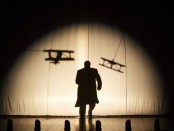
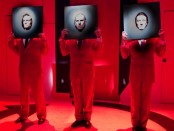
Godwin's talent in seamlessly operating the puppets is an impressive sight and the use of old-fashioned materials, such as a slide projector to represent a lab was a nice choice in this age of advanced technology. The classic "mad scientist" imagery is perfect for evoking historic New York. Some choices are definitely not for the squeamish and audiences should prepare themselves for certain sights and sounds that will definitely prompt a reaction. [more]
New Country
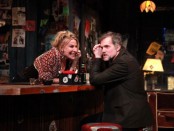
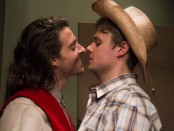
In addition to his superior writing achievement, Mr. Roberts also plays the complex old codger, Uncle Jim. He has written a grand vehicle for himself, and his performance is as tremendous as his writing. Blusteringly entering, carrying a garish blow-up sex doll, and resembling a grizzled Duck Dynasty figure with a big scraggly beard, wearing a cap, camouflage gear and orange sneakers, he instantly gets laughs. With a unique, guttural, singsong twang, he delivers numerous zingers, but soon the pathos and depth of this disaffected character is poignantly revealed. [more]
Blood Red Roses: The Female Pirate Project
Perhaps the most unique aspect of this devised piece is the venue itself. Boarding the Lehigh Valley Barge off the docks of Red Hook, Brooklyn, is like taking a literal step off the land and a figurative step back in time. During normal business hours, the old barge is a museum dedicated to New York City’s rich maritime history. During the run of this production, however, the rickety, wooden fixture serves as the galley of a ghost ship. At the performance under review, thunder crackled in the distance and the makeshift stage bobbed in the Upper Bay’s stormy waters while the players carry on in costume designer Emily Blumenauer’s grungy, Victorian seafarer wear; if nothing else, "Blood Red Roses' is a chillingly atmospheric evening of theater. [more]
The Butter and Egg Man
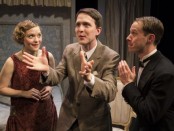
George S. Kaufman’s only solo effort, the 1925 satire, "The Butter and Egg Man" is a colorfully exaggerated snapshot of the nitty-gritty, seat-of-your-pants theater of a prolific decade when two men could do it all: casting, hiring designers, booking theaters and, of course, raising the dough. How things have changed! It’s the money, and the chicanery involved in raising it, that animates the plot of The Butter and Egg Man. The title, in fact, refers to the rich dilettante who can be duped into investing in a clunker, here played by a wide-eyed Ben Schnickel who makes Peter Jones a sweet guy from the sticks who finally finds a backbone and love. [more]
Forever
The press performance under review left audiences hanging on her every word, as Orlandersmith painted a picture of the challenging and draining relationship she had with her mother, including the arguments, the name-calling, the shame and her mother’s constant need for security and attention. Well-spoken and tuned into her emotions, Orlandersmith has a true ability to connect with a large room, making them feel every emotion and sensation that she was feeling. She didn’t sugarcoat one detail and her authenticity aided in processing each thought and feeling, and ultimately allowed Orlandersmith to rise above her past. [more]
A Queen for a Day
If the casting of four powerhouse actors hadn’t been the case—including Proval’s "The Soprano"’s co-star Vincent Pastore--this play would not falter. Michael Ricigliano, Jr.’s writing is consistent and engaging, and the dialogue between the characters is so fluid and effortless that it feels like two real people having a conversation. Full of powerful social commentary, this is a dark, exciting, and at times violent story with a little bit of something for everybody. [more]
Cool Hand Luke
Director Joe Tantalo’s striking, minimalist production has no scenery and virtually no props. It marvelously relies on purely theatrical imaginative devices. Mr. Tantalo’s accomplished, choreographic staging and the performances achieved yield often intense experiences. [more]
Love Me
Charlie is an amiable, 31-year-old struggling actor, writer and motivational speaker, who chickens out while calling a woman from a Village Voice personal ad. He soon becomes romantically involved with Carol, a successful lawyer, and later the temperamental Susan, a controlling singer. During these complications, we meet an assortment of colorful best friends, sidekicks, and view a satirically enacted commercial casting session. Most crucial is “Charlie’s Head,” which is the theatrical device of his subconscious being represented by another actor. This alter ego is always present, commenting on the action with the honesty and insight that Charlie is often unable to articulate. [more]
‘Tis Pity She’s a Whore
We associate Jacobean revenge tragedy with the reign of King James I. Each play’s atrocities seemed to dare the next playwright with an unspoken “Can you top this?” Playwright John Ford continued the genre under the next king, Charles I, coming up with new and even more lurid variations. Red Bull Theater which specializes in the plays of Shakespeare and his contemporaries is offering a staging of Ford’s rarely revived masterpiece "‘Tis Pity She’s a Whore." While artistic director Jesse Berger has piloted a solid production which is a good introduction to this unfamiliar play, it all seems a bit tame when the script seems to cry out for tremendous excesses. As always, however, with Red Bull productions, the diction in this revival is impeccable and totally intelligible. [more]
American Moor
A play that has much opportunity to expose the relationship of casting director with actor, not merely across the table but across racial backgrounds and stereotypes begins as it promises. Enter Cobb, a large black man, anxiously awaiting the call of the casting assistant as he proceeds to unapologetically disturb the entire waiting room with his nervous behavior. The thought of playing Othello brings back memories of his youth and a single theater teacher unwilling to allow him to play any role other than that which he might be traditionally cast in for an assignment. As the character’s exposition is beginning to evolve, the casting agent interrupts us. We can tell the actor has an agenda to prove; that now as a grown man in this audition things will be different. [more]
The Indelible: The 11th Annual East Side Stories
Rodriguez, Brown and McNeill all go that extra mile to establish a connection - and make eye contact with every single audience member contained on the three sides of the theater. As they share their stories, the emotion and passion used to bring out the truth in each of these East Village residents is well translated from a period in time to the present day. While the historical elements are fascinating and provide context, the ultimate theme of acceptance, finding a guiding light to outshine the world's cruelty, and celebrating life creates a lasting impact. [more]
The Belle of Belfast
The ample set by John McDermott is an intelligent divide between interior and exterior life, the run down streets of Belfast and a humble, wooden and warm rectory. Contemplation goes on in both places, be it perils of war or morals. Famed film director Claudia Weill returning to the New York stage establishes this well. Each character has his or her place and is well defined. Weill has a clear vision of the conflict at hand. Impressive music, explosions and street noise punctuate the scenes artfully with sound design by Daniel Kluger. [more]
The Unexpected Guest
Set in South Wales in the 1950’s, "The Unexpected Guest" (first produced in London in 1958) is a mystery surrounding the events that led up to the death of Richard Warwick, patriarch to the Warwick fortune. In the opening minutes of the play, his lifeless corpse is discovered by Michael Starkwedder (Nicholas Viselli), a seemingly random stranger who—upon driving his car into a ditch—stumbled up to the Warwick Estate in search of assistance. Upon discovering the body, Michael is confronted by Laura Warwick (Pamela Sabaugh), now widow to Richard. [more]
39 Steps
Working from Simon Corble and Nobby Dimon’s 1995’s original concept, Patrick Barlow’s adaptation is a witty, tongue-in-cheek, homage that recreates the plot of the film, with comic flourishes. There are also verbal, musical and visual references to other Hitchcock films such as The Man Who Knew Too Much, North By Northwest, The Lady Vanishes, Vertigo, The Birds, Strangers On a Train, and Psycho. There’s an updated nod to Downton Abbey. [more]
Hamlet
The first problem is the attractive modern setting by Walt Spengler of the wedding breakfast of Claudius and Gertrude with a huge cake in the background. The issue is that the table and the cake remain on stage for the entire evening, a terrible distraction. Does this palace have only one public room? The next situation is that Pendleton has chosen to cut both ghost scenes so that the audience is never told that Gertrude had an affair with her brother-in-law or that Claudius poisoned his brother Old Hamlet. The problem that this creates is that young Hamlet has to be played as paranoid as we have no way of knowing what the off-stage ghost told him, nor do we know what is bothering him when he acts so badly to his mother and step-father. [more]
The Undeniable Sound of Right Now
Like Laura Eason’s "Sex with Strangers" seen at The Second Stage last summer, "The Undeniable Sound of Right Now," her new play having its world premiere in New York in a joint production of Rattlestick Playwrights Theater and Women’s Project Theater, has a pulsating urgency that pulls you into it from the moment the lights come up. Director Kirsten Kelly, another long time Chicago resident along with Eason, has obtained dynamic characterizations from her cast of six including Jeb Brown, Margo Seibert and Daniel Abeles. While the play has a rather abrupt and unsatisfying ending as well as its clunky though accurate title, it brims with the authority of real life rather than theatrical artifice. [more]
A la Carte: A Feast of New Plays
"A la Carte: A Feast of New Plays" is a presentation of The Workshop Theater’s leading playwrights that consists of six short plays, all with the theme of food. Most of the works are comic though some are very moving. The styles all vary but the level of writing of each is solid, and contains interesting situations and characters. Cumulatively it’s an entertaining program that gives a wonderful showcase to the excellent cast of actors that have been assembled to portray these often rich roles. [more]
Twelfth Night, or What You Will
Since Bedlam theatre company arrives on the radar in 2013, theatergoers have left their performances as devoted fans. Beginning with acclaimed productions of "Hamlet" and "Saint Joan" in the fall of 2013 and an extended run in the spring of 2014 with casts of only four actors, they returned last fall with a delightfully faithful and inventive stage adaptation of Jane Austen’s "Sense and Sensibility." The same four actors who appeared in Bedlam’s "Hamlet" and "Saint Joan" are back (along with Susannah Millonzi) in two alternate versions of the same Shakespeare comedy, one titled "Twelfth Night" and the other, "What You Will." Minimalist and clever to the nth degree, the "Twelfth Night" performance under review brought the audience to its feet at the end of the two (ingenious and intermission-less) hours. [more]
House of Tards
Director Paul Dobie’s staging gives the show a fast pace and well utilizes the small playing area, which is the upstairs cabaret theater of The Stonewall Inn, the historic gay bar on Christopher Street, where it is performed once a week on Thursday nights. It premiered there in October 2014 and ran through December 2014. It has returned to New York following engagements in Los Angeles and San Francisco. [more]
Martyrs Street
Shulman is a skilled story teller, creating characters that are real and complex: honorable people that make mistakes, some misguided, some well-intentioned or ruthless. People we all know, maybe even in our own families. Shulman makes the head of each household, two women, the focal point of the play. Noor, which means light in Arabic, is a widowed professor at the university with a 16-year-old daughter, Aisha, and a son, Nimer. She doesn’t wear a headscarf, and spends time alone with her late husband’s friend Salim (Alok Tewari), which is frowned upon in the community. Noor received an order from the Israeli government that her house is going to be taken down in 30 days. [more]
Five Times In One Night
Through a series of five two-character scenes, Atik’s play charts the evolution (or lack thereof) of sex in humanity. While one segment depicts Adam and Eve fumbling through their first discovery of intercourse, another shows a pair of apocalypse survivors struggling to repopulate earth. In between, Atik includes a medieval couple’s epistolary romance, another couple’s post-breakup fling from “last week,” and a third’s inept attempt at exploring fetishes “next week.” Each with their own unique angle, Atik’s five self-contained shorts add up to a heartfelt, whimsical look at the reasons we pursue sex and the means we employ in order to have it. [more]
The Book of Moron
“Who Are You,” recorded by The Who, starts off "The Book of Moron." It’s a well-crafted 80-minute theater piece of observational stand up comedy written and performed by Robert Dubac. The title is a pun on the musical, The Book of Mormon and is representative of Mr. Dubac’s comic sensibility. Those who find him funny will have a great time at this show, and those who don’t, will have a tough time. [more]
Posterity
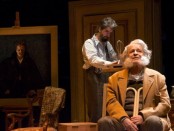
In Doug Wright’s "Posterity" at the Atlantic Theater Company two monumental cultural figures of 19th century Norway lock horns in a battle of wits and sensibilities with tragic results. Wright, who seems to have a penchant for writing about real people (viz. "Quills," "I Am My Own Wife," and "Grey Gardens"), here, takes on Henrik Ibsen, monumental 19th century playwright, and sculptor Gustav Vigeland, forty years his junior. [more]
Irreversible
Josh Doucette, Hugh Sinclair and Jordan Kaplan in a scene from “Irreversible” (Photo credit: [more]
The Mystery of Love & Sex
Bathsheba Doran’s new drama, "The Mystery of Love & Sex," now at Lincoln Center Theater’s Mitzi E. Newhouse, is yet another play whose title is a misnomer. The story is really about friendship and self-identity for a young college-age couple who grew up together in a Southern suburb. Along the way, the play brings in racism, sexism, homophobia and religious mania, as well as the confusions of youth, as the couple try to maintain their close relationship while falling in love with other people. Although director Sam Gold’s cast is made up of veteran actors Diane Lane and Tony Shalhoub and newcomers Mamoudou Athie and Gayle Rankin doing fine work, the play’s first act is entirely exposition and is basically used to set up the situation. This is a play that would do well to lose its intermission as it really doesn’t begin until its second act. [more]
I Catch You Dreaming
Dream sequences, fantasies, and confessional monologues add to the play’s eclectic form. There’s a rapid montage portion with racing NYC denizens including business workers, homeless people, drunks, and cutthroat landlords. The plot turns are often typical for this genre, but there are enough new ones that make it all seem fresh. Playwright Albarrán, who is in his 20’s, also plays the leading part. [more]
On the Conditions and Possibilities of Hillary Clinton Taking Me as Her Young Lover
Whether or not I am convinced that Hillary Clinton needs to take a lover, and indeed how confident I am in Meek’s sexual aptitude for the task, the presentation was a great success triggering booming laughter thanks to a wit wholly unaccounted for in this age in America, a repartee most welcome to this writer. [more]
Placebo
The play’s scenes alternate between the scientific research institute and the couple’s apartment. The theatrical device of having one set representing both places is well rendered by scenic designer David Zinn’s realistic and well-appointed set. Matt Frey’s lighting design and Ryan Rumery’s sound design contribute requisite razzle dazzle effects for the transitions from one setting to another. Mr Zinn also designed the purposeful costumes.
[more]
Fashions for Men
Though totally unknown to Americans, Ferenc Molnár’s "Fashions for Men" is another treasure newly unearthed by the reliable Mint Theater. Davis McCallum’s polished and period-perfect production is not only vastly entertaining and enlightening about the human condition, but it should go a long way to making this play more widely known to the theater-going public. While the play is set in a world that is long gone, its contemporary relevance is based on the fact that it dramatizes the human comedy which will always be in fashion. [more]
The World of Extreme Happiness
Frances Ya-Chu Cowhig’s eye-opening The World of Extreme Happiness reveals the urgent problems in contemporary China in which people from rural communities who move to the cities are second class citizens but where protest is quickly stifled, where the one-child policy causes girl children and women workers to be ignored, and the vast numbers of people in the factory cities have little access to education or money. Eric Ting’s powerful co-production for Manhattan Theatre Club and the Goodman Theatre of Chicago deserves to be seen for turning contemporary social science into the stuff of drama. [more]
Keeping Up Appearances
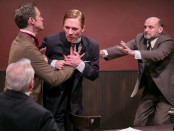
This hasn’t played London’s West End, and has not been performed in the United States until now. The Fifth Avenue Presbyterian Church’s Theatre Fellowship has presented this premiere. The cast of this Actor’s Equity showcase production is made up of polished professional and engaging non-professional performers, many of who are Fellowship members. The overall results for this light-hearted fare are that of high-level community theater. [more]
The Man of the Hour
While Broadhurst is most famous today for the Shubert theater named after him on 44th Street, in his own time he was an expert at light comedy and the author of 48 Broadway plays between 1896 and 1924. While The Man of the Hour is in no way an historical play, it does expose the excesses of New York’s Tammany Hall, the Democratic Party’s political machine, and parallels the election of 1897 in which Tammany Boss Richard Croker engineered the accession of Robert A. Van Wyck to the mayoral chair. Proof that reform of politics is on Broadhurst’s mind is that he refers to progressive leaders Wisconsin Senator Robert La Follett, Missouri governor Joseph W. Folk, and President Theodore Roosevelt, all of whom ran on platforms to clean up corruption. The reading text of The Man of the Hour actually indicates where the play’s Boss Horigan reiterates the policies and dictums of the real life Boss Crocker. [more]
Diversions & Delights
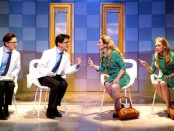
The famous late-19th century author Oscar Wilde is a rather paradoxical historical figure. On the one hand, he was a proud Irishman quick to correct anyone who suggested otherwise; on the other, he spoke with the finest English accent. He was too pedantic to relate to the masses, and yet his work was widely revered by all social strata. Many people loved to hate him and others hated that they loved him. In "Diversions & Delights," the 1979 play that recently returned to Manhattan for a one-weekend run presented by The Ensemble Theatre Company of New York, writer John Gay distills these many facets of a complicated man into a solo performance piece that is appropriately pretentious and accessible. [more]
Lives of the Saints
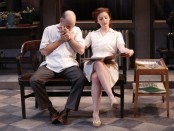
The advantage of an evening of one acts is that you are bound to like one, while a single long play may disappoint you. After a series of very successful full-lengths that include Venus in Fur and School for Lies, David Ives has returned to Primary Stages and the one-act form with a new evening, "Lives of the Saints," for the first time since his 1997’s Mere Mortals. Unlike his masterpiece in this genre, "All in the Timing," (also seen in New York at Primary Stages in both 1993 and 2013), out of the six playlets (five of which are receiving their New York premieres), three are terrific ones and three fall flat. Don’t blame the game cast of expert comedians made up of Arnie Burton, Carson Elrod, Rick Holmes, Kelly Hutchinson and Liv Rooth or director John Rando, a longtime Ives collaborator on six New York shows. The best ones are clever premises brilliantly developed, while the minor ones are blackout sketches drawn out to inordinate length. [more]
Rocket to the Moon
The Peccadillo Theater Company has finely and faithfully revived this rarely seen Odets play, the 6th of his plays to be produced in the late thirties. They are, “dedicated to the rediscovery of classic American theater, particularly those works which, despite their obvious literary and theatrical value, are not regularly revived.” [more]
An Octoroon
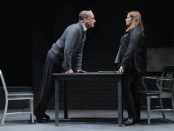
In 2015, it’s a bold move to revive a century and a half-old play that bears a racially insensitive title, and it’s an even bolder move to refrain from apologizing for such source material. Nevertheless, playwright Branden JacobsJenkins does just that in" An Octoroon," his adaptation of Irish playwright Dion Boucicault’s 1859 melodrama "The Octoroon." Back by popular demand from its previous Soho Rep mounting and recently extended at the Theatre for a New Audience through March 29, the production makes the risky decision to embrace an uncomfortable facet of our history and transform it into a contemporary piece. Thankfully, it paid off big time: the result is an entertaining, touching and illuminating theatrical experience that speaks to today’s audience. [more]
The Nether
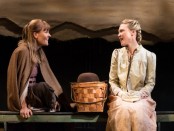
Playwright Jennifer Haley describes her work as delving “into ethics in virtual reality and the impact of technology on our human relationships, identity and desire.” On the basis of her New York debut with The Nether, we can expect some truly frightening dramas from her in the future. Even now, The Nether is such an extreme cautionary tale of the future of the Internet, that some may have difficulty sitting through it. [more]
Abundance
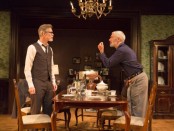
Inspired by real life events of the 1860's and concerned with telling the relatively unknown stories of women pioneers, "Abundance" is highly engrossing, steeped in historical details, and a poignant examination of relationships and friendships. Each of the four main characters is precisely detailed. The complexity of their virtues and flaws are examined with great clarity. The good and bad sides of everyone are shown realistically. [more]
The Winter’s Tale
"The Winter’s Tale" is classified as one of Shakespeare’s “problem plays” or “dark comedies” and as such it does not get produced very often. Under the direction of The Shakespeare Society’s Michael Sexton, The Pearl Theatre’s revival is elegant and entertaining. It solves some of the play’s problems while creating new ones. Surprisingly, the contemporary sets by Brett J. Banakis and costumes by Tilly Grimes work amazingly well for a tale told of the 16th century. [more]
The Insurgents
Playwright Lucy Thurber is angry about the state of things in America today. As a result she has written an angry play about her feelings and given them to her heroine Sally Wright in "The Insurgents, "now having its New York premiere courtesy of Labyrinth Theater Company. Unfortunately, while her heart may be in the right place, and who would disagree with her about the state of things today, Thurber has not written a play so much as a series of rants which basically say the same thing: no one is doing anything to help the poor and disenfranchised who continue to lose their footing on a downward slope. While the audience is asked to sing a hymn of hope at the end of the evening (the words are provided in the program), the play has no ending and is totally lacking in hope. [more]
Churchill
Ronald Keaton gives us an amiable but charmless man. (The latter is arguably authentic.) He replicates faithfully the halting speaking style (young Churchill stammered), but rarely gives the sense of calculated intensity with which Churchill could deliver even the most anodyne remarks. The man of steel who stood up to Hitler without blinking, who rallied Londoners suffering daily loss of life and property from relentless Nazi bombardment--that man is nowhere to be found. [more]
Rasheeda Speaking
Under the assured direction of Cynthia Nixon, renowned actresses Tony Pinkins and Diane Wiest turn Joel Drake Johnson’s "Rasheeda Speaking" into an acting tour de force. A play which investigates office politics and concealed racism, Rasheeda Speaking is a provocative work for our times which asks some serious questions. This spellbinding play increases the tension in each scene to an almost unbearable pitch. Just try taking your eyes away from the stage. [more]
The Absolute Brightness of Leonard Pelkey
The fabric of the community of a small Jersey shore town is torn apart in the wake of the mysterious disappearance of young Leonard Pelkey. At first this one-man show, written and performed by James Lecesne, follows the lines of every crime drama you have seen. Yet, "The Absolute Brightness of Leonard Pelkey" proves to be much more than superficial intrigue and ends up challenging the very conscience of society. The standing ovation and second curtain calls this show has been receiving in previews are already setting this piece of theater apart. [more]
The Events
New York Theatre Workshop is hosting Britain’s Actors Touring Company production of Scottish playwright David Greig’s acclaimed Edinburgh Festival Fringe hit, "The Events." With the London cast again directed by Ramin Gray, artistic director of ATC, this play inspired by the horrendous massacre in Norway by a lone gunman in 2011, is a powerful drama of communal grief after a mass shooting compellingly depicting the catharsis reached by its leading character, a female Scottish vicar. Unfortunately, where this unusual play falls short is that the audience, while cerebrally involved, does not also undergo a similar catharsis. Among the novel techniques of the production is the use of a different choir at each performance and the use of that choir to play members of the community. [more]
Application Pending
Hugely talented singer-comedienne Christina Bianco has become famous for her "Forbidden Broadway" and YouTube appearances where she has performed many impressions. Most notable has been her YouTube clip of her rendition of “Total Eclipse of the Heart” in which she impersonates 19 inimitable singers and which has received over seven million views. In the new one-woman, Off Broadway comedy, "Application Pending," she outdoes herself doing 40 voices often at breakneck speed. Bianco is a wonder to listen to. Unfortunately, the show which attempts to satirize the culture that believes that kindergarten classes at fashionable private schools are the only way to get ahead in life is a one-joke plot which becomes tiresome long before its 75 minutes are up. [more]
Between Riverside and Crazy
Venerable and accomplished fixture of the theater, Austin Pendleton has perfectly directed the play. The characters and their relationships have all been minutely realized and the action well staged.
Scenic designer Walt Spangler’s turntable set brilliantly renders the various rooms in Pops’ apartment as well as the building’s rooftop. Among the authentic looking details and props is a mournful Christmas tree with lights that subtly comments on the passage of time. [more]
Snow Orchid
Pintauro’s play about a tragic American family is highly dramatic but lacks nuance. The four main characters are clearly defined in the first fifteen minutes of the play and remain static throughout. The dialogue is unnatural at times and makes for awkward lulls and pauses. As a result, the action becomes monotonous. [more]
Everything You Touch
It’s a stylized “family secrets” drama, presented with a broad comedic tone. Heightened and arch (often including lengthy florid speeches) the dialogue has shades of "The Devil Wears Prada." Though mostly dense and opaque, there are emotionally involving sequences, particularly as the play reaches its conclusion. Ms. Callaghan also explores the theme of women’s self-image and how that issue clashes with society’s idealized view and the resulting conflicts. Bordering on the didactic, this nevertheless does yield moments of poignancy. [more]
Animals Out of Paper
With only a few days until Valentine’s Day we are surrounded by constant reminders of humanities obsession with being loved and understood. Quite timely, and unapologetically, YOLO! Productions has brought us a piece of theater concerning the affairs of the heart. You won’t be able to help but fall in love with the revival of Rajiv Joseph’s 'Animals Out of Paper" as directed by Merri Milwe. Trust us you’ll love the writer for the corny folding analogies and forgive him for the unsubtle appearance of an origami heart in this quirky tale of humanity’s capacity for love. [more]
Sun and Room
Matthew Socci, Zoë Pike and Leah Brewer In a scene from “Sun and Room” (Photo credit: Danielle [more]
City Of
Unlike Strindberg’s "Dream Play," it is not always possible tell what is real and what is dreamed from what the main characters say. Aside from the ghosts and the painting that comes to life, the additional characters (played by two actors) including a gargoyle on the top of the Cathedral of Notre Dame who has fallen in love with a pigeon, the Green Fairy that is the essence of Absinthe, the ghost of Dash’s mother, and a talking sewer rat. Along with the story of the horny curator of the Musée de l’Homme (an actual but obscure tourist site), it often feels like there are too many stories and quests going on at the same time - unless the point is that for the author Paris is a city of journeys. With much of the dialogue in poetry, "City Of" is often too precious for its own good. [more]
Winners
Although I was never bored, at 135 minutes (including intermission) the play is quite long for the story it's telling. The animals, as fun as they are, get a considerable amount of stage time but never move the narrative forward. They even get solo spots where they recite beat poetry, which are brilliant and amusing but stop the show dead. Even money says that if the parents’ through line was clarified and strengthened this play would slim down easily to a more appropriate length. [more]
Shesh Yak
Theatergoers knowledgeable with "Death and the Maiden" will find "Shesh Yak" very familiar territory. Those who aren’t will still find this play tediously predictable as this scenario has been played out in a number of other dramatic works. The writing is flat, formulaic and rudimentary. [more]
The Road to Damascus
Set at some time in the near future, Tom Dulack’s The Road to Damascus (not to be confused with Strindberg’s play of similar name) is set in a world not that different from our own, with terrorism and civil wars still the major problem for political leaders. A parable of 9/11 and the Bush Adminstration’s reaction to it, "The Road to Damascus" depicts a time when Miami and New York have been attacked by terrorists, with St. Patrick’s Cathedral and Rockefeller Center on Fifth Avenue the major casualties. The play posits the first third party president in American history and the first Black African pope, a not inconceivable event in the near future. [more]
No One Loves Us Here
Playwright Ross Howard’s new work illustrates the characteristically 21st Century sentiments of unbridled selfishness, feigned apathy, and perennial discontent. His pointed, political indictment of our skewed American values is simultaneously too hard to watch and too illuminating to ignore. "No One Loves Us Here" is an entertaining, engaging bloodbath that leaves its audience thinking lots and feeling little. Perhaps this is as it should be. [more]
Lionboy
Shadow puppetry, audience participation, actors as animals, talking lions, ladders as boats, a circus with a trapeze artist and a bearded lady, a live drums and percussion score, a hot air balloon, and storytelling in the style of Harry Potter. Complicite, Britian’s acclaimed collaborative theater company, has devised its first family-oriented production, "Lionboy," based on the best-selling young adult trilogy by Zizou Corder, and the exciting results of this U.S. premiere are now on display at The New Victory Theater. This engrossing storytelling experience, suitable for all ages, combines science fiction, fantasy, economics, science and a futuristic dystopia to tell a fascinating adventure tale using all of the techniques of storytelling by a company of eight versatile actors. [more]
Everybody Gets Cake!
Theatergoers familiar with Richard Foreman’s work with the Ontological Theater will be especially receptive to this frenetic production. There are also traces of Monty Python. Those open to a experiencing a collection of an hour of seemingly plotless, frantic, very well performed vignettes, might find it an entertainingly provocative time. It’s a barrage of colorful imagery composed of heightened sights and sounds. The loud tone of a ringing telephone is prominently featured. [more]
Film Chinois
While "Film Chinois" certainly has an interesting premise to create a stage film noir set in turbulent postwar China, the play fails to deliver on its promise to entertain as well as thrill with a coherent story. Though the play has all the elements of the genre, here they are confusing rather than organic to the material. The elegantly staged production never remembers to turn up the heat. [more]
Da
This finely constructed memory piece is characterized by comedy and melancholy. Overcoming parental dysfunction is it’s universal theme. It’s rendered with complexity, as the characters are often shown at their most vindictive but also with their good qualities that they often repress. The dialogue is crisp and filled with mordant Irish wit. [more]