Off-Broadway
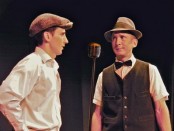
Continuing the trend of producing challenging new works of theater in interactive environments, The Representatives are back with a riveting production of Stan Richardson’s "Veritas." Founded by Richardson along with Matt Steiner, the duo behind The Representatives chose to have their newest project performed at The Cave @ St. George’s, the ornately decorated basement chamber of the 300 year old St. George’s Church. [more]
Travels with My Aunt
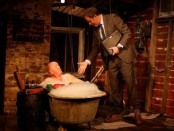
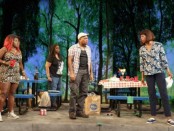
Havergal’s adaptation is unusual in that it uses four male actors to play 25 roles including the central role of Aunt Augusta, with all the actors taking turns narrating the story. Dressed exactly alike in each act, Thomas Jay Ryan, Jay Russell, Daniel Jenkins and Rory Kulz switch identities, nationalities, age, and genders in a madcap adventure told with decided British understatement. This is challenging for the audience as well as the actors: since the performers do not change costumes, it is necessary to follow the plot closely to follow who is who, with the actors sometimes changing characters in the same scene. Steven C. Kemp’s minimal but clever unit set is not much help either as it remains basically the same in each act throughout all of the outrageous adventures that unlikely hero Henry Pulling is taken on by his aunt. [more]
Empanada Loca
Rubin-Vega dazzles from her first moments on stage. She is sassy and witty while sharing her life story in a raspy tone to match the mood, and maintains this intense connection with the audience the entire time. All eyes are on her as we comprehend her past and are in suspense as we see her present life unfold after learning the secrets of this empanada shop. They are unexpected and gruesome and will make the hair stand up on your head. The lighting design by Bradley King adds to the haunting atmosphere as there are moments when the light shines just right on Rubin-Vega and all you see is her face in the dark. [more]
Barbecue
Robert O’Hara’s "Barbecue" may seem like a series of sleights of hand, but as a satirist of American culture, the playwright has a good deal to say about how the media shapes and defines our culture by how it reports the evens of the day. Under the direction of Ken Gash, Barbecue will take your breath away at its invention and cleverness while holding up the mirror to our natures, exactly what theater is supposed to do. [more]
Romance Language
In Joe Godfrey’s new play, Romance Language, middle-aged Kay (Audrey Heffernan Meyer) is searching for joy again after experiencing a divorce and the death of her husband. Kay’s grown and smart-as-a-whip lawyer daughter Penny (Mairin Lee) is worried about her mother spending the rest of her life alone and insists that her mom find some kind of productive hobby or class to fill her time. With the help of her attractive and charming Italian tutor, Fiore (Jared Zirilli), Kay soon finds herself a lot less lonely. [more]
Cloud Nine
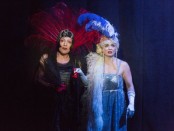
What is most remarkable about Caryl Churchill’s time traveling comedy "Cloud Nine" is that this prescient play about sexual politics and repression is now 36 years old, though it could have been written this year. Still a challenging gender-bending play, it asks us how far we think we have come from the Victorians in our attitudes about sex and identity. Set among the British in Africa during the repressed 1879 in Act I and back in England in liberated London in 1979 in Act II, the characters switch roles, genders and ages in the course of the evening. It isn’t obvious until the second half where the play is headed or how brilliant Churchill has been. Cloud Nine (which proves not to be a nirvana for the characters) challenges a great many of our strictly held beliefs about the way the world is or should be. [more]
Unseamly
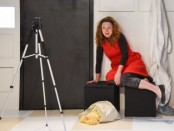
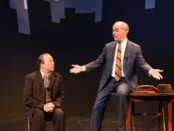
Director Sarah C. Carlsen does an excellent job of utilizing minimalism to tell the story. "Unseamly" is told in a non-linear format, and relies heavily on flashbacks. Instead of having set pieces rolling in and out to change scenes, the play is presented in a bright white room which has secret doors and set pieces that pop out of the walls to change the environment and accommodate the next flashback. The set and costumes are both designed by Brian Dudkiewicz, and there is definitely a consistent style throughout. Minimalist with flashes of bright color, the clothing is sexy and trendy, and contributes to the overall theme of the play: costumed liberally, the whole production is steeped in sexuality. [more]
Sisters’ Follies: Between Two Worlds
With a cast led by downtown icons Joey Arias and Julie Atlas Muz, "Sisters’ Follies" includes life size puppets, flying ghosts, music and dance, topless performances, talking masks, and spectacular recreations of their most famous productions. When we first meet them, they are ghosts flying about the stage in long white diaphanous gowns glad to be back in their theater. They then sing a duet of Irving Berlin’s “Sisters” with appropriately new ribald lyrics. From their clever banter, we discover that Alice (Arias) was an actress and Irene (Muz) a dancer who were continually warring over everything from billing to which of them received more flowers to their legacies. Self-centered Alice, the older sister, is always cool and collected while Irene, who worships her even though she always seems to get the short end of the stick, is more passionate and temperamental. Today Irene is remembered as having founded the Costume Institute of the Metropolitan Museum of Art, while the acting school they both founded, The Neighborhood Playhouse School of the Theatre, is also very much alive. [more]

Death of a Salesman in Yiddish
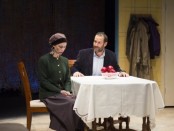
Although Arthur Miller grew up in a Jewish family, none of his characters with the exception of the antique dealer in The Price are explicitly Jewish. Yiddish stage star Joseph Buloff sought to correct that when he adapted "Death of a Salesman" as "Toyt fun a Seylsman" and presented the play in Argentina in 1949. In 1951, Miller permitted Buloff to bring the translation to Brooklyn’s Parkway Theatre where it was deemed a great success. Not seen again in New York until now, New Yiddish Rep is giving the Yiddish adaptation its Manhattan premiere in a slightly revised version in which the non-Jewish characters speak in English and the text is projected with English supertitles for a contemporary audience that does not know Yiddish. [more]
Rabbit Hole
With its realistic and detailed dialogue, Mr. Lindsay-Abaire’s very well constructed script is a superior work of playwriting containing many humorous and moving dramatic exchanges. It is greatly realized by director Maria Riboli’s sensitive, accomplished, and subtle staging. That the racially diverse cast appears to be an actual family is a testament to her talents. [more]
Street Theater
The downstairs of the gay leather bar, The Eagle, has been configured into a runway-style performance space with rows of white folding chairs. This setup is for this giddy revival of the panoramic fantasia "Street Theater" by Doric Wilson. The play takes place on June 28, 1969, before, during and after the Stonewall riots on Christopher Street in Manhattan. [more]
Clever Little Lies
Before coming to the Westside Theatre, director David Saint helmed this production at the George Street Playhouse. No stranger to DiPietro’s style (he also premiered The Toxic Avenger at George Street), Saint does an excellent job of keeping the pace up when it matters most. The physical comedy is subtle and effective, but is over-the-top in just enough places to keep the laughter going continuously. Though one can hardly call the comedy of "Clever Little Lies" 'smart'—it is more vulgar than anything—Saint employs many different tactics to elicit laughs from his audience. [more]
Would You Still Love Me If …
Is it possible to love unconditionally? While we all say the words and make those promises, sometimes we may be faced with a condition that we never saw coming and may not be strong enough to accept. In John S. Anastasi’s "Would You Still Love Me If…," modern couple Dayna (Sofia Jean Gomez), a hard-working and ambitious lawyer, and Addison (Rebecca Brooksher), a beautiful and talented writer, seem to be well on their way to the perfect life as they are trying to adopt a child together and working to create the home of their dreams. [more]
Believers
Donna and Chris, the couple under the microscope in this play, are portrayed by two sets of actors: the first pair represents the lovers while they are still in college (where they first meet), and a second set of actors play the couple twenty years later—married and expecting their first child. The way these two stories intersect is through rotation, as alternating scenes flip between the two timelines until both stories come together at the climax. [more]
Half Moon Bay
Under Margarett Perry’s careful direction, Half Moon Bay, challenges an audience to try and decipher Richie’s infatuation with Alicia and what type of relationship he wants with her. Her mysterious ways question if she even wants his help at all or if his obsession clouds his otherwise logical judgment. Dumeng is the perfect mix of purity and puzzlement when she doesn’t even recall where she grew up or who her family is. The only concern she has is her baby who was taken away from her as she worked hard at part-time job after part-time job to make ends meet. The audience is left to ponder what her motives are and if there is any rationale to Richie’s decision to invest in her life. The do-gooder in him is admirable but the price he pays to help this woman is heartbreaking, causing the audience to feel sympathy as well as concern for his condition. [more]
Be That Guy (A Cat and Two Men)
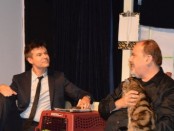
Heavyset and with a sullen countenance, Mr. Marinelli plays Trey by ably conveying the character’s melancholy and witty expressiveness. The charming John Carhart as Keith is animated and gives a fully realized characterization of the contemporary middle-class gay man navigating through New York City’s difficult milieu. [more]
The Awful Truth
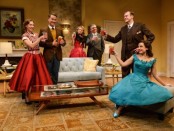
If this story sounds familiar, it is the plot of the classic thirties screwball comedy "The Awful Truth" which starred Cary Grant and Irene Dunne. In fact, Arthur Richman’s 1922 play of the same name has been filmed four times including a 1925 silent version, a 1929 sound version with original stage star Ina Claire which has been lost, and a 1953 musical version with Jane Wyman and Ray Milland. As part of its 24th Season devoted to “Hope,” Metropolitan Playhouse is producing the first New York revival of this unpublished play, surprisingly as the original production ran a successful 144 performances. [more]
Reread Another
"Reread Another" is a collection of Stein’s sometimes illuminating, sometimes moving, and sometimes completely ridiculous linguistic portraits arranged into a series of discrete scenes. Spoken by three actors taking on various roles from sailors to shrubs, the text is an angular, twisting mix of paradoxes, circular logic, and contradictions that achieve satisfying moments of coherence when we least expect them to. Although the performance lacks any sort of cohesive story, it amounts to a shockingly moving evening, providing its viewer the unique sense that something indescribably interesting, perhaps even important, has occurred. [more]
The Quare Land
Mr. Maloney is a veteran character actor of stage and screen with New York City theater credits going back to 1964. This leading role of Hugh Pugh is a marvelous showcase for his immense talent. With a perfect accent, graceful physicality, and his grandly expressive face, deep set eyes, and prominent bald head he creates a riveting characterization out of Samuel Beckett. Visually and vocally he effortlessly combines humor, pathos and malevolence in this towering and memorable performance. [more]
The Pumpkin Pie Show: Labor Pains
The annual "The Pumpkin Pie Show" is back for its 17th year. Performed with no sets and no costumes, it has been described as “bedtime stories for adults.” Usually presented around Halloween (hence the pumpkin), this year the show has a run from September 24 to October 10. The reason is simply that creator, storyteller and writer Clay McLeod Chapman is about to become a father. The due date for his baby boy is October 31. As result Chapman’s scary and engrossing evening this year is called “Labor Pains” and includes five tales about babies from birth to childhood. Parenting has never been dissected so closely or seemed so chilling. [more]
A Midsummer Night’s Dream – Pearl Theatre
If you thought Bedlam’s artistic director Eric Tucker had created physical productions for his acclaimed acting troupe in the past, think again. His "A Midsummer Night Dream," seen this summer at the Hudson Valley Shakespeare Festival and now in residence at the Pearl Theatre, gives the actors a workout from beginning to end. Whether all audiences will go along with it – it is tiring for both performers and viewers – is a question, but like watching a world-class circus or ballet troupe, you know at the end of the evening that you have seen an extraordinary imagination at work. Tucker just expects everyone to go the extra mile. This is not a "Midsummer" for people who have never seen the play before, but one for whom the traditional interpretation no longer has anything to offer. [more]
The Gray Man
Mr. Farmer has crafted a suspenseful and gripping tale based on the reality of child abduction with mythical overtones. The dialogue is very fine and is evocative of the era. The intriguing script has been tremendously elevated by the superb production it has been given that is comparable to visiting a Halloween haunted house. [more]
The Legend of Georgia McBride
Lopez knows these characters and how they speak. He is helped immensely by his director Mike Donahue who allows just enough comic exaggeration without ever letting the show become a cartoon. Paul McGill’s hilarious choreography for the drag acts is right on target. Donyale Werle’s single set is wonderfully adaptable, changing from the grungy dressing room at Cleo’s to its stage to Casey and Jo’s apartment with just the shifting of a wardrobe rack and a couch. Anita Yavich’s costumes are a show in themselves, maybe a bit too posh for the Panama City venue but a hoot nonetheless. [more]
The New Morality
When American born Londoner Harold Chapin was killed in W.W. I in 1915, he was a highly regarded actor, stage manager and playwright, although not as famous as his colleagues George Bernard Shaw, James Barrie or John Galsworthy. While he had completed four full-length plays, his early death led to an eclipse of his work and his fame. In the centenary of his death, the Mint Theater Company well-known for uncovering lost works of merit, has revived his major comedy, "The New Morality." While Jonathan Bank’s production is elegant and polished, this diverting play unfortunately seems lightweight and thin today. [more]
Rough Draft
Performed at The Wild Project, a stylish downtown venue with a raked stage, the set (John Lavigne), lighting (Robert M. Stevenson) and sound design (Jorge I. Sanchez) all compliment the production and enhance the overall experience. Co-written by Wittrock, Donovan and Custer, and conceived and developed by the members of Improbable Stage, "Rough Draft" is a piece of theater which remains in its own category; a challenging, creative, and unique work presented by a group of talented artists with a message. [more]
Fulfillment
"Fulfillment" by the always surprising Thomas Bradshaw is about anything but the contentment and success implied by its ironic title. The Flea Theater’s production, directed to emphasize its undercurrents of eroticism and anger by Ethan McSweeny, is both shocking and sad. The audience witnesses the almost classically Greek downfall of a man done in by his own weaknesses. Anger, lust, pride and greed does in the central character. [more]
Radio Mystery 1949
Could Dennis Richard’s new play "Radio Mystery 1949" be inspired by the Mad Bomber George Metesky who terrorized New York in the 1940’s and 1950’s? Otherwise, there is no explanation for why this mild recreation of a radio mystery show which is beset by a mysterious actor who may or may not be carrying a bomb is set in 1949. Aside from no references to the post-war period, there are also some anachronisms like speaker phones which came from a later era. [more]
Hamlet in Bed
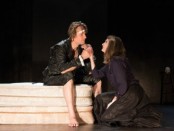
The play is told mainly in monologues by both actors on microphones, alternating with rehearsal scenes from the Gertrude/Hamlet confrontation. This makes the evening more of a performance piece than a stage play. Once we are given the facts, the ending becomes very predictable though the actors are very intense throughout the play’s 90 minutes. Except for the battered white mattress, Rachel Hauck’s set is entirely black, as are most of the costumes by Jessica Pabst. Sometimes due to Scott Zielinski’s lighting, the actors fade into the dark walls of the set. [more]
The Christians
"The Christians," Lucas Hnath’s examination of the intricacies of religion currently playing at Playwrights Horizons, comes to us at a unique cultural moment: every day, scientific advances further challenge the existence of God; ostensibly in an attempt to stay palatable to his mainstream constituents, The Pope has issued a series of proclamations regarding the acceptability of homosexuality, the truth of evolution, and other topics; "The Book of Mormon"—a patronizing, tongue-in-cheek assessment of the Church of the Latter Day Saints—is still playing to sold-out houses after five years on Broadway. Indeed, the fact that "The Christians"’ opening line, “Brothers and Sisters, let us pray,” was met with a hearty laugh is telling: today, New York audiences are largely secular and conditioned to sharpen their daggers at the very mention of Christ. To Hnath, however, the subject of religion is no joke. [more]
Death of the Persian Prince
Playwright Dewey Moss has crafted a well structured, taut, and seemingly conventional romance among clashing cultures that shockingly switches gears. Inventively based on news stories about situations in Iran, Mr. Moss skillfully weaves political issues into the dialogue among the characters and creates a plot that is gripping and painful. [more]
How To Live on Earth
Audiences will receive a refreshing and meaningful gift in "How to Live on Earth." This production sparks several of the big overarching questions, regarding the meaning of life and will also keep you chuckling throughout the 90 minutes. The mix of personalities blends really nicely together and ultimately proves that underneath it all we are all the same: human beings trying to figure out what will make us happy in this world (or the next!). [more]
The Black Book
"The Black Book" follows the faculty of United University while they attempt to unravel the mystery
surrounding a difficult student named Collin Archer and a suicide on campus. Drama instructor Axel
Cooper works together with his co-workers Arthur Chase, Julie Edwards and Riley Andrews to decipher
the boy's disturbing set of clues. As the action rises, motives are questioned, allegiances are
challenged, and the lines between reality and delusion are blurred. Time and space spiral out of
control in a climax beyond (or maybe just shy of) the point of coherence. [more]
Laugh It Up, Stare It Down
Romantic comedy was once the staple of Broadway. Today it turns up more often in the movies. When it appears on the stage it is fairly unusual today and something of a throwback to an earlier era. Alan Hruka’s "Laugh It Up, Stare It Down" is quite charming in its way. However, its whimsical style tends to undercut the serious topics it deals with on the subject of love, marriage and how to treat life’s problems. As a result, it seems more than vaguely inconsequential. However, it remains a diverting if innocuous evening of light entertainment. [more]
Desire: An Evening of Plays Based on Six Stories by Tennessee Williams
Having commissioned evenings of one act plays by major American playwrights based on the short stories of Anton Chekhov and the sonnets of William Shakespeare, The Acting Company has now turned to the work of a native author. As directed by Michael Wilson, the result, "Desire: An Evening of Plays Based on Six Stories by Tennessee Williams," is a mesmerizing work of one acts in which each author handles the original material differently and the brilliant group of nine actors, mainly Acting Company alums, get to tackle two – four roles each. Many give such vivid and varied performances that it is necessary to examine the program to realize that you have seen the same performer in a contrasting role. [more]
Sex of the Baby
With the quirky poignancy of Lanford Wilson, the ferociousness of Edward Albee, and the farcical precision of Alan Ayckbourn, playwright Matthew-Lee Erlbach’s superb new comedic drama "Sex of the Baby" culminates literally in a shattering conclusion. [more]
Stoopdreamer
"Stoopdreamer," a new play by Pat Fenton, is an intimate commentary on the gentrification process in Brooklyn, specifically applying to the small neighborhood of Windsor Terrace. Located between Prospect Park and Greenwood Cemetery, Windsor Terrace is a nine-block wide residential neighborhood which for years was home to many immigrant families, a majority of which were Irish. Though the gentrification of Brooklyn continues today, for Windsor Terrace this has been an event 70 years in the making: in 1946, Robert Moses announced a brand new road building program that consequently destroyed an enormous amount of residences in the community, and as a result over 1,200 Windsor Terrace residents were left homeless. [more]
Isolde
Experimental playwright/director Maxwell has a uniquely personal vision of theater. He has said in interviews that he directs his actors to be “neutral,” in other words all emotions are drained from the performances. Only the subtext tells us what they are feeling. His characters never seem to finish their sentences. Questions are left dangling. Much information is withheld. The play pulsates with unspoken tensions. He makes use of traditional forms and archetypes but explodes them partly by avoiding our expectations. "Isolde," which uses the Arthurian legend of Tristan and Isolde for its underpinnings, is absorbing theater. However, you will either find it pretentious or brilliant depending on what you want from a theatrical experience. [more]
Couriers and Contrabands
Director Kareem Fahmy is also ambiguously credited as “Co-Developer.” Mr. Fahmy’s staging is purposeful when it grapples with the problematic first act and does achieve very fine work from the cast. In the second act, his direction of the action sequences are lively and the pace thankfully quickens. Scene transitions between the Montgomery house and Miss Gardner’s house are swiftly and cleverly executed. [more]
A Delicate Ship
Anna Ziegler’s "A Delicate Ship" is an intelligent, intensely absorbing play that treats its three thirty-something characters like chess pieces moving warily about Reid Thompson’s raised platform apartment set, floating amidst a rock garden which becomes a life-sized game board. [more]
In Bed with Roy Cohn
If "In Bed With Roy Cohn" were seen at a theater event such as The New York Fringe Festival, it could be viewed as a promising offbeat creation. But as a commercial Off-Broadway production it is quite deficient on a basic narrative level that undermines its other successful and outrageous qualities. [more]
Love & Money
"Love & Money" is light, literate entertainment, impeccably acted by its small cast led by the charismatic Ms. Anderman. Mr. Paulik amusingly projects his lack of experience while putting up a gruff front. Ms. Dunlap’s Agnes is priceless. Mr. Brown is a tad too much of a whirlwind as Walker, but as his façade cracks, he warms up nicely. Ms. Kim is onstage for less than four minutes, but made a good impression. [more]
Mercury Fur
In his 2005 "Mercury Fur," being given its belated Off Broadway premiere by The New Group under the direction of its intrepid artistic director Scott Elliott, there has been a complete breakdown of society: gangs roam the city and kill and destroy in supermarkets and museums, while the population is addicted to hallucinogenic butterflies. The one redeeming factor: people will still go to any lengths to save the ones they love. However, "Mercury Fur" is not for the squeamish or faint-hearted: Ridley’s original publisher refused to publish the text. [more]
John
Baker fills "John" with telling details, from the food (ever hear of Sailor’s Duff?) to hidden rooms to specifics of Gettysburg, that keep the play from floating away into total surrealism. She is helped by Mimi Lien’s extraordinarily detailed set which evokes worlds within worlds with its amazing array of tchotchkes, perfectly chosen furniture, a player piano that erupts at odd moments, ceiling fans lazily, but ineffectively whirring, and a multitude of doors. Mark Barton’s atmospheric lighting is perfection. Ásta Bennie Hostetter’s costumes are well thought-out and Bray Poor’s sound design gives eerie life to the show. [more]
Drop Dead Perfect
Everett Quinton has found the ideal vehicle in the hilarious "Drop Dead Perfect" to revive the style of the Ridiculous Theatrical Company for which he originally found fame. Like the plays of the late Charles Ludlam plays, Erasmus Fenn’s Drop Dead Perfect parodies a specific genre using movie and television quotes and characters, situations lifted from famous melodramas, and sexual puns placed in new contexts. Here the new play is a satire of 1940’s and 50’s Bette Davis and Joan Crawford melodramas, with dollops of I Love Lucy which allows Quinton do sparkle as a Southern heiress with many scores to settle. Director Joe Brancato manages to keep the melodrama believable at all times and none of the quartet of actors goes beyond the histrionics inherent in the plot. [more]
Whorl Inside a Loop
A titanic ensemble of six highly talented actors plays the prisoners as well as multiple roles including females with slight costume changes. Derrick Baskin, Nicholas Christopher, Chris Myers, Ryan Quinn, Daniel J. Watts, and Donald Webber, Jr. all superbly convey the pathos, comedy and humanity of these characters. [more]
Sense of an Ending
Mr. Urban does an excellent job of dramatizing and explaining a complex historical situation in this fictional treatment of a real case. In 1994, Rwandan President Juvénal Habyarimana died when his plane was shot down. This assassination instigated a brutal tribal conflict between the majority Hutus who blamed Tutsi extremists for the death of the Hutu president. Varying estimates of the death toll range from 500,000 to 1,000,000. [more]
Baba: the Show
Life comes with detours, but more important than any of that is the personal response. Instead of allowing the past to dictate the future, Mahgoub’s path is one filled with determination and perseverance. Hard work is ultimately more important than “luck,” [more]
Informed Consent
Deborah Zoe Laufer’s fascinating and engrossing "Informed Consent" tells three interlocking stories that eventually become one by the end. Under Liesl Tommy’s assured direction and with Tina Benko’s riveting central performance as a research scientist, the play, co-produced by Primary Stages and Ensemble Studio Theatre under the auspices of the Alfred P Sloan Foundation, deals with such issues as genetic testing, science versus religion, scientific ethics, and early onset Alzheimer’s. Inspired by a true story," Informed Consent" uses various theatrical devices to tell its compelling story and remind us of the necessary work needing to be done if we are to find cures for unsolved diseases like diabetes which involve a great many victims. [more]
Cymbeline
At The Public Theater’s Shakespeare in the Park venue, director Daniel Sullivan has proved himself a brilliant interpreter of the Bard’s comedies, both dark and light, from the evidence of his "Merchant of Venice," "The Comedy of Errors" and "Twelfth Night," to name only a few. Therefore it is a great disappointment to report that his "Cymbeline," the second and last 2015 Shakespeare in the Park offering, based on his 1999 Old Globe Theatre, San Diego, staging, is both confused and uneven, both visually and theatrically. Even more discouraging, the production wastes the talents of noted stage stars Kate Burton, Raúl Esparza, Patrick Page, and Lily Rabe and Hamish Linklater, the acting couple being reteamed on the New York stage for the fifth time. [more]
The Singularity
Under the careful direction of Amy Fowkes, Lundy-Paine captures a woman’s painful journey when trying to have a baby and nothing is working. She finds the ever so delicate balance between finding the strength to keep it together and allowing her vulnerability and struggle to shine through. While she knows what she wants when it comes to selecting a donor, her choices become limited with time and she resorts to an option that is way ahead of her – or medicine’s – time. [more]
Summer Shorts 2015 – Festival of New American Short Plays – Series B
Series B of Summer Shorts 2015 is similar to Series A in that all three plays are also relationship dramas, here between a woman (or three women) and a man in which the men aren’t sure they want to give in to the women. Unlike Series A, all three have endings that are open ended and rather unsatisfying to varying degrees. Although two of the three authors have excellent credits (Lucy Thurber and Robert O’Hara), the plays may feel unfinished or early drafts. [more]
Delirium’s Daughters
"Delirium's Daughters" by Nicholas Korn is faithful to the form and figures of Commedia dell'arte. This theatrical genre is grounded in comedic improvisation and began in 16th century Italy with easily recognizable satirical stock characters. This middling production of Mr. Korn’s solid play is presented by Triumvirate Artists. Though unintended as such, it comes across as ideal children’s entertainment but is too slight for adults. [more]
Summer Shorts – Festival of New American Short Plays 2015 – Series A
Summer Shorts – Festival of New American Short Plays has returned to 59E59 Theaters for its 9th annual outing offering six world premieres by famous playwrights, as well as some who ought to be more well-known, along with different casts and directors for each. The three plays in Series A are a fascinating grouping of new one acts in which women attempt to manipulate their companions for various ends. Neil LaBute, Vickie Ramirez and Matthew Lopez take very different stories and handle them in distinctive ways. All of these new plays can use a bit of pruning, but they are all works that will get under your skin and stay with you. [more]
the dreamer examines his pillow
Like most of the other of the author’s works, the three characters here are very colorful individuals who histrionically clash with each other while verbosely explaining their feelings and motivations. As entertaining, funny, and thoughtful as these often quite lengthy exchanges are, they’re unable to compensate for a lack real action or suspense over the course of the three scenes lasting 90 minutes and becomes wearying. Though similar in structure and themes to many of his successful other works, the dreamer examines his pillow is not as satisfying. [more]
Three Days to See
Using a versatile cast of seven (Ito Aghayere, Patrick Boll, Marc delaCruz, Theresa McCarthy, Chinaza Uche, Barbara Walsh, and Zoe Wilson) who all play both Helen Keller and her teacher Anne Sullivan at some point in the evening, "Three Days to See" will impress you with the courage of this remarkable woman and remind you how grateful you should be for having your five senses unimpaired. While Keller’s early life was brilliantly dramatized in William Gibson’s "The Miracle Worker," that play and movie only dealt with Keller at age seven. "Three Days to See" tells the rest of the story as well as gives us insight into her beliefs, ideas and causes to which she was passionately devoted. [more]
Butcher Holler Here We Come
"Butcher Holler Here We Come" begins like any other theatrical: a quick pre-show announcement to silence all electronic devices, a note about the run-time of the production, and then a black out. The difference is that once those house lights go completely dark, they never turn back on until the final bow. With the exception of the small mining headlamps strapped to the foreheads of the five actors in the production, from beginning to end, this entire show is performed in darkness. In fact, it is nearly fifteen minutes in complete darkness before even one of the actors turns on a headlamp. [more]
Threesome
Yussef El Guindi’s "Threesome" is really a political treatise in the guise of a romantic comedy. Engrossingly performed by Alia Attallah, Quinn Franzen and Karan Oberoi, it is in the end more than a bit superficial and unconvincing, though it will generate a good deal of diversion. Chris Coleman’s direction covers up some of the play’s flaws by keeping the pace moving swiftly along. [more]