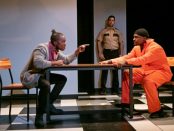
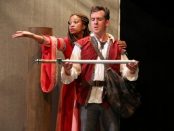
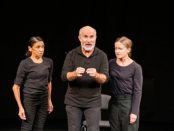
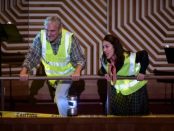
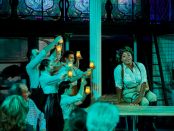
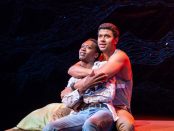
The play’s dynamic—with the two brothers trying to stay in sync even as they find themselves polar opposites in nearly all areas of their lives—seems at points to make the play a kind of clunky “what if” scenario from a modern-problems textbook (the punny title doesn’t help). However, Goodwin’s talent for writing smart, occasionally amusing dialogue and for making his characters seem like real people rather than emblems largely mitigates that concern. Also, the work of the actors in this production is quite strong. [more]
As is Mr. Friel’s The Faith Healer, Molly Sweeney is a monologue play. Here, instead of being separated in individual acts, the three characters appear on stage together without interacting, and speak alternately. It’s certainly a viable format and Mr. Friel gives us a gorgeous cascade of memories, biographical details, differing points of view and suspense. However, as beautiful as these reveries may be, there’s too much of them and the play’s impact is diluted. Lasting two and a half hours and comprised of two acts with an intermission, the slender plot is embellished with the leisure of a literary work rather than a taut stage play. Still, by its end, one is caught up by the characters and their fates. The arguable structural deficiencies are compensated for by the faultless presentation. [more]
Knud Adams directs this one-set show which at times has moments of humor, but overall is a slow moving and usually depressing narrative. Ari Fliakos, who plays the son, gives a reserved performance. Too often I thought of the somber tones of The Twilight Zone’s Rod Serling. Fliakos speaks directly to the audience while seldom having conversations with his mother, played convincingly by Caroline Lagerfelt. When they do interact, it’s via a call that usually describes her mundane days. [more]
"Games" shines a light on the long forgotten stories of two Jewish athletes in post-World War I Germany, a Germany that slid into National Socialism by the 1930’s, effecting the lives of Helene Mayer, a world-class fencer, and Gretel Bergmann, a record-setting high jumper. The play, directed with attention to pacing and unadorned expressiveness by Darren Lee Cole (assisted by Hayley Procacci) takes the protagonists through the world-changing 1936 Berlin (aka the “Nazi”) Olympics. [more]
Written by Sean Daniels, "The White Chip" is reportedly an autobiographical play, directed with an earnest finesse by Sheryl Kaller who sometimes has difficulty keeping her three different performers in character, in terms of whom they represent. If one has difficulty following the many tangents, Kaller has to be held principally responsible for that. [more]
Bearded, bald and utilizing a pronounced Irish accent, the physically imposing Jeffrey Bean is towering as John. The beaming Mr. Bean’s delightful bonhomie gives way to harrowing anguish as he conveys John’s dark sensibility while consuming more and more whiskey, shambling about and later coping with the bender’s aftereffects. Bean’s everyman presence endows his performance with the dimension of being a stand in for all self-pitying delinquent fathers. [more]
Rocky execution aside, the play is not without humor, imagination, charm and whimsy, and the same can be said about the designs by Jessie Bonaventure (scenic), Johanna Pan (costumes), Kelley Shih (lighting), and Brian Heveron-Smith, (sound), all of which work well together to allow this tale to be told. The play’s wonderfully emotional climax which has Elle, Rebecca and Ethel casting off the shackles of their lives into the winds of an oncoming storm is absolutely jubilant and makes the entire evening worthwhile. [more]
The play captures emotions that many of us have felt, from unrequited love, to loss. Seldom are we allowed access to such a raw story and candidness. In a time where we shield each other from truths, this stark and unapologetic performance allows us to feel what Victor meant to Edgar. [more]
As a writer, O’Dell seems to eschew melodramatic elements, including pat endings with fully resolved conflicts. This a work grounded in sober reality, a work that rejects the prevalent idea that “closure” is something that will surely erase all scars and “make whole” once more those who’ve lived through such traumatic incidents. If there’s any “message” that O’Dell offers, it’s that keeping silent about having been raped can only exacerbate the pain. At the same time, she suggests, women who’ve experienced such assaults need to be able to come out about them in their own time. [more]
The problem with Vaynberg’s play, now being given its Off Broadway premiere, in which she plays the lead female role, is that it has so many interlocking plots that it can give you a headache trying to keep them straight. And as all of the actors play two and five roles it is difficult to always know who is who. While director Geordie Broadwater keeps the pace zipping along, this often makes it more of a strain to follow the convoluted plotting. Plus the extensive quoting from Tennyson’s Arthurian narrative poem, Idylls of the King (not identified until late in the play) doesn’t help a bit. [more]
Numb from two straight-through hours of far-right speechifying emoted in perpetual semi-darkness, the audience at "Heroes of the Fourth Turning" then endures a ghastly aria of despair by a Lyme Disease-debilitated character. We also soon learn a deafening recurring sound that was thought to be innocuous, may have supernatural ramifications as the play ends on an unjustified cryptic note. The shooting and implied mutilation of a deer during the awkward prologue was an omen that this was going to be a lulu of a bad play. It’s symptomatic of the uneasy symbolism threaded throughout. [more]
It is Ginger Grace as Amanda that is the crowning glory of this production. Though slender and frail looking, she is still a powerful, if bothersome figure, memories of a golden southern belle past clashing with her poverty-stricken present. Grace lives Amanda on the tiny Wild Project stage, making it seem large and teeming with life, although nothing really happens in "The Glass Menagerie," nothing that is except the dissolution of a family. [more]
Despite the fine writing and acting, these two plays do not stand alone: we are given no backstory to understand the context for these relationships in the longer saga; both plays dealing with a character’s depression, they are too similar in the theme of being haunted by the past; and thirdly, as they are basically two-character plays, both are too long for the limited story and plot lines they contain. Unlike the first two plays, these use two different directors (Loretta Greco for "runboyrun," and Awoye Timpo for "In Old Age"), ironically making them seem quite similar in style. [more]
A downer by its nature, "Nothing Gold Can Stay" is playwright Chad Beckim’s heartbreaking 95-minute family drama depicting the ravages of rampant opioid addiction in the present day United States. It’s a bleak and accomplished take on the eternal subject of substance abuse. Mr. Beckim’s topical scenario is enforced by his skillful writing, the searing performances and the crisp production. [more]
When the Gingold Theatrical Group’s revival of Bernard Shaw’s epic "Caesar and Cleopatra" begins, the characters are wearing white contemporary clothes and sitting on what looks like an excavation site which might give one pause. Like David Staller’s revival of "Heartbreak House" last year, his Caesar and Cleopatra tries to give this 1898 play a more contemporary relevance, but unlike Heartbreak House which pointlessly updated that play to W.W. II rather than the usual W.W. I setting, this modern approach works extremely well and proves to be quite charming. [more]
It’s 1948 and we’re in an Italian prison where “The Beast of Rome,” German SS Colonel Herbert Kappler (1907-1978) is serving a life sentence for war crimes. Kappler was the Chief of Police of occupied Rome and was responsible for the deportation of Jews to concentration camps as well as ordering massacres of civilians. He is visited by his nemesis Monsignor Hugh O'Flaherty (1898-1963). “The Scarlet Pimpernel of the Vatican” was the nickname of this Irish prelate who as a Italian resistance figure saved the lives of over 6000 Allied soldiers and Jews during W.W. II. In real life, O'Flaherty did visit Kappler out of a quest of instigating redemption in the Nazi, and a complex friendship evolved. [more]
"Ludwig and Bertie," written by Douglas Lackey, gives us insight into the relationship of two of our greatest twentieth century philosophers, the younger Jewish Ludwig Wittgenstein and the 20-year-older atheist Bertrand Russell. Bertie, played smartly by Stan Buturla, is the wise old professor at Cambridge when he meets the almost half his age young student Ludwig, poignant, headstrong and hungry for more knowledge, insight and truth, played passionately by Connor Bond. [more]
Legendary director Peter Brook has always investigated the big questions. In recent years his productions have become more intimate and the questions bigger. In "Why?", written and directed by Brook and his collaborator of four decades, Marie-Hélène Estienne, the performance takes place on a nearly empty stage and uses only three actors to tell its story. While the performance is mesmerizing, the play seems unfocused, beginning with the question why do we do theater and ending with the political dangers to theater artists who create experimental theater. [more]
The latest offering by JoAnne Akalaitis, "Bad News! i was there…" is something of a misnomer, since none of us was there for the “bad news” of the ancient Greeks, which is what Akalaitis focuses on. If the text is cobbled together with passages taken from Sophocles, Euripides, and Aeschylus, it can prove pretty tedious and at a far remove. But then, Akalaitis is more known for her spectacles than for her texts. [more]
Though off-putting, "Sunday"’s periodic non sequitur choreographic interludes become a respite from its bad writing and grating performances. For no discernable reason, characters stop speaking and engage in herky-jerky movements accompanied by crashing music and frenetic lighting. “A sort of frenzied dance. Think "They Shoot Horses Don’t They?" But perhaps slightly less macabre,” is the stage direction's description. The action then resumes. These tangents fill things out as the show is scant on plot. [more]
Katsura Sunshine is the stage name of this charismatic 49-year-old Toronto-born performer who relocated to Japan and apprenticed to a Rakugo artiste. Mr. Sunshine eventually became a notable practitioner in his own right and has the distinction of being a Westerner. Sunshine is affable, animated and possessed of a pleasing fast-paced vocal delivery that demonstrates comic timing and dramatic heft with a Canadian lilt. This vocal expressiveness combined with his shock of jagged blonde hair, striking facial features that he contorts into a gallery of expressions enables him to command the stage. Wearing a kimono, kneeling at a small table and handling the hallowed props of a fan and a hand cloth, he evokes the genre’s essence with assured authenticity. [more]
The first act of Anna Moench's "Mothers" concludes with a genuine shock as the playwright startlingly upends all of our expectations. Visually punctuated by Wilson Chin's suddenly not-so-stable set, this audacious turn suggests Moench's intermittently funny satire of upper middle-class motherhood at a "Gymboree-style playroom" has only been a prelude to something much more challenging and profound. Unfortunately, what you soon begin to suspect is that Moench just ran out of narrative steam and started writing something else. [more]
Cusi Cram’s "Novenas for a Lost Hospital" (with dramaturgy by Guy Lancaster) presented by Rattlestick Playwrights Theater is an unusual site-specific theatrical event that pays tribute to the now defunct St. Vincent’s Hospital which for 161 years was situated three blocks from the theater’s location. Directed by Daniella Topol, the play is both uneven and scattershot in its non-linear format and content. However, it conveys a great deal of information in an entertaining manner and has some affecting scenes of life in the hospital in two eras: the 1849 cholera epidemic when it was founded in the mid-19th century and the AIDS crisis in the final years of its tenure in the late 20th century. [more]
Halfway through the abstract hijinks there are fleeting references to terrorists, getting in trouble for bringing a little knife on an airplane and vague political debates as the tone grows more serious. Devotees of Mr. Wellman’s idiosyncratic style may be enchanted while anyone else could be baffled. Brevity, playfulness and presentational polish are its virtues. [more]
Both Moran and his script are disarming, captivating, touching, and thought-provoking. The audience cranes to hear his every truth-packed word, feeling his moments of joy and triumph as well as those of disappointment, resignation and, yes, even anger. [more]
The Flea Theater is honoring one of its co-founding members, playwright Mac Wellman, with a five play festival called “Perfect Catastrophes” which includes two world premieres and three revivals, with casts made up of The Bats, The Flea’s youthful resident company. First up are the one-act plays, "Sincerity Forever" and "Bad Penny," which require separate admissions but can be seen back to back on the same evening or afternoon. Any two of the plays in this festival are an immersive view of the avant-garde playwright who has created new works for almost 50 years and has won three Obie Awards. [more]
Tucker’s dialogue is breezy and amusing, and it’s fun to see these talented actors—all mainstays of the New York stage—being playful together. Together, they make interesting stuff out of the material they’ve been given, and they are all highly watchable. But would the play seem more fulfilling and important if there were more fully developed personal and interpersonal conflicts? [more]
If you are put off by the idea of women defining themselves based on the men in their lives, then Lois Robbins’ one-woman play "L.O.V.E.R." is not for you. However, if you concede that there are women today whose mothers brought them up to believe that they are nothing without a man, then you will find "L.O.V.E.R." entertaining if not enlightening. Last seen Off Broadway in the revival of "Cactus Flower," Robbins proves to be a very personable and genial narrator of this semi-autobiographical story of love, sex and finding contentment. [more]
Ms. Backhaus’ writing is erudite, well-shaped and imaginative but isn’t funny which is problematic considering it’s intended as a barbed comedy until its heartfelt metaphysical conclusion. Much of it frantically plays out with Monty Python’s intellectualism crossed with Mel Brooks’ coarseness and dashes of Alan Bennett’s pathos. Virginia Woolf figures prominently in one part. Though noble in intent, it’s an unsatisfying exercise that’s more synthetic than profound. [more]
Cobb is titanic in this piece bringing his resonant voice and impressive physical presence to bear on the most famous classic role for a Black actor in the canon as well as his thoughts about race and the theater. His justifiable anger when the director tells an anecdote about a woman who drove across the country in diapers to confront her rival as an example of the effects of jealousy is enough to flay one alive. His analysis of the man Othello and his relationship to the white Venetians is a brilliant explication of both character and society. Cobb’s understandable problem with white directors who want to tell him how to play a Black man exposes race in America from a new point of view. American Moor may make you angry but it is always enlightening and right on target. Although Cobb’s passion gets the better of him, you will never feel that he has gone too far or misrepresented things as they are. [more]
As John, Christopher Sears is an enjoyable pill, perfectly offset by Tommy Crawford's Paul whose amiable placidity is almost Buddha-like. More importantly, both actors have impressive musical chops, which wonderfully serves Stevens' truncated overview of Paul and John's tuneful reminiscing about their musical influences: Chuck Berry, Bobby Freeman, Gene Vincent. Sears even has the opportunity to do a bit of Elvis Presley hip swiveling that feels absolutely perfect in its oh-so-British imperfection. [more]
Making is U.S. debut 19 years after its Scottish premiere in an actual park, Douglas Maxwell’s "Decky Does a Bronco" is a worthy addition to the dramatic literature of plays about childhood and the loss of innocence. Under the direction of Ethan Nienaber, the talented cast of five gives indelible performances which remain with the viewer long after the final curtain. The guilty that the narrator David’s expresses as to what he might have done differently leaves a poignancy that cuts very deep. [more]
The trouble is Lee’s almost catatonic approach to Gene. He speaks in a toneless monotone and adapts a monolithic physical approach, his hands constantly held stiffly at his sides. When he does erupt in anger it registers as bizarre overacting rather than the culmination of a life of living under his father’s thumb. This leaves an emotional vacuum in the center of the play. Even when he delivers the poignant punch line—“Death ends a life, but it does not end a relationship”—what should have been an emotional wallop becomes a whimper. [more]
Hopkins had added selections from Lewis Carroll (references to the Jabberwock and “The White Knight’s Song: The Aged Age Man,” the poem which gives her the new title), Emily Dickinson (“I’m Nobody! Who are you?”), Alfred Lord Tennyson’s “Ulysses” (“To strive, to seek, to find and not to yield”), and unidentified poems from Dylan Thomas. Aside from the fact that these are several centuries newer, all of these have a different rhythm than Shakespeare’s Lear. The music credits include Satie’s “Gymnopedie” No. 1, Chopin’s “Nocturne in E minor,” excepts from Beethoven’s Symphony No. 7 and Piano Sonata No. 23 in F minor, and “Ombra mai fu” from Handel’s opera Serse. The most outstanding problem is that we have other associations with this material so that they stick out like a sore thumb. [more]
"Dining with Ploetz" at Theater for the New City consists of three short plays by writer, director and teacher Richard Ploetz. The program adds up to slightly under two hours’ running time (with one intermission). The plays are all billed as comedies, and—as the title implies—they all, to one degree or another, involve “dining.” They are, however, quite diverse in terms of style and tone. The first and last of them (both of which the playwright directed) hold the audience’s attention fairly well. The middle piece, directed by Steven Hauck (who acts in the other two), is riveting. [more]
Poseidon Theatre Company’s "The Cooping Theory 1969: Who Killed Edgar Allan Poe?," described as a "new immersive paranormal experience,” is set at the RPM Underground which is more interesting than the play. This interactive event leads the audience through many of the 18 rooms, all of which are different, in this unusual venue by designer Seok Huh. As for the show, it may be “the only story-driven, multi-room immersive experience in the heart of Times Square,” but as written by Nate Raven it is very thin on information about 19th century writer Poe. As conceived and directed by Aaron Salazar it is mainly participation in a séance to reach the author in order to hear his version of his mysterious death, which is neither spooky nor scary. Poe never actually appears except in spirit and not much happens. However, it takes a long time getting there. [more]
Bess Wohl’s new play, "Make Believe," is a fascinating study of how the traumas of childhood affect our adult lives, particularly the damage seen and unseen parents inflict on their offspring. Director Michael Greif whose trenchant productions go back to the 1990 "Machinal" at the Public has piloted a fine cast of eight actors both young and mature. Make Believe is at the same time entertaining and enlightening in its dramatizing childhood and its aftermath in an inventive way. [more]
Deborah Whitfield’s 'Tech Support" offers a clever idea in order to review feminism in the past century. Unfortunately, her rather superficial approach misses a great many opportunities. The romantic comedy aspect of the play is not entirely believable and works to the detriment of the play’s serious elements. The slick production is entertaining without ever delving below the surface even though it attempts to cover a great many important and serious issues, many of which are not yet solved today. Don’t blame the actors who do their best with the material they have been given. [more]
The small studio theater space where the show is performed with its basic living room scenic design informs director Cameron Clarke’s resourceful and bold staging. Working in such a confined environment with the actors in close proximity to each other, Mr. Clarke emphasizes the piece’s claustrophobic, paranoid and menacing tones with vividness. Unseen ominous events taking place in the offstage bedroom and bathroom incite terror. An open window with shutters becomes a focus of dread, with the outside world represented by eerie red light and sounds of sirens. With the cast’s explosive performances and a command of the visual, Clarke realizes the play’s uneasy power. [more]
This production is a rambunctious enterprise, and Hunter and his cast do a reasonably good job of keeping dialogue that’s made up largely of long strings of short declarative sentences (or sentence fragments) from seeming dreadfully monotonous. The actors slow down at moments, then quicken the pace, their spat lines overlapping. Some of them leave the platform in order to play in the adjacent areas for a spell. Some bring furniture onto the platform, arrange it and later reconfigure and remove it. The ensemble members work well together, and each has some fine moments. The gruff-voiced Allan-Headley, the flamboyant Reid and the lost-lamb Toth are especially memorable. [more]
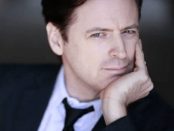
The latest edition of the recurring political humor show "Laughing Liberally" is titled "Make America Laugh Again" and is decidedly anti-Trump. It’s created by the brilliant veteran comedian John Fugelsang who is ubiquitous on radio, cable television news shows and comedy clubs. Mr. Fugelsang introduced it and his headliner 45-minute set was the finale and contained many bright spots. Each performance has a different cast in between and at the one under review, five polished comics did their acts. [more]
Jonathan Spector’s "Eureka Day" now having its East Coast premiere at Walkerspace is a blisteringly satiric and provocative play torn right out of the headlines. Ostensibly about how one progressive elementary school handles a case of mumps due to many anti-vaxxers, the play also tackles many other hot button topics. Ultimately, the play’s message is that with too much sensitivity and too much political correctness nothing can be accomplished. It is a wake-up call for all of us. [more]
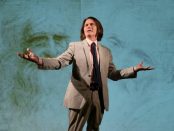
Described as a multimedia production, "Da Vinci & Michelangelo: The Titans Experience" is actually a lecture by art historian Mark Rodgers to slides of the masterpieces of these two geniuses. Both enlightening and dense, the performance by this animated and exuberant lecturer tells you a bit more than you can take in in one sitting. It is a little like two art classes back to back. However, one comes out of the show with an even higher respect for these two Renaissance men who were far ahead of their time and are still at the top of their professions after 500 years. [more]
Lenore Skomal’s "The Exes" wants to revive the Broadway-style sex comedies of the 1950’s and 60’s, earlier called boulevard comedy. Unfortunately, not only is the formula passé but television sit-com now does it better. The play is also too heavily plotted with two main characters with the same name and a great many petulant, entitled people. Worse still, the play fails to deliver any witty or clever lines, instead giving us quotes and references from much better works without much point. Directed by Magda S. Nyiri, "The Exes" has at least two false endings before it comes to an unearned conclusion. [more]
Mr. Wills’ demonstrates a facility for dramatic writing with his snappy dialogue and fast-paced scenario that inspires laughter and also incites thoughtfulness. Amidst the merriment are keen insights into the gay male experience including aging, relationships and promiscuity. "Stormy Weather," though, is more Ray Cooney than Tony Kushner. [more]
Feraud’s scenario is structured as a series of taut precise scenes bursting with sharp dialogue and topical references including an Uber driver with a musical recording on Spotify. She drops well-timed details that advance her agenda of tackling the issue of the preoccupation with feminine physical perfection. We learn of Peter and Joan’s strained marriage that is characterized by resentfulness over financial inequity and past infidelity. Everything reaches a realistic and dramatically satisfying conclusion. [more]
"Midsummer: A Banquet" is an auditory and oral treat, a light entertainment for this time of year. Using Zach Morris and Victoria Rae Sook’s skillfully adapted abridgment of Shakespeare’s comedy, the evening of dinner theater is a delightful way to experience the Bard. The meal designed by Emilie Baltz contains various surprises that coincide with the events in the play and are tasty enough to be a filling repast. Shakespeare as dinner theater may not be a new idea but this is an evening of many pleasures. [more]
William Shakespeare’s "Measure for Measure" (circa 1604)—the story of a woman who is sexually victimized by a man in power—seems as though it would lend itself to an adaptation crafted in light of the #MeToo movement. To some extent, The Acting Company’s streamlined 95-minute modern-dress version proves itself a good fit for such an approach, although there are elements of Shakespeare’s play that don’t quite conform seamlessly with what director Janet Zarish seems to be going for. [more]
Kelley’s adaptation begins with the murder of Mary which avoids preparing us for the limited life of opportunity that Bigger leads in the Black Belt of Chicago. Told in a fragmentary form often with flashbacks within flashbacks, it is only possible to put the chronology together if one knows the novel. Kelley has also eliminated the powerful speech to the jury by Bigger’s lawyer which is one of the most famous of all statements on social racism and the constricted environmental influences on people living in the ghetto. [more]
While Shakespeare’s "Coriolanus" has a great deal to warn us about as a cautionary tale, it is also not as deep or as poetic a play as his major tragedies. Daniel Sullivan’s production for Free Shakespeare in the Park is fine with the surface values of this historical tragedy but less so with creating the subtext of the story. In his second time around as its titular hero, Jonathan Cake is excellent as the brutal warrior, not so accomplished as the public man wrestling with his own demons. [more]
Neil LaBute’s “Appomattox” is the most substantial of the three plays and deals with a topic new to his work. Two long-time friends, Frank, black, and Joe, white, are having a picnic in the park without their wives where they get to throw around a football. Joe tells Frank about a story he read in the newspaper that the freshmen at Georgetown University have decided to pay an annual reparation to the families of slaves who were sold off by the college centuries before as collateral to keep the school going. He is impressed that the $27.20 will be annually added to their tuition. For Frank, this is nothing but a symbolic gesture. He would like to see the figure sting a little for 400 years of slavery. [more]
Following up on Luis Alfaro’s critically acclaimed Chicano retelling of Sophocles’ "Oedipus Rex" called "Oedipus El Rey," The Public Theater now stages his equally relevant and timely "Mojada" which melds Euripides’ "Medea" with the Latinx immigrant experience in the big American cities. Those who know the Greek myth of Jason and Medea will be prepared; those who at the performance under review obviously did not know what was coming were shocked and horrified by the ending. Either way the play is spellbinding theater. Chay Yew, artistic director of Chicago’s Victory Gardens Theater who also directed the Public’ production of Oedipus El Rey, has staged the stunning and devastating play with an excellent cast of Hispanic-American actors which is as timely as tomorrow’s headlines. [more]
Series A of this year’s Summer Shorts: 13th Festival of New American Short Plays is unified around the theme of death and dying and how it affects the living. Lest you think that this sounds morbid, the three provocative one-act plays that make up this first program are so beautifully handled that this is a superior theatrical evening in three totally different styles. Unlike many evenings of one acts, the productions of all three are worth of your attention and could not be bettered. [more]
Ms. Murphy’s writing is a rich amalgam of biographical data, pivotal incidents and humane observations. The monologue structure has the three characters alternately expressing themselves in the same recurring order with often all three on stage but not interacting with each other. Through this theatrical device, Murphy enacts her eventful scenario. At 100 minutes without an intermission, it does lag, particularly the introductory portions which too leisurely introduce the characters. However, Murphy does create three zesty roles. [more]
It is not until the second act of British playwright Chris Urch’s "The Rolling Stone" that the play catches fire but from then on the drama is explosive, compelling and very disturbing. Once the play gets past the introductory exposition that sets up the plot, the production by Saheem Ali (Donja R. Love’s "Sugar in Our Wounds" and "Fireflies," and Christopher Chen’s "Passage") is taut, tense and involving. [more]
Halley Feiffer's new comedy, the obsessively titled "Moscow Moscow Moscow Moscow Moscow Moscow," is an intermittently funny ten-minute parody of Anton Chekhov's "Three Sisters." Unfortunately, it goes on for another hour and twenty-five minutes, tiresomely recycling jokes and shallow insights until you begin to wonder if Feiffer actually read the Russian playwright's work or just a Wikipedia synopsis for her cooler-than-thou "adaptation," which seems motivated by a strange desire to ridicule not only Chekhov's characters but also anyone who might feel bad for them. So, be forewarned, if you have an ounce of sentimentality in your soul, it may seem as if the laughter heard during the production (and, to be fair, there was a lot of it) is to some extent directed at you. [more]
The title of playwright Dianne Nora’s fascinating new work, "Monica: This Play is Not About Monica Lewinsky," is disingenuous. Is it about you-know-who? Well, yes and no. There were passing references to the title character’s notoriety and enough images of and quotes from President Clinton, among others, to imply that the title is, at best, a white lie; at worst it is a tongue-in-cheek bait-and-switch. But if that is a way of getting an audience to see this incisive and adult drama, then more power to Ms. Nora who knows how to write sharply focused dialogue. [more]
Unfortunately, Daniel’s ambivalence proves to be an impediment to the success of Patience. It would be one thing if he were a strong character, torn about which path he’ll take moving forward. Rather, he seems to be a customarily wishy-washy guy, who avoids making choices (or “decisions”—the play suggests there’s a difference). Other characters accuse him of speaking vaguely and not answering questions directly. He certainly seems not to be socially adept. [more]
Wearing a green prison uniform, the tall athletic blonde curly-headed Mr. Stewart who is in his early 20’s delivers an enthralling performance. Speaking in smooth rich tones that convey a youthful sensibility, Stewart powerfully details the grim experiences of life on the inside especially for a privileged white man. Not only is he riveting as Roy, Stewart masterfully portrays a gallery of figures Roy encounters. These precise impersonations include his black trans cellmate, a black Muslim he befriends, a menacing Puerto Rican gang member and an amiable corrections officer. Vocally and physically Stewart is impeccable and truly carries the play to success. [more]
The power and majesty of the theater are affirmed by this ravishing production of the acclaimed English playwright Philip Ridley’s two-character play, "Tender Napalm." For 75 enchanting minutes on a bare stage we follow the fantastical exploits of a young man and a young woman apparently shipwrecked on a jungle island. They engage with monkeys, aliens and serpents and time passes through a gloriously written cascade of memories, erotic verbal exchanges and biographical details. There’s mention of “A dildo shaped like a dolphin from the lost city of Atlantis.” [more]