Scotty Bennett is a retired businessman who has worn many hats in his life, the latest of which is theater critic. For the last twelve years he has been a theater critic and is currently the treasurer of the American Theatre Critics Association and a member of the International Association of Theatre Critics.
He has been in and around the entertainment business for most of his life. He has been an actor, director, and stage hand. He has done lighting, sound design, and set building. He was a radio disk jockey and, while in college ran a television studio and he even knows how to run a 35mm arc lamp projector.
"Bringer of Doom," written by Joe Thristino and smoothly directed by Mark Koenig, is a comedy about Lotte and her effort to exact revenge against her estranged mother, Esme, because of a public humiliation her mother inflicted. She uses an ex-comedian, Demetrius, or more precisely, a no-longer-performing comedian, as the waiter to serve her revenge, cold, but with a measure of spice. His job is to "roast" Lotte's mother with clever rejoinders and barbed put-downs when she comes for dinner at Lotte's apartment. He is to make her highly uncomfortable without causing her to leave. [more]
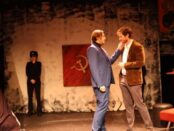
"Darkness of Light: Confessions of a Russian Traveler," written and directed by Michael Mailer and Alexander Kaletski, is a story of an artist's journey from the restrictions of one political and economic system to the compromises needed in a more open and accepting system. It explores how a Russian artist, Nikolai Rodnin (Jonathan Glass), tries to hold onto the truth of his artistic expression while dealing with the material needs for survival. An important, subtle, and contrasting story is that of his brother Sergei Rodnin (Alex Yuille). [more]
"Lunch Bunch" by Sarah Einspanier and directed by Tara Ahmadinejad is a rapid-fire comedy with farce ensemble timing in the service of a serious underlying topic, presented on a bare-bones set. It is about a group of overstressed lawyers in a public defender's office who think they have the perfect antidote for their daily struggles by sharing lunches. It is funny, touching, and worth experiencing the comic talent of the cast and the amazing flow of the story. [more]
"Trilogy II" by Garry Batson, directed by Evria Ince-Waldron, is three one-act plays depicting the struggles of African-American families faced with difficult and troubling events. The good and bad things that happen seem random or unfair. According to Batson, the common link among the stories is the clash between good and evil. However, except for "Fort Knox," the remaining two plays, "Flight Risk" and "Ill Winds," focus on aspects of good and bad, not specifically evil. For this reviewer, something evil is an extreme form of bad because not all bad things are necessarily evil. [more]
The direction by Ella Jane New delivers this emotionally complex story with skill and sensitivity. There are only a few instances when the action doesn't entirely ring true, such as the opening scene when the brothers first enter the house. Gostkowski's presentation is somewhat distracted as if he is looking for the character's voice. Rysdahl is more in tune with his character at this early stage but is also somewhat flat in affect. They may be trying to bring out the awkwardness of two brothers trying to find their emotional footing with each other after a number of years apart. They find their footing as Act I progresses and deliver fine performances. [more]
"The Conductor," by novelist Ishmael Reed and directed by Carla Blank, is a play that uses the revival of the Underground Railroad system as a device to address several contemporary socio-political issues related to race and ethnicity. It is a show that directly addresses extremist conservative groups and their movements that seek to restrict and limit governmental and social actions used to address institutional inequality. Reed utilizes the result of a school board recall election in San Francisco as the basis for illustrating the insidious nature of these reactionary groups. [more]
"War Dreamer" is a compelling exploration into the psychology of a female veteran who served in Iraq. It is a depiction of the struggles of a veteran to make sense of the memories, nightmares, paranormal events, and mental dislocations that intrude daily. Those experiences are more than a function of post-traumatic stress disorder. They result from a life lived in the alien world of war and all that is that experience. The play is a frighteningly accurate presentation of the process that some veterans must navigate as they try to return to a "normal" life. Written by Leegrid Stevens, "War Dreamer" has a storyline that is not straightforward in time and place. It is disconnected from a regular flow of action, with jumps in time, place and reality. However, he skillfully keeps the audience guessing what is real and what is not without losing the story's underlying thread. Stevens makes the audience both witness and participant as he brilliantly weaves his story of trauma and disassociation. [more]
The show is billed as a musical, but it is more concert than play, strong in music and weak in the storyline. The songs cover a lot of emotional ground, many with a humorous edge, but the book only provides a slim dramatic structure for the characters' actions. What is missing is more detail about who the characters are and for what reason we should care about the events being depicted. The dialogue is more of an introduction to the songs than a dramatic link to the overall story. [more]
The ensemble in this show does an outstanding job. Christina Bennett Lind as Annie gives us a direct and well executed view of a frightened, emotionally conflicted woman amid a psychological breakdown. Wilson convincingly plays Izzy, showing us a character who appears balanced and somewhat detached from the emotional conflict but still leaves room for questions about what may be behind that stable, rational façade. Eckert, as the Warden, plays a crucial part as the bridge to the understanding of the show's central theme and later provides a path to the ending. Finally, Ingulsrud is both Paul and Eddie, presenting characters who, although growing up together, developed radically different reactions to the dysfunction that was and is their family. His embodiment of the disturbed mental state of Paul is exceptional, as is his detached, somewhat arrogant depiction of Eddie. [more]
The set is a bare-bones representation of a boat with fishing gear, picnic coolers, and fish made from paper. The lighting is basic, given the nature of the venue, a small basement theater. It is the nature of Fringe Festival productions since it is a chance for playwrights and actors to showcase their work with very tight budgets. None of these things matter with Kingfish since the play and performances are strong enough to make the reality of the set of no great importance. If you like short, well-written, thought-provoking, dark comedy, Kingfish will be a good choice. And if this is representative of the plays in the festival, there should be more good work to be found. [more]
"Untitled Calamity Jane Play" by Kati Frazier is a memory play attempting to make sense of all the different versions of the iconic woman, Calamity Jane. As directed by Akia Squitieri, the play is well-told from the perspective of different versions of Martha Jane Cannary. It leaves the viewer with an idea of who this person is without establishing a clear identity. It also shows that it is not so important to know the truth of her life as much as to revel in the wonder of it. [more]
This moment is where the message of the play becomes apparent. From this point on, the dialogue will be about the planet's condition and humankind's responsibility for that condition. Although there are moments when it seems "preachy," the discussion is handled well without distracting from the story's core. It is clear from the ensuing conversation that Tom's report will be a recommendation to destroy the planet. In terms of the report, Dick is a dissenter, Harry uncaring either way, and Pat struggling to understand the enormity of what is being discussed about the future of humankind and all the living creatures on the planet. [more]
What is a mystery inside a riddle wrapped in an enigma? A Winston Churchill question from 1939 aptly fits a play with music set in 1924 that toys at being a murder mystery. As a play with music "Who Murdered Love?" doesn't work. As a play without music, it doesn't work as well. It is Dadaism with Surrealist overtones, and Surrealism with Dadaist overtones, if anyone in the audience knows what Dada or Surreal means. [more]
The set by Sascha van Riel has the feel of an unfinished work, with minimal props and an amateurish feel. His lighting does help in moving the story along, but the play itself doesn’t rise above the blandness of the set. The eleven actors, most of whom are seasoned performers, give an almost affectless reading of the script as if they are working with no direction and no understanding of the characters or the intent of the play. [more]
"Offal Endings" is billed as "a dark comedy" but it is more of a drama with some comedic elements. It grapples with complicated subjects and is not always successful. It "reads" better than it plays, which is not to say that it is a bad play, just that it needs more structure in its story development and execution. The topics it touches on are important given the increased commercialization in the delivery of medical care and, more importantly, psychological care in the complex socio-political environment of the present and near future economy. It presents challenging ideas but doesn’t clarify the challenges those ideas represent. [more]
"Christmas Magic in the Big Apple" continues Richard Holbrook's many years of presenting Christmas season shows. What sets his productions apart from many other performers is his view that this time of year is a time for celebrating family and friends. It is not simply a time of religious holidays but more of an all-encompassing recognition of the joyous spirit that moves people to engage with one another in a celebration of life. His shows are a creative mix of holiday songs with a universal theme. Holbrook commented, “Not everyone celebrates Christmas, and I don't want people coming to my show being made to feel uncomfortable." His playlists over the years have exemplified that view, with the current show being the latest in the series. [more]
Sommerville gives an exquisite reading of Betsy's emotional highs and lows, embracing the difficult range of expression so that the audience can experience the intensity of the feelings being shown. She also provides vivid characterizations of the people who populate her story, bringing them to life as it unfolds. Sommerville seduces the audience into empathizing and sympathizing with Betsy. She uses certain physical mannerisms in her presentation that may go overboard at times, but they do add truthfulness to the depth of emotions being shown. However, please make no mistake: this is ultimately a tragic story. [more]
While Arthur Greenleaf Holmes is the creation of a talented comedian Gordon Boudreau as is Holmes poetry, the presentation is very much true to the era being presented. It is funny. It is bawdy, in the broadest sense of that word. Nevertheless, it is thought-provoking for those who are interested in the skillful use of language. It is not for those who may be offended by ribald, and some may call filthy imagery and poetic descriptions of bodily functions, but it is an immensely entertaining time in the theater. [more]
Taylor Reynolds has directed an excellent ensemble in bringing this play to life in an engaging, thought-provoking, and heartfelt way, but not without some issues. Through his direction and the actors' performances, "La Race" challenges the audience with clearly articulated and impactful ideas. However, the success in presenting those ideas depends on how they are performed, which is one of the problematic areas. Expressing strong emotions about an issue is challenging without being preachy or strident. There are scenes where certain key characters go into rants about racism, sexism, and gentrification that seem out of place with the carefully constructed plot lines that approach those issues in a less strident and more thoughtful way. [more]
"George Kaplan" is a beautifully realized drama with comedic elements by Frédéric Sonntag, translated into North American English by Samuel Buggeln. The viewer will laugh but will also be brought to gently encounter deeper and possibly disturbing questions about our political and cultural perceptions. Questions such as What is the nature of a surveillance culture? How do fiction and disinformation relate to the perception of reality? Does myth lead to conspiracy theories? Who is manipulating us, and for what purpose? Does any of it matter in the whole scheme of things? [more]