Articles by Joel Benjamin
Do we need another jukebox musical? In the case of "Rolling Thunder: A Rock Journey," the answer is a wavering yes. Written with more insight than usual by Bryce Hallett, with musical direction by Sonny Paladino, "Rolling Thunder" manages to find a fresh way to bring that era to life, opening with a brash burst of music (“Magic Carpet Ride” by Steppenwolf) and a period newscast of Nixon explaining why the war was expanding—contrary to growing public anti-war sentiment. The title refers to the sudden savage saturation bombing campaign against North Vietnam 60 years ago. [more]
Pilobolus: Other Worlds Collection
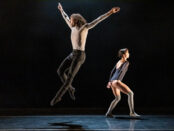
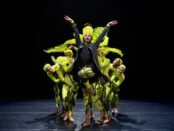
What has happened to Pilobolus? Two programs, A and B, under the umbrella title “Other Worlds Collection,” made up the repertory during this visit to NYC. If Program A at The Joyce Theater is any indication, the troupe has become—yipes!—a dance company: no gimmicks, no mirrors; no feathers; no shadow play; no nudity; and, worst of all, no sense of humor. Program A was particularly lacking in the last-listed quality, four works that took gloom and mystery to new heights (depths?). [more]
Breakin’ NYC
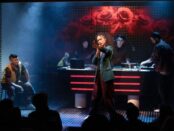
Each dancer contributes a unique personality and approach to the parade of styles, but when they all perform together it is as if they had been together forever. Each has a solo and a chance to speak about how they came to love hip-hop and how it changed their lives. Several impressed: Choung Woo Hyun has an elegance and lanky quality; Irina Brigita Laiciu’s bare midriff is as expressive as any ballerina’s toe-shoed feet; and Adrian T. Martin has a loose-limbed, easygoing quality. The other principal dancers are Jihad Ali, Messiah Brown, Kayla Muchotrigo, Rafaela Oliveira and Nicholas Porter, all displaying terrific individual qualities. [more]
CARMEN.maquia (Ballet Hispánico)
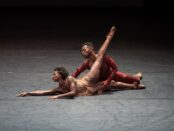
The twisty, but clichéd, choreography was not without its clever and eye-catching moments, but try as he might Ramírez Sansano never fully defined the characters, hindered by the equally colorless setting and costumes. The only variation on the relentless white of the ever-morphing pile of white bits and pieces that made up the set were several black-gray-white drops which divided the space and punctuated the action. The painting had clear references to Picasso’s masterpiece, "Guérnica." [more]
Parsons Dance: Spring 2025 Season
Six quite diverse works made up the program, four by Parsons and two by guest artists (Robert Battle and Rita Butler) who pushed the dancers to their limits. The guest choreographers worked the company in ways that challenged them after being used to Parsons’ style, which is a witty combination of ballet and modern dance, most particularly the modern dance exemplified by the late Paul Taylor with whom Parsons notably danced for a number of years. [more]
Just in Time
Groff is simply sensational in both his roles, charming as himself and astonishing in his revelatory Darin. He confesses to being “a wet man.” He proves it with his near aerobically paced performance, which included much singing and dancing and even a touch of beefcake. (Well, if you got it—and Groff got it—flaunt it!) [more]
Buena Vista Social Club
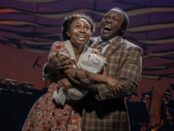
Wesley Wray (center at microphone) and the company of the Broadway musical “Buena Vista Social [more]
Love Life (New York City Center Encores!)
Brian Stokes Mitchell, Andrea Rosa Guzman, Christopher Jordan and Kate Baldwin in the opening scene [more]
A Streetcar Named Desire (Almeida Theatre)
Even though the director, Rebecca Frecknall, honors most of the play’s dialogue, Blanche’s heartbreaking confession scene with Mitch (Dwane Walcott), her suitor, revealing the sad roots of her dysfunctional life, is truncated by several meaningful words; also, the play as written ends with the men arguing over a poker game as Stella quietly mourns in the arms of her landlady, Eunice (Janet Etuk, excellent). Here it is Stella’s mournful cries that bring the curtain down, distorting Williams’ message. [more]
Talking with Angels: Budapest, 1943
So much of "Talking with Angels" is taken up by the rantings of these otherworldly emenations, which are filled increasingly by cryptic, impenetrable spoutings referencing religious imagery, that the play loses all momentum. Even though these Angels are the eponymous subjects, the really dramatic stretch of the play begins with Gitta’s plan to save not only her Jewish intimates, but scores of Jewish women after these Friday kaffeeklatsch idylls are suddenly interrupted as the Nazis bomb and then enter Budapest with frightening speed. [more]
Tango After Dark
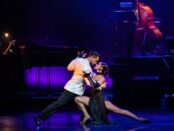
"Tango After Dark" came across as more of a slick cabaret act, albeit one that was performed and staged with professional polish. The dramatically focused lighting by original designer Charlie Morgan Jones (Clancy Flynn, assistant lighting designer and USA tour) gave theatrical flair to the choreography which, though a limited vision of this dance form, was entertaining and, at times, quite exciting. There’s nothing wrong with entertainment or excitement even if it isn’t high art. This ensemble provided two hours of fantasy even if it was a glib take on the Tango. It was a good show and a good time. [more]
Curse of the Starving Class
Elliott has directed too realistically, turning "Curse" into a sad melodrama, minus the magic. Maybe Shepard’s odd take on rural goings-on had more of a shocking appeal to sophisticated urban audiences back in the seventies before TV series about Yellowstone and Fargo, filled with their own weirdness, effaced the darkness of Shepard’s characters and plots. [more]
Anima Animal (Grupo Cadabra)
Featuring ballet great and former American Ballet Theatre star, Herman Cornejo in the leading role, "Anima Animal" was choreographed by Anabella Tuliano on Cornejo’s ballet concert group from Argentina, Grupo Cadabra. A creation-themed work, the long program notes detailed the complex folk vision of the world, a story that once fascinated the legendary ballet titan, Vaslav Nijinsky when the Diaghilev Ballets Russes toured South America during the First World War. [more]
Dances by Charles Weidman
“Lynchtown” (1936), probably Weidman’s best known work, is an indictment of lawlessness and group anarchy. It is one section of a three-part work called “Atavisms.” Members of the Sokolow Theatre/Dance Ensemble (Samantha Géracht, Eleanor Bunker and Lauren Naslund artistic directors) honored Sokolow’s commitment to chilling psychology interpreting Weidman’s choreography. (Sokolow was a Graham acolyte who went off on her own artistic path.) The earth-colored paneled costumes (courtesy of Kanopy Dance) were a kind of camouflage for the large group of dancers led by the Inciter (Margaret Mighty Oak Brackey). They slinked in, stalking their poor Victim, Sam K who was distinguishingly dressed in blue. Their initial stilted, flex-footed walk slowly deteriorated into skitters, off-balance tilts and turns and stomps which turned into a pileup with the Inciter on top, scouting for their quarry. Lehman Engel’s strongly percussive music supported the choreography perfectly as the Victim is trapped like an animal and dragged to his fate. In its time, “Lynchtown” was a strong work and still retains much of its power. [more]
B*tchcraft
Bitch turns herself inside out in ways sometimes difficult to bear, particularly with her frank, anatomical language, but she communicates her joy and anguish so honestly and unflinchingly that it is all somehow totally fine. "B*tchcraft" is a collaboration between Bitch and her director Margie Zohn. Between them they have crafted a powerful show that is both personal and universal in its emotional heft. The language and imagery are strong, maybe not for everyone, but they resonate with Bitch’s totality. [more]
Urinetown (NY City Center Encores!)
“What an awful name for a musical,” spouts Little Sally (a brilliantly talented Pearl Scarlett Gold) as one of the narrators of the New York City Center Encores’ witty production of the 2001 surprise hit "Urinetown." Yes, it is, but it’s also an entertaining show that actually has inadvertent relevance to today’s audience with its artful jabbing at big business. [more]
Malpaso Dance Company: Winter 2025 Season
This may not have been a typical program for the Malpaso Dance Company, but the troupe seems to lean towards the darker parts of life. As moving as each of the works are, they all painted a gloomy view. The movement style was an amalgam of ballet and the plasticity of good old-fashioned modern dance: lots of extensions, falls, turned-in legs and twisty partnering. [more]
Ronald K. Brown/Evidence: A Dance Company – 2025 Winter Season
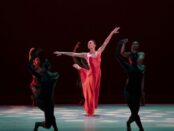
The best constructed work was the finale, “Grace” (1999), in which Brown created a Goddess figure come down from Heaven “to spread grace among humans.” In addition to a score by Duke Ellington, Roy Davis, Jr. and Fela Anikulapo Kuti which went from darkly dreamlike to upbeat, guest vocalist Gordon Chambers sang an uplifting soulful, spiritual number as the angel-like lead ushered the cast through a portal to their ultimate fate: heaven. Was it my imagination or did the dancers costumed in red change into the white of the rest of the cast as they exited? Was this, perhaps, a symbol of the acceptance of …grace? Costumes were by Omotaya Wunmi Olaiya. [more]
Ragamala Dance Company: “Children of Dharma”
The troupe, led by a mother and two daughters—Aparna Ramaswamy, Ranee Ramaswamy (mother) and Ashwini Ramaswamy—presented “Children of Dharma,” based on elements of the famous Hindu epic "The Mahabharata." A totally original interpretation of this age-old story, it is a complicated tale about Krishna, “the embodiment of nature,” (a bare-chested Garrett Sour wearing just a plain dhoti), somewhat explicated by a voiceover narration recited by Leon Conrad. Two other characters dominate: Draupati whose epic dice game incites an epic war and Gandari, who tragically loses and mourns her many children. [more]
Mrs. Stern Wanders the Prussian State Library
Jenny Lyn Bader’s "Mrs. Stern Wanders the Prussian State Library" has moved from a successful run at the 59E59 Theater to the intimate WP Theater on the Upper West Side. This is fortunate for those who missed it. Mrs. Stern shines a light on a dark moment in the life of a major cultural figure of the twentieth century whose career was nearly short circuited. [more]
The Hard Nut
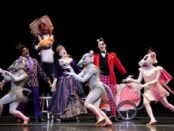
The main difference is the delightfully over-the-top, campy production that takes the audience into the fertile mind of Mark Morris and his artistic colleagues. The mostly black and white scenic design by Adrianne Lobel features circular prosceniums within circular prosceniums, exaggerated furniture and, wittily, a gigantic world map with lights indicating where the different ethnic dances—Chinese, Spanish, Russian---are from, as if Martin Pakledinaz’s hilarious costumes didn’t already tell the story. [more]
Alvin Ailey American Dance Theater: Winter 2024 Season
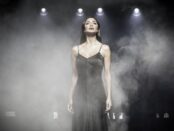
The second premiere was a battle of the sexes duet, “Me, Myself and You,” choreographed by Elizabeth Roxas-Dobrish to a Duke Ellington song, “In a Sentimental Mood” sung lustrously by Brandie Sutton. Caroline T. Dartey, in a long, silvery robe (costumes by Danté Baylor) rose from the floor and wandered beautifully towards a standing screen on the other side of the stage. Once unfolded, the screen was revealed to be a three-part mirror which seemed to fascinate Dartey as she almost made love to her own image. [more]
Death Becomes Her
“Glitter and Be Gay” is not just a Leonard Bernstein aria from Candide, but the perfect description of the campily funny new musical "Death Becomes Her" which just hit the Lunt-Fontanne Theatre like a friendly tornado. Double entendres explode in all directions. Take the song titled “For the Gaze,” as a tongue-in-cheek example. Based on the 1992 film of the same name, the creators of the musical—Marco Pennette (book), Julia Mattison and Noel Carey (music and lyrics)—have taken the smarmy, star-studded film and turned it into an entertaining, equally star-studded musical. [more]
Oud Player on the Tel
Can the tale of two families living in Palestine just before the partition that created the State of Israel shine a light on the current status of affairs? Playwright Tom Block’s "Oud Player on the Tel" does just that with a combination of wit and empathy. The play, currently at HERE Arts Center in SoHo, is part of HERE’s SubletSeries. [more]
Ragtime
"Ragtime," thought of as an unwieldy musical with too many characters and too many themes, hit Broadway in 1998. Based on the 1975 E.L. Doctorow novel of the same name, the many storylines were artfully tamed by the team of Terrence McNally (book), Stephen Flaherty (music) and Lynn Ahrens (lyrics). New York City Center has chosen "Ragtime" as its 2004 Annual Gala presentation in a brilliantly streamlined production directed with an eye to its still-important message by Lear DeBessonet with a large and exceptional cast and an excellent orchestra under the baton of James Moore playing William David Brohn’s original rich orchestrations. [more]
Sunset Blvd.
Now, director Jamie Lloyd has taken the clunky—but entertaining—Andrew Lloyd Webber musical "Sunset Blvd." (1993) and stripped it of all realistic scenery—and a few songs—hoping to get to the nitty-gritty of its Hollywood characters and period with enormous projections which suggest an expressionistic silent film. The results are decidedly mixed mostly due to a failure to settle on a tone plus some head-scratching additions that have nothing to do with the story. Lloyd, most recently represented by his dreary, stripped-down A Doll’s House and an equally spare production of Pinter’s Betrayal, has shepherded this production with a combination of brilliance and self-indulgence. [more]
The Christine Jorgensen Show
Donald Steven Olson’s "The Christine Jorgensen Show," a two-hander, focuses on the creation of her nightclub act. Jorgensen (portrayed by Jesse James Keitel known for "Younger," "Queer as Folk" and "Star Trek: Strange New Worlds") approaches showbiz veteran Myles Bell. Mark Nadler, virtuoso pianist, cabaret superstar, and co-composer for this show, takes on the role of this quirky, energetic performer and songwriter. [more]
Yellow Face
Clearly, Hwang’s playwright-within-the-play has been on a colorful journey, full of characters that amuse, anger and move him. Hwang’s genius here is his ability to spin his real life into a fascinatingly entertaining work using all these events and characters. He is artful in balancing the lighthearted with the sardonic and the dramatic, the result being a colorful portrait. The flier for "Yellow Face" shows its handsome star Daniel Dae Kim holding a mask of his smiling face away from his own scowling visage, a witty take on the Greek Comedy/Drama masks, a shorthand for "Yellow Face"’s richness. Of course, having Daniel Dae Kim in the central role embodies his character with depth and subtlety. [more]
Distant Thunder
We’ve come a long way from "Annie Get Your Gun" to the new musical "Distant Thunder" produced by Amas Musical Theatre at the A.R.T./New York Theatres. The Irvin Berlin song “I’m an Indian, Too” from "Annie" is filled with silly clichés about our indigenous people that "Distant Thunder" puts to rest. "Distant Thunder," written by Lynne Taylor-Corbett and Shaun Taylor-Corbett (book) and Shaun Taylor-Corbett and Chris Wiseman (music and lyrics), (with additional music and lyrics by Robert Lindsey-Nassif and Michael Moricz,) deals sensitively with issues facing Native Americans today. All of the actors are members or descendants of Native Americans and all give body and soul to their characters. [more]
BalletX: Fall: 2024 Season
The final work of the evening was Takehiro Ueyama’s “Heroes,” dedicated to the brave, hard-working citizens of Japan who helped pull themselves out of the devastation of World War Two. Set to darkly emotional music by Kato Hideki and Ana Milosavljevic (played live) and a recording of John Adams’ moody, but energetic “The Chairman Dances – Foxtrot for Orchestra,” “Heroes” was filled with a wide range of emotions beginning with a long duet, a portrait of a deeply emotionally involved couple who, heartbreakingly, wind up parting, Ueyama’s choreography skillfully, but subtly illuminating a wealth of emotions. [more]
The Goldberg-Variations
"The Goldberg-Variations" by George Tabori (written in 1991, now having its belated new York premiere) is a confused and confusing conflation of Bible stories and backstage bickering amongst a playwright, his director, designer and actors. Now at the Theater for the New City, the overlong production, directed by Manfred Bormann keeps the audience scratching their heads as each part of the Good Book is explored. [more]
London City Ballet: Fall 2024 Season
“Larina Waltz,” choreographed by Ashley Page to the lilting melodies of Tchaikovsky, opened the program. It was a dynamic expression of the classical ballet bona fides of this youthful company. Arrayed in a line of five couples, the men in black tunics and the ladies in white tutus, they performed unison partnering showing off the easygoing style that became more evident as the program progressed. Couples peeled off until only one remained, soon replaced by a succession of couples, all of whom performed charming, if not dazzling, turns, lifts and complicated steps, the men leaping and the women showing off balance and grace. This was a charming lagniappe, a gift to warm up the audience’s expectations. [more]
Airport and the Strange Package
"Airport and the Strange Package" effectively combines good old-fashioned paranoia with witty references to Kafka’s classic. King and his collaborators have fashioned a frightening but entertaining portrait of airport security gone crazy. After all, what modern traveler hasn’t feared the awesome, if arbitrary, power of the Transportation Security Administration? [more]
Pilobolus: Summer 2024 Season
"Memory" brought back “Untitled,” a masterpiece from 1978. This work had everything that made Pilobolus the world class dance troupe it became. Choreographed by Pilobolus founders Robby Barnett, Alison Chase, Martha Clarke, Moses Pendleton, Michael Tracy and Jonathan Wolken, and using disarmingly and misleadingly pleasant music by Robert Dennis, “Untitled” began with two women (Feliz and Klinkman) wearing ornate 19th century dresses as they lay on the ground having a pleasant picnic. (Costumes by Kitty Daly and Malcolm McCormick.) As they rose they slowly grew into giants, their legs clearly those of men. These now eight-foot tall women moved gracefully about soon joined by two fully dressed men (Loman and Langford) who flirt with them. As the two ladies were lowered onto their own legs, their supporters proved to be two naked men (Chaparro and Ellis), a bit of a shock to the audience, softened by the beauty of the two. The two women wafted about blissfully unaware of the four men until the naked men resumed their positions under the women’s skirts as they floated off. This combination of period nicety, nudity and psychology and superb movement made for a hauntingly memorable work. [more]
Ain’t Done Bad
Jakob Karr conceived, choreographed and directed his full-length dance/drama, "Ain’t Done Bad" currently heating up the Irene Diamond Stage at the Pershing Square Signature Center just west of Times Square. It is a courageous, if generic look at the trials and tribulations of a young gay man confronting his inner demons and his hard-as-stone father. [more]
Introdans: Energy (triple bill)
The Netherlands-based dance troupe Introdans (Roel Voorinthoff, artistic director) exploded onto The Joyce Theater stage in an aptly titled program, "Energy," making a very welcome return to this esteemed home for dance. Although worlds apart stylistically, the first two works, “Kaash” and “Concerto,” were choreographically similar, their form based on repetition of simple themes that gathered strength as each work progressed. [more]
Titanic
The tapestry Stone weaves with his multitude of characters—too many to mention here—is always fascinating in its subtle details. Each person stands on his or her own helped by superb performances by the entire cast under the skilled direction of Anne Kauffman ("Mary Jane" and "The Sign in Sidney Brustein’s Window"). Under her care they all sing magnificently helped by guest music director Rob Berman’s sensitive handling of the Yeston score, directing the large Encores! Orchestra to bring out all the facets of the almost operatic music. [more]
Party Clown of the Rich and Famous & The Hungry Mind Buffet
There’s so much fascinating material in "Party Clown of the Rich and Famous" and its companion compendium of four short works, "The Hungry Mind Buffet" that it pains me that the works aren’t presented with classier production values, unfortunately a reality in cash-strapped Off-Broadway presentations. Even so, the evening offers much to savor. [more]
Christopher Caswell: Listen to My Heart
Christopher Caswell: "Listen to My Heart" took the audience into his confidence as he opened up about his personal life: friends, loves, children and, of course, show business. His show had the intimacy of being in Caswell’s living room in the guise of the Laurie Beechman Theatre, just off the theater district. Lean, youthful and handsome, Caswell—who admits to being sixty-plus—opened with a stroll through the audience singing the title song, which, after many personal revelations, also ended the show, taking on a different meaning. [more]
Bettye and the Jockettes Spinning Records at the Holiday Inn
Christie Perfetti Williams’ genial new play "Bettye and the Jockettes Spinning Records at the Holiday Inn" transports the audience back to the moment Elvis Presley became an international star via his appearance on the Ed Sullivan Show in July 1956. Working at the tiny all-female Memphis radio station, WHER, tucked off the lobby of a Holiday Inn, Bettye (Heather E. Cunningham) is devoted to spinning jazz records and does the occasional interview. She is not a fan of Presley’s music but is given the assignment of interviewing him, a task made all the more important for the station now that Presley’s career is about to zoom into the stratosphere. [more]
The Heart of Rock and Roll
"The Heart of Rock and Roll" at the James Earl Jones Theatre is one of the more pleasant entries in the jukebox musical derby. Using the musical catalog of Huey Lewis and the News, Tyler Mitchell and Jonathan A. Abrams, (book by Abrams), have fashioned an amusing story of a working class Joe who is torn between his love of rock music and his need to make a living in business. Heart began its Broadway-bound journey in 2018 at the Old Globe in San Diego, but is set firmly in the 1980’s. [more]
Mother Play, A Play in Five Evictions
"Mother Play," though based on Vogel’s own life, is her most schematic, more an outline barely fleshed out with lots of details rather than the intense emotional revelations of her earlier works such as "How I Learned to Drive" and "Indecent." The chronological span of the play precludes anything but a quick portrayal of a procession of life-changing events in the Herman family and the rest of the world. Only Martha comes close to revealing her inner tumult at being torn between her mother and her brother. AIDS and other markers of the fast-moving decades are served up too quickly and with foregone conclusions in weak attempts to pluck the audience’s heart strings. [more]
Mary Jane
The play is an expression of the quiet whirlwind within Mary Jane’s soul, exquisitely expressed by the warm McAdams, surrounded by the boundless support of the others. Director Anne Kauffman masterfully allows the play to express vast emotions in the most subtle ways. What might have been a tearjerker is so much more, a chance to completely belong in this character’s mind and heart. [more]
Suffs
The transfer to Broadway has brilliantly expanded the show. The new production designed by Riccardo Hernández (scenery), Paul Tazewell (costumes), Lap Chi Chu (lighting) and Charles G. LaPointe (wigs & hair) brings Taub’s script to vivid life, much better than the more didactic and spare Public Theater rendering. These artists put Taub’s script into historical context making the battle all the more vibrant. The new version also has rethought the casting, reshuffled and improved the songs and, more importantly, is more focused and effective in telling about the conflicts—internal and external—that plagued the suffrage movement. These included dissonance between Catt and Paul; the thorn-in-the-movement’s side of the Black contingent led by the brilliant Ida B. Wells (a charismatic Nikki M. James); and the far left, Socialist ideals of the hothead Ruza Wenclawska (Kim Blanck, brilliantly avoiding caricature). [more]
Stereophonic
David Adjmi’s "Stereophonic" at the Golden Theatre, a transfer under the auspices of Playwrights Horizons, is a minutely detailed, almost minute-by-minute recreation of a recording session by a rock band, purportedly based on Fleetwood Mac’s creation of its epic album "Rumours" in 1976. (Adjmi has denied that this was his inspiration, claiming that the show has an amalgam of sources.) [more]
Dali’s Dream
The four patients’ stories occupy the bulk of "Dali’s Dream" in an uneven stream of oddball activities which divert the plot from the more important consideration of the Freud/Dali interaction. Their behavior is whimsical at best, arbitrary at worst. The play becomes an awkward phantasmagoria of the four patients’ crippling neuroses, hiding the fact that the reason for the play, its important focus, the meeting of two major minds of the twentieth century, becomes secondary, not to mention swelling the play’s running time. Their discussions are never fully realized, but get as far as Dali’s admission that he could remember being in his mother’s womb, more a boast than a revelation. [more]
Oh, Mary!
No one should be sacrosanct or above satirical treatment, not even our heroes. Everyone has feet of clay. Cole Escola in their huge hit "Oh, Mary!" at the Lucille Lortel Theatre in Greenwich Village certainly believes this. Their over-the-top, irreverent take on Lincoln, Mary Todd Lincoln and John Wilkes Booth is so scurrilously sexual that it is difficult to avoid guffawing at their magnificent awfulness helped by Escola’s constant silly shtick and blatant playing to the audience, all of whom seemed to be having fun. [more]
Travels
"Travels" at Ars Nova isn’t just a story of the many places James Harrison Monaco has been. That’s part of it, the most superficial part. "Travels" is far more: a deep look at the people in his life, two in particular, whose fascinating and moving stories emerge from a torrent of music, videos, lights and words. In eight songs/scenes a very personal saga unravels until a chilling coda. On the tiny Ars Nova stage, a console contains the control center of the production. Constantly moving images give the illusion of flying into a vortex, soon replaced by more informative images that illustrate the stories told by Monaco and his very talented compatriots: El Beh, Ashley De La Rosa, Mehry Eslaminia and John Murchison. [more]
Stalker
Peter Brynolf and Jonas Ljung, two coolly elegant Swedes—who wrote the show with Edward Af Sillén (also the show’s director)—perform one mind-boggling feat after another, fed by information culled from the audience. The two performers also speak of their own lives, although why they have to describe themselves as “two heterosexuals” is questionable. [more]
Orson’s Shadow
For those interested in both theatrical history and the lives of our former artistic heroes, Pendleton doesn’t disappoint, even if he exaggerates and manipulates the facts a bit. He does better with Welles and Olivier, both played smartly and quirkily, than he does with Taff’s almost invisible Plowright and Menna’s ghostly, but glamorous Leigh. Hamilton’s Tynan is more didactic than dramatic, but he looks terrific and keeps the show rolling along. Listening to these giants kvetch and spew is fascinating and strangely satisfying. [more]
The Look of Love (Mark Morris Dance Group)
"The Look of Love" was filled with Morris’ least complex choreography, relying on repetition, walking, running and soft leg extensions along with simple arm gestures. Considering the sophistication and elegance of Iverson’s arrangements for the MMDG Music Ensemble, Morris, whose musicianship is his best feature, clearly decided to go for the obvious and easily digestible. Nothing wrong with this approach, but it made "The Look of Love" appear less substantial than it really was. [more]
Dongpo: Life in Poems
Dongpo’s travels through life is set forth in the lovely poems—projected in Chinese script and in English—full of observations of nature, sad inner monologues and thoughts intimating the end of a long life. They helped set the tone of "Life in Poems," including some humorous trips to the twenty-first century wittily added to the next-to-the-last act: dancers on skateboards, scooters and other unabashedly modern modes. Divided into six short acts, each defined by a Dongpo poem projected onto several large scrims, the ballet slowly builds to an eye-popping full cast finale. [more]
Doubt: A Parable
In this Roundabout/Scott Ellis production, Amy Ryan’s Sister Aloysius (stepping in for the originally cast Tyne Daly) comes across as less absolute in her suspicions while Liev Schreiber’s Flynn is less wavering than was the more nervous O’Byrne. Perhaps this is partly due to the fact that, unlike the original casting, Schreiber is physically more imposing than Ryan making her seem more like a small creature attempting to take down much larger prey. The current production, brilliantly and realistically designed by David Rockwell and costumed by Linda Cho, has a more human feel than the original which, unfortunately, makes the play’s last scene less effective. The war Sister Aloysius imposes on her church and school becomes more a battle of old against new and the lack of power of nuns versus the entitled males of the Catholic Church. [more]
Fair Winds and Winds of War
Kahn has a good ear for the subtleties of each character and the period. However, "Fair Winds" doesn’t handle all the major themes smoothly and the use of the narrator sometimes feels like a way to make up for her storytelling shortcomings, although Maisonett is an accomplished enough actor to make it work. [more]
Pontus Lidberg: “On the Nature of Rabbits”
How the metaphor of rabbits fit into this was puzzling, yet the dreamlike (nightmarish?) rabbit imagery was the strongest visual idea and pervaded the work, from a toy stuffed bunny to grotesque rabbit masks the dancers wore throughout the show. Perhaps the stuffed bunny was akin to the madeleine which Proust tasted, leading to a river of memories and Á la Recherche du Temps Perdu, the rabbit inducing Lidberg to ponder his childhood? [more]
The Maid & The Mesmerizer
Lynn’s dialogue is astute and subtle, following the heartbeat of this strange, but understandable couple lifting it out of soapiness and melodrama. She has written a very modern drama. ... Jenn Susi’s direction helps transform conversations into a real one-act play with natural rhythms and a satisfying ending. [more]
A Sign of the Times
This York Theatre Company production at the New World Stages, following a presentation at Goodspeed Musicals in 2016, shoehorns these songs into a book by Lindsey Hope Pearlman from a story created by Richard J. Robin. It has an ambitious plot that glibly takes on a number of themes roiling through the turbulent Sixties: women’s lib, civil rights, the war in Vietnam, the sexual revolution, Andy Warhol, and even a premature touch of gay liberation. [more]
This is not a time of peace
"This is not a time of peace" has a stream of consciousness feel effectively handled by the director Jerry Heymann. There is never any confusion about who is who and what they represent despite overlapping dialogue and quick segues from one era to the other. It is Cohn’s performance as Alina that is the strong spine of the play. She opens and closes the play going from a matter-of-fact opening monologue to an impassioned closing statement, leaving the audience to empathize with her and comprehend all the frustrations she experiences. [more]