In college, during my senior year, I had an assignment to put together a half hour cabaret. I did that also about being a redhead, so I started there and dug up that old sheet music and changed/added to some of that. I’m covering some iconic gingers in musical theatre as well as some of the social aspects of being a ginger -- some of the things that "South Park" brought up. There’s this episode where they claim that gingers have no souls and make fun of them, so will be referencing and challenging those views. It’ll also be some stories and some of my favorite songs. [more]
"Alice in Black and White" is a play-within-a-play. Two parallel stories are told: one of Austen’s life and relationship with Gertrude Tate, her companion for over 40 years; and one in the early 1950’s involving a Staten Island Historical Society receptionist and journalist Oliver Jensen, who later published "The Revolt of the American Woman" (which included Austen photographs) and a Life magazine article on Austen. [more]
A new media and sophisticated ticket booking system is brought into play even before the play begins. In order to buy tickets, a theatergoer has to give out his/her cell phone number for text follow-up information as to confirmation of time and the Midtown location. The immersive theater is kept secret until the day of booking the event. The address of where "Paradiso: Chapter 1" is being held is texted only four hours before the participant’s allotted time. [more]
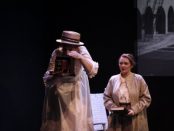
Thomas G. Waites has a long list of major credits that go back to the film "The Warriors" in 1979. As Austin, he gives one of the strangest performances in memory. It’s a monotonously upbeat steamroller turn that recalls the hyper enthusiasm of the young Donald O’Connor combined with the cloying seriousness of the older Mickey Rooney at his most lachrymose. Watching Mr. Waites is exhausting and bewildering. [more]
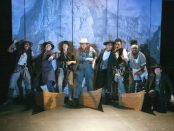
In this swashbuckling comedic play, 'Men on Boats" takes an innovative approach by casting ten women in the roles of the first “white” discovers of the Grand Canyon. However, this was not a nod to the current trend of casting cisgender or transgender actors. The use of “on boats,” instead of “in boats,” indicates the state of being in which the actresses find themselves — a history panorama where gender and race play little part. [more]
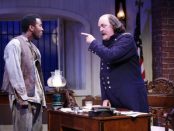
Taking place during the time of the Civil War, "Butler" is a tale of conscience, courage, and transcendence. As Major General Benjamin Butler, Ames Adamson has risen to power but is faced with a decision that could change the game for slavery in America. Many of the themes surrounding a nation divided such as injustice, prejudice, and lack of understanding remain extremely relevant today and are just as impactful with events occurring every day in our world. Instead of ignoring the issues or using power as the only weapon, Butler flips the script and uses empathy and understanding as a means to connect. [more]
“We’re actually going to be talking about 14th century Italian literature,” proclaims BenDeLaCreme near the start of his/her entertaining multimedia solo show" BenDeLaCreme’s Inferno A-Go-Go." It’s very loosely and irreverently based on Dante Alighieri’s The Divine Comedy. That literary classic describes a journey through hell including The Ninth Circle. Here it’s used as a clever pretext for an hour of inspired silliness with flashes of seriousness. [more]
The charming and charismatic Broadway leading man Santino Fontana performs the role of Elliot Rosewater with as much commitment as if he were playing J. Pierrepont Finch. Mr. Fontana’s performance is the magnetic anchor of the show. Kilgore Trout is a loony science fiction author of 117 novels and over 2000 short stories and is a recurring character in Vonnegut’s novels. Here he appears briefly near the end of the show wearing a hunting cap and rising from a wheelchair. That he is played by the legendary 85-year-old James Earl Jones with his thundering voice, joyous presence and sly comic timing is wonderfully jolting. Mr. Jones also is the narrator. [more]
“The characters in this play both the living and the dead are completely fictional.” This statement explains the play’s overall contrived quality. Both of the lead characters have such striking similarities that at times they come across as mouthpieces academically articulating “The Troubles,” the 30-year war in Northern Ireland between The British and Catholic natives that ended in 1998. [more]
These are among the choice zingers in playwright Anne Adams’ emotionally raw, earthy and often very funny contemporary dysfunctional Texas-set, family drama, "Strange Country." This entertaining piece of Americana has the humanity of Lanford Wilson, the quirkiness of Beth Henley and the unruliness of Sam Shepard. [more]
Bartlett Sher complements Rogers by punctuating the play with visual puns that substantially add to the drama and importance of the enfolding events. A dinner party at Mona and Larsen’s home is disturbed by two phone calls, ringing at the same time. Larsen fields a call from Israel and Mona takes a call from the P.L.O. Phone cords or wires are crossed, as Larsen and Mona exchange mouthpieces and try to arrange meetings and facilitate a place and time for the negotiations in Norway. [more]
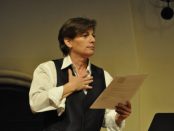
Dressed in black slacks, a white shirt and a black vest, Ms. Wolpe demonstrates a fluid physicality and a soothing vocal expressiveness. Wolpe quite adeptly offers rich characterizations of some of those most illustrious roles. In addition she seamlessly switches to delivering revelatory reminiscences and concise analysis of the plays with élan that recalls Spalding Gray’s monologues. The combination of these elements yields to a wonderful performance. [more]
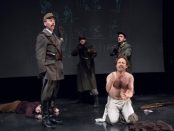
Director Richard Romagnoli who also staged the 2007 production and he has done an excellent job of visualizing the scope of the scenes. Action on the battlefield, political conflicts in Moscow and German atrocities in the Ukraine are all exciting. A life drawing class sequence at a Budapest art school is quite compelling. A longhaired female model makes sardonic observations from atop a ladder as the students in long white coats swirl around her. It recalls the stunning achievements of Derek Jarman and Peter Greenaway in their art house films. [more]
After a less then engrossing hour of prattling and a too stylized presentation, in its last thirty minutes "The Red Room" becomes the powerful family drama it intends to be. [more]
If you're stuck in the city in the hot summer, there's good reason to come to the cabaret. All the Manhattan clubs have impressive lineups for the summer months. Some of the most entertaining and musically refined engagements can be found at Feinstein's/54 Below as they offer rosters that are hard to top. Two recent engagements stand out. [more]
The score that Mr. Antin composed and wrote the lyrics for is a serviceable collection of songs that could possibly have succeeded in a show about the conflicts among married couples. Wedged into a dramatization of a horrendous historical event, they’re hollow and rarely achieve other then a filler quality. [more]
Under John Duff’s direction, this energetic group of performers get an A+ for accurately portraying their chosen characters. As KimKat, Carmen Mendoza is as self-centered as can be and let her queen status be known with “The Selfie Song,” while Elliott Brooks’ KhloeKat takes on the role of the black sheep of the family with her hysterical, crude and unfiltered persona shining through. As KrisKat, Bailey Nolan makes her mark as the creator of the litter known from the start and is just as domineering and commanding as you’d expect. Peter Smith, who is a supporting player in the Kardashians’ show, takes on the role of Bruce Jenner/Catlyn and tries to find his place among divas – getting his moment with the catchy, “Bruce Jenner (He's a Man's Man).” [more]
Karen Carpenter singing her song, We Have Only Just Begun (to live), sitting on a stool in the afterlife takes the meaning of ill-fated to a whole new level. However, Karen Carpenter, Whitney Houston, Amy Winehouse and Kurt Cobain singing Karen and Richard Carpenter’s number one hit, Top of the World, brought the house down. The staging of whom sang what verse and when was priceless. And, Greg Schlotthauer’s musical direction is inspired. [more]
It is August 11, 2033, and there’s a wild party happening because the world is ending. That’s the setup of the exuberant one-hour multimedia fantasia "HYPERBOLIC! (The Last Spectacle)." This often very funny and eerie Downtown mash up of the styles of Bob Fosse and Baz Luhrmann is crossed with dashes of enigmatic Sci-Fi and drag queen sensibilities. [more]
"Phoenix Rising: Girls and the Secrets We Keep" takes place in two worlds: the New York CBGB punk scene of 1985, and a dark, Greek mythological other world of indeterminate time and place. In 1985, a high school social worker by the name of Grace mentors an after-school, trauma therapy session. In the other world, the Archetypal Mother/Storyteller presides over her “damaged souls” and reads from an ancient tome, the “Phoenix Book.” [more]
Over the last several years, PRISM and two colleague chamber groups, Sō Percussion on the one hand and PARTCH on the other, have been engaged in the “Color Theory” project, and presented two separate concerts. Taking as their model early modern visual artists' examination of pigment mixes through the insights of Isaac Newton's discovery of color theory and prisms, the four saxophonists and composers with whom they collaborate have been using “color theory as a framework to explore the spectra that make up instrumental sound.” The results were exhilarating. [more]
At one point stumbling around in a sleep mask and wearing a colorful nightgown, the 88 year-old Estelle Parsons has a field day as the 88 year-old Evelyn, a former journalist for The International Herald Tribune. Ms. Parsons delightfully barrels through the play growling, cursing, and exhibiting vibrant physicality. Being the skillful old pro that she is, Parsons has the technique to tone it down when needed. [more]
A leggy dark blonde young woman with her hair pulled up, wearing a black skirt, a patterned short gray blouse and high heels walks through the audience and onto the bare black stage. She begins dancing and then is joined by two lovely young female dancers in psychedelic tunics and all three perform Valerie Mae Browne’s beautifully choreographed modern dance accompanied by mellow pulsating electronic music. It’s all something that would not be out of place on a program at The Joyce Theatre. [more]
The Wheelhouse Theater Company presents this fast-paced and faithful version of the romantic classic. Co-directors Jeff Wise and Matt Harrington have inventively pared down William Shakespeare’s enduringly resonant tragic play to 90 minutes. Mr. Wise and Mr. Harrington’s staging is visually compelling with a number of clever touches. Mortal wounds are indicating with the unfortunates tossing red rose petals. Juliet delivers a speech as a stand-up comedy routine with recorded audience laughter heard. That there’s no actual balcony doesn’t really matter as that famous scene is so finely blocked and performed. [more]
James Joyce most always put himself first, according to Jonathan Brielle, who wrote the book, music and lyrics for "Himself and Nora," (subtitled “The Greatest Love Story Never Told”), Minetta Lane Theatre’s new Off-Broadway musical. Brielle explores the narcissistic and codependent 37-year relationship between James Joyce and Nora Barnacle (who later became Joyce’s wife). For a purported love story that defined a genius and mesmerized Joyce enthusiasts for ages, the two-act musical is lightweight with minimal literary biographical details. [more]
Rolling Stone magazine’s 2014 controversial article "A Rape on Campus: A Brutal Assault and Struggle for Justice at UVA" about an alleged rape at a University of Virginia fraternity house seemingly has inspired the author of this play, Kim Davies. Ms. Davies has taken many of the facts of that story and woven them into this fictionalized narrative that falls short of being compelling. [more]
Growing up in Wood-Ridge, New Jersey, Rita McKenzie never imagined the places that her career would take her. Traveling all over the world with "Ethel Merman’s Broadway," McKenzie has shared the life and career of an international superstar with audiences from different cultures and backgrounds who continue to honor her legacy. Along the way, McKenzie has also made discoveries about herself and her desire to always keep growing and learning in an ever-changing world. [more]
C4 has always been driven by certain core values and goals; the particular repertoire “cornerstones” being emphasized this season, as indicated in the concert's program notes, were important but infrequently performed works, beauty, and the nurturing of new composers' voices. This concert contained all these features in both recent works and four premieres. [more]
Chris Doi winningly conveys Ichiro’s anguish and holds attention as this leading character with his emotional performance. The personable Glenn Kubota is deeply gentle as Pa, and Mr. Kubota performs a beautiful movement piece with his hands fluttering as birds during a storytelling segment. As Ma, Karen Tsen Lee poignantly descends deeper into her delusions with histrionic expertise that Japan won the war and is marvelously engaging during her fable-like recitations. [more]
Ms. Feiffer’s rudimentary characters communicate by the sledgehammer approach to comedy. Until the mawkish finale there is a barrage of zingers, one-liners and vulgarisms. If a theatrical awards body had a category that honored the most abundant use of the word “fuck,” this play would be a major contender for such an honor. [more]
"Blankets and Bedtime: 3 Restless Plays" is produced by the theater company A Pixie Theory and is presented as part of The Planet Connections Festivity.The stated theme of the three plays is “the extremes people will go to in the name of self-preservation.” Erik Champney succeeds at dramatizing this concern and also demonstrates that he is a talented and imaginative playwright. [more]
First performed in 1979, this is a relatively early work by the supreme British dramatist Alan Ayckbourn (b. 1939) who is as of this writing up to his 79th play, "Hero’s Welcome.' The new play is having its U.S. premiere at 59E59 Theaters and performs in repertory with "Confusions." "The Norman Conquests" is among Ayckbourn’s best-known works and "Confusions" is representative of his trademark style and concerns. Human behavior in all its complexities is dramatically rendered with depth and humor in a boldly theatrical and inventive manner. Both productions come from the Stephen Joseph Theatre, Scarborough, which has staged almost all of Ayckbourn's plays and from which he retired as Artistic Director in 2009 but where he continues to direct plays. . [more]