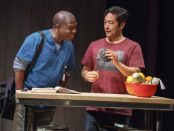
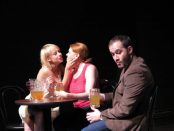
Pierce coolly addresses the audience while delivering this mundane litany. His superb comic timing, long evident on the television situation comedy "Frasier," is on glorious display here. That quality combined with his dramatic depth and soothingly funny delivery makes this opening sequence mesmerizing. [more]
British author Stephen Sharkey’s new translation is faithful to Brecht, but the Phoenix Theatre Ensemble has fashioned the presentation as an old-time radio show. Brecht was known for his self-conscious style of distancing and alienation, where the audience is made aware that they are watching a play but this additional device is a distraction and not as funny as intended. [more]
Despite its formulaic story, "I Like It Like That" is quite exhilarating with its sensational salsa renditions as performed by its appealing cast and excellent band. [more]
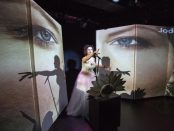
Visual artist and puppeteer Jessica Scott navigates through a satiric and fascinating new media “seascape” with a dysfunctional ship’s crew, albeit all women. Scott’s "Ship of Fools" uses nightmare structure, intentionally drawing from Book VI of Plato’s "Republic" (from whence its title came), Bosch imagery and other surreal allegories, depicting the fine line between heroines and madness. [more]
In "The God Projekt," the “Divine He” repeatedly tries to make reparations for his past destructive deeds, but to no avail. God is wrestling with dementia and in a time loop. Yet, he is determined to correct, well, his god-awful mistakes -- one of which is not only acknowledging the “Divine She” in his heavenly order, but atoning for a heinous crime against her. [more]
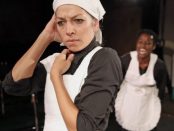
Obie award-winning playwright José Rivera is an Oscar nominee for his adapted screenplay for "The Motorcycle Diaries." For this adaptation, he has set "The Maids" (which premiered in Paris in 1947) in Vieques Island in Puerto Rico in 1941. This was a politically tumultuous era with native factions resisting the U.S. presence there. Mr. Rivera’s script reflects this situation and locale and is filled with cultural references to sugar cane, bustellos and revolutionaries. [more]
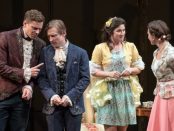
The scenic design by Brett Banakis is a functional, minimalist configuration of a slightly raised wooden performance platform surrounded by a wooden frame dotted with small antlers suggesting the pub. There’s an assemblage of vintage furniture, potted plants, screens and vines that are shifted about to designate the various locations. This all contributes to a deficit of visual grandeur that the production is understandably striving for on a limited budget but doesn’t achieve. These design flaws could be superseded by an abundance of bravura performances, but there aren’t. [more]
The gregarious Matt Koplik plays Donald Moscowitz who constantly bears the brunt of his parents’ overbearing natures. He is instantly likable, charming, and relatable as any young person can identify with in trying to maintain his independence while also respecting his parents. Kate Katcher and Tony Rossi play Donald’s parents and make quite the electric pair as they are nothing short of domineering. With his close friends, Levi and Henrietta, by his side, Donald is able to concoct an elaborate story that he hopes will make his parents happy and one that he will be able to pull off without hurting anybody’s feelings. [more]
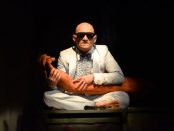
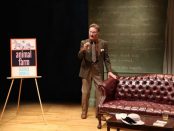
Grand highlights of Mr. Horton’s dynamic work includes an analysis of "Animal Farm" while he erases the novel’s seven animal commandments that are written on a blackboard as they are overturned one by one, by the pig Napoleon who represents Josef Stalin. There’s also a dramatic demonstration of American versus British rationing during W.W. II as Orwell produces bountiful American foodstuffs comparing them to the meager provisions allowed in Great Britain. [more]
Sheppard recollected that in the Underground Railroad game his fifth grade classmates were designated to be either Union or Confederate soldiers. The Yankees (Union) tried to covertly run slaves (portrayed as “black dolls”) from a classroom “safe house” to another classroom “safe house.” The Rebels (Confederates) endeavored to prevent the Yanks from accomplishing their mission. The end goal was to secret slaves or dolls to Canada (a school lobby glass case filled with memorabilia served as Canada). [more]
Gentili and Davis riotously appear together in a confrontational scene that’s similar in style to one of Tennessee Williams’ outlandish later works written during his 1960’s drug fueled “Stoned Age.” It culminates in an outrageous catfight right out of the campy 1960’s 'Batman" television series. [more]
Headsets are on the backs of the audience’s seats when they arrive and which they are asked to wear throughout the show. The stage is set with a desk, several microphones and many water bottles. The back wall is adorned with foam sound proofing panels. The overall look is that of a cavernous sound studio. [more]
The playwright sets the action in Turner’s jail cell where he’s chained up, visited by Gray, and overseen by a guard, the night before his execution. Mr. Davis states that this situation is a fabrication inspired by the book. A possibly unreliable account is the source material for this even more fanciful dramatization. Davis even expresses through the mercenary Gray the possibility that his chronicle will be sensationally tailored in order to sell more books. [more]
"All the Ways to Say I Love You" is refreshingly free of this formula. The incidents are straightforwardly depicted and the circular conclusion is simple. LaBute palatably sets up the situation by establishing that the male student is a senior who has had to repeat a year of school, so he is clearly a young adult. It is implied that he is African-American and it is stated that Mrs. Johnson’s emotionally distant husband is of mixed race. Despite these intriguing elements, the play narratively peaks halfway through and then grinds on. [more]
Writer and director Peter Darney’s script is based on and intertwines over 50 hours of interviews with gay men contacted through the gay social media site Grindr. From this real life material, Mr. Darney has skillfully fashioned an engaging five-person, unflinching character study. There’s no plot and no resolution but it is still a compelling take on this phenomenon. [more]
"Safe" is crammed with so much dysfunction and adolescent angst that if its adult language were excised it would make a perfect "ABC Afterschool Special," if those were still being produced. Instead, it’s an earnest but flat social drama. [more]
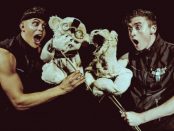
"Bears In Space" is a story-within-a- story. An interstellar archivist, who collects “every story in the universe,” enjoys having his sons (Bertram, Darcy and Lady Susan Vernon) regularly act out his favorite tales. The Story Keeper, as the archivist is known, invites the audience to “bear” witness to the telling of one of his prized narratives from his galactic library -- "Bears In Space." The celebrated Irish theatre company, Collapsing Horse, employ their adept puppetry, comedic talents, linguistic prowess (including the fine art of punning and utilizing malapropisms to artistic advantage), and clever music making "Bears In Space" a delightful farce for puppet, improv, Disney and Simpsons’ enthusiasts alike. [more]
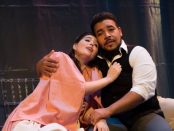
The performance of Verdi's "La Traviata" featuring Bonnie Frauenthal as Violetta and Jose Heredia as Alfredo Germont was wonderful in many ways. Frauenthal sang and acted her complex role compellingly: she is a confident singer, capable of both womanly sturdiness and subtle virtuosity, and she inhabited the dense narrative of Violetta's story credibly and compellingly. Heredia's youthful and earnest Alfredo was also convincing; his deep love of Violetta and grief at her death were poignantly believable. Interestingly, as an actor, Heredia stuck so literally to the movement of Alfredo's character in Piave's libretto that Alfredo's subservience to his father was maddening: the son's filial weakness undercut the manliness of his love for Violetta. Both Frauenthal and Heredia sang with integrity; they held nothing back from full commitment to either their roles or their audience. [more]
Playwright Ana Nogueira has a facility for often arch dialogue but not much else. The play’s potentially promising sci-fi premise is undermined by its bizarre vagueness. Not only do the leading characters not have names, there is no biographical data about them imparted. Their professions and life details are never described. Most crucially HIM’s thesis is mentioned several times but what the subject of it was is not stated. Ms. Nogueira basically presents two ciphers that are difficult to truly care about. Ultimately, it’s all a hollow and smug exercise. [more]
While proud of how she is portrayed in the press, as a woman who couldn’t be broken, McPhee delves beneath the surface to illustrate how Shanley really felt once she returned to an empty apartment at the end of the day -- with her beloved dog as her only real company. Like everyone else, she experiences confusion, loneliness, and pain and only can hope that her good choices and desire to help mankind outweigh the mistakes that she has made. [more]
Lott employs skillful puppetry, complementary video projections, innovative lighting and novel sound design to show the transitions between the present and make-believe. Five puppeteers (Robert Stevenson, Jamie Agnello, Rowan Magee, Chelsea Fryer, and Sam Jay Gold) carefully and exactingly portray the slow but sure disintegration of Blossom's mind. Real-time and imaginary time are each given their own set pieces through which Blossom explores memories and in-the-moment relationships. [more]
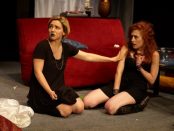
This comedy revival of Leslye Headland’s 2010 play, that was adapted for the 2012 film of the same name, "Bachelorette," is as caustic and outrageous as ever. While looking ahead to a wedding day is supposed to generate feelings of excitement and bliss as women band together to stand by their girlfriend as she prepares to say “I Do,” this is often times not the case with several different personalities in the same room. It can be a very stressful time as emotions heighten and feelings get hurt, and "Bachelorette" humorously and dramatically represents this experience as three girls meet up to celebrate the night before their friend’s wedding in a swanky hotel suite. [more]
Playwright Julia Cho has crafted an engaging and universal work that unevenly blends reality with mysticism. The characters are all very well delineated and the dialogue is flavorful and realistic. It’s structured as a series of short scenes that include monologues, flashbacks and fantasies. The play’s two-act form diminishes its momentum, running two hours and fifteen minutes with an intermission. Repetitiveness and a preoccupation with profundity sidetrack its effectiveness at times. [more]
Director Kira Simring’s superior staging theatrically presents the play’s complicated situations with clarity and surrealistic flourishes. Characters often enter and exit through unlikely places such as through the audience or from a side door. Though the play lasts only 75 minutes, Ms. Simring’s physical realization of it makes it seem lengthier with the depth she has brought to it. Her results with the cast, some of who play dual roles is superb. [more]
Besides achieving sensitive and strong performances from the cast, director David Drake masterfully fulfills the playwright’s intentions with his lively and brisk staging. The collaborative group UnkleDave's Fight-House’s fight direction is thrillingly realistic for several physical conflicts. [more]
The beauty of Chen’s technique lies in engaging the audience in a guessing game that they don’t immediately know they are a part of – presenting them with certain messages that appear to be true, but challenge them to think about it from a different perception. One of the main themes is examining the different viewpoints between the Chinese and American cultures and how perceptions can be skewed. The result is a clever and eye-opening puzzle that teaches important lessons around the human experience in a shocking way by offering extremes. [more]
"Crashlight" is a musical that is so inept that the recurring age-old mental question while watching it is, “What were they thinking?” The "King Lear"-style eye gouging sequence in the second act pushes it into the realm of the totally ludicrous. [more]
The dynamic cast is made up of Marquis Gibson, Lauren Shaye, Nicole Stacie and Christian Lee Branch. These four very talented performers all portray numerous characters during this 75-minute work. President Barack Obama is depicted as well. [more]
"To Protect the Poets" shows how readily lines can be crossed when “street justice” is employed, instead of the judicial system. This first-rate, timely and intelligent play is a just representation of how two people who love each other deal with violent crimes against women and police brutality. [more]
Laden with jokes, sight gags and flamboyant characters, Mr. Free’s well-constructed and startling work combines the outrageous sensibilities of John Waters’ films with the social consciousness of Norman Lear’s television sitcoms. Free’s giddily convoluted scenario is dense with flashbacks, fantasies and surprises. Just when a thread is exhausted he is seamlessly on to another. The classic horror film "Night of the Living Dead" is emulated for the deadly serious dénouement. [more]
Writer Gustavo Pace is the handsome, youthful and animated performer of this autobiographical exploration. He loudly rattles on in Portuguese and English while adequately portraying himself and several characters. These include his father, brother, a female therapist working on turning him straight, and various others he encounters. It’s an amiable and passable performance that’s heavy on volume and shaky on intelligibility. [more]
The August Strindberg Repertory Theatre presents this production. Since 2012, they have produced a number of the author’s works in New York City and for this one it was decided to condense and update it in order bring out its humor. The result is pretty much laugh-free. [more]