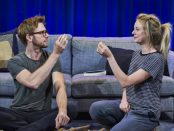
Essentially it’s a glorified and arch 90-minute, scripted, sketch comedy show. The conceit is that it’s inspired by audience suggestions. The composition of the program changes from performance to performance. Throughout the show, slides are projected of printed extracts from online surveys of people’s theatrical preferences with the dates that they responded. These have been collected over a period of many months. The cast then performs a scene based on these answers. [more]
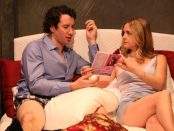
Reading David Foster Wallace’s Infinite Jest while lying on a couch is Jay, a slacker-looking type in his 30’s. Sitting in the living room nearby is his 60ish mother who enjoys watching Dr. Phil on television and complaining about her ailments. Gabe McKinley’s Homebody is an enthralling black comedy with shades of Grey Gardens. Mother and son bicker, rehash recriminations and share their joy over the possibility of Jay’s novel being published. In 35 minutes, Mr. McKinley delivers a very well written, plotted and satisfying one-act play. It’s so pleasurable that a full-length version would be most welcome. [more]
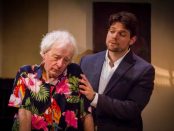
As Paul Harold, a 60ish artist, Pendleton has a leading role that wonderfully showcases his idiosyncratic and considerable talents. With his unruly white hair, limber physicality and distinctive vocal twang, he mines all of the humor and depth of this fascinating character. Sharing the memory of when he met Pablo Picasso in his youth is a vivid moment. [more]
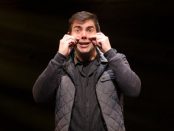
O'Connell’s script is a well-structured series of confessional anecdotes interwoven with the lore of the movies. His performance is a riveting blend of stand-up comedy and grand stage acting with Shakespearean flourishes. The audience is on three sides of the very small theater. This intimate space at times feels too constrained for the unbridled emotionalism on display. [more]
In "DannyKrisDonnaVeronica," playwright Lawrence Dial bitingly delves into the lives of two Brooklyn couples each with two small children. Through his precise, often humorous and realistic dialogue, Mr. Dial has his very well-drawn characters who all in their mid 30’s eloquently express their conflicted feelings and despair. Short on actual plot, the play is rich in incident and is a wistful character study. [more]
Mr. Rosenblum’s dense book is a rudimentary and repetitive serio-comic treatment imparting the minutia of that cause célèbre. In 1972, burglars connected to Republican President Richard Nixon’s re-election campaign broke into the Democratic National Committee’s headquarters in the Watergate building complex in Washington, D.C. This resulted into a calamitous scandal and inept cover-up causing a national crisis. Rosenblum’s treatment doesn’t totally succeed at tying together all of its complicated threads. [more]
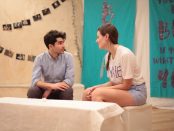
Playwright Beth Hyland’s very effective conceit is that we’re watching the dress rehearsal of Annie Lambert’s memorial celebration in an auditorium of the State University of New York at Onondaga. There, students act out Ms. Lambert’s story in the manner of a Greek chorus often directly addressing the audience. “What would Annie have wanted?” [more]
It was a Tallis-perfect performance. Palestrina has long been one of the most sure-fire dazzling jewels in the Tallis Scholars' treasury. In writing sacred music, Palestrina made his particular kind of beauty – elegance, intellect, decorous sensuality – a kind of theology of mediation, a meeting place for the human and the divine. The Tallis precision of diction and tone and their ability to reveal every rhythmic and melodic nuance in the music they sing make Palestrina marvelous. The bright acoustic features of St. Mary the Virgin provide a wash of light on the singing. [more]
Director and choreographer Jessica Burr has created a number of dazzling moments with her precise unison of expressive staging, movement and dance. With only a few vintage trunks and a door, all on wheels, Ms. Burr achieves many vivid stage pictures. Walking up a flight of imaginary stairs is a thrilling display of mime. Burr’s work with the ensemble, most of whom play several roles is excellent with their colorful characterizations as evidence. [more]
The Heath, The McKittrick Hotel’s restaurant, bar and music venue, has been dressed up with appropriate signs and objects such as a stuffed wolf to resemble a pub in Scotland. After the audience seat themselves, actors roam around and talk with them. They’re told to rip up the white napkins on the tables into little pieces. Later, they’ll be cued to throw them in the air to simulate a snowstorm for a cool effect. They’re also told that there are complimentary shots of whiskey at the bar where other drinks are sold. During the intermission, the staff offers small ham and cheese sandwiches. It’s all quite atmospheric. [more]
“The Little Drummer Boy” was an emotionally shattering highlight of Richard Holbrook: "Always December." Mr. Holbrook’s performance of this perennial was revelatory due to the intensity he brought to it. This was performed in tandem with the equally moving “Some Children See Him.” [more]
The beautiful wreath and garlands hanging above the stage were festively lit up for the wonderful finale, the “Jingle Jangle Sing-Along.” All of the performers appeared and encouraged the audience to join in for convivial group singing of “Rudolph the Red Nosed Reindeer,” “Frosty the Snowman,” “Here Comes Santa Claus,” and “Jingle Bells.” [more]
The score by Kristen Anderson-Lopez, James-Allen Ford, Russ Kaplan and Sara Wordsworth is a pleasant collection of serviceable songs. Their book, based on their original concept, is a workmanlike blueprint of peppy clichés. It does have topical references such as the Pizza Rat. The show lasts one hour and 40 minutes without an intermission and somewhat lags due to the familiar plot threads. [more]
For those who could not understand the lyrics of Traore's songs – he sang in Mali's French – each song was an experience of four interconnected musical sounds: the calabash thump and click rhythms, the harmonica, the amplified acoustic guitar, and Traore's voice. The songs' lyrics – love songs, folk tales, celebrations, imprecations – added particular locations and stories to what, all together, was a full, rich exploration of human experience through the lens of the blues, of hard-won wisdom and infinite empathy for joy and anguish, for hope and despair. [more]
The consistency – the from-the-very-beginning wholeness – of Bach's genius was clear in this chronological arrangement. The kinds of writing techniques and subjects – the sequences and suspensions, chromaticisms and counterpoint intricacies – that Bach transformed from craft common to hundreds of composers to art unique to only a few became, over the years, Bach's vehicles for examinations of all aspects of being human. In this single program, Crawford's choice of music from almost all major liturgical seasons enabled his singers to present grief and joy, despair and hope, prayer and praise. And this they did marvelously. [more]
Raucous highlights include a jive reinterpretation of A Christmas Carol, “by Chazzie D, about a cat called Scrooge...who lives in Scrooge Tower.” There’s also Buckley’s irreverent take on The Gettysburg Address, “I’m a Lincoln cat.” Intertwined are Broder’s cool renditions of “On The Sunny Side of The Street” and “Georgia On My Mind.” He also demonstrates excellent saxophone and tambourine playing. [more]
The audience sits on either side of the large runway stage that set designer Laura Jellinek has arrestingly fashioned into an indoor soccer field. It’s a green vista of Astro Turf that gives the sense “…that the field goes on forever,” writes playwright Sarah DeLappe in her stage directions. [more]
LeFranc’s dialogue is a marvelous blend of the realistic and mundane. The well-delineated main characters all express themselves with true to life simplicity. Plot developments are the combination of subtle details that gradually do build to a satisfying resolution. It all has the sense of John Cheever’s suburban short stories where the darkness behind bonhomie is revealed. Swimming pools are mentioned in passing. [more]
"The Big Uncut Flick is a 1953 live, mid-day movie program broadcast on the Dumont network. The audience is addressed as if they were the studio audience. The stereotypical hosts are a married couple. Jack Sheldon is a hyper announcer type and Arlene Lewis is a grand dame. During commercial breaks they extoll dog food, cigarettes, frozen dinners and laxatives. There’s a quiz show portion as well. References to Sen. Joseph R. McCarthy and the Red Scare are also tossed in. [more]
The real life Internet hacktivist and Reddit developer Aaron Swartz contrives to have his fictional childhood friend Billy, who is a theater teacher of prisoners, to collaborate on a play about Bradley Manning in order to galvanize public opinion in favor of his clemency. During the moving climax, they act out the roles of Manning confronting President Barack Obama. [more]
Joined by percussionist John Ferrari and conductor Jeffrey Means, the five members of the Da Capo Chamber Players – Curtis Macomber/violin, Chris Gross/cello, Patricia Spencer/flute, Meighan Stoops/clarinet and Steven Beck/piano – recently presented a concert inspired by the vibrant, important music of Milton Babbitt (1916-2011) on the occasion of the centennial of his birth. One piece was written by Babbitt himself, but all the other pieces, ranging in date from 1981 to 2013, were written by contemporary composers who at one point or another had studied with Babbitt at either Princeton or Juilliard. [more]
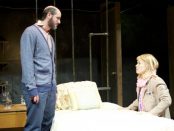
Besides guiding these engaging performances, director Christopher Martin has meticulously staged the action on the arresting minimalist set that he designed. The floor and brick walls are white. There is a small black rug on the floor near the two plush black cube chairs. Red leaves are strewn about and there’s a pile of them as well. In view are the theater’s windows, an air conditioner and a shelf with a coffee service and drinks. [more]
Musical numbers are catchy and silly while sharing important life lessons. “What Are Friends For” and “All Alone” examines feelings of sadness, loneliness, and finding your tribe no matter your family circumstances. You may not be able to choose your family, but these babies will always have each other’s back. The emotional ballad, “We Will Get through This,” tugs at the heartstrings and is sung beautifully by Mallory. The scenic and lighting design by Josh Iacovelli brings light and warmth to the space with minimal props as not to distract from the group dynamic on stage – while ensuring that the babies are comfy and cozy in their distinctive onesies. [more]
Mr. Irving has an amazing singing voice that soars from octave to octave. His witty songs include a funny one about texting. He tells an epic story about his parents meeting. His musicianship is tremendous as he plays banjo, bouzouki, shruti box, mbira, jew's harps, whirly tube, scacciapensieri, and the ocean harp during the show. He does a wild dance to America’s “A Horse With No Name.” [more]
That sequence is just one of the highlights of John Doyle’s commanding direction. Best known for his vibrant minimalist approach to musicals, Mr. Doyle brings that precise and visually expressive focus to this play. The cast of ten is expertly placed and moved around the relatively bare and spacious stage creating tension, excitement and striking tableaus that all connect to the story. There are also many presentational flourishes. [more]
“He” and “She” are a 40ish upper middle class couple who divorced ten years earlier following the traumatic death of their young son who was hit by a car. Due to toxic waste from a nearby gas factory, 200 graves, including their son’s will have to be dug up and the remains reinterred elsewhere. This unpleasant circumstance instigates this reunion after a long estrangement at a cemetery in Holland. [more]
The actors make the characterless space come alive. Elizabeth Van Dyke (Zora Neale Hurston) shrouds Zora with the same purity and authority that she conveyed in the 1998 production. Zora never pandered to convention -- Harlem Renaissance beliefs (Langston Hughes or Richard Wright) or white America politics. Zora walked her own path and was unwaveringly true to who she was and her ideas about art, politics, men and women, academia, and Black culture. Van Dyke towering performance is one that depicts Zora's all these character traits, as well as having a vulnerability and zest for life.
[more]
Performed the evening before the American election, the theme and purpose of the concert – remembrance of John F. Kennedy and Martin Luther King, Jr., two “outstanding stewards of humanity,” in Merriweather's words, whose lives were cut short by violence – embodied for musicians and audience alike art's core purposes. Art locates, grounds and inspires us; it gives us vocabularies for understanding ourselves. In the case of the works on this program, the American music of remembrance, contained in pieces by Steven Stucky and David Hurd, reminds us that moral and political conscience transcends individual lives and is strong within us all, even when our heroes are slain; and Mozart's "Requiem" calls up the universality of hope for salvation and pleadings for peace. [more]
From the very first opening bars of the "Chaos" overture, Hyde set the tone for the evening: conducting with gentlemanly authoritativeness, Hyde led the Orchestra of St. Luke's – who were all in exceptionally fine form – in a performance of expansive energy and optimism. Theologically, God's working material for his creation may have been unfathomably chaotic and formless, but in this particular artistic account of creation, Haydn's description of chaos is so informed by elegance, wit and bravura that the primordial chaos seems to have been imbued with goodness. [more]
Gordon created the role of Gertrude Stein with mezzo-soprano Stephanie Blythe in mind. Blythe’s monumental presence, thanks to a towering, charismatic, forceful voice, is meant to arrest and command attention. Blythe captures Stein’s complicated personality – her genius, her stalwartness, her humor and her occasional, brutal judgments about the artistic quality of her bon mots. [more]
Shrouded by clear shower curtains, the actors enter the stage and bring out furniture, including a gramophone, and chat with each other. There is newsreel footage proclaiming the end of W.W. II in Great Britain. Half-baked anachronisms pile up during the next two hours and half hours. These include the intermission shtick of old-time drive-in movie announcements, “The show will start in five minutes…visit the snack bar… for buttered popcorn.” [more]
The pomposity of the Tony Kushner-style title extends to naming its leading characters “The Academic” and “The Writer.” They’re two gay men in their late 20’s and the play charts their meeting, relationship, breakup and aftermath. This is accomplished by a dizzying structure of non-linear, rapid-fire, time shifting brief scenes. This intrusive device undercuts emotional involvement with the couple, as all of the jumping around of the narrative becomes artificial, repetitious and uninvolving. The period covered ranges from 2006 to 2011. [more]
Josie Rourke, artisic director of the Donmar Warehouse, understands the game’s complexity and what adroit moves need to be made throughout to maintain a psychological cohesiveness. Her deft hand is evident in her light touch so that the production is not weighed down by nastiness. Where Rourke falls down is casting Schreiber, who is known for his charismatic masculinity and not for being a jocund bon vivant. Valmont needs to be more calculating, as well as, effete. [more]
"Lavender Songs: A Queer Cabaret in Weimar Berlin" has the mature and slim Mr. Lawrence in drag virtually for the entire length of the performance. In a dirty-blonde curled wig, his face garishly made up, twirling a red and purple boa, and wearing a sleeveless sequined black dress, Lawrence is like an Otto Dix painting come to life. [more]
In the first concert of the 2016-2017 Composer Portraits season at Columbia University School of the Arts' Miller Theatre, current music of American composer John Zorn (b. 1953), including five premieres, was presented and enthusiastically received. More accurately: Zorn's music-making – his understanding of individual composing and collegial collaborating as interconnected projects – was exuberantly celebrated. [more]
Healy’s treatment is faithful to the novel with a good deal of it being Clegg’s narration addressed to the audience. There are lengthy conversations between Miranda and Clegg, and her escape attempts are depicted. No matter how skillful Healy’s stage version is, it’s still two hours of often-philosophical talk between two characters in an unpleasant situation. [more]
Founded in 1991, the National Asian American Theater Company’s mission is to present theater with all Asian-American casts. This is accomplished by producing classics of European and American works of dramatic literature, or adaptations of these works by Asian-American playwrights or new plays written by non-Asian Americans, not for or about Asian Americans. That last precept is the case of this East coast premiere of "Sagittarius Ponderosa." [more]
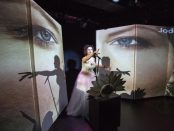
Benjamin Stuber’s puppetry designs are a disappointment and should be more thoughtful and complementary to the play. Ghoulish puppets that are meant to disturb seem make-shift and thrown together. There is only one disturbing and appropriately quirky puppet effect – the appearance of a huge eye, set into a collage background of assorted textiles. [more]
Out of this frustration, Larson in 1991 began performing a rock monologue about his life and stalled career called 30/90, as it was set in 1990 as he turned thirty. Later it was retitled "Boho Days" and then "tick, tick... BOOM!," as a chief device is the ticking of a clock. The show was performed for short engagements at several New York City venues and ignited Larson’s career, leading to the creation and presentation of Rent Off-Broadway in 1996. [more]
Pierce coolly addresses the audience while delivering this mundane litany. His superb comic timing, long evident on the television situation comedy "Frasier," is on glorious display here. That quality combined with his dramatic depth and soothingly funny delivery makes this opening sequence mesmerizing. [more]
British author Stephen Sharkey’s new translation is faithful to Brecht, but the Phoenix Theatre Ensemble has fashioned the presentation as an old-time radio show. Brecht was known for his self-conscious style of distancing and alienation, where the audience is made aware that they are watching a play but this additional device is a distraction and not as funny as intended. [more]
Despite its formulaic story, "I Like It Like That" is quite exhilarating with its sensational salsa renditions as performed by its appealing cast and excellent band. [more]
Visual artist and puppeteer Jessica Scott navigates through a satiric and fascinating new media “seascape” with a dysfunctional ship’s crew, albeit all women. Scott’s "Ship of Fools" uses nightmare structure, intentionally drawing from Book VI of Plato’s "Republic" (from whence its title came), Bosch imagery and other surreal allegories, depicting the fine line between heroines and madness. [more]
In "The God Projekt," the “Divine He” repeatedly tries to make reparations for his past destructive deeds, but to no avail. God is wrestling with dementia and in a time loop. Yet, he is determined to correct, well, his god-awful mistakes -- one of which is not only acknowledging the “Divine She” in his heavenly order, but atoning for a heinous crime against her. [more]
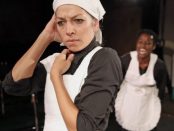
Obie award-winning playwright José Rivera is an Oscar nominee for his adapted screenplay for "The Motorcycle Diaries." For this adaptation, he has set "The Maids" (which premiered in Paris in 1947) in Vieques Island in Puerto Rico in 1941. This was a politically tumultuous era with native factions resisting the U.S. presence there. Mr. Rivera’s script reflects this situation and locale and is filled with cultural references to sugar cane, bustellos and revolutionaries. [more]
The scenic design by Brett Banakis is a functional, minimalist configuration of a slightly raised wooden performance platform surrounded by a wooden frame dotted with small antlers suggesting the pub. There’s an assemblage of vintage furniture, potted plants, screens and vines that are shifted about to designate the various locations. This all contributes to a deficit of visual grandeur that the production is understandably striving for on a limited budget but doesn’t achieve. These design flaws could be superseded by an abundance of bravura performances, but there aren’t. [more]
The gregarious Matt Koplik plays Donald Moscowitz who constantly bears the brunt of his parents’ overbearing natures. He is instantly likable, charming, and relatable as any young person can identify with in trying to maintain his independence while also respecting his parents. Kate Katcher and Tony Rossi play Donald’s parents and make quite the electric pair as they are nothing short of domineering. With his close friends, Levi and Henrietta, by his side, Donald is able to concoct an elaborate story that he hopes will make his parents happy and one that he will be able to pull off without hurting anybody’s feelings. [more]
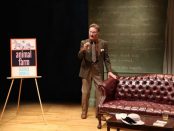
Grand highlights of Mr. Horton’s dynamic work includes an analysis of "Animal Farm" while he erases the novel’s seven animal commandments that are written on a blackboard as they are overturned one by one, by the pig Napoleon who represents Josef Stalin. There’s also a dramatic demonstration of American versus British rationing during W.W. II as Orwell produces bountiful American foodstuffs comparing them to the meager provisions allowed in Great Britain. [more]
Sheppard recollected that in the Underground Railroad game his fifth grade classmates were designated to be either Union or Confederate soldiers. The Yankees (Union) tried to covertly run slaves (portrayed as “black dolls”) from a classroom “safe house” to another classroom “safe house.” The Rebels (Confederates) endeavored to prevent the Yanks from accomplishing their mission. The end goal was to secret slaves or dolls to Canada (a school lobby glass case filled with memorabilia served as Canada). [more]
Gentili and Davis riotously appear together in a confrontational scene that’s similar in style to one of Tennessee Williams’ outlandish later works written during his 1960’s drug fueled “Stoned Age.” It culminates in an outrageous catfight right out of the campy 1960’s 'Batman" television series. [more]
Headsets are on the backs of the audience’s seats when they arrive and which they are asked to wear throughout the show. The stage is set with a desk, several microphones and many water bottles. The back wall is adorned with foam sound proofing panels. The overall look is that of a cavernous sound studio. [more]
The playwright sets the action in Turner’s jail cell where he’s chained up, visited by Gray, and overseen by a guard, the night before his execution. Mr. Davis states that this situation is a fabrication inspired by the book. A possibly unreliable account is the source material for this even more fanciful dramatization. Davis even expresses through the mercenary Gray the possibility that his chronicle will be sensationally tailored in order to sell more books. [more]
"All the Ways to Say I Love You" is refreshingly free of this formula. The incidents are straightforwardly depicted and the circular conclusion is simple. LaBute palatably sets up the situation by establishing that the male student is a senior who has had to repeat a year of school, so he is clearly a young adult. It is implied that he is African-American and it is stated that Mrs. Johnson’s emotionally distant husband is of mixed race. Despite these intriguing elements, the play narratively peaks halfway through and then grinds on. [more]
Writer and director Peter Darney’s script is based on and intertwines over 50 hours of interviews with gay men contacted through the gay social media site Grindr. From this real life material, Mr. Darney has skillfully fashioned an engaging five-person, unflinching character study. There’s no plot and no resolution but it is still a compelling take on this phenomenon. [more]
"Safe" is crammed with so much dysfunction and adolescent angst that if its adult language were excised it would make a perfect "ABC Afterschool Special," if those were still being produced. Instead, it’s an earnest but flat social drama. [more]
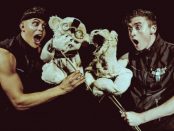
"Bears In Space" is a story-within-a- story. An interstellar archivist, who collects “every story in the universe,” enjoys having his sons (Bertram, Darcy and Lady Susan Vernon) regularly act out his favorite tales. The Story Keeper, as the archivist is known, invites the audience to “bear” witness to the telling of one of his prized narratives from his galactic library -- "Bears In Space." The celebrated Irish theatre company, Collapsing Horse, employ their adept puppetry, comedic talents, linguistic prowess (including the fine art of punning and utilizing malapropisms to artistic advantage), and clever music making "Bears In Space" a delightful farce for puppet, improv, Disney and Simpsons’ enthusiasts alike. [more]
The performance of Verdi's "La Traviata" featuring Bonnie Frauenthal as Violetta and Jose Heredia as Alfredo Germont was wonderful in many ways. Frauenthal sang and acted her complex role compellingly: she is a confident singer, capable of both womanly sturdiness and subtle virtuosity, and she inhabited the dense narrative of Violetta's story credibly and compellingly. Heredia's youthful and earnest Alfredo was also convincing; his deep love of Violetta and grief at her death were poignantly believable. Interestingly, as an actor, Heredia stuck so literally to the movement of Alfredo's character in Piave's libretto that Alfredo's subservience to his father was maddening: the son's filial weakness undercut the manliness of his love for Violetta. Both Frauenthal and Heredia sang with integrity; they held nothing back from full commitment to either their roles or their audience. [more]
Playwright Ana Nogueira has a facility for often arch dialogue but not much else. The play’s potentially promising sci-fi premise is undermined by its bizarre vagueness. Not only do the leading characters not have names, there is no biographical data about them imparted. Their professions and life details are never described. Most crucially HIM’s thesis is mentioned several times but what the subject of it was is not stated. Ms. Nogueira basically presents two ciphers that are difficult to truly care about. Ultimately, it’s all a hollow and smug exercise. [more]
While proud of how she is portrayed in the press, as a woman who couldn’t be broken, McPhee delves beneath the surface to illustrate how Shanley really felt once she returned to an empty apartment at the end of the day -- with her beloved dog as her only real company. Like everyone else, she experiences confusion, loneliness, and pain and only can hope that her good choices and desire to help mankind outweigh the mistakes that she has made. [more]
Lott employs skillful puppetry, complementary video projections, innovative lighting and novel sound design to show the transitions between the present and make-believe. Five puppeteers (Robert Stevenson, Jamie Agnello, Rowan Magee, Chelsea Fryer, and Sam Jay Gold) carefully and exactingly portray the slow but sure disintegration of Blossom's mind. Real-time and imaginary time are each given their own set pieces through which Blossom explores memories and in-the-moment relationships. [more]