News Ticker
- December 12, 2025 in Musicals // The Faggots and Their Friends Between Revolutions
- December 12, 2025 in Cabaret // Mary Foster Conklin — Mirrors Revisited (50th Anniversary)
- December 11, 2025 in Cabaret // Kathy Kaefer — Kiss Me Once: Stories from the Homefront
- December 11, 2025 in Off-Broadway // The American Soldier
- December 9, 2025 in Off-Broadway // This World of Tomorrow
- December 9, 2025 in Cabaret // A Noel Coward Celebration — Steve Ross & Friends
- December 7, 2025 in Off-Broadway // Diversion
- December 5, 2025 in Off-Broadway // Meet the Cartozians
- December 5, 2025 in Features // Tom Stoppard: An Appreciation
- December 4, 2025 in Off-Broadway // Practice
- December 4, 2025 in Cabaret // Eddie Bruce — The Magic & Music of Tony Bennett
- December 3, 2025 in Interviews // Interview with Ty Jones, Classical Theater of Harlem
- December 2, 2025 in Features // Gingold Theatrical Group’s 20th Anniversary Gala at The Players
- December 2, 2025 in Interviews // The American Soldier – An Interview with Douglas Taurel
- December 2, 2025 in Off-Broadway // A Bodega Princess Remembers La Fiesta de los Reyes Magos, 1998
Archive
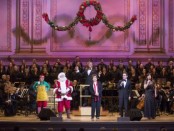
Opening with a soaring symphonic “Deck the Halls” and then joined by the wonderful Essential Voices USA chorus for it, The New York Pops closed their concert, "It’s Christmas Time in the City,." with a rousing audience sing-a-long of “Come All Ye Faithful” and “Silent Night.” In between, there was a delightful selection of classic and newer Christmas songs several performed by Broadway stars Stephanie J. Block and Brian d’Arcy James. Santa Claus and one of his elves also comically visited. Beaming music director Steven Reineke commandingly conducted the 78-piece orchestra and personably hosted this engaging presentation.
[more]
Playwright Marsha Norman’s book brilliantly and very faithfully streamlines and extracts the events and themes of the novel and film. These include racism, sexism, self-esteem and same-sex attraction. In addition, Ms. Norman created the clever device of three gossiping church ladies who appear throughout and briskly impart exposition. Her work swiftly and skillfully renders this sprawling tale into a contained and emotionally involving narrative.
[more]
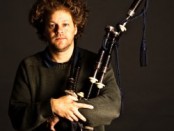
At the 10:00 show on Wednesday, December 9, Welch played bagpipes with Brendon Randall-Myers on electric guitar and Brian Chase on drums and electronics performing "The Library of Babel," a 35 minute piece Welch composed in 1999. In a subsequent post-concert conversation, Welch indicated that the work of Jorge Luis Borges had been a foundational inspiration in his composing early in his career. This piece, titled to pay homage to Borges' astonishing 1941 story of the same name, is an immediately recognizable child of Borges. It is also, however, strong enough to stand on its own, meaningful and effective, even for listeners unfamiliar with the works of the Argentinian writer.
[more]
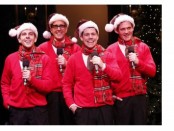
The tale of their demise in 1964 en route to a show in their native Pennsylvania and their temporary 2015 resurrection still works brilliantly. Even though "Tidings" cover a good deal of the "Forever Plaid" musical territory, the holiday songs they’ve added give this show seasonal warmth.
[more]
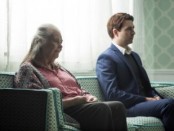
Playwright Jordan Harrison is a graduate of the Brown University M.F.A. program and the recipient of several prestigious awards such as a Guggenheim Fellowship and the Kesselring Prize. On a technical level "Marjorie Prime" is expertly constructed and contains serviceable dialogue that propels the plot, but in totality it never rises above the level of an academic contrivance. The premise is a familiar but promising one, but in execution it is flat. The exposition and setup never really become emotionally involving and the closing revelations are consciously sensationalistic.
[more]
Malcolm Gets, Jerry Dixon, Mario Cantone and Matt McGrath in as scene from “Steve” (Photo
[more]
Conceived by Daniel Fish and Jim Findlay, "Who Left This Fork Here"—inspired by the emotional themes found in Anton Chekhov’s "The Three Sisters"—is a stark and jarringly honest piece which examines morality and aging through the eyes of three different female performers. Separated by nearly seven decades, the three women (Tina Benko, Judith Roberts, and Auden Thornton) each represent a different phase of a woman’s life.
[more]
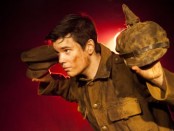
Besides playing Boyce, Gwyther depicts other British soldiers as well as Germans. It is an exhilarating display of rapid vocal and physical transformations subtly giving each brief characterization a fleeting depth. With his angular features, intense eyes, expressive voice, and limber physicality, his performance is a superb display of riveting solo theater acting.
[more]
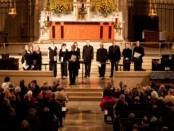
The program itself was a masterpiece of artistic and theological integrity. Pieces by three composers – contemporary Estonian Arvo Part (b.1935), and Renaissance Englishmen John Sheppard (c.1515-1558) and Thomas Tallis (c.1505-1585) – carried the full chronological account of the earthly life of the Word made Flesh, from conception in the Virgin's womb to emergence as the salvation-bearing Lamb of God. The order of the program essentially replicated the Nicene Creed, each piece providing an illumination of a particular narrative or liturgical moment.
[more]
It has taken years and many people, to restore the book and score of the 1923 "The Golden Bride" which was last performed in 1948. A concert performance by the National Yiddish Theatre Folksbiene in May 2014 laid the groundwork for the current full-blown staging with its large cast, orchestra, sets and costumes, zestfully co-directed by Bryna Wasserman and Motl Didner with not so great, but energetic, choreography by Merete Muenter.
[more]
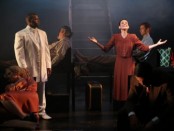
The Peccadillo Theater Company’s "A Wilder Christmas" is a gentle and genteel evening of theater: two early Thornton Wilder one-act plays, directed with an attention to detail and a leisurely sense of timing by Dan Wackerman, the company’s artistic director. "The Long Christmas Dinner" (1931) and "Pullman Car Hiawatha" (1930) together make for a rich sampling of Wilder’s familiar themes of family and the unavoidable specter of death (which, in Wilder, is only the beginning of another journey). These themes were perfected in his 1938 masterpiece, "Our Town," including the conceit of a godlike Greek chorus in the form of a Stage Manager who explains and even supervises the action.
[more]
While C.S. Lewis’ famous theological allegory, "The Great Divorce," is written as a series of conversations, you might not expect that it would be suitable for stage dramatization as a religious treatise. However, the Michael McLean and Brian Watkins adaptation for Fellowship of the Performing Arts turns this into a high provocative and theatrical evening. Under the assured direction of Bill Castellino, three extremely talented actors (Christa Scott-Reed, Joel Rainwater, and Michael Frederic) play 19 characters among them, making them distinct and fully dimensional. The remarkable projections by Jeffrey Cady and the evocative original music and sound design by John Gromada make this a treat for the ear and eye as well as the mind.
[more]
Alas, the Tiny Tim of olden days exists no more. Thanks to medical advancement in the mid-1800’s, young Tim underwent a surgery which not only cured him of his ailment, but gave him a new heightened ability referred to as “a dancing leg.” This newly autonomous dancing leg is Timothy’s calling card and—whether he accepts it or not—the leg which was once a burden is now the precious asset upon which this grand adventure is based. "The Astonishing Times of Timothy Cratchit" is massively ambitious. As if imagining a sequel for one of Dicken’s most famous fictional characters wasn’t enough, Knee and Catrini scale things to an even higher level by tying in the fictional accounts of A Christmas Carol with the real-life autobiographical "Memoirs of Joseph Grimaldi," written first hand by the famous English clown and then later rewritten by Charles Dickens. It is a heroic effort which attempts to bridge the gap between two of Dickens' most famous works, even if there isn’t much correlation between the two to begin with.
[more]
Marko Mandič is an award-winning acclaimed classical actor from Slovenia who has worked several times with Mr. Buljan. His talent, charisma, and physicality justify that acclaim as witnessed here by his performance in the title role. Vocally expressive and emotionally volatile, he is truly naked through most of the play’s second half and unselfconsciously performs heroically even through the most awkward sequences. These include the incident with the watermelon and later painting his genitals black to match those of the actor playing Orestes who doesn’t display his.
[more]
"Gigantic," the new feel-good musical, is a dynamic up-to-date show about teenagers at a summer weight-loss camp. Previously seen as Fat Camp in the 2009 New York Musical Theatre Festival, Gigantic’s book by Randy Blair & Tim Drucker may be conventional, but its pulsating pop-rock score by Matthew roi Berger to lyrics by Blair is vigorous and high-powered and the energetic, first-rate cast under the fast-paced direction of Scott Schwartz makes the material seem better than it is. This is one of the few teen musicals in which the characters actually sound like modern youth rather than what adults think they sound like.
[more]
The new musical is similar to Sater’s "Spring Awakening" in that it takes a group of people in a specific historic time and place (here New York, circa 1995) and adds music between the scenes which is in a different style from the play. It also resembles Bacharach’s "Promises Promises" in depicting a series of New York types at work and play. While the Bacharach/Sater score is sumptuously sung by an on-stage band of five led by impressive lead vocalist Jo Lampert, Sater’s book in which we meet various Manhattan denizens whose lives intersect in the course of one day feels dated in that we have met these people before and the problems of the characters seem trivial compared to the problems of today.
[more]
Over the course of just over an hour, the actors enact Dylan Thomas’ classic prose work of his childhood recollections interspersed with their sweet performances together and solo of familiar Christmas songs including “Silent Night” in his native Welsh. Cullum often sits in a chair holding an elaborately covered edition of the book, reading from and sometimes referring to it as if grandly telling a story.
[more]
Victor Morales enters and introduces himself and notes that we are at Dixon Place. Mr. Morales who created this piece is stocky, bald, bespectacled, and possessed of a quirky everyman presence. For just under an hour, he delivers an amusing lecture with serious overtones enhanced by the illustrative projections.
[more]
Every member of this trio has experienced love and loss, and this show explores what it truly means to be human. Moments of drama exemplify the character’s toughest challenges, and their individual approaches to solving them. The strength of a woman as the leader of a household is brought to the surface, as these women have been let down by the men in their lives. The bond they share ultimately proves that true happiness can be found whether you achieve your personal goals and dreams or find something beautiful within yourself.
[more]
The legendary stage actress Kathleen Chalfant is appearing in her second one-woman show, a follow-up to her “Mrs. Dalloway” in The Party, from the Virginia Woolf stories in 1993. This time she plays Rose Fitzgerald Kennedy, the 79-year-old matriarch of the most famous political family in 20th century America. It is July 1969 and we meet her in the tasteful living room of her Hyannis Port, Massachusetts, home (designed by Anya Klepikov) one week after her youngest son Teddy’s tragic accident at Chappaquiddick. The premise of "Rose, The Kennedy Story as Told by the Woman Who Lived It All" is that we are members of the Ladies Auxiliary of the Knight of the Redeemer visiting from Dublin. We are invited to stay until Teddy comes back from sailing which he has been doing since the previous day. Her husband Joe, Sr., who has had a stroke eight years before is being cared for in an upstairs bedroom.
[more]
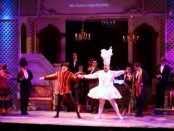
Bejeweled codpieces, sequined thongs, taut bustiers, powdered wigs, elaborate masks, frock coats, tutus, and leather harnesses, are among the eye-catching elements of Zane Pihlstrom’s lavish costume designs. Mr. Pihlstrom’s dazzling set is composed of spiral staircases, ramps, old-fashioned footlights, mirrors, a miniature carousel with a pole on top used for dancing, and a period-looking curtain.
[more]
"That Physics Show!" is the brainchild of David Maiullo, a professional physics demonstrator who also happens to have a knack for comedy. Created and performed by Mr. Maiullo, this one man show—plus his assistant Kelsey Lane Dies—is a surprisingly educational production which, though it doesn’t have any narrative, is very engaging. From the moment the theater doors open, there is an infectious curiosity which permeates through the crowd: the stage is littered with test tubes, weights, racks, liquids, mysterious boxes containing curious looking objects and random items such as balloons, a fire extinguisher, and even a can of coke. Looking around, one can’t help but wonder how all the different objects will come to use.
[more]
Inspired by George Takei’s experiences in a Japanese internment camp during World War II, "Allegiance" is a sometimes moving, sometimes stodgy musical about this terrible injustice perpetrated against Japanese-Americans. One hundred and twenty thousand Japanese-American men, women and children, classified as “enemy aliens,” were forcibly removed from their homes and businesses and incarcerated under terrible, inhumane conditions, far from their West Coast homes.
[more]
Author Jane Martin has taken the familiar dramatic staple of a love story between two clashing opposites and rendered it compellingly here. There are plot twists, witty dialogue and violent incidents all with a tone-combining sweetness and melancholy. Jake is a depressive riddled with self-doubt and Deborah’s devoutness complicates her personal emotions.
[more]
Pendleton has made some strange directorial choices. Characters appear on stage and stand silently long before their entrances. This is distracting as one wonders are they supposed to hear the conversations taking place. Many of the entrances and exits take place through the main aisle of the theater which breaks the fourth wall convention continually. He has also cast several actors as older than they are described so that this shifts the character relationships appreciably. The most famous scene in the play when Nora slams the door, possibly the most iconic moment in modern drama, is diluted considerably as there is no door for Nora to slam. Harry Feiner’s set design has the drawing room and bedroom visible side by side throughout the play which seems somewhat inappropriate for the 19th century setting.
[more]
The pleasure of" Night Is a Room" is watching these three expert actors speak Wallace’s rich, insightful language which veers from wittily highfalutin to excitingly vulgar. Charting their emotional reactions which teem with hyperbolic outbursts, she has her finger on the pulse of these three self-deluders. Bill Rauch directed with total comprehension, walking a fine line between permitting the audience to observe the drama and also be mystified and appalled by these awful people.
[more]
The great mid-20th century American poets Elizabeth Bishop and Robert Lowell were friends from 1947 until his sudden death 30 years later. As they were usually in different cities and countries (Bishop lived in Brazil for many years while Lowell lived in New York City and Boston), they wrote each other over 450 letters which were published in 2008 as "Words in Air: The Complete Correspondence between Elizabeth Bishop and Robert Lowell." Sarah Ruhl, an adventurous playwright whose plays tend to be very different from each other, has adapted the letters for the stage in a homage to writing and friendship called Dear Elizabeth in which all of the words are that of the poets. Kate Whorskey’s fascinating production for WP Theater (formerly The Women’s Project) has staged the play much in the manner of last year’s revival of A.R. Gurney’s "Love Letters" and also with revolving casts.
[more]
It wasn't until the sixth song, "Birth of the Blues" by DeSylva, Brown and Henderson, that she finally addressed the crowd which had filled the small venue. She commented that she has never considered herself a blues singer, although she has been identified as such for years, and went on to belt out a very heartfelt, bluesy rendition of the song. She then transitioned into one of her old-time favorites, a traditional English ballad from her Hair days, "The House of the Rising Sun." Interpreted with great feeling and emotion, this was one of her best performances maybe because of the memories it conjures up in her.
[more]
Calling their 2015-2016 season “Cornerstones,” C4 is exploring musical and artistic themes that have established the group's identity and excellence during its first decade. Their November program, "Vocal," included works by C4 composers, as well as others, familiar favorites and two premieres; the eleven works performed were conducted by seven C4 members.
[more]
Arthur Miller is having a great posthumous 100th birthday! "A View from a Bridge" opened on Broadway to sensational reviews to be followed soon by "The Crucible." Now a revival of "Incident at Vichy," his frightening, microcosmic examination of Nazi-occupied France during the height of World War II, is enjoying a fine revival at the Signature Theatre. While the first two plays are each experiencing radical re-assessments, the director of Vichy, Michael Wilson has opted for a straight-forward, naturalistic interpretation in which each character exists as a finely etched portrait and the set (by Jeff Cowie) is a real, frightening place down to the period French newspapers plastering the holes in the windows.
[more]
Metropolitan Playhouse has done itself proud with its revival of the rarely seen "Alison’s House." Alex Roe’s splendid production with its accomplished cast demonstrates the vitality of Susan Glaspell’s play as well as its contemporary relevance. This is a revival of the highest caliber.
[more]
"Shadowland" follows the young girl, played to perfection by Heather Jeane Favretto, on a surreal journey, exposing her fears and pleasures, leaving her forever changed. A true collaborative adventure, the show is the product of the inventive minds of Steven Banks, Robby Barnett, Renée Jaworski, Matt Kent, Itamar Kubovy and Michael Tracy along with input from the original cast members. This resulted in some inevitable unevenness of style and a few too sudden changes in mood, but the mind-boggling complexity of the choreography and stagecraft (including superb lighting by Neil Peter Jampolis, constantly morphing sets by Neil Patel and very sexy costumes by Liz Prince) plus the witty presentation of the wandering storyline, makes for an overwhelming theatrical experience.
[more]
From offstage we hear the hyperbolic exclamations of a young man, Copious Fairchild, as he masturbates mixed with the soundtrack of a television cooking show. He enters the living room with a jar containing his semen and places it on the coffee table. After favorably commenting on its magnitude his young wife Hibiscus Van Der Waal, takes it and goes offstage. We soon hear her orgasmic sounds as she inseminates herself during this anti-sexual reproductive process called “coagulating.” It’s a pivotal sequence in Stephen Kaliski’s excruciating futuristic spoof "Gluten!"
[more]
«
1
…
92
93
94
95
96
…
114
»
Copyright Jack Quinn, 2001-2023