News Ticker
- December 13, 2025 in Off-Broadway // BUM BUM (or, this farce has Autism)
- December 12, 2025 in Musicals // The Faggots and Their Friends Between Revolutions
- December 12, 2025 in Cabaret // Mary Foster Conklin — Mirrors Revisited (50th Anniversary)
- December 11, 2025 in Cabaret // Kathy Kaefer — Kiss Me Once: Stories from the Homefront
- December 11, 2025 in Off-Broadway // The American Soldier
- December 9, 2025 in Off-Broadway // This World of Tomorrow
- December 9, 2025 in Cabaret // A Noel Coward Celebration — Steve Ross & Friends
- December 7, 2025 in Off-Broadway // Diversion
- December 5, 2025 in Off-Broadway // Meet the Cartozians
- December 5, 2025 in Features // Tom Stoppard: An Appreciation
- December 4, 2025 in Off-Broadway // Practice
- December 4, 2025 in Cabaret // Eddie Bruce — The Magic & Music of Tony Bennett
- December 3, 2025 in Interviews // Interview with Ty Jones, Classical Theater of Harlem
- December 2, 2025 in Features // Gingold Theatrical Group’s 20th Anniversary Gala at The Players
- December 2, 2025 in Interviews // The American Soldier – An Interview with Douglas Taurel
Archive
Jessica Lange and Gabriel Byrne joyously enter through a porch door after the sounds of the ocean have been heard. Their love and attraction for each other is palpable. Mr. Byrne embraces her and with his Irish accent says, “You’re a fine armful now, Mary, with those twenty pounds you’ve gained.” It is instantly clear that this revival of "Long Day’s Journey into Night" is going to be beautiful.
[more]
Before the cameras started rolling, there was this anxiety and doubt, but I began to really focus and believe in myself, in my ability, in my technique, and in my drive, and that put me in the zone.
[more]
The cheery Mr. Bowers also explains that in the mime tradition only mimes in whiteface are silent. He simply but breathtakingly mimes a multitude of actions, objects and situations that precisely conjure up the intended imagery. Written by Bowers, the show is comprised of a series of stories of varying length that perfectly transition from one to the other.
[more]
The musical’s new libretto, written by Jessie Nelson, riffs broadly on Shelly’s quietly poignant storyline and her very human, finely etched characters. The characters, broadened and amped up several notches to register on the large stage of a Broadway house, eventually do endear themselves even if they are just a bit shy of caricature. Singer-songwriter Sara Bareilles’ music and lyrics further perpetuate the broad brush paint job with all the characters getting an exultantly defining number that elucidates their eccentric stories or the turmoil in their minds.
[more]
Red Bull Theater which has specialized in Elizabethan and Jacobean tragedies has moved on to the 18th century with Marc Vietor’s exquisite and stylish revival of "The School for Scandal," Richard Brinsley Sheridan’s famous but rarely revived classic comedy of manners. With impeccable casting and a pitch-perfect production team, this School is as witty, delightful and accessible as one could wish. The 18th century look of the play is both historic and satiric. Anna Louizos’ clever settings transform one into the other with the turn of a wall or a door and a rearrangement of the furniture, highlighted by Russell H. Champa’s lighting. Her witty use of props (a chamber pot, a trunk, empty picture frames) adds to the fun.
[more]
The show’s creator and director Ramesh Meyyappan also plays a character named Nabokov. The Lolita author Vladimir Nabokov was a renowned butterfly enthusiast. Naomi Livingstone plays Butterfly, a kite maker who hunts, kills and mounts butterflies. She meets Nabokov and they fall in love. Chris Alexander plays a customer who visits Butterfly’s shop and falls in love with her. Their relationships are ultimately marred by violence and tragedy.
[more]
Shanahan’s adaptation has a great many delicious one-liners and double-entendres (“I don’t go out for mutton when I can have filet mignon at home;” “Keep referring to me as a plate of food and you’ll be dining a la carte;” “I put a leash on my ‘inner beast’ and take him out for a walk every once in a while;” “Looks like you have a bad case of the puberty, kid. You should see a doctor,”) as well as witty exchanges between the warring couples. Much of the fun of the play is seeing the same actors return over and over again in different roles often within a matter of seconds. Best is Kelly Curran who throws herself into four very different women, one more enticing than the other: the Parisian vixen Claudia Pontegnac, the tempestuous Italian Fabiola Soldignac, the oversexed New Yawker Mandy, and a very sexy French maid in bouffant costume with a feather duster.
[more]
Ms. Duffin portrays the heroine as well as a multitude of characters using a strong Irish accent, expert physical transformations and her strong presence. Barefoot, wearing plaid lounge pants and a blue T-shirt Duffin holds forth on the black walled stage that has a few slits of lights and a floor strewn with earth. Though she is commanding, the nature of the material ultimately renders her performance and the overall experience of the play as wearying.
[more]
Blizzard doesn’t miss a beat as she keeps the whole room in stitches during the course of this 80 minute performance. Her wit, charm, and wisdom are comedic gold and make for a flawless piece of entertainment. Hidden underneath the humor is the important theme of togetherness and female solidarity as she emphasizes needing your girls to get through life, as they understand many of the emotions/dilemmas that men aren’t able to understand. It is empowering to hear her truth about not trying to be perfect and admitting that sometimes the “crazy” is proof that you are doing this whole thing (“adulthood” and “parent thing”) correctly.
[more]
Testing the patience and understanding of both the audience and the dancers, Ballet Preljocaj, Angelin Preljocaj’s modern troupe from Aix-en-Provence, performed the complete version of his “Empty Moves” at the Joyce Theater. Two of the three parts were previously seen in New York City. Set to John Cage’s “Empty Words,” a deconstruction of a text by Henry David Thoreau, the work put four terrific dancers through their paces for nearly two hours.
[more]
While many of the scenes are right on target, others seem too metaphoric and anarchic to make much impression, while others take on too many targets to make their point. The best ones deal with our long-held accepted beliefs both of our ways of speaking and our societal conventions. In its American premiere, Revolt. She Said. Revolt Again. is challenging theater which doesn’t always land where it wants. However, Alice Birch is definitely a unique new voice in the theater and someone to watch closely in the future.
[more]
Playwright Henry Naylor achieved prominence in Great Britain as a television writer most notably for the satirical program "Spitting Image." This work is not groundbreaking but it does very effectively depict the two women and their plights with shrewdly imparted historical and cultural details that conjure up exotic imagery reminiscent of David Lean’s epic films. Humor and tragedy are seamlessly combined. There are topical references to Donald Trump, Ted Cruz, drone strikes and the British tabloids as well as 19th century specifics.
[more]
The simple staging also gave emphasis to this unique push and pull relationship between these two young men and the overall tone of the play. The story as well as Jake’s continuous pretentious commentary made me identify that there was a specific reason behind Jake’s intentions to be seen as this cool and confident man, while Noah is made out by Jake to be this hopeless, “more than likely” to be positive “fag”, when in reality Jake is actually the one who is hopeless and insecure.
[more]
Dynamic performer Migguel Anggelo exhilaratingly recalls the showmanship of Desi Arnaz and the performance art of Klaus Nomi in his terrific autobiographical cabaret act, "Another Son of Venezuela," that has the razzle dazzle of a Bob Fosse production.
[more]
In theory, the material that "A Pregnant Pause" attempts to provide commentary on is thought-provoking. However, this production is one which unfortunately stumbles and falls within its very first minutes and never recovers. Calvin Knie and Carla Duval play the lovers Bob and Susan, respectively. Though the duo deserve some credit for their efforts, there is hardly any chemistry to be found on stage, and thus the entire premise on which the play is founded is hardly believable. Knie turns in an absolutely enigmatic performance as Bob, one which is confusing and muddled, lacking clear intentions and any kind of subtlety. He constantly resorts to screaming and yelling, a confusing choice which is often unfounded and simply out of character.
[more]
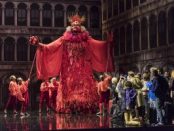
At turns beautifully silly, dreamy, exquisitely moving and always delightful, "Fêtes" is a sweeping, if daffy, look at life in eighteenth century Venice. Christie and his director Robert Carsen, framed the opera ingeniously by beginning the work in modern day Saint Mark’s Square complete with modern day tourists—mostly members of Ed Wubbe’s Scapino Ballet—with their cellphones, backpacks and obnoxious behavior.
[more]
You might wonder why Morag, Fiona’s mother, in Sharman Macdonald’s groundbreaking Scottish play, "When I Was a Girl I Used to Scream and Shout," is so repressive about sex. What the program doesn’t tell you about this play having its Off Broadway premiere at the Clurman Theatre is that it was first produced in 1984 in London and that the daughter’s childhood goes back to the fifties when female sexuality was frowned upon. Then it becomes obvious that this play is now a period piece dealing with a time when feelings about female sexuality were changing but the older generation was still stuck on the other side of the divide with the teachings of their childhood. While the play seems to be two generations behind the times, what the play continues to be is a blistering portrait of a toxic mother-daughter relationship.
[more]
The Royal Shakespeare Company’s "King and Country: Shakespeare’s Great Cycle of Kings" is a magnificent achievement and a fitting tribute in this 400th anniversary of the bard’s death. Not only are the four plays an accessible presentation of what is often confusing for Americans unversed in British history, but taken together they are a very great study in the use and abuse of power and authority in this year of our own contentious political wranglings. Gregory Doran’s unfussy and intelligible productions set a bench mark by which others will be measured and offers star performances that should become legendary.
[more]
Van Hove sets his version in a modern classroom. When the curtain goes up we first see the girls who will later accuse various people in Salem, Massachusetts, of having bewitched them, seated at desks and singing in unison. The curtain descends and then the play begins with Miller’s first scene. Puritan Reverend Samuel Parris has caught his daughter, his niece Abigail Williams, his black servant Tituba, and other girls in the community dancing in the forest around a cauldron, all forbidden behaviors. On seeing him, his daughter Betty has become catatonic. When expert witch hunter Reverend Hale, who has been sent for, questions Tituba, she confesses to communing with the devil, an idea he plants in her mind.
[more]
Since the 1670’s, the Choir has consisted of voices ranging from bass to treble, all students at St. John's College or the College School. There are currently six basses, five tenors, four counter-tenors and seventeen trebles; of the trebles – two or three of whom are no bigger than buttons – there currently appear to be thirteen families represented. In some senses, the trebles are the stars of the show: that such young boys should demonstrate such consistently high levels of both innate musicianship and disciplined formal training is remarkable. The sweetness of tone inherent to boys' soprano voices is not like anything else: its combined ethereality of the moment and promise of future sturdiness make it a perfect instrument for the invocation of angels, heavenly beauty and divine wisdom.
[more]
I cannot remember the last time a ballet company so completely blew me away as the Miami City Ballet did during its recent, depressingly short season at the David H. Koch Theater in Lincoln Center. The explosive metaphor is entirely apt. This is a stylish classical ballet troupe that is definitely a company whether they are dancing works by Alexei Ratmansky, Twyla Tharp or George Balanchine. They exude a lushness of style that allows them all to be individuals, yet cohere into an exciting artistic unit.
[more]
“Our goal is not to impersonate her but to channel her,” said Mr. Sperling, the artistic director, writer and director of this entertaining event. In addition to these tasks, he also sang, played piano and as the genial host effortlessly delivered his authoritative biographical statements. A fan of Merman’s since childhood, Sperling’s conception and execution of this show was a very well done labor of love. His patter skillfully documented her renowned charisma, saltiness and, most importantly, her unique vocal abilities.
[more]
Florian Zeller is the most famous French playwright you probably never heard of. He won France’s highest theatrical honor, the Moliere Award, in 2011 for his play, "The Mother," and the Moliere Award again in 2014 for "The Father." This last named international hit is currently running in both Paris and London with major stars in the leading role. Manhattan Theatre Club now brings the Christopher Hampton translation to Broadway with Frank Langella in the title role. As André, an 80-year-old man beset with dementia in which his reality keeps shifting, Langella turns in a virtuoso perform but you won’t be bored for a moment.
[more]
This trio certainly embodies the dynamic of most family relationships – with sisters struggling to get along and the eldest child having to take responsibility. Comerzan acts as a parent to her youngest sister and uses her compassionate nature to try and take charge of the situation. D’Angelo is the firecracker in the mix and keeps the audience in stitches with her snappy one-liners and sarcastic comments. Krane plays well to the youngest child part – attempting to be understood while making sense of her bizarre hobby. As the play develops, the audience learns about the fourth sister, Margo, played by Leslie Marseglia, whose life path and relationship with Naomi has greatly impacted her sister’s life and means of coping.
[more]
On stage, Birbiglia’s presence differs significantly from that of his fellow comics. It is no exaggeration in referring to Birbiglia as a soft-spoken individual, a term not often associated with a stand-up comedian. Birbiglia embraces his subtlety as his calling card, and this unique quality is the trait that differentiates his style from that of others. Further, because of the way he controls his onstage presence, when he does raise his voice or get particularly physical, it is even more effective as a result. This style paves the way for many different forms of comedy and jokes along the way, thus keeping the show free of any break in pace or monotony.
[more]
An opportunity to see the luminous Academy Award winner Lupita Nyong’o live on stage may be the reason most people are rushing to the Golden Theatre, but, thrilling as that may be, "Eclipsed" is its own reward, a starkly detailed, microcosmic observation of just one ghastly corner of a ghastly civil war.
[more]
Though the evening was studded with some of the more famous and mainstream orchestral pieces of William’s career—namely the March from "Raiders of the Lost Ark" or the Theme from "Jurassic Park," the evening also highlighted some of the more experimental pieces that came with Spielberg’s influential works of science fiction. A series of excerpts from "Close Encounters of the Third Kind," as well as a suite from "E.T. the Extra-Terrestrial," shed light on the fact that, though Williams is gifted at the art of creating a catchy melody, he is also an expert at concocting complex, ethereal music that makes the world of science fiction seem wholly believable.
[more]
Scholars, critics, actors and audiences have long been entranced and intrigued by these plays. They appear to reflect Beckett’s perpetual theme of despair and joy coexisting within the human condition. This mesmerizing production of "Beckett Trilogy: Not I/Footfalls/Rockaby" vividly captures that expression with Lisa Dwan’s titanic performance and its striking presentation.
[more]
It’s an uneasy stretch that ultimately fails to convincingly conflate the surprisingly liberal religious arguments that Lessing makes with the extraordinarily complex political/religious/cultural impasse in today’s Israel. The interactions between the Christian, Muslim and Jewish characters are frank, barbed and boldly modern sounding—at least in Kemp’s version—but come across more as statements of the class structure of eleventh century Jerusalem than deep-seated psychological or sociological issues.
[more]
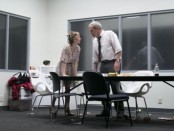
The problem with the staging begins from the outset. Daniels' Ray, tense and rigid, pushes demanding, triumphant Una into a corporate break room. He is upset to see her, and she is all confidence and gloating. Unfortunately, this scene starts at so high a peak of emotion that the play has nowhere to go. In fact, while their startlingly different accounts of the night they ran off together ought to be the high point of the play, the opening scene is peak of emotion instead. It is a calculated risk and it damages the play.
[more]
This month, the 13th Street Repertory Theater will kick off its celebration of Founder/Artistic
[more]
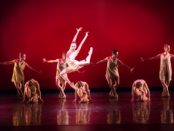
The four works on the Dance Theatre of Harlem’s program revealed a troupe that loves to entertain and show off but one that also hasn’t quite reached a secure level of technical achievement. Fervor and personality can take a dance company only so far. Nevertheless, this is definitely a ballet company with most works featuring solid point work.
[more]
Tarell Alvin McCraney’s "Head of Passes" is an advance over his earlier work seen in New York ("The Brother/Sister Plays," "Wig Out," "Choir Boy") in its attempt to take on bigger themes and archetypes. In creating the role of Shelah, he has put on stage a magnificent role for an actress of tremendous gifts. Phylicia Rashad rises to Greek tragic heights required by Shelah’s plight. However, the meaning and message of the play remains obscure and tends to leave the audience outside of the play’s dramatic action. We watch mesmerized in horror as events unfold, but why they are happening and what is the underlying cause remains a mystery.
[more]
«
1
…
87
88
89
90
91
…
114
»
Copyright Jack Quinn, 2001-2023