News Ticker

Archive

The Lightning Thief: The Percy Jackson Musical

April 15, 2017

Theaterworks NYC’s stage version of Rick Riordan’s best-selling novel, "The Lighting Thief," about Percy Jackson and other demi-gods, first seen in 2014, has returned in an expanded two act format that, from reaction of the audience at the Lucille Lortel Theatre, is sure to become a cult musical. This fast-paced fantasy-adventure story would not seem to be destined for the stage due to the number of special effects needed to tell the story. However, designer Lee Savage and other technicians have come up with a series of clever low tech solutions which are always inventive and always witty. Using masks, puppets and elaborate costuming, five members of the cast of seven play multiple roles which often require quick changes. [more]

Mourning the Living

April 15, 2017

Ms. Hogan’s dialogue is well crafted and the structure is stageworthy, but it all comes across as a playwriting exercise rather than a full-fledged dramatic work. Medically, Hogan’s premise is extremely unlikely and adds to the off-kilter dimension. The plot points of the combination of someone in their 30’s being stricken with Alzheimer’s Disease, and then years later getting a respite from it, stretches credibility. [more]

A Gambler’s Guide to Dying

April 14, 2017

“To some he was dad, to some he was mate,” says McNair, at the top of his monologue, “to others he was liar, cheat, addict, hero, story teller.” Over the course of the next 70 minutes, McNair will also do, with modest effects and a modicum of success, other voices including his much younger self, a schoolteacher, mates of Archie’s, and even his own mother. Through it all, the one thing we never lose sight or sound of is his love for his grandfather. [more]

CasablancaBox

April 14, 2017

“The structure of 'CasablancaBox' is inspired by another filmmaker’s technique, Robert Altman’s roaming camera,” writes playwright Sara Farrington and director Reid Farrington in their program notes. This homage results in a collection of frantically staged vignettes that aren’t funny and don’t add up to much. [more]

Luft Gangster

April 13, 2017

It is fascinating to watch Lowell Byers face his unfounded, country boy optimism as he is confronted with the brutal realities of his situation. That Byers’ Lou never completely succumbs, despite having to perform several vile acts, makes him the moral center of the play that pushes the idea of morality to the extremes. In addition, his exacting research, based on his cousin’s travails, pays off in the complexity of his writing. [more]

The Play That Goes Wrong

April 12, 2017

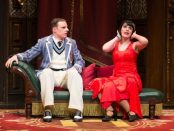
While the non-stop buffoonery is reminiscent of Charles Ludlam and his Ridiculous Theatrical Company, this British import (produced by London’s Mischief Theater, no less) immediately evokes inevitable comparisons with "Noises Off," Michael Frayn’s divine and (admittedly, more) sophisticated farce about a community theater company putting on a play--perhaps the most hilarious, theatrical farce that has ever been devised by a playwright. But the present offering also has less of an agenda, settling for the sheer mayhem of putting together a group of people on a stage, during an ongoing performance, when absolutely everything that can possibly go wrong, does. It’s a surefire setup for the comic and rewarding chaos that ensues. In the end, and basically throughout, "The Play that Goes Wrong" has gone very right, indeed. [more]

“Rosalee Pritchett” & “The Perry’s Mission”: Two one-act plays

April 12, 2017

"Rosalee Pritchett" and "The Perry's Mission" are in the provocative tradition of such works of the period as Amiri Baraka’s 1964 play Dutchman and Melvin Van Peebles’ 1970 film "Watermelon Man." This exemplary production brings attention to these neglected playwrights, and is a welcome opportunity to experience their unsettling power. [more]

Vanity Fair

April 11, 2017

Tucker’s production uses seven actors playing 20 named characters plus members of the ensemble: the women (Joey Parsons and Hamill play one each, good girl Amelia Sedley and bad girl Becky Sharp, respectively) and the men play all the rest, including other female characters with the addition of wigs and slight costume changes. This allows the cast to demonstrate tremendous versatility in these juicy roles. [more]

Amélie

April 10, 2017

"Amélie" is frustrating. The characters exist as two-dimensional cartoons that a talented cast almost brings to life. The uneven rhythms and poor timing of the show bog it down. An inability to find stage equivalents for the film’s gimmickry also hurts. It does have a game cast who vie with undistinguished songs, choreography and staging. Finally, there is Phillipa Soo who radiates warmth amidst the disarray. [more]

The Profane

April 10, 2017

Playwright Zayd Dohrn has a facility for setups, punch lines and zingers that might play well as an HBO situation comedy attempting to mix humor with seriousness. As a theater piece, his premise has potential but his execution is deficient. [more]

World Music Institute: Salif Keita

April 9, 2017

Over the course of Salif Keita’s recent appearance at The Town Hall there was a story whose shape reflected both Keita’s identity and his music. At 7:00 p.m., there was a question-and-answer session with Keita, musician and writer Banning Eyre of www.afropop.org, and translator Isabelle Dupuis. By the end of the evening, audience and performers were inseparably merged; singing and dancing had become one, and Keita had made us all his own. Far from needing any explanation or translation, the music of Salif Keita is entirely universal. [more]

Miss Saigon

April 9, 2017

The scenic design with original concept by the late Adrian Vaux, production design by Totie Driver & Matt Kinley, and projections by Luke Halls is as eye-filling as a movie would be. The new helicopter scene during the evacuation of Saigon uses both scenery and video in a breathtaking stage effect. Connor makes excellent use of the cinematic and realistically three-dimensional sets in moving his crowds around to completely populate the stage picture. Bruno Poet’s lighting varies from shadowy evening scenes, to romantic moonlit ones, to blatantly lit day time scenes. [more]

Perversion

April 8, 2017

If only there were perversion in "Perversion." Instead, it’s a tedious, mélange of the absurdist styles of Jean Genet, Eugène Ionesco, Jules Feiffer and Dr. Seuss. There’s the eerie sensation of watching a satirical, counter-culture work that might have been exhumed from the archives of La MaMa, which was performed for three weeks in 1969, and then forgotten. [more]

La Campana Sommersa (New York City Opera)

April 8, 2017

This production was a co-effort with Fondazione Teatro Lirico di Cagliari whose orchestra joined forces with the New York City Opera Orchestra under the baton of Ira Levin who brought out every bit of color in the music. Maestro Levin was sensitive to the needs of the singers, knowing just how to mold the orchestra’s sounds so that their voices soared over the often over-orchestrated score (not helped by the wrong-headed scrim used in the forest scenes). [more]

Du Barry Was a Lady

April 6, 2017

The show has a great many topical references to celebrities of 1939 (Minsky, Sophie Tucker, Tallulah Bankhead, Franklin and Eleanor Roosevelt) not all of whom still ring any bells for most theatergoers. Aside from the justly famous “Friendship,” which has also been interpolated into Anything Goes since the 1962 NY revival, the show is second-rate and unfamiliar Porter. Ironically, three of the songs (“It Ain’t Etiquette,” “Well, Did You Evah!” and “Friendship”) resurfaced in Peter Bogdanovich’s flop original movie musical, At Long Last Love, in 1975. The patter songs, “But in the Morning, No,” “Give Him the Oo-la-la,” “Well, Did you Evah!,” and “Katie Went to Haiti” have clever lyrics but are not up to Porter’s usual standard. [more]

Church & State

April 4, 2017

Rob Nagle (who created the role in the Los Angeles production) plays “compassionate conservative” North Carolina Senator Charles Whitmore who is up for reelection in a statistical dead heat in just three days’ time, running on a campaign slogan of “Jesus is my Running Mate” (chosen by his wife Sara). However, earlier that day he has been shaken by attending the funeral of 29 students shot by a lone gunman at the local elementary school which his sons attend. It could have been his sons who had been killed. [more]

Diva: Live From Hell

April 4, 2017

"Diva: Live From Hell," an energetic, campy variation on the “All About Eve” theme, is performed with manic glee by Sean Patrick Monahan who also wrote the book and created all the colorful characters. His partner in crime is Alexander Sage Oyen who provided the music and lyrics. Sex (requited and unrequited), ugly violence and dark humor are all thrown into the story which is told by Desmond Channing (Monahan, who also plays virtually a high school’s worth of characters). [more]

Sweat

April 3, 2017

"Sweat" is a classic, “well-made”--or carefully constructed--play, with a focus on the dwindling work for people in the middle of the country, prompting them to install Trump in the White House--to the ongoing dismay of the rest of the world. It couldn’t be more topical even as it helps us understand just exactly what’s been happening to bring us all to this sorry state. It was also based on Nottage’s extensive interviews with many actual residents of Reading, fueling the drama’s impact. [more]

Doug Varone and Dancers: Spring 2017 Season

April 2, 2017

Varone employs movements loosely flung out from the body’s core; sudden, inexplicable pauses; (painful looking) drops to the floor (usually onto a knee!); contrasting chaotic activities with stillness, high with low and slow with fast. There is a sense—clearly mistaken—that the choreography is improvised which makes for unfocused and nervous stage pictures. The fact that his dancers, a diverse bunch, wear his movement style like a second skin adds an excitement to his ballets. They seem born to his particular style and give it an offhanded grace, looking more like people moving rather than dancers. [more]

Joan of Arc: Into the Fire

April 1, 2017

Don’t blame singer Jo Lampert who gives a passionate performance as the Maid of Orleans. Unfortunately, she hasn’t been given anything very interesting to sing in this mostly sung-through musical. Her lyrics are trite and repetitious. She may have been a teenager, but there is no reason to have written lyrics that continue to sound like they were written by a junior high school student attempting his or her first songs. The endlessly repeated refrains do not serve to make Joan seem more simple and holy but sound like a lack of imagination. The minimal spoken dialogue is used for the various narrators and the trial testimony taken from the actual transcript of the event. [more]

William Inge in Rep: Picnic & Come Back, Little Sheba

April 1, 2017

Though rather flawed in execution, there is much to enjoy in "Picnic" & "Come Back, Little Sheba": William Inge in Repertory. It is also revelatory in proving William Inge’s high ranking in the annals of dramatic literature. [more]

Paul Taylor American Modern Dance: Spring Season 2017

March 31, 2017

Now named Paul Taylor American Modern Dance, Taylor has included ballets by other choreographers which allows for some healthy comparisons and a hope for the future of this legendary company. The four non-Taylor works, all but one danced by the Taylor dancers, made fascinating comparison with his work: particularly Martha Graham’s “Diversion of Angels,” her ode to romantic and sexual love, choreographed in 1948 to music by Norman Dello Joio, one of the few works in which Graham, herself, did not appear. [more]

Growing Up Gonzalez

March 31, 2017

Mr. Rojas vividly creates an entertaining panorama of the Puerto Rican community in The Bronx of the 1960’s and 1970’s. A gallery of characters and numerous incidents are lovingly described. Orchard Beach, Roberto Clemente, various foods, the Catholic Church and a visit to Puerto Rico are among the cultural touchstones that are represented. [more]

How to Transcend a Happy Marriage

March 30, 2017

Marisa Tomei excels as George, the narrator of "How to Transcend…" --and of her own story. Thanks to Tomei’s vocal and visual expressions, we constantly share in George’s ongoing surprise, as she graduates from naivety to knowledge. In the end, it is George who has the most “transcendent,” and religious, experience. (It is not insignificant that we’re told George is the only Catholic in the group.)“It seems like you have omniscience,” says George, in her closing monologue, “when you can talk to the audience in a play.” And talk to us, she does, in the playwright’s smart, yet snappy language. Consider George also telling us that Jenna, “over time forgave us,” after walking in on her parent’s participating in a sex orgy. And “the trauma of seeing her parents’ aberrant sex lives up close--it became an anecdote in a college application.” Or consider David’s saying: “I’m from everywhere. And nowhere. I moved constantly as a child…. as a result, I don’t really believe in nationality.” [more]

The New Yorkers: A Sociological Musical Satire

March 29, 2017

Herbert Fields’s book was based on a story by E. Ray Goetz and New Yorker cartoonist Peter Arno. This clunky concert adaptation by Jack Viertel is crammed with double entendres, puns, anachronisms, and contemporary inside jokes that mostly thud. [more]

The Emperor Jones

March 28, 2017

Directed by Ciarán O’Reilly as a feverish nightmare, this "Emperor," in just over an hour, exposes the inner reaches of the mind of the title character, Brutus Jones (played with a booming voice and a larger-than-life charisma by Obi Abili) leaving tedious reality behind. [more]

Beneath the Gavel

March 28, 2017

Bated Breath Theatre Company specializes in original works inspired by and in partnership with museum collections and exhibitions. However, this show about the fate of the “Haddie Weisenberg Collection” painted by artist Daniel Zeigler appears to be entirely fictional. Written and directed by Mara Lieberman, executive artistic director of the company since 2012, the play uses six actors in 43 different roles from artists both famous and imaginary, to auction house sales personnel and staff, to collectors to dancers, as well as having actors impersonate free standing sculptures. Ironically, 59E59 Theaters was at one time part of Christie’s Auction House and Theatre B was actually one of the firm’s galleries. [more]

The Price

March 27, 2017

Maybe “fireworks” is too strong a word for a production that is more of a slow burn. The play begins when Mark Ruffalo, as Victor, walks up, into the top floor of the home his family was consigned to, when the Great Depression of 1929 hit and their father lost his fortune. The essence of the conflict between Victor (a policeman) and Walter (a doctor) boils down to economic inequality. (As Walter says to Victor, “It’s very complicated between us.”) Though they both grew up with a chauffeur, the older Walter went on to a successful career while Victor stayed behind to care for their father when everything was lost during the Depression. [more]

Who Would Be King

March 25, 2017

Jason Slavick’s direction keeps the cast rollicking along, taking advantage of every inch of Ars Nova. He is helped by an energetic cast, all on the same wavelength, giving their physical and emotional all. Silly at times, yes; but ultimately dark and meaningful. [more]

Angry Young Man

March 24, 2017

The confusion and the rapid pace of the production pretty much engulf--and finally overwhelm--the extremely complicated story of"Angry Young Man." The performers, on the other hand, make this something of a gem of a small, Off Broadway offering, from Urban Stages. The wayward plot eventually takes Youssef to a disco with Patrick, and with Patrick’s girlfriend Alison, where Youssef is confronted by a skin-head, Terry, whom he accidentally kills. “The other customers were almost exclusively male,” says Youssef. “They seemed for the most part to be dressed as Patrick: long-hair, T-shirts, scruffy blue jeans.” [more]

Glass @ 80: Philip Glass & Foday Musa Suso

March 24, 2017

Beginning in the 1980s, Glass and Suso collaborated on several projects. Genet’s difficult, demanding, essentially un-actable and relentlessly fracturing play, "The Screens," elicited from Glass and Suso unexpectedly warm and affirming music. The setting for Genet’s play – the wretchedness of the French Algerian War – calls for music that is both European and African, but to imagine Glass’ contribution as “the European one” and Suso’s as its African opposite is to misunderstand the creative relationship. [more]

Jack Charles V The Crown

March 23, 2017

His innate charm, joy of performing and theatrical grandeur is always on display in this show. All of those qualities combined with his resonant, Australian accented vocal delivery makes it easy to imagine him being commanding in Shakespearean and any number of roles in the classics of dramatic literature, as well as a screen actor. Sadly, environmental circumstances did not as of yet make this possible. [more]
1 75 76 77 78 79 114