
The Adding Machine
Elmer L. Rice's legendary expressionistic play has been given a revision by Thomas Bradshaw for The New Group.
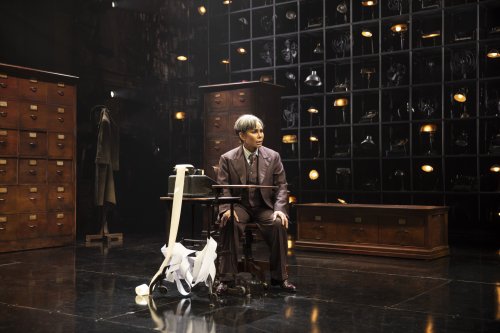
Daphne Rubin-Vega in a scene from The New Group’s production of “The Adding Machine” at Theater at St Clement’s (Photo credit: Monique Carboni)
While The New Group’s mission is to develop new work, in recent years it has taken to updating and revising classic plays for contemporary audiences like Thomas Bradshaw’s The Seagull/Woodstock, NY, inspired by Anton Chekhov. Now as the first play in its new home at The Theater at St. Clement’s, it is presenting a new version of Elmer L. Rice’s rarely staged 1923 expressionistic classic The Adding Machine with revisions by Bradshaw and a cast that includes Daphne Rubin-Vega and Jennifer Tilly.
Among Bradshaw’s revisions are the use of a narrator, reducing the original cast list from 25 to four, adding an intermission, updating some of the slang to contemporary speech, and having its protagonist Mr. Zero played by a woman instead of a man. The effect of all of these changes is that the play now runs longer than it used to, and the long monologues are still in evidence and become rather tedious. The new version still includes some of the protagonist’s racist rant in the trial scene. Few of these changes make the play any better or more relevant today..
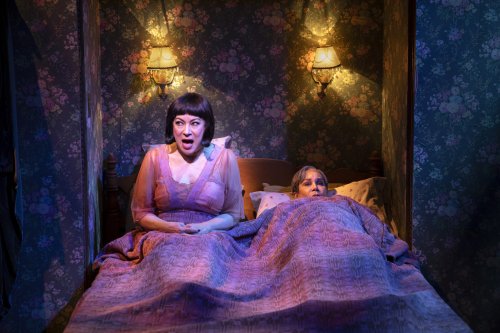
Jennifer Tilly and Daphne Rubin-Vega in a scene from The New Group’s production of “The Adding Machine” at Theater at St. Clement’s (Photo credit: Monique Carboni)
While reducing the cast to four performers, this version makes this play more acceptable to modern theater companies who need to watch their budgets. On the other hand, this means that one actor (Michael Cyril Creighton) plays a great many parts including enacting several in the same scene. While Mr. Zero is a quintessential masculine role, having the role played by a woman is not as effective in this story even played by an actress as fine as Rubin-Vega who has impressed elsewhere in her roles in the Pulitzer Prize winners Rent, Anna in the Tropics, and A Streetcar Named Desire in revival.
Expressionism was a movement in art and theater developed in the 1920s. It emphasized subjective emotions over objective reality. It usually critiqued the status quo using scenery symbolically and film noirish lighting. The protagonists were usually an Everyman or Everywoman and the other characters generally had no names but were referred to as The Mother, The Boss, the Doctor, The Mistress, etc. While this style was more popular in Germany than the United States, the most famous American examples are Eugene O’Neill’s The Emperor Jones (1920), The Hairy Ape (1922) and The Great God Brown (1922), Sophie Treadwell’s Machinal (1928) and Rice’ s The Adding Machine (1923).
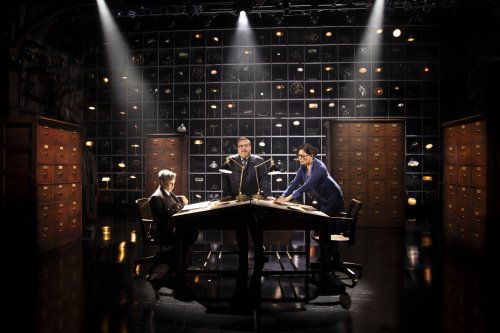
Daphne Rubin-Vega, Michael Cyril Creighton and Sarita Choudhury in a scene from The New Group’s production of “The Adding Machine” at Theater at St. Clement’s (Photo credit: Monique Carboni)
Best known now for his Pulitzer Prize-winning Street Scene (later turned into a Broadway opera with composer Kurt Weill and lyricist Langston Hughes), Rice burst onto the theatrical scene with The Adding Machine six years earlier in a legendary production by The Theatre Guild. Rice’s protagonist simply known as Mr. Zero has worked as an accountant for the same company for 25 years opposite Daisy Diana Dorothea Devore while he has been married to Mrs. Zero, who has become a shrew and a nag. Expecting to be rewarded on this anniversary for his years of excellent service, he is instead informed by his boss that he is being replaced by an adding machine which will be cheaper and more efficient.
Mr. Zero kills his boss (unseen by the audience), is tried, convicted and executed. In a surprising afterlife in the Elysian Fields, he meets his secret love Daisy who has committed suicide after his death and Shrdlu who has killed his domineering, possessive mother. Although he has the choice to remain with Daisy in this paradise, he chooses instead to reject it and become an accountant again. Finally, he is told he is a waste of space and sent back to earth to begin all over again for his soul to be reused. He is warned that with his slave mentality, he will again be at the bottom of the social ladder.
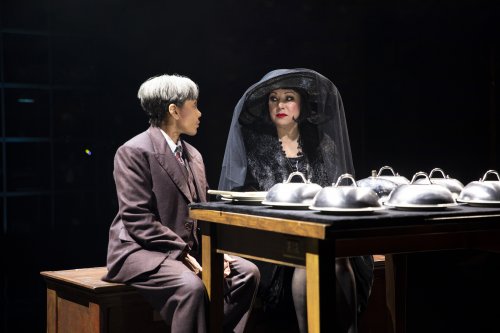
Daphne Rubin-Vega and Jennifer Tilly in a scene from The New Group’s production of “The Adding Machine” at Theater at St. Clement’s (Photo credit: Monique Carboni)
The play explores the impact of technology, dehumanization and obsolescence on society. Mr. Zero (obviously a nobody) is only a cog in the wheel of industry and easily expendable. With Artificial Intelligence taking away jobs in the near future on everyone’s minds these days, The Adding Machine has a new relevance in our time. Unfortunately, Scott Elliott’s production makes numerous choices that vitiates this parallel. Casting a woman as Mr. Zero changes the relationship between him and his wife and his co-worker Daisy. While an excellent actress elsewhere, Rubin-Vega is not convincing as a man even dressed in Catherine Zuber’s three-piece suit and with Tom Watson’s wig design.
While Derek McLane’s set with its endless wall of lamps, fans and business machines suggests the claustrophobia of Mr. Zero’s daily life, the pleasant afterlife in the Elysian Fields is also confined by this setting and never suggests an alternative to the life that Zero knew. The dark lighting by Jeff Croiter is fine for the earlier scenes, but not suitable for the later ones. As Mrs. Zero, Jennifer Tilly who last appeared on the New York stage in 2013 is convincing as the shrewish wife but is very unsympathetic even though we realize her life has been as boring as that of her husband. Sarita Choudhury as Daisy, first Mr. Zero’s colleague and later his girlfriend is very bland, making her fade into the woodwork, so to speak. Playing numerous roles including the narrator, Creighton is the same throughout so that it is hard to differentiate his many characters.
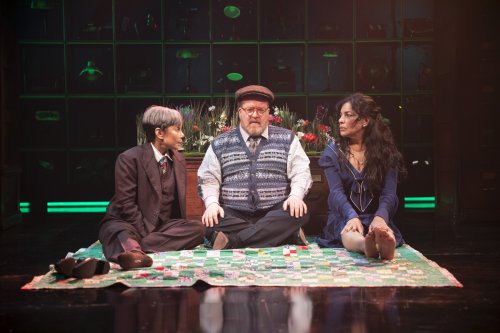
Daphne Rubin-Vega, Michael Cyril Creighton and Sarita Choudhury in a scene from The New Group’s production of “The Adding Machine” at Theater at St. Clement’s (Photo credit: Monique Carboni)
Historically, The Adding Machine remains an important play and was successful in a 2008 Off Broadway musical version. Revivals of Treadwell’s similar Machinal still prove to be very powerful. The New Group is to be commended for reviving this landmark play which is now timely once again but the choices made in this production dilute the play’s effectiveness from eliminating the 12 characters who live the same life as the Zeros, to the unchanging set, to the distracting casting, to the unnecessary contemporary additions which fail to bring the play up to date.
The Adding Machine (extended through May 17, 2026)
The New Group
Theater at St. Clement’s, 423 W. 46th Street, in Manhattan
For tickets, call 917-935-4242 or visit http://www.thenewgroup.org
Running time: two hours and 15 minutes including one intermission


Leave a comment