
Fallen Angels
Falling gracefully: O’Hara and Byrne turn Coward’s light comedy into a comic playground.
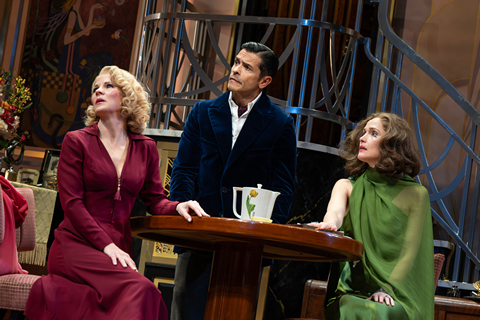
Kelli O’Hara, Mark Consuelos and Rose Byrne in a scene from the Roundabout Theatre Company revival of Noel Coward’s “Fallen Angels” at the Todd Haines Theatre (Photo credit: Joan Marcus)
In case you’re considering a visit to Fallen Angels, the Roundabout’s frequently amusing revival of Noël Coward’s comedy, slickly staged by Scott Ellis, you should be forewarned that the press was (I quote) “vituperative to the point of incoherence. No epithet was spared. It was described as vulgar, disgusting, shocking, nauseating, vile, obscene, degenerate, etc., etc.” One critic even alluded to its two leading ladies as “suburban sluts.”
That candid summation comes from Coward himself, describing the reaction to the play’s original West End production in 1925. Fallen Angels even was banned in Amsterdam a year later, but when it hit Broadway in 1927, starring Fay Bainter and Estelle Winwood, critical indignation was aimed at its theatrical, not its moral, insufficiencies. These led it to an early grave after only a month, much shorter than its scandalous life in London.
Two principal reasons drove the uptight London critics and civilians crazy (the latter inundated Coward with letters): first, the sight of two polished British women getting falling down drunk, and second, their unashamed admission to having had premarital sex. Coward even went so far as to publish a defense of using the stage for the open discussion of sex, calling it “the fundamental root of good drama.”
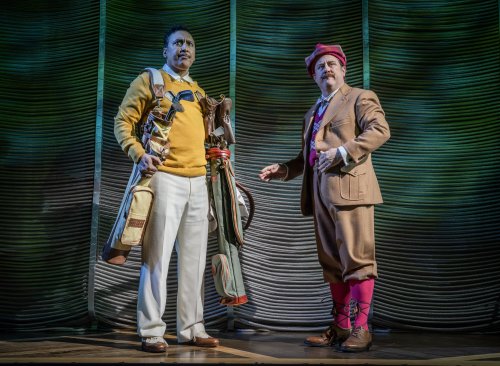
Aasif Mandvi and Christopher Fitzgerald in a scene from the Roundabout Theatre Company revival of Noel Coward’s “Fallen Angels” at the Todd Haines Theatre (Photo credit: Joan Marcus)
These women are Julia Sterroll (Kelli O’Hara) and Jane Banbury (Rose Byrne), elegantly dressed (costumes: Jeff Mahshie) and coiffed (hair and wigs: David Brian Brown and Victoria Tinsman), who await the arrival of the dashing Frenchman, Maurice Duclos (Mark Consuelos). Both Julia and Jane were romantically intimate with him nine years earlier, and their torches are still burning.
With their stuffy spouses, Fred Sterroll (Aasif Mandvi) and Willy Banbury (Christopher Fitzgerald), off playing golf, the women pass the time drinking cocktails and champagne and dining in Julia’s exquisite, mansion-like, Art Deco flat (sets: David Rockwell; lights: Kenneth Posner). (Costumes and sets appear to place the action in the 1930s, not the 1928 given in the program.) Bored with their seven-year-old marriages (five in the original), they fantasize about what to expect in their upcoming rendezvous, as a comical maidservant, Saunders (Tracee Chimo), with a surprising fund of experiential knowledge, traipses in and out to serve their needs.
Physical mayhem takes precedence over verbal sparring, Jane and Julia sprawl, fall and slide, and Jane returns from a rainy night at a hotel with her brunette hair looking as if she’d stuck her finger in a live outlet. A few minor complications are thrown in for dramatic ballast before and after Maurice finally arrives, the skeptical husbands are momentarily hushed, Jane, Julia, and Maurice go off to examine the upstairs flat, and a hilarious sight gag brings down the curtain. As they say, always leave ‘em laughing.
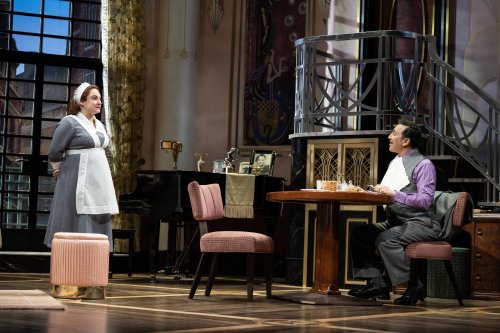
Tracee Chimo and Aasif Mandvi in a scene from the Roundabout Theatre Company revival of Noel Coward’s “Fallen Angels” at the Todd Haines Theatre (Photo credit: Joan Marcus)
Fallen Angels, for all its dramatic frailty and critical disdain, has held the stage for a century, with multiple New York revivals, two (1956 and today) on Broadway, and three Off (1978, 1980, 1995), nearly all with noted actresses. It continues to be revived by regional companies everywhere.
In conventional terms, Fallen Angels is a bit like a shallow Feydeau farce without the slamming doors and complex complications. And, hard as it tries, its wit is hit and miss. In theatrical terms, however, it offers two first-class actresses a platform for virtuoso comic acting, and, as such, will continue to inspire revivals for the foreseeable future. The farcical emphasis appears not to have been Coward’s intent, however, and only after the performances of Hermione Gingold and Hermione Baddeley in a 1949 London revival, to which he at first objected, did he gradually accept a broader approach.
It’s therefore a delight to see two such skilled actresses as Byrne and O’Hara, both using ultra-posh accents, willing to play against their striking beauty to get laughs, demonstrating both physical dexterity and perfect timing. At first, it seems as if everyone, the stars included, is trying express some stereotypical notion of what being in a Coward comedy requires, from the ultra-sophisticated speech, mannerisms, and elevated tone, and it takes a few minutes to begin seeing through the self-consciously lacquered veneer to the characters inside.
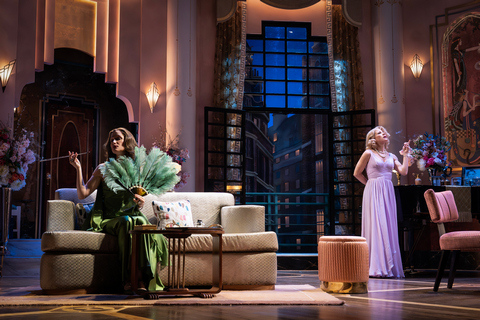
Rose Byrne and Kelli O’Hara in a scene from the Roundabout Theatre Company revival of Noel Coward’s “Fallen Angels” at the Todd Haines Theatre (Photo credit: Joan Marcus)
Although Coward now and then comes through with a bon mot matching his reputation, much of the laughter is generated by throwaway comments and responses, gestures, facial expressions, and bodily reactions. Ellis creates amusing business with props, like long cigarette holders, and food, like strawberries. What Byrne does with a slinky green gown and veil, using her elegant slimness to visually hysterical advantage, will long remain in my memory, just as will the image of the glamorously blonde O’Hara, flopped upside down over a club chair as she ever so slowly slides down it to the floor.
Although clearly overstated, Chimo makes more than one expects of Saunders, a role rarely even mentioned in reviews of previous productions. Fitzgerald and Mandvi are appropriately bewildered as the boorish spouses. Consuelos, in his Broadway debut (but getting a star’s applause despite an inconsequential role), uses an ersatz French accent but is attractive enough to make the women’s fascination with him convincing.
The three acts of Fallen Angels have been condensed into a single act running 90 uninterrupted minutes. Cuts and revisions likely have been made (Coward himself heavily revised the 1956 version) and they’re probably why the show retains its champagne fizz, with no time for longueurs.
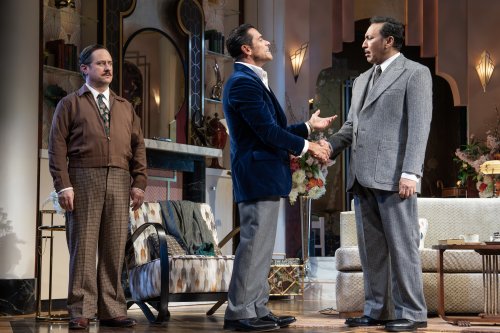
Christopher Fitzgerald, Mark Consuelos and Aasif Mandvi in a scene from the Roundabout Theatre Company revival of Noel Coward’s “Fallen Angels” at the Todd Haines Theatre (Photo credit: Joan Marcus)
In the end, Fallen Angels isn’t revived because it’s a great play; it’s revived because it’s a great playground for a smart director and gifted performers. Byrne, O’Hara and Ellis turn Coward’s champagne bubble of a script into a showcase for comic finesse. Dramaturgic quibbles aside, the show delivers exactly what its title promises: a graceful fall for two angelic presences from sophistication into silliness—and a soft landing.
Fallen Angels (through June 7, 2026)
Roundabout Theatre Company
Todd Haimes Theatre, 227 W. 42nd Street, in Manhattan
For tickets, visit http://www.roundabouttheatre.org
Running time: 90 minutes without an intermission


Coward may well be Coward, but good acting and good directing are, for sure, de rigueur.