
The Waterfall
Patrice Johnson Chevannes gives a titanic performance as a Haitian mother in Florida whose American lawyer daughter wants different things out of life.

Patrice Johnson Chevannes and Natalie Paul in a scene from Phanésia Pharel’s “The Waterfall” at WP Theater (Photo credit: Joan Marcus)
The world premiere production of Phanésia Pharel’s The Waterfall is an homage to her Haitian roots told from a first-generation American daughter’s point of view. As the mother Emi (short for Emiliene) who lives two hours north of her lawyer daughter’s home in Miami, Florida, Patrice Johnson Chevannes gives the kind of intense performance that should become legendary. The only problem with this two-character play, a co-production between New York’s WP Theater and Connecticut’s Thrøwn Støne theater company is that Chevannes’ too accurate Haitian accent and the use of Haitian Creole will make it hard for much of the audience to understand what is being said, dialogue being the driving force of the play, dialect coach Wynnie Lamour-Quansah having done too good a job this time around. Supertitles would have been a satisfactory solution to this linguistic problem. Nevertheless, the play is a powerful study of a mother- daughter relationship as well as an investigation of the American Dream from an immigrant point of view.
Bean, aka Rose, a Miami lawyer awaiting making partner, and the only person in her office of color, is called home to care for her mother who has fainted from low blood sugar at Bible study and is in the Sebastian, Florida, hospital. Once Bean gets her mother home and on a healthy diet, the focus turns to Bean’s unhappiness. According to her mother she should be married by now and having children. But Bean had decided long ago that her path would be “Partner, Wedding, Baby.” Her long-time boyfriend Richard has agreed to this schedule but as Bean nears reaching partner, she does not think she wants to be a mother.

Natalie Paul and Patrice Johnson Chevannes in a scene from Phanésia Pharel’s “The Waterfall” at WP Theater (Photo credit: Joan Marcus)
Emi who had been a nurse has very definite ideas about women’s roles. She points out that “no matter how much a man loves a woman, he is not going to give up what he wants for her.” Emi found this to be true of Bean’s late father but she also knew how to make him desire her wishes. Emi warns Bean that she might lose Richard if he wants a family and she does not provide one: he will go elsewhere to find what he wants.
However, there is a hollowness in Bean’s life which she has been exploring with her therapist. Bean is no longer even sure that she wants to be partner or that doing real estate law is what she wants to do with her life. Brought up to believe in doing good, she has been doing pro bono work for immigrants which is frowned upon by her company and might jeopardize her making partner. Wanting love, she is not comfortable with being a mother and following in the path set out for her. Of course, their line will come to an end if she doesn’t have children.
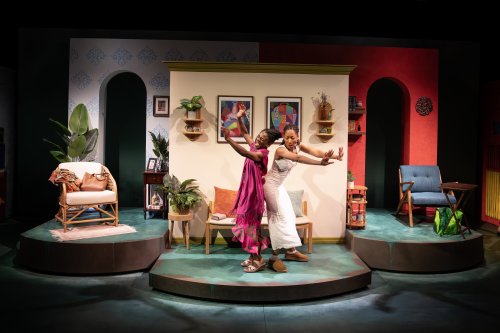
Patrice Johnson Chevannes and Natalie Paul in a scene from Phanésia Pharel’s “The Waterfall” at WP Theater (Photo credit: Joan Marcus)
The title refers to a waterfall near where Emi grew up in Haiti that has come to represent both dreams and answers for her. She has used it as a symbol for Bean throughout her growing up, though Bean now admits that she has never been able to picture it having not seen it in person. In a flashback to when Bean was 11 years old and feeling like an outsider in her class, Emi introduces the idea of asking the waterfall for solutions to her problems. Venus Gulbranson’s lighting occasionally makes us feel we are seeing and experience this waterfall in Haiti.
Under the assured direction of Taylor Reynolds, Chevannes’ performance as Emi is titanic: big, exuberant, commanding, humorous, mesmerizing, and using many significant gestures. She is Haitian to her very bones but her Emi has become entirely Americanized quoting television characters as though they are members of their family. However, Emi makes it clear she cannot go back to Haiti as it would not be safe for her but she still dreams of its water, its fruit, its mountains which she will never see again.
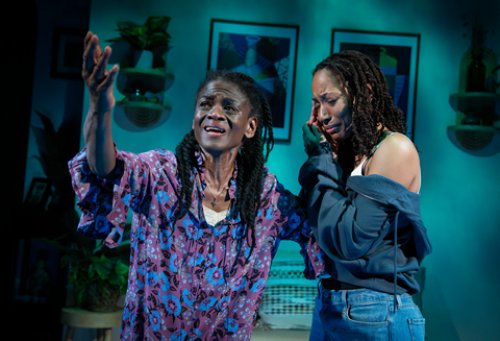
Patrice Johnson Chevannes and Natalie Paul in a scene from Phanésia Pharel’s “The Waterfall” at WP Theater; set design by Teresa Williams (Photo credit: Joan Marcus)
Natalie Paul as Bean does not give as big a performance but she holds her own opposite Chevannes. She reveals her emotions and state of mind, going deeper and deeper as the time passes. She peels away layer after layer of history and discontent as she tries to get to the root cause of her problem. At times she lets her emotions get the better of her and we worry that she will bring on a nervous breakdown. We become more and more involved with her decision-making as the play makes its way to its surprising conclusion.
Teresa Williams’ colorful set is used to represent first the hospital and then various rooms in Emi’s house. The attractive design has three platforms, backed by a red archway on stage left and a white and blue one on stage right, and on center stage a beige wall with brightly colored paintings for Emi’s living room. One of the side walls is in blue with multicolored corrugated panels with posters in English representing Florida while the opposite side wall is in red with posters in French representing Haiti which comes into use at the end of the play. Dina El-Aziz’s costumes are also colorful, Emi’s in particular often in shades of red or brightly colored patterns. Bean’s wardrobe is more subdued, the colors of a high-powered professional. The lighting by Gulbranson beautifully depicts various times on the clock including bright sunny days and blue moonlit nights. KaileyKielle Hoga and DJ Potts’ sound design includes appropriate songs sung by female singers between the scenes.
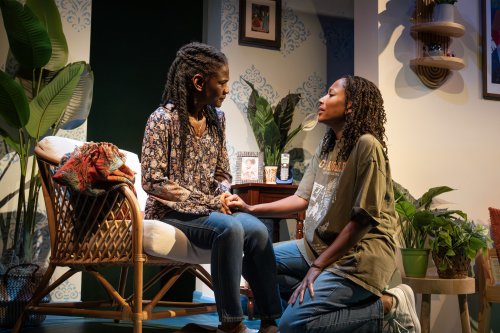
Patrice Johnson Chevannes and Natalie Paul in a scene from Phanésia Pharel’s “The Waterfall” at WP Theater (Photo credit: Joan Marcus)
Not only does Phanésia Pharel’s The Waterfall have a great deal to say, it is also very revealing of immigrant views on the American Dream. A tour de force for two actresses, Taylor Reynolds’ production takes hold of you and never lets up for a moment. This captivating play says much about mother-daughter relationships as well as Haitian-American values. See it for Patrice Johnson Chevannes and Natalie Paul’s thrilling performances which fill the stage.
The Waterfall (extended through March 8, 2026)
WP Theater & Thrøwn Støne
WP Theater, 2162 Broadway, between 76th and 77th Streets, in Manhattan
For tickets, call 929-456-0636 or visit http://www.WPTheater.org
Running time: 100 minutes without an intermission


Leave a comment