
The Other Place
Modern variation on Sophocles' "Antigone" from Britain's Alexander Zeldin but not as a political play but a social one.
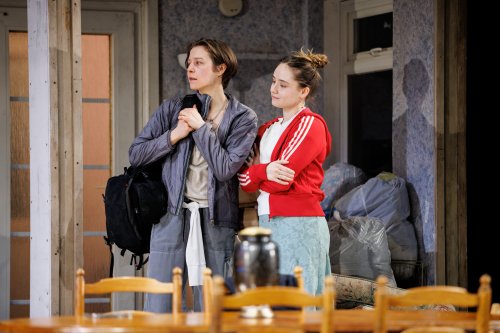
Emma D’Arcy and Ruby Stokes in a scene from Alexander Zeldin’s “The Other Place” at The Griffin Theater (Photo credit: Maria Baranova, courtesy of The Shed)
Direct from London’s National Theatre, Alexander Zeldin’s The Other Place is the latest contemporary adaptation of the Greek tragedies following Robert Ickes’ Oedipus and Luis Quintero’s Medea Re-Versed, with Anna Ziegler’s Antigone (This Play I Read in High School) yet to open. However, Zeldin’s play is only inspired by Sophocles’ Antigone and uses a modern version of the characters and the plot for his own purposes: whereas Sophocles was writing about the body politic, Zeldin has instead turned inward to the dynamics in a dysfunctional family and their grief. Most of the elements remain the same but the effect is quite different. If Zeldin’s play seems thin it is simply that so much is left unsaid that the characters have little to talk about and we have to figure out the subtext.
Adam committed suicide ten years ago and his brother Chris brought up his daughters Annie and Issy in this very house. However, at some point Annie showed signs of mental illness and was sent away to a doctor and school a distance away, and has never returned until now. In the ten years since Adam’s death, his ashes have been sitting in an urn in the basement of the house untouched.
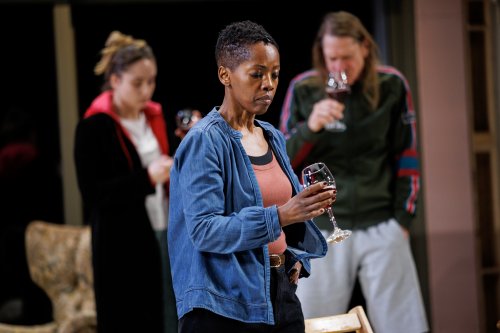
Ruby Stokes, Lorna Brown and Jerry Killick in a scene from Alexander Zeldin’s “The Other Place” at The Griffin Theater (Photo credit: Maria Baranova, courtesy of The Shed)
Now Chris who with his wife Erica and her son Leni have moved in and want a new start: he wants to bury the ashes. His niece, the designer Issy who has come from London to live with them, is willing to go along with the burial in the nearby St. Margaret’s Park. Annie who has not been heard from in years emails that she will attend. However, when she arrives, she refuses to give permission to Chris for the burial as she wants her father to remain in the house. And when he is willing to divide the ashes three ways, she steals and hides them, leaving Chris terribly embarrassed at the public ceremony he has organized.
If any of this sounds familiar, in Sophocles it is niece Antigone who wants to bury her brother Polynices, her uncle King Creon having declared him a traitor, wielding his power as ruler. Her sister Ismene can not decide whose side she is on. Complicating the issue is that his and his wife Eurydice’s son is in love with Antigone. Creon’s advisor is the blind prophet Teireas (here Terry) who predicts the outcome but is ignored. In both plays, the ending is mainly the same but for different reasons.
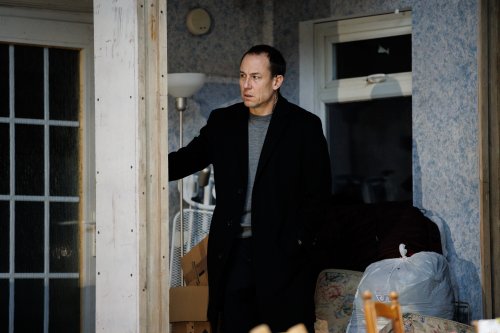
Tobias Menzies in a scene from Alexander Zeldin’s “The Other Place” at The Griffin Theater (Photo credit: Maria Baranova, courtesy of The Shed)
The title must refer to the lawn outside the newly built picture window with its sliding doors. Here Adam committed suicide, his children slept in a tent with their Uncle Chris in the months that followed, and now Annie who is not comfortable in Chris’ house, puts up the same tent in the same place and plans to sleep there during her visit. But what happened between Annie and Chris in that tent ten years ago, and why does Issy remember it all differently? And why when Annie puts the pack of ashes down her pants and Chris attacks her in order to get them back does it seem like rape? The play has several violent attacks which seem like a throwback to ancient times but are handled in contemporary fashion.
Going along with leaving much unsaid, Zeldin in his direction has kept things rather slow and leisurely so that the play’s 80 minutes seems much longer. Also much of the backstory is missing: what does Chris do for a living as we are told he is very rich? As his friend Terry is described as his contractor, does that make him a builder or has Terry only been hired to do the renovation on the house? The house incidentally has been made unrecognizable with walls removed to let in the light – though the view outside is still in darkness until the trees are torn down, including the tree from which Adam hanged himself. How has Annie been living since leaving the hospital? She has refused to take Chris’ money so that is not an explanation. And is his offer of money an expiation for some unnamed guilt?
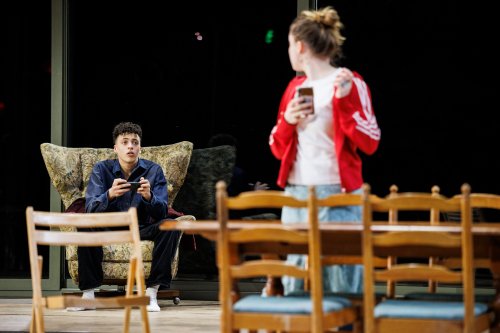
Lee Braithwaite and Ruby Stokes in a scene from Alexander Zeldin’s “The Other Place” at The Griffin Theater (Photo credit: Maria Baranova, courtesy of The Shed)
Although not so old, Chris has taken over the role of the patriarch and Annie is the troublesome daughter, they are still the central characters. As played by Tobias Menzies and Emma D’Arcy, both seem traumatized and seem to underplay their parts. The other characters played by Lee Braithwaite as Leni, Jerry Killick as Terry, and new to the cast British actors Ruby Stokes as Issy and Lorna Brown as Erica seem like a Greek chorus commenting on the action or feeding us important facts not stated elsewhere. Ironically Killick’s creepy Terry who never seems to want to go home to his wife and daughters next door and is attracted to Issy is the most colorful character though he has the fewest lines and the least stage time. As in Greek tragedy, the play has a horrific ending which does not seem foreshadowed or earned by what preceded it.
Rosanna Vize’s fairly empty suburban kitchen/dining room/family room feels huge as if to suggest a Greek amphitheater but never gives the play the claustrophobia it needs with characters standing at great distance between them. Vize’s bland contemporary costume design downplays the characters’ personal traits though it is a bit of a shock when Annie dresses in her father’s clothing after her arrival at the house. The eerie sound effects from composer Yannis Philippakis and sound designer Josh Anio Grigg make us expect a much more Gothic tale than we are given. James Farncombe’s lighting is rather showy in its attempt to go from afternoon to night to the next morning.
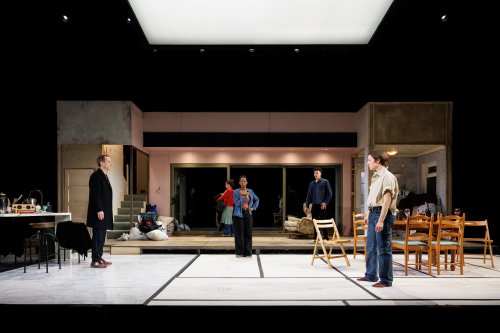
The cast of Alexander Zeldin’s “The Other Place” at The Griffin Theater; set and costume design by Rosanna Vize (Photo credit: Maria Baranova, courtesy of The Shed)
Alexander Zeldin’s The Other Place (the title is never referred to in the play) may be a disappointment for those who are expecting high drama which his production never presumes to be. It stands on its own as inspired by Antigone but fails to have the same impact both in its lack of tension and in its build up to its conclusion. It may just be one of those plays that one has to experience more than once in order to get the full impact of its hidden riches.
The Other Place (through March 1, 2026)
Th Shed and The National Theater, in association with the A Zeldin Company (AZC)
The Griffin Theater, The Bloomberg Building, 545 W. 30th Street, in Manhattan
For tickets, visit http://www.TheShed.org
Running time 85 minutes without an intermission


Leave a comment