
Hildegard
Sarah Kirkland Snider’s debut opera enchants with an elegant score as it captures a single medieval instant as vast, resonant history.
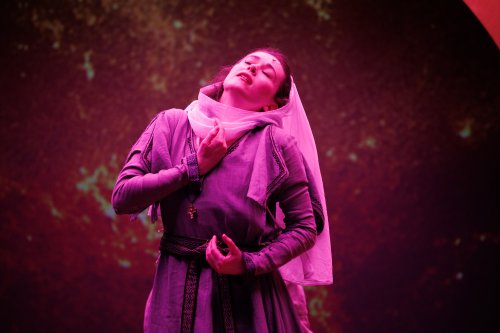
Nola Richardson as Hildegard von Bingen in the Beth Morrison Projects production of Sarah Kirkland Snider’s “Hildegard” at The Gerald W. Lynch Theater at John Jay College (Photo credit: Maria Baranova)
Sarah Kirkland Snider’s first opera arrives with a confidence that feels almost paradoxical: it is at once tightly focused and lavishly expansive, a work that fixes its gaze on a single hinge in medieval history while allowing the implications of that moment to ripple outward in all directions. Hildegard does not so much resurrect Hildegard von Bingen as acknowledge what she has always seemed to be—a figure who belongs as much to myth as to chronology, a woman whose historical footprint feels improbably modern, even futuristic.
Hildegard herself resists easy categorization. An abbess, yes, but also a polymath of startling breadth: philosopher, composer, medical thinker, proto-naturalist. She believed herself to be a conduit for divine visions, which were dutifully illustrated by others and which, seen now, feel uncannily out of time—jagged, abstract, hallucinatory images that would not look out of place in a twentieth-century avant-garde gallery. She was, improbably, a pioneer in nearly every direction she turned, and it is precisely this sense of overflowing possibility that has drawn artists to her across centuries.
The fascination has often had less to do with what Hildegard demonstrably did than with what she seems to represent. Artist Judy Chicago placed her at the symbolic table in The Dinner Party, the legendary installation artwork of elaborate place settings on a triangular table for 39 mythical and historical famous women, now a permanent exhibit in the Elizabeth A. Sackler Center for Feminist Art at the Brooklyn Museum, New York; she was the subject of Margarethe von Trotta’s 2009 film Vision starring Barbara Sukowa; historical fiction author Mary Sharratt devoted a book to her in the 2012 work, Illuminations. Snider’s opera joins this lineage not by flattening Hildegard into an icon but by treating her contradictions—saint and sensualist, authority and supplicant—as dramatic fuel.
Produced by Beth Morrison Projects, Hildegarde opened Friday evening at John Jay College’s Gerald W. Lynch Theater as one of the centerpieces of New York’s Prototype Festival. The work centers on a romantic relationship between Hildegard and Richardis von Stade, the woman tasked with illustrating her visions. It is a choice that immediately declares Snider’s priorities: this is not an opera about institutional achievement or catalogued output, but about intimacy, vulnerability, and the cost of revelation.
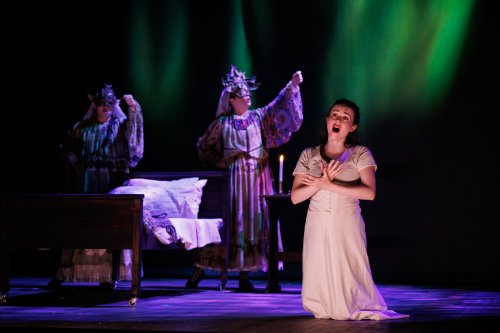
Raha Mirzadegan, Blythe Gaissert and Nola Richardson as Hildegard von Bingen in the Beth Morrison Projects production of Sarah Kirkland Snider’s “Hildegard” at The Gerald W. Lynch Theater at John Jay College (Photo credit: Maria Baranova)
Surprisingly—and wisely—for an opera about one of history’s great composers, Hildegard is not about composition at all. Nor does it attempt cradle-to-grave biography. Snider, who wrote both the score and the libretto, narrows her focus to a decisive juncture: Hildegard’s quest for papal imprimatur for her visions, unfolding alongside her growing attachment to the troubled Richardis. In doing so, Snider finds a dramatic crucible in which faith, power, desire, and artistic legitimacy are fused.
Yet, like its subject, the opera contains multitudes. Without ever becoming didactic, it touches on feminism (or rather a pre-cursor to feminism, as that was not a term used until the mid-19th century), sexual violence (already a pervasive issue in the Middle Ages), erotic longing, remorse, religious devotion, and the reparative power of art. These themes drift in and out of focus, accumulating resonance rather than argument. What Snider achieves is a rare sense of abundance without heaviness—a work that feels generous, even overwhelming, in its emotional reach but never obligatory.
Snider compresses and rearranges biography, embracing scholarly speculation where certainty is unavailable: the romantic nature of Hildegard’s bond with Richardis, the possibility that her visions were entwined with migraines. The first act unfolds deliberately, almost contemplatively, establishing an interior world that allows the second act to bloom with urgency. The climax interlaces triumph and loss, binding Hildegard’s hard-won papal approval to the devastating death of Richardis.
Snider’s libretto does not announce itself as poetry in the literary sense; it lacks the lapidary turns of phrase that invite quotation on the page. Yet in performance it reveals a far more elusive and, ultimately, more important virtue: it sings. The language seems calibrated less for silent admiration than for breath, pitch and duration, yielding itself willingly to the contours of the vocal line. Words that might appear plain or utilitarian in isolation acquire resonance when carried by Snider’s melody, their meanings deepened by the way they stretch, hover or resolve in sound. What emerges is a text that understands the opera house as its true home—a libretto whose intelligence lies not in verbal fireworks but in its supple musicality, allowing voice and orchestra to do the expressive labor that poetry alone might otherwise be asked to bear.
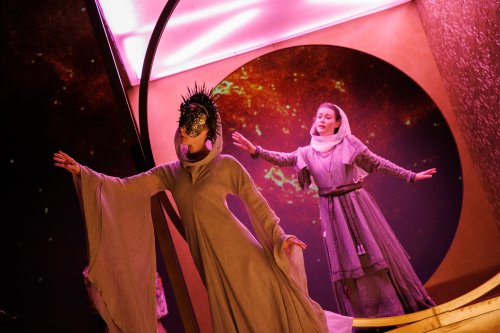
Chloë Engel and Nola Richardson in the Beth Morrison Projects production of Sarah Kirkland Snider’s “Hildegard” at The Gerald W. Lynch Theater at John Jay College (Photo credit: Maria Baranova)
This is no surprise from a composer who understands the voice as an expressive instrument shaped by breath and instinct. She demonstrated this gift in her 2009 song cycle Penelope, a landmark of avant-pop classicism, and has previously engaged directly with Hildegard’s legacy by arranging her music and setting Latin texts in Mass for the Endangered in 2020. Here, the English language—often clumsy in operatic settings—finds unexpected suppleness.
What reaches the ear in Hildegard could only have emerged from Snider’s particular musical imagination. The immediate impression is one of voluptuous tunefulness, lines that seem to beckon and coil with an almost hypnotic allure, while beneath that inviting sheen runs a framework of remarkable discipline and density. The singing unfolds with an ease that feels almost physiological, rising and falling as if guided by breath itself, set against a backdrop of shimmering bowed textures and cascading figures from the harp. This sonic reverie is never allowed to drift into complacency, however: it is insistently jolted awake by propulsive, insistent patterns that recall the mesmeric repetitions of minimalist forebears, lending the score a sense of forward motion that is at once ecstatic and rigorously controlled.
Gabriel Crouch, an early-music specialist, led an intimate ensemble of nine players with an easy fluency that accommodated Snider’s stylistic shifts. Snider nods obliquely to medieval music but the score never loses its own radiant fingerprint. Both Hildegard and Richardis are written for soprano, though their voices occupy distinct emotional terrains. Nola Richardson’s Hildegard possessed a luminous, calming lightness that could gather robust force in moments of crisis. Mikaela Bennett’s Richardis sounded earthier, more volatile, her mercurial vocal writing mirroring the character’s inner turbulence. When their lines intertwined, they hinted at “Aber der Richtige,” Richard Strauss’ exquisite duet for sisters Arabella and Zdenka. The fact that this new opera can elicit an audience’s contemplation of moments in glorious standard repertory is mighty praise indeed, for Snider as well as the singers.
The supporting cast was no less compelling. Patrick Bessenbacher brought passion and specificity to the small role of Mechtild. In the role of Volmar—presented here as both Hildegard’s steadfast advocate and, in a willful bending of history, a sympathetic enabler of her feelings for Richardis—Roy Hage offered a vocal performance of unbroken gentleness. His upper register carried a warm, ambered glow, caressing each phrase with an almost pastoral tenderness, so that even moments of authority were suffused with a benevolent calm rather than force. David Adam Moore’s Abbot Cuno loomed with authoritative weight, his baritone capable of unsettling softness alongside brute power.
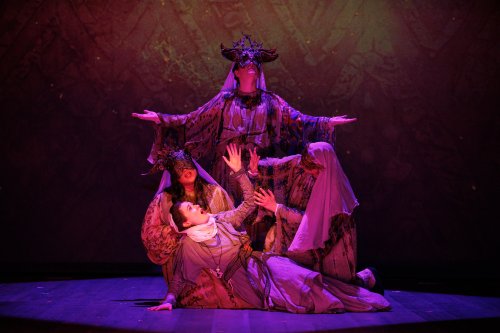
(Clockwise from top) Blythe Gaissert, Raha Mirzadegan, Nola Richardson and Mikaela Bennett in the Beth Morrison Projects production of Sarah Kirkland Snider’s “Hildegard” at The Gerald W. Lynch Theater at John Jay College (Photo credit: Maria Baranova)
Elkhanah Pulitzer’s spare production stages a continual collision between the ordinary and the visionary, until the two begin to merge. Marsha Ginsberg’s sets juxtapose everyday objects—a bed, a desk—with a visual language that drew freely from sacred art and devotional objects: structures that evoked a scaled-down sanctuary, alongside an interior fashioned to resemble a radiant vitrine, as if the stage itself had been transformed into a precious container for holy remnants. At the center of the stage, a pillar-like screen becomes the surface onto which Deborah Johnson’s vivid projections give visceral life to Hildegard’s visions.
Molly Irelan’s costumes extend this logic. Angels appear in dresses printed with motifs from illuminated manuscripts, their faces masked and crowned with spiked halos that recall saintly iconography. Pablo Santiago’s illumination operates in constant dialogue with the chromatic schemes of the projected imagery and the opulent garments, binding light, surface, and fabric into a single, carefully coordinated visual composition.
At the close, a short concluding tableau alters the physical and symbolic terrain: the pillar is removed, opening onto a female religious community founded by Hildegard (her Abbey) after her release from suffocating masculine authority—a liberation paradoxically sanctioned, as history so often insists, by the official approval of one more powerful patriarch. She appears among her sisters, who unbind their tresses and weave blossoms through them, moving together in response to Snider’s score, whose lilting meter rocks with an easy, settled pleasure, as if satisfaction itself had found a rhythm. It is a quiet, deeply affecting conclusion. Hildegard stands not as a solitary monument but as the origin of a lineage—of women, of artists, of worlds imagined into being. Snider’s opera becomes one more descendant of that lineage, extending the reach of a medieval visionary into the present, and reminding us how audacious, and how necessary, such acts of creation still are.
Hildegard (through January 14, 2026)
Prototype Festival
Beth Morrison Projects
The Gerald W. Lynch Theater at John Jay College, 524 West 59th Street, in Manhattan
For tickets, visit www.prototypefestival.org
Running time: two hours and 40 minutes including one intermission


Leave a comment