
If We Kiss
With candor and keen wit, playwright Vail tracks Charlie’s escalating dilemmas, drawing us onward; resilient, she rebounds from heartbreak with convincing grace.
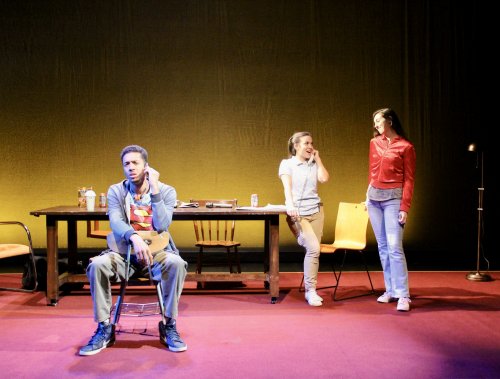
Jordan Bellow, Caroline Grogan and Frankie Placidi in a scene from Rachel Veil’s “If We Kiss” at A.R.T./New York Theatres Mezzanine Theatre (Photo credit: John Davis West)
Adapted from her novel, Rachel Vail’s script for If We Kiss arrives as a romantic comedy acutely attuned to the interior weather of adolescence—the charged silences, the moral vertigo, the way a single, impulsive act can reorganize an entire social universe. Its heroine, Charlotte “Charlie” Collins, is a teenager caught at the precise moment when innocence gives way to self-consciousness, when desire first announces itself not as pleasure but as complication. The inciting incident is almost laughably small yet the production and director Zachary Elkind understand, with admirable seriousness, that for a young person this is nothing less than an earthquake.
Charlie’s private reveries about what a first kiss might confer—transcendence, romance, a cinematic hush in which the world briefly recedes—are briskly and almost cruelly corrected by the actual experience. The long-imagined moment arrives not as rapture but as farce: her inaugural smooch with the irrepressibly flirtatious Kevin Lazarus unfolds in the least exalted of locales, pressed against the unforgiving back wall of the school building. The setting itself seems to conspire against illusion, a decorative brick jutting out just far enough to dig into her spine, a physical reminder that adolescent fantasy rarely survives contact with the real world unscathed.
Compounding the indignity is the presence of adult authority, peering down from above like a Greek chorus armed with disciplinary protocols. The eleventh-grade head teacher, Mr. Herman, glimpsing the scene from his window, transforms what might have remained a private, if awkward, rite of passage into a public and punitive affair by reporting the kiss to Charlie’s mother. In this moment, the play deftly captures the particular humiliation of early desire: not merely that it disappoints, but that it is so often exposed, misunderstood, and adjudicated by forces far beyond one’s control. The result is both comic and quietly devastating—a first kiss that inaugurates not romance, but consequence.
From this furtive exchange radiates a widening spiral of consequences. The play’s genius lies in how it frames Charlie’s predicament not as melodrama but as ethical entanglement. Kevin, the boy at the center of her sudden emotional life, is also the object of her best friend Tess’ long-standing devotion. Tess’ eventual romance with Kevin—entered into in perfect good faith—casts Charlie into a quiet purgatory of guilt and longing, forcing her to rehearse the oldest adolescent question: what do we owe our friends when our hearts have already betrayed them?
As if this triangulation were not destabilizing enough, the adult world intrudes with a parallel narrative that mirrors and complicates the children’s. Charlie’s divorced mother and Kevin’s father begin a relationship of their own, collapsing the distance between teenage crush and domestic reality. The kiss, once secreted away behind a school wall, suddenly reverberates through kitchens and living rooms, threatening to redraw the very definition of family.
What If We Kiss captures, with rare delicacy, is the way young people experience such convergences as both comic and catastrophic. The play treats adolescent feeling with respect, refusing to condescend to its intensity while still allowing space for humor and grace. In doing so, it reminds us that first love is never merely personal: it is social, moral, and—when the generations begin to rhyme—quietly political.
What might, in a lesser telling, register as adolescent melodrama is here rendered with the grave, slow-burn inevitability of classical tragedy, its stakes measured not in kingdoms but in consciences. At the heart of the play is a triangle of affection and silence that corrodes from the inside out. Charlie’s betrayal of Tess is not an active cruelty but a passive one, which the theater understands to be the most devastating kind. By withholding the truth of that first, awkward, illicit kiss with Kevin, Charlie condemns herself to spectatorship. Scene after scene, she must watch her best friend fall more deeply in love with the very boy who occupies her own private longings. The stage becomes a chamber of penance: Tess’ joy is performed inches from Charlie’s despair, and guilt seeps into every pause, every aborted confession, isolating Charlie more thoroughly than any explicit rejection ever could.
The romantic dilemma is then tightened to an almost unbearable pitch by the intrusion of the adult world, whose supposed stability proves just as reckless as adolescent desire. As Charlie’s mother and Kevin’s father drift from flirtation into seriousness, the play introduces its most deliciously cruel irony: the lovers’ intimacy is mirrored—and legitimized—by their parents’ courtship. When marriage is proposed, the personal becomes unavoidably social. Charlie and Kevin are no longer merely two teenagers fumbling toward desire; they are potential step-siblings, their romance suddenly freighted with taboo and the unspoken horror of communal judgment. The phrase “a mess of trouble” barely contains the seismic shift this brings to the story. Love, once secretive but plausible, now threatens to collapse under the weight of structure—family dinners, shared hallways, the inescapable architecture of home.
From this pressure cooker emerges the play’s most electric tension: secrecy elevated to a mode of survival. Charlie and Kevin’s relationship is forced underground, consigned to stolen moments and whispered encounters—those “crossing lines late at night” that feel less romantic than desperate, less thrilling than necessary. Daylight demands performance: the illusion of a harmonious blended family, all smiles and civility, while the audience, fully aware of the fault lines beneath, waits for the inevitable rupture. Every scene hums with the possibility of exposure, each gesture a potential detonator. The brilliance of the writing lies in how it understands secrecy not as a temporary obstacle but as an erosive force—one that threatens to “explode” not just a romance, but the fragile, newly assembled family that surrounds it. In this world, love does not merely risk heartbreak; it risks total annihilation.
A story this complex is taken to the next level by an exemplary cast. Caroline Grogan is a stunning Charlie, the only actor to play one role. We frequently are allowed into Charlie’s thoughts with asides done many times mid-conversation with other actors. It is a stylistic choice that gives the audience the advantage of intrusion – we are very much a Greek chorus that never gets to say a word. Grogan pivots from knowing the dangers in pursuing Kevin to contemplating how better off she should be in a relationship with George, a classmate presenting no danger at all.
Jordan Bellow finds nuances in both of these love interests. With the donning of a woolen hat, Bellow becomes George, a cerebral, thoughtful, but otherwise socially awkward sweetheart who doesn’t possess the emotional vocabulary to actively pursue Charlie. At her Autumnal Equinox party, it is Charlie who asks George if he will go out with her. Woolen hat off, Bellow embodies the sexy and dangerous purveyor of that first kiss. We know from the outset, like a kissing bandit he has made passes at other girls in their circle but he has not allowed any of those exploits to amount to anything.
Frankie Placidi is Tess, Charlie’s bestie and “the other woman” in this triangle that stars Charlie and Kevin. Placidi also plays Kevin’s younger, very bookish sister Samantha. Her Samantha is green and oblivious to the intricacies of adults. As Tess, she is unquestionably devoted to Charlie and honestly smitten with Kevin which makes the results of the deception and the secrets played out with her the loser so painful to watch.
Katie Hartke is wonderful as Elizabeth, Charlie’s mom. As adults we will understand that she chose to keep her budding relationship with Joe a secret so as to protect the three innocent children should it turn out to be a disaster. Thankfully it ultimately ends up being a blessing for all concerned. A scene she shares with Grogan explaining the differences between the feelings she had for her husband and the feelings she has for Joe is one of Kleenex-worthy tenderness. Hartke convinces in her other roles: Darlene (the other classmate that flirted with Kevin), Penelope (Charlie’s abrupt supervising editor at the school paper) and Mrs. Buckley (an expressionless school board head).
Jeffrey Omura is remarkable in his five roles, a palette that shows how gifted he is as an actor. As Joe, Kevin and Samantha’s dad, he is warmth personified, a devoted dad and man who is trying his chance at marital bliss once again with Elizabeth. His scene where he asks for Charlie’s blessing before he proposes to her mom is probably the most touching scene in the play. His portrayals of Mr. Herman, the teacher that catches Charlie and Kevin kissing, Mr. McKinley (the teacher overseeing the school paper) and Mr. Buckley (the husband of the school board pesident) are very different shadings of academia bureaucracy each with their own distinct personalities. As Brad, the bad boy of the 11th grade, he is the stud of the parties we watch unfold.
Elkind has been gifted a great team in scenic designer Anna Grigo, costume designer Alyssa Korol, and lighting designer Riva Fairhall, each responsible for subtleties that give the entire production an embracing intimacy complementing a very touching journey of growing up.
If We Kiss (through December 20, 2025)
The Map Theater
Mezzanine Theatre at A.R.T./New York Theatres, 502 West 53rd Street, in Manhattan
For tickets, visit www.art-newyork.org
Running time: 90 minutes without an intermission


Leave a comment