
Practice
A group of young actors and their director live together and create a performance piece that we see in the evening's second act.
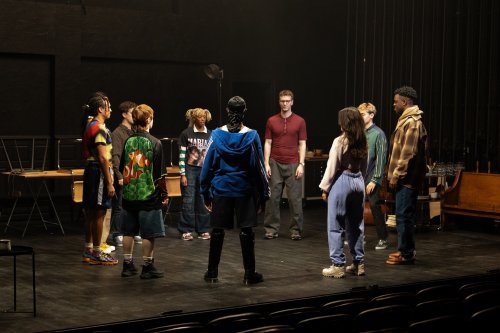
The Ensemble of Nazareth Hassan’s “Practice” at Playwrights Horizons (Photo credit: Alexander Mejía, Bergamot)
The old adage goes “How do you get to Carnegie Hall? Practice, practice, practice.” The same goes for actors and dancers who spend five days a week at the proverbial barre. Practice by Nazareth Hassan, author of last season’s equally challenging Bowl EP, takes us into the rehearsal room big time, as we watch seven actors and their director prepare for an avant-garde play, what used to be called a performance piece, and then lets us see the finished work.
Unfortunately, as directed by Keenan Tyler Oliphant, Practice can’t make up its mind whether it is satire, exposé or a realistic depiction of working practices in ongoing experimental theater companies. Is MacArthur Genius Grant director Asa Leon (played by Ronald Peet) a monster looking to assert power or a gifted and innovative stage director? Are his teaching techniques typical or a power trip? Those theatergoers who have never taken acting class with a famous guru teacher or director won’t know for sure.
With a three-hour running time (the first act runs two hours straight without an intermission) the play is too long for its repetitiousness having the actors go over the same theater games and monologues over and over again. Of course, the play becomes an endurance test for the actors as well as viewers, whether it was intended to or not. Actors who have undergone this kind of training may be amused; those of us who have not may be bored or lose interest. Although the actors who make up the ten-member cast of Practice play very different personalities, we see so little of them individually that it is hard to keep them separate and they become a big blur.
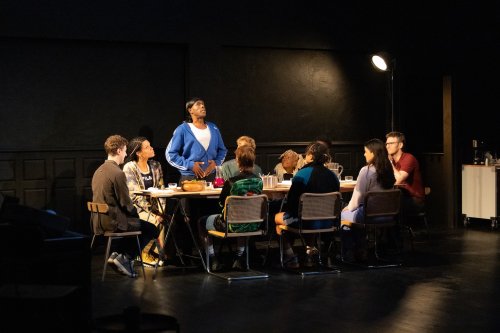
Ronald Peet (standing) and ensemble in a scene from Nazareth Hassan’s “Practice” at Playwrights Horizons (Photo credit: Alexander Mejía, Bergamot)
The first act takes place at the Brooklyn theater center founded by Asa and his husband architect Walton Rhodes (Mark Junek) in a former church. Like A Chorus Line, it begins with auditions for the new theater company with the unseen director Asa at the back speaking to the candidates through a microphone. Each declaim the same monologue which offers several challenges: some have trouble interpreting the words, some their body language, some accents that get in the way of the words, or have trouble creating a character who is very different from them.
The seven auditioners are the ones chosen for the company and the workshop: Ro (Opa Adeyemo), Black American actor and dancer; Rinni (Susannah Perkins) , a German sculptor turned performance artist ; Keeyon (Hayward Leach), Black dancer and performer, non-binary and decidedly gay; Tristan (Omar Shafiuzzaman) English of Indian heritage, always getting too emotional; Mel (Karina Curet), Chilean actress, born to privilege; Savannah, (Amandla Jahava), the youngest performer, a Black actress who is repressed and tries to overachieve; and Angelique (Maya Margarita), a trans American actress who has dropped out of Yale law school and tends to be very suspicious.
We then find out that the group also includes Danny (Alex Wyse), the dramaturg and technical director who records everything that goes on for Asa’s use later. They will live, rehearse, eat and sleep at the facility for eight weeks, after which they will perform their devised piece to be written by Asa in both Berlin and London. They are each on a weekly salary. We watch them have communal meals that seem like a time for Asa to give his progress reports. Early on he sets up a chart in which each actor is supposed to anonymously rate the others in categories they have chosen as a group. At one point, Walton confides to one of the actors that it is his trust fund that has made this all possible, not simply Asa’s MacArthur Grant.
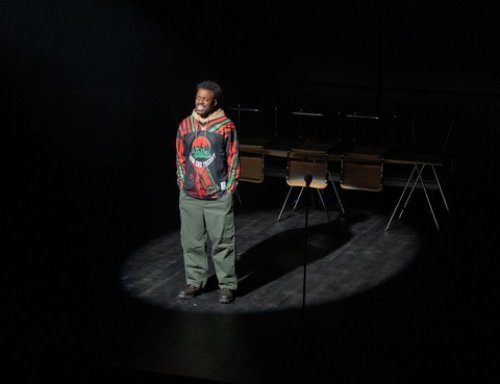
Opa Adeyemo in a scene from Nazareth Hassan’s “Practice” at Playwrights Horizons (Photo credit: Alexander Mejía, Bergamot)
The theater games initially consist of things like communally running in a circle, running in place, jumping up and down, all of which are increased to greater time limits as the weeks go on. Each actor is made to stand up and reveal three things about themselves and the others have to guess as to which one is a lie. Then there are the theater games that lead to Asa’s devised piece: each is asked to reveal their greatest trauma, and then another paired actor (the one most unlike them) must repeat it just as they told it. Along the way, there are the events that happen over time with a large group living in close quarters: one person is accused of lying, another betrays Asa, still another not trusting Asa decides to leave. Several have breakthroughs as to painful events in their lives. However, none of the stories are that compelling and several of these events are prolonged too long.
The second act takes place during their performance in Berlin of their play called “Self Awareness Exercise 101,” subtitled “How to Start a Cult,” with supertitles naming the various parts: set in a mirrored box that the audience can see in but the now six actors cannot see out, all dressed in masks and different costumes, each playing one of the others as they did in class, they perform the scenes and dialogue that we have heard before. The things that Asa has said they repeat as choral passages. Many of the exercises that they performed in class are recreated periodically. The finale is one of violence and chaos. What it all means is anyone’s guess.
Aside from the seven actors in the company, Peet’s Asa is cool and collected, never raising his voice or losing his temper. As his husband in their apparently open relationship, Junek is even cooler, never even showing an emotion in his few bits of dialogue. Wyse as the technical director almost never speaks, being a silent observer, an eye on the proceedings. Afsoon Pajoufar’s first act set for the church’s rehearsal room is realistic and accurate but not particularly attractive, while his design for the Walton designed mirrored box suggest the kind of performance pieces one saw in the 1960s and 70’s in both theater and dance.
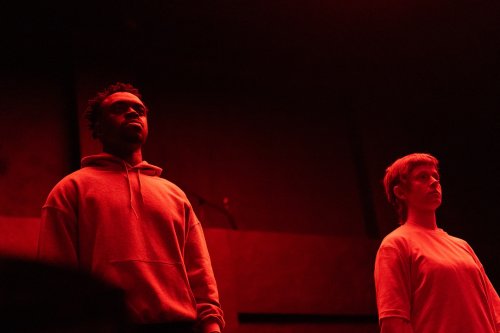
Opa Adeyemo and Susannah Perkins in a scene from Nazareth Hassan’s “Practice” at Playwrights Horizons (Photo credit: Alexander Mejía, Bergamot)
The costumes by Brenda Abbandandolo and Karen Boyer define and differentiate the members of the company with Asa in the most distinctive and unisex one of all. The lighting by Masha Tsimring and the sound design by Tei Blow do not come into their own until the second act performance piece: the glass box often goes red, while the stage is often filled with ambient sound or music. While it would be difficult to know who did what without having attended rehearsals of “Practice,” the movement is by Camden Gonzales and director Oliphant and the fight direction and intimacy coordinator is Rocío Mendez, though the results are definitely evident.
On one level, Hassan’s Practice is about abuse and manipulation by famous directors on power trips. On another level, from program notes by the author, it is an accurate depiction of events he witnessed in theater class. However, at three hours, the play is self-indulgent to some extent just like Hassan’s Bowl EP. While Practice is not for all theatergoers, and certainly not for you if you expect your theater to tell a coherent story, yet others may find it liberating or instructive.
Practice (extended through December 14, 2025)
Playwrights Horizons
Peter Jay Sharp Theater, 416 W. 42nd Street, in Manhattan
For tickets, call 212-564-1235 or visit http://www.playwrightshorizons.org
Running time: three hours including one intermission


Leave a comment