
GLORIA! — Canterbury Choral Society
GLORIA! from the Canterbury Choral Society unites Vivaldi, Puccini, and Arnesen in a luminous performance shaped by expressive voices and rich ensemble color.
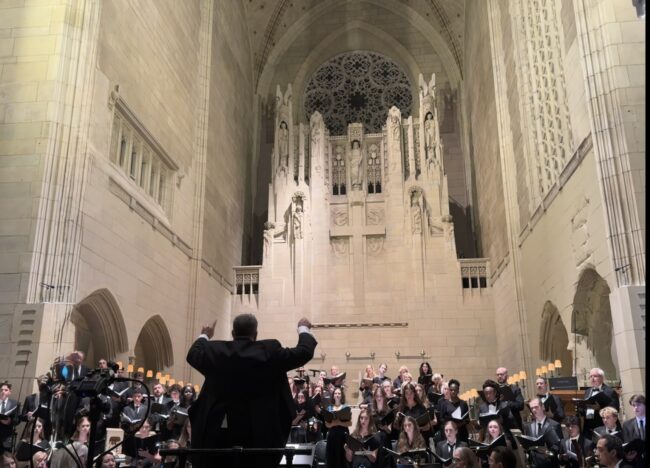
Maestro Jonathan DeVries conducts Canterbury Choral Society. Photo by Jack Quinn
Appreciation by Jack Quinn, Publisher
Church of the Heavenly Rest, November 23, 2025
The 2025–2026 season marks Jonathan De Vries’s eighteenth year with the Canterbury Choral Society and his twelfth as Artistic Director. His parallel work at Greenwich Country Day School — where he directs Upper School choral and musical theater programs — continues to shape his sound: expressive, disciplined, and grounded in community.
GLORIA! unfolded as a beautifully crafted journey from Vivaldi’s jubilant Baroque brightness to Puccini’s youthful lyricism and the contemporary luminosity of Kim André Arnesen’s Magnificat. It was one of those Canterbury programs where centuries meet without friction.
Vivaldi — Gloria, RV 589
Vivaldi’s opening “Gloria in excelsis Deo” arrived bright and unfussy. Kathleen Thomson’s violin leadership set the lines cleanly, while Karen Bogardus’s flute softened the outer edges of the choral proclamations.
The Greenwich Country Day School Concert Choir blended in with sincere, youthful clarity — an intergenerational resonance that felt completely organic to De Vries’s approach.
Soprano Jennifer Zetlan entered with the focused ease that has earned her international recognition; Hannah Spierman added a brighter top line in Soprano II passages; and Anna Willson (mezzo-soprano), active with multiple New York ensembles, grounded the trio with warm, centered tone.
Their blend formed a compelling “Domine Deus, Agnus Dei,” delivered with quiet emotional weight.
Puccini — Messa a quattro voci
Puccini’s student-era mass offered early glimpses of the theatrical instincts that would shape his operatic voice.
Tenor Blake Friedman — a friend and frequent Canterbury soloist, praised by The New York Times for the plummy fullness of his sound — sang a beautifully clear, ringing “Gratias agimus tibi.” Blake performs with an unforced musical intelligence that draws you in almost before you realize it.
Bass Christopher Tefft anchored inner movements with firm, polished resonance — the kind of grounded presence that gives Puccini’s choral writing its architectural strength.
The orchestra responded with color:
– Arthur Fiacco, deepening the Agnus Dei on cello
– Eva Conti, lending warmth in the French horn lines
– Deane Prouty, keeping Puccini’s rhythmic pushes crisp on timpani
Arnesen — Magnificat
After intermission, Arnesen’s Magnificat shifted the room into a more open, luminous sound-world. De Vries let the long phrases breathe, giving the work a quiet spaciousness.
Zetlan returned with a lighter, floating profile. Student soloist Kristina Estock stepped forward with admirable poise — her centered, even tone bringing a gentle honesty to the text’s humility and wonder.
A Personal Note
I’m not a music critic (and won’t pretend to be one), but I always come to Canterbury concerts from the same place: love, pride, and belonging. My husband Curtis Strohl sang in the tenor section today, and seeing him up there — focused, grounded, part of a community that feels like chosen family — is always moving.
It was also meaningful to see familiar faces woven throughout the performance. Our friend Anne Seeler sang with her characteristic warmth, and Blake’s solos were a genuine highlight — elegant, expressive, deeply musical.
Final Impression
By the final Amen, dusk had settled outside. Three composers, three eras, one through-line: gratitude carried across time through breath and harmony. Canterbury didn’t overstate the message. They simply let the music speak — and that felt exactly right.
If you’ve never been to a Canterbury concert, the blend of musicianship, history, and real human warmth is rare. I left feeling lifted.


Leave a comment