
Hannah Senesh
A luminous testament to defiance and endurance, Jennifer Apple’s mesmerizing performance radiates courage, artistry, and an unforgettable emotional grace.
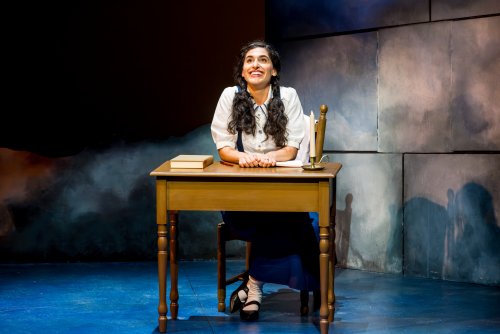
Jennifer Apple in a scene from the National Yiddish Theatre Folksbiene’s production of David Schechter’s “Hannah Senesh” at Theatre Row (Photo credit: Tricia Baron)
There are certain figures whose lives seem preordained for dramatization—figures who, though their mortal span was brief, carved out moral eternities in the collective imagination. Hannah Senesh (1921–1944) is one such figure. For Jewish audiences, she remains not merely a historical personage but a sanctified emblem of courage, resistance, and the incandescent idealism of Zionist vision. Of all the young martyrs who perished for the dream of Jewish self-determination, her story truly resonates with us; idealism and artistry meet in poignant equilibrium: the poet who became a soldier, the diarist who became a symbol.
Captured mere hours after parachuting into enemy territory, Senesh endured interrogation and torture without betraying her comrades. She withheld what could have doomed countless others, choosing integrity over survival. David Schechter’s play, therefore, becomes not simply a memorial but a meditation on conviction—on what it means to live, and die, by one’s own hand-carved principles.
The narrative is tenderly framed by the perspective of Hannah’s mother, Catherine—an inspired structural choice. We open on Catherine in her twilight years, a frail figure in a Hungarian nursing home, coaxed into watching a play about her daughter’s life. She believes, at first, that Hannah is still in Palestine—until the image of her child, imprisoned, floods her mind. Blackout. It is a heart-stopping transition, both literal and emotional. Jennifer Apple, extraordinary in her dual embodiment of mother and daughter, inhabits both women with luminous specificity: Catherine’s stoic grief and Hannah’s blazing, ungovernable conviction.
The early scenes—depicting teenage Hannah as an inquisitive, privileged student at a Protestant school—are a clear indicator of a vibrant girl who would become an incandescent individual. These adolescent moments sketch the faint outlines of a mind beginning to sense disquiet—a young woman poised between intellect and destiny.
As antisemitism seeps like poison through Budapest, the play finds its heartbeat. Hannah joins a Zionist youth movement and begins addressing the audience directly, collapsing the fourth wall with a mixture of urgency and grace. Her confessional asides—passionate, clear-eyed, unguarded—draw us into her moral awakening. Though she yearns to write, Hannah concludes that words alone are not enough. “I need to feel my life has meaning—that I’m needed in this world,” she declares, folding her acceptance letter to an agricultural school into a paper airplane and sending it fluttering over the audience. It’s a small, exquisite theatrical moment—one that elicits a collective intake of breath.
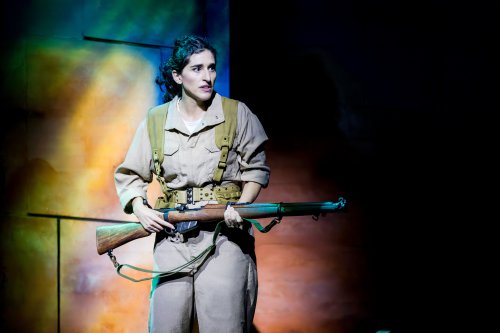
Jennifer Apple in a scene from the National Yiddish Theatre Folksbiene’s production of David Schechter’s “Hannah Senesh” at Theatre Row (Photo credit: Tricia Baron)
In Palestine, Hannah immerses herself in the disciplined optimism of kibbutz life, and soon joins the Haganah, precursor to the Israeli Defense Forces. The script here wisely compresses chronology without dulling intensity; we believe her transformation from poetic dreamer to determined operative. The shadow of war encroaches. “France has already negotiated a shameful peace,” she laments.
In 1943, Hannah enlisted in the British Women’s Auxiliary Air Force and was recruited almost immediately for special operations. Only 22 years old but her perceptions show wisdom beyond her years, “All the darkness cannot extinguish a single candle, yet one candle can illuminate all the darkness”—a statement that seems to hover above the stage like a benediction. The play’s depiction of Hannah’s final mission—her parachute descent, her separation from her comrades, her arrest in Hungary—is stark and chilling. The staging jolts with its suddenness, mirroring the abruptness of history itself. Though historical fact notes that she was captured with two others, the artistic choice to isolate her heightens the tragic poetry of her fate. Tortured, she never betrays a single secret. Sentenced and executed by firing squad, she writes in her diary: “The dice have rolled. I have lost.” These words, penned in captivity, are rendered here with devastating restraint.
Playwright and director David Schechter shapes the piece with fluid pacing and intuitive staging. The production breathes with a quiet, persuasive rhythm. Court Watson’s scenic design is both spare and evocative—a liminal landscape of cinder blocks and suggestion, deepened by Vivien Leone’s painterly lighting. The sound design by Dan Moses Schreier is crystalline, never intrusive, while Steven Lutvak’s score—lyrical, mournful, tender—serves as a shimmering emotional undercurrent. Izzy Fields’ costumes are largely apt, though one particular aqua frock encrusted with pink flowers for young Hannah feels intentionally lifted from a Disney-meets-Crayola outtake rather than a Budapest classroom.
At the center of it all stands Apple, whose performance is nothing short of revelatory. As Catherine, she is brittle yet unbowed; as Hannah, she radiates vitality and purpose. Her voice—both spoken and sung—cuts through the air with the precision of belief. A stirring portrait of resistance, resilience, and unyielding hope, Apple’s one-woman tour de force unfolds with the emotional breadth and intensity of a full ensemble. Apple commands the stage with a virtuosity that transcends mere performance; she channels something elemental and deeply human, crafting an experience that lingers long after the lights fade. It is as inspiring as it is unforgettable—a testament not only to the power of storytelling, but to the indomitable spirit it so eloquently celebrates. Around her, Simon Feil lends quiet gravity as the spectral voices of Hannah’s brother and her Nazi captor.

Jennifer Apple in a scene from the National Yiddish Theatre Folksbiene’s production of David Schechter’s “Hannah Senesh” at Theatre Row (Photo credit: Tricia Baron)
In an era when antisemitism once again festers like an old wound reopened, Hannah Senesh feels less like a history lesson than an invocation. It reminds us, insistently, that heroism often begins in solitude, and that to ignore the heinous acts is the first act of surrender.
Hannah Senesh carries with it a lineage of devotion that stretches back more than four decades, to its original development alongside actress Lori Wilner who first embodied the eponymous heroine in 1984. Wilner’s performance, incandescent and deeply internalized, earned her a Drama Desk nomination for Best Solo Performance, yet the production itself—despite critical admiration—never quite transcended the cultural boundaries of its moment. It remained a cherished but somewhat insular work, revered primarily within Jewish theatrical circles, its subject’s radiant courage too often confined to the margins of communal remembrance.
Now, in a gesture both redemptive and forward-looking, the National Yiddish Theatre Folksbiene seeks to rectify that historical oversight. By underwriting the attendance of thousands of students, the company extends Hannah’s story beyond inherited memory into new consciousness—offering it not as relic but as living moral inheritance. It is an act of cultural stewardship as much as artistic revival: a deliberate effort to ensure that Senesh’s words, and the ideals for which she died, find resonance in generations who might otherwise never have heard her name spoken from a stage.
Hannah Senesh (through November 9, 2025)
National Yiddish Theatre Folksbiene
Theatre Three at Theatre Row, 410 West 42nd Street, in Manhattan
For tickets, visit http://www.nytf.org
Running time: 90 minutes without an intermission


Jennifer Apple performed both mother, Catherine, and daughter, Hannah Senesh, with sheer brilliance
and talent. A true masterpiece! It was mesmerizing to watch as not a sound could be heard in the audience. The 90 minutes fled and felt experiential evoking plenty of emotions. The script was creatively written by David Schechter which gave dignity to a true warrior and hero performed gracefully and realistically by Jennifer Apple. Although sadly, Hannah felt that she lost because she was captured (and ultimately brutally murdered), her quest, and even this one person performance depicts, not a loss, but HOPE.
Phenomenal performance, must see!
I am an 88 -year-old nearly blind, Yiddish-mother-tongue woman, writing from Montreal, with great regret that I can never “see” this play. Of course, I have known of Hannah Senesh for many years, and would give anything to see it, as it is described in the beautiful, excellent review by Tony Marinelli.
Saw this brilliant rendition of Hannah Senesh today. I was familiar with her story but Jennifer Apple brilliantly portrayed multiple roles in a one woman show. Her performancwe was flawless. This is a must-see performance only on until Nov. 9.