
Heaux Church
A rapturous, heaux-ly revival of self-love and sensual liberation, Brandon Kyle Goodman dazzles with divine wit, gospel flair, and shameless joy.
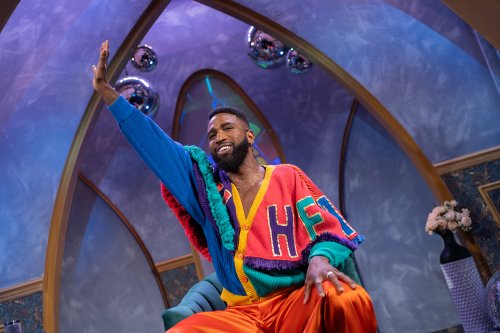
Brandon Kyle Goodman in a scene from his one-man show “Heaux Church” at Ars Nova (Photo credit: HanJie Chow)
In Heaux Church, writer-performer Brandon Kyle Goodman does not so much deliver a sermon as they detonate one—turning the pious pulpit upside down and shaking loose its centuries of shame, repression, and whispered taboo. What emerges from the rubble is something gloriously unholy and defiantly sacred: a new gospel of pleasure, pride, and personal liberation. Directed with ecstatic precision by Lisa Owaki Bierman, and buoyed by the ecstatic ministrations of DJ Ari Grooves, enveloping sound design of Christopher Darbassie, and flirty adult puppets of visual provocateur Greg Corbino, Goodman presides over a theatrical communion that is part revival, part stand-up confession, and part drag-tinged spiritual exorcism.
Before the performer even appears, Grooves sets the tone with regal command, spinning her turntables like a high priestess of the dance floor. Draped in a blue satin gown that catches the light like stained glass, she is both DJ and deity, orchestrating a sonic overture of pop, R&B, and hip-hop hymns remixed with sanctified swagger. Her beats summon the audience—a congregation, really—into a shared space of anticipation. When she invites them to rise for the “opening hymn,” a disembodied choir bursts forth with brazen humor:“I’m a heaux, and I know it, and I ain’t afraid to show it. I’m a heaux, and I know it—buss me wide open!”
The irreverence is intoxicating. As the final note rings out, the lights snap to black, and from the darkness emerges Goodman: tall, luminous, resplendent in a sparkly orange ensemble that gleams like liquid sunlight, courtesy of costume designer Mika Eubanks. Their silhouette is statuesque—part Billy Porter, part downtown demigod—and their presence fills the stage with the kind of charisma one associates with revival preachers and rock stars alike.
From the moment Goodman opens their mouth, the air changes. They invoke inclusivity not as a performative gesture, but as a spiritual necessity. Though they speak from their own lived experience as a queer, Black, nonbinary person, they address every soul in the room with equal urgency, declaring that the evening’s invocation—“Buss me wide open”—is not merely erotic provocation but philosophical invitation. What follows is a communal exercise in release: Goodman invites the audience to turn to one another and repeat the phrase, thrice, until the words lose their naughtiness and gain a kind of sacred resonance. Suddenly, the bawdy has become the beatific; the profane, profound.
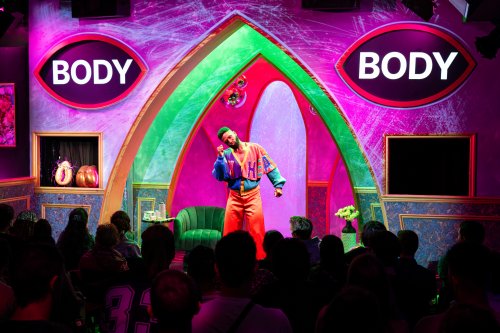
Brandon Kyle Goodman in a scene from his one-man show “Heaux Church” at Ars Nova (Photo credit: Ben Arons)
This is the genius of Heaux Church: its ability to transmute laughter into healing, and spectacle into ceremony. The work pulses with the same radical empathy that animates Goodman’s 2022 memoir, You Gotta Be You:How to Embrace This Messy Life and Step Into Who You Really Are, a manifesto of selfhood that asks, “Who would I be if society never got its hands on me?” Here, that question becomes flesh—and glitter.
Much of Heaux Church’s intoxicating power stems from the kaleidoscopic production that director Bierman has so exuberantly conjured around Goodman. Bierman envelops her star in a visual world that feels both exalted and joyously irreverent—a sanctuary where the sacred winks at the profane. The result is less a set than a state of being: a temple of self-expression bathed in sequins and spirit.
Scenic designer Lawrence E. Moten III carries this unabashedly “out-and-proud” aesthetic into glorious overdrive conjuring a cathedral of the carnal—a Gothic fantasia whose stained-glass arches conceal sly subversions. Where one might expect a crucifix, there gleams instead a pair of vulva-shaped frames spelling out BODY, flanked by puppet windows through which Corbino’s hilariously explicit creations—a penis, a vulva, a booty—emerge to cavort and sermonize. It is absurd, audacious, and oddly moving, a burlesque baptism for the grown and the curious. His altar gleams not with solemn gold but with the mirrored facets of disco balls, transforming traditional reverence into a shimmering reflection of queer joy. Around this radiant centerpiece, Stivo Arnoczy’s video projections bloom across auxiliary screens like digital stained glass—an ecclesiastical fantasia rendered in pixels and pulsing color.
Meanwhile, Matt Lazarus’ lighting design bathes the proceedings in waves of saturated light, sometimes divine, sometimes decadent. In one moment, the glow recalls the ethereal hush of a candlelit chapel; in the next, it bursts forth with the pulsing abandon of a midnight dance floor. It is in this oscillation—between worship and nightlife, ritual and revelry—that Bierman’s vision truly sings.
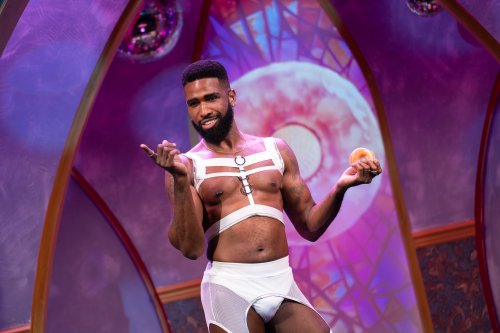
Brandon Kyle Goodman in a scene from his one-man show “Heaux Church” at Ars Nova (Photo credit: HanJie Chow)
Yet beneath the camp and color lies something deeply personal. Goodman’s sermon is stitched together with memories of two towering matriarchs: a devout grandmother who preached from the pulpit, and a mother whose spirituality defied orthodoxy. Their tension, their love, and their contradictions pulse through every anecdote. Goodman refers to themself, with a wry blend of affection and irony, as a “pastor’s kid.” Yet the pulpit in question belonged not to their single mother, but to their grandmother—a formidable minister whose steady faith and guiding hand shaped much of Goodman’s early life. Their mother, no less vital a presence, inhabited a different sort of stage. A professional theater actor, she raised her child within a liberal, artistically minded household, one where self-expression was prized and boundaries seemed delightfully porous. That is, until the grandmother’s passing—a seismic loss that sent Goodman’s mother spiraling toward religion with an almost desperate fervor, seeking solace in scripture rather than self-invention.
It is here, amid this intimate tangle of love, faith, and betrayal, that Heaux Church finds its most heart-rending revelation. Goodman recounts, with poised vulnerability, the day their mother visited and—armed with three carefully chosen Bible verses—made it devastatingly clear that she could not embrace her child’s queerness. The moment lands like a quiet thunderclap: not staged for pity, but offered as sacred testimony. In that instant, the audience can trace the genesis of Goodman’s spiritual rebellion, the sorrow that would ultimately blossom into this radiant, defiant act of theatrical healing. Mother and child no longer speak—a silence that hums through the performance like a ghost note—but Goodman transforms that ache into art.
From the ashes of estrangement, Heaux Church rises: a glittering sanctuary for all who have ever sought love beyond the boundaries of doctrine. Heaux Church is not for the timid or the uninitiated. It demands surrender—a willingness to laugh, blush, and perhaps weep in recognition. But for those who accept its invitation, the reward is transcendent. Goodman transforms confession into celebration, turning shame into song and body into benediction.
At one particularly uproarious juncture, Goodman ascends from preacher to professor, offering the congregation a gleefully explicit master class in the fine art of oral pleasure—a lesson illustrated, with both pedagogical clarity and comic panache, by way of a Krispy Kreme doughnut and an obliging packet of cleaning wipes. It is at once bawdy and instructive, a moment that straddles the line between sex education and sacrament, reminding us that Heaux Church’s gospel of embodiment leaves no act—however sticky—outside the realm of holiness.
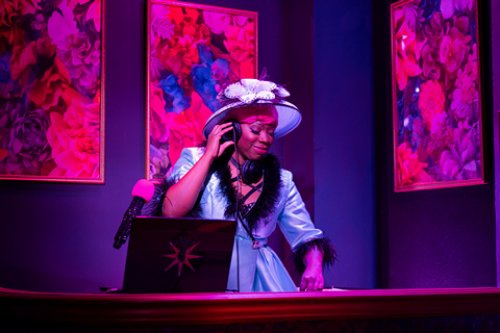
DJ Ari Gooves in a scene from Brandon Kyle Goodman’s show “Heaux Church” at Ars Nova (Photo credit: Ben Arons)
By the show’s end, one feels not merely entertained, but converted—a joyful initiate in Goodman’s glittering gospel of self-love. Heaux Church is no ordinary theater; it is revelation wrapped in rhinestones.
Ars Nova in association with Lena Waithe
Heaux Church (through November 8, 2025)
Ars Nova, 511 West 54th Street, in Manhattan
For tickets, visit http://www.tix@arsnovanyc.com
Running time: 90 minutes without an intermission


Leave a comment