
Gene & Gilda
A pleasant diversion from the hustle and bustle of everyday life, especially when that diversion is filled with laughter.
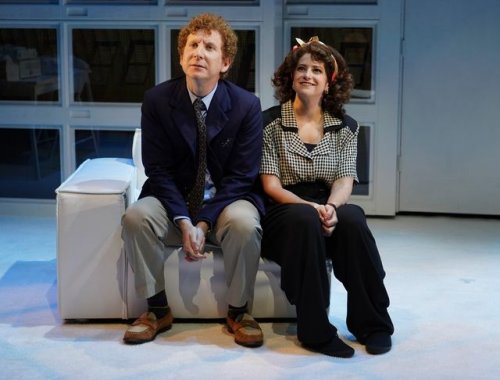
A stroll down a memory lane can sometimes be a pleasant diversion from the hustle and bustle of everyday life, especially when that lane is one filled with laughter. Gene & Gilda by Cary Gitter is such a stroll. As directed by Joe Brancato, it provides an entertaining evening of theater worth spending time with, even if you only vaguely know who Gene and Gilda were.
Gene Wilder (Jonathan Randell Silver) and Gilda Radner (Jordan Kai Burnett) were two gifted actors with comedic skills who encountered each other by chance, fell in love, and created an enduring love story from the time they first met in 1981 until Gilda’s death from ovarian cancer in 1989. The story is told in the form of flashbacks during a television interview with Gene by Dick Cavett two years after Gilda’s death.
The show opens as Gene is being introduced on The Dick Cavett Show. The unseen interviewer is the real Dick Cavett, who voices the introduction and the questions. One of the questions being asked is about Gilda, to which Gene says is a topic he does not want to talk about. At that moment, Gilda appears to Gene and tells him to answer Cavett’s questions and to reveal the story of their relationship from beginning to end, starting with their meeting on the set of the film Hanky Panky.

It is the first of several vignettes that will span the seven years they were together. The encounter provides an insight into each of their personalities. Gilda covers her insecurity by talking a lot, and Gene masks his discomfort with social interactions by a studied, calm detachment. In private, their behavior takes on a different tone with Gilda, becoming more introspective yet still marked by an anxious demeanor. Gene, on the other hand, reveals his deep insecurities at times, resulting in panic attacks.
Burnett solidly embodies Gilda, giving a seamless portrayal of the performer the world knew her to be while also revealing the private woman few people knew. While the show provides a balanced portrayal of these two aspects of her, it still has a superficial quality to it. The comedic talent on stage and the comedy writing genius off stage are present, but they lack the emotional depth that fans would want to hear and feel. It is not to say that this lack of depth detracts from the overall entertainment value of the show, but rather that, for some, more of the off-stage insights and revelations would make it better.
Silver’s portrayal of Wilder, while convincing, still lacks a spark that rings true. It is more of playing the character rather than being the character. This reaction may be a function of the private side of Wilder being less widely known to audiences, and it is not something that people unfamiliar with his work will be concerned about. Silver’s performance reveals the emotional complexity of Wilder, based on some of the traumatic experiences he endured growing up. Some parts raise questions about whether the private side of Wilder was revealed in some of his public performances. One scene, in particular, brings this question to the fore. Wilder is having an anxiety attack, and Silver’s performance is a solid portrayal of Wilder as Leo Bloom in the film The Producers having a panic attack, but is this an accurate depiction of the private Gene Wilder?

As part of the moments that provide sweetness to the story are several interludes of choreography that again reference the public side of Gene and Gilda. These scenes are beautifully realized and enhance the overall enjoyment of the production, but they are not grounded in reality.
The show deals with the emotional impact of their not being able to have children after a series of miscarriages, and finally leading to the diagnosis of ovarian cancer. Gitter adds emotional depth to the story with an understanding and sensitivity to the affection Gene and Gilda had for each other in these moments of stress, culminating in an ending that underscores their love.
The set design by Christian Fleming is limited but ideally suited to the production’s style, with the main feature being a pair of sectional couches that are moved around to support various scenes. A wall of video monitors forms the upstage wall, with Brian Pacelli’s projections effectively supporting the action on stage. Gregory Gale’s costume design is period-perfect, adding definition to the two characters. Bobbie Zlotnick’s hair, wig, and makeup design are important elements in the show, especially when Burnett is depicting some of Radner’s memorable characters. Rounding out this superb creative team is Max Silverman, whose sound design and original music add to the overall entertainment quality of the show.
Gene & Gilda (through September 7, 2025)
Penguin Rep Theatre
59E59 Theaters, 59 East 59th Street in Manhattan.
For tickets, call 646-892-7999, or visit http://www.59e59.org/shows/show-detail/gene-gilda/#schedule-and-tickets


Leave a comment