Joan Marcus
Joan Marcus is one of the preeminent theatrical photographers working in the US today. Over the past 25 years she has photographed over 500 shows on and off Broadway and regionally. A native of Pittsburgh, Pennsylvania, Joan graduated from George Washington University. In 2014 she received a Tony Honor for Excellence in the Theater. Joan Marcus is married to the theatrical press agent Adrian Bryan-Brown of Boneau/Bryan-Brown, a leading Broadway press agency. http://www.joanmarcusphotography.com/
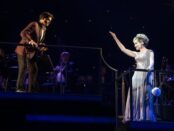
Michael Lepore as the Telegram Boy, Micaela Diamond as Sabina, Ruthie Ann Miles as Mrs. Antrobus, [more]
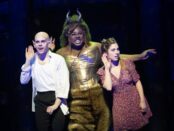
Bat Boy: The Musical
Beneath the camp and chaos, 'Bat Boy" remains what it always was: a parable with a pulse. O’Keefe’s rock-opera score jabs with wit but bleeds sincerity; his lyrics cut deep with irony and compassion. The story still howls against hypocrisy—the intolerance of difference, the fear of the Other, the absurd theatre of morality that masquerades as virtue. "Bat Boy" feels less like a musical and more like a communal exorcism of repression, guilt, and joy. In the capable, chaotic hands of this remarkable company, it doesn’t just sing—it soars, claws, and howls. To want to belong has rarely felt this thrilling. What emerges, through all the shrieks and laughter, is something profoundly moving: a hymn to belonging, a love letter to strangeness, a primal scream for empathy. [more]
Oh Happy Day!
"Oh Happy Day!" demonstrates an advance of technique over Cooper’s eight-scene sketch evening in "Ain’t No Mo’." However, the new play is much too talky and seems to cover some of the same material more than once, even though on another level it deals with our relationship with God. The play is an interesting entertainment but one assumes Cooper meant it to be more than that. It is, however, an artifact of the difficult times we live in. [more]

Twelfth Night (Free Shakespeare in the Park)
When the play begins those who know the original will recognize that Ali has edited the text: the first two scenes have been flipped which makes perfect sense letting us know that Viola, the heroine, has been shipwrecked off the coast of Illyria, and that she has lost her twin brother Sebastian. (She decides to dress in male clothing in order to see the lay of the land as a single woman in a foreign country.) Unfortunately some of the other edits, including the most famous scene in the play in which the unloved puritan Malvolio reads out loud the forged letter he has received with the famous lines “Some are born great, some achieve greatness, and some have greatness thrust upon ‘em,” are mistakes. Much of the edited material makes the play dark so the intent may have been to soften the play’s somber side, though it does eliminate much of the characters’ best material. [more]
Joy: A New True Musical
Under Lorin Latarro’s direction, there is little or no character development in Davenport’s book, with all of the characters remaining the same throughout, and the only thing that propels the show are the surprising events that happen. Joy’s family remains negative and dismissive about her inventing career (while eventually helping out in the marketing) until almost the very end. Davenport fudges the last scene by not telling us how the biased Texas judge ends up ruling in Joy’s favor so that the ending leaves us hanging. When the judge demeans Joy as a one-time inventor, we know that she has one of her clever inventions in her pocket (a reflective dog flea collar) but she never takes it out in her own defense. The songs are more like window dressing than adding much to the show and Milazzo’s generic lyrics tend to be very repetitious and give away their message in their titles. The show might have been more powerful as a straight play without the musical score. [more]

Goddess
In the title role, Amber Iman makes a sensational return to Off Broadway after her Tony Award and Drama League-nominated performance in "Lempicka" last season. This beautiful statuesque actress brings poise and elegance to the role of the goddess who comes down to earth in human form. Her magnificent singing brings the audience to its feet for her final solo. Austin Scott is a stalwart Omari both in his singing and saxophone playing which also impresses. As the excitable Rashida and Ahmed, Arica Jackson and Nick Rashad Burroughs make a terrific team playing off of each other. [more]
Pirates! The Penzance Musical
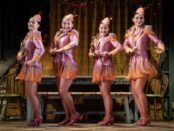
Not seen on Broadway since 1982 but racking up 26 productions up to that time since its New York premiere in 1879, the Roundabout Theatre Company’s new version of the Gilbert and Sullivan classic operetta, "The Pirates of Penzance," has been given a delightful facelift: retitled "Pirates! The Penzance Musical" is has now been Americanized and reset in a jazzy 1880 New Orleans by the team of director Scott Ellis, adapter Rupert Holmes, choreographer Warren Carlyle and music director and co-orchestrator Joseph Joubert. The energetic cast is led by Ramin Karimloo as the Pirate King, Jinkx Monsoon as Ruth and two-time Tony Award-winner David Hyde Pierce as Major-General Stanley, backed by a lusty crew of singers and dancers. [more]
Floyd Collins
Unfortunately, while the carnival atmosphere in the field above the cave increases, the musical is mostly a waiting game: if and when Floyd Collins will be brought up from the deteriorating cave. The emotions that you would expect as time begins to run out as passageways become either waterlogged or impassible are not in evidence except for Floyd’s father who is more concerned with finances that his son’s life. Floyd himself is often depicted as delirious or depressed so that we don’t get much of an arc of his emotions. [more]
Glass. Kill. What If If Only. Imp.
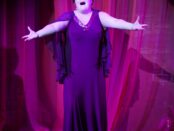
The cumulative effect of the four plays is greater than the sum of its parts. The quartet of plays seems to demonstrate Caryl Churchill in a new mode. While the plots are slight, the themes are of major importance and suggest new ways of thinking about them. James Macdonald’s production and the acting of his cast are quite assured even though the plays are mainly non-realistic and require their own kind of suspension of disbelief. [more]
minor•ity
"minor•ity" is a wonder of a play written by francisca da silveira and skillfully directed by Shariffa Ali telling a tale of clashing artistic egos encompassing issues of Black identity, cultural influences, and financial support. The cast of three leaves no question in the viewers’ minds that what is being witnessed are real people telling a story through their actions, not actors playing roles. There is a message in the name of the show presented in the script but not in the show. [more]
All the Beauty in the World
Bringley, making his theatrical debut as himself, delivers a performance marked by restraint and quiet intensity. His words, drawn largely from the memoir, reveal a man of thoughtfulness and delicacy—someone who seeks refuge not in action, but in observation, retreating to the hushed galleries of The Metropolitan Museum of Art, where he once worked as a guard. “You lose someone,” he tells us, simply, “and it puts a hole in your life—and for a time you huddle down in that hole.” It’s in that stillness, that huddling, that the piece finds its quiet power. [more]
Love Life (New York City Center Encores!)
Brian Stokes Mitchell, Andrea Rosa Guzman, Christopher Jordan and Kate Baldwin in the opening scene [more]
The Jonathan Larson Project
Adam Chanler-Berat, Lauren Marcus, Taylor Iman Jones, Jason Tam and Andy Mientus in a scene from [more]
Sumo
Despite its predictable overarching plot, "Sumo," produced jointly by the Ma-Yi Theater Company and La Jolla Playhouse, is never boring. Partly, that's because, as Mitsuo, Shih is villainously charismatic, portraying the preening bully with the disarming and false sense that there is a method to his sadism. But, even more compellingly, Sumo is an immersive and sumptuous eyeful--no matter your personal predilections for loincloths and bare, overhanging bellies--with a set, props, costumes, projections, and all that glorious sumo hair provided by Wilson Chin, Thomas Jenkeleit, Mariko Ohigashi, Hana S. Kim, and Alberto "Albee" Alvarado respectively. As for the main event, there is certainly loads of cheer-inducing sumo wrestling throughout the play, but it's the sumo karaoke after the intermission that adds much-needed joy to the proceedings. That exhilarating scene, aided by Paul Whitaker's vibrant lighting effects mixed with Fabian Obispo's equally energetic sound design, also offers director Ralph B. Peña the opportunity to let the actors cut loose, at least for a little while. [more]
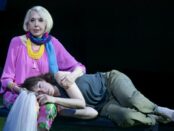
On the Evolutionary Function of Shame
The author complicates the issue by bringing in autism (Margot) and Alzheimer’s (the unseen father of Adam 2 and Eve 2.) When asked if she would want her autism cured, Margot answers: “I might. Plenty of people would. I’m fine with who I am, but it’s also undeniable that the world only became truly accessible to me when I entered a specific tax bracket.” Ridding the world of Alzheimer’s wouldn’t help Adam and Eve’s father who is too far gone but might help the next generation. However, Adam feels betrayed by his sister’s research that would “give transphobic parents the option to prevent their kid from being trans before they are born.” He feels he is being elimin [more]
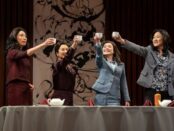
Liberation
Bess Wohl’s latest play is the ambitious and engrossing "Liberation," her attempt to investigate the roots of the Women’s Liberation Movement back in the 1970s from a decidedly contemporary point of view. Calling it a “memory play,” she uses a narrator “Lizzie,” who tries to recreate the consciousness raising group her mother started back in 1970 in Ohio where she lived at the time. Complicating things for the viewer, Lizzie also plays her own mother (who also seems to be named “Lizzie”) in the flashbacks, showing us seven meeting from the many the group had in their weekly encounters back in the seventies. She also interviews the survivors now in the present about what they recall of those days as her mother has recently passed away and she is sorry she didn’t ask her more questions. [more]
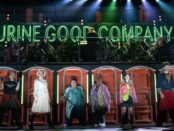
Urinetown (NY City Center Encores!)
“What an awful name for a musical,” spouts Little Sally (a brilliantly talented Pearl Scarlett Gold) as one of the narrators of the New York City Center Encores’ witty production of the 2001 surprise hit "Urinetown." Yes, it is, but it’s also an entertaining show that actually has inadvertent relevance to today’s audience with its artful jabbing at big business. [more]
My First Ex-Husband
Joy Behar and a rotating cast of female celebrities find humor in divorce in "My First Ex-Husband," a new show at the MMAC Theater. Directed by Randal Myler, the evening chronicles tales of failed relationships through a series of hilarious monologues. The cast of four trade off, each delivering two vignettes about men who turned out not to be “the one.” "My First Ex-Husband" is witty, quick and ceaselessly funny. [more]
Cult of Love
Must you love your immediate family unconditionally if you know they drive you crazy? And must you show up for family gatherings like Christmas if it always evolves into a vicious fighting match? Is love nothing more than propinquity, that is biological closeness? Leslye Headland’s "Cult of Love" produced by Second Stage at Broadway’s Helen Hayes Theater, a searing comedy-drama, reminds us that most American plays other than Our Town are about dysfunctional families that make various levels of accommodation to their problems. The cast led by Zachary Quinto, Mare Winningham and David Rasche are consummately believable as a family who has seen too many Christmases devolve into shouting matches. [more]
Strategic Love Play
How can you make a new play about a couple on a blind date in a bar interesting for today’s jaded audience? In "Strategic Love Play," British playwright Miriam Battye makes them play games as well as dislike each other as soon as they meet. Under Katie Posner’s direction Heléne Yorke ("The Other Two," "Masters of Sex") and Michael Zegen ("The Penguin," "The Marvelous Mrs. Meisel") are able to keep up the startling interactions between them for the 90 minutes of the play. The play covers several arcs from dislike to interest to boredom to acceptance to disbelief. [more]
Walden
Nevertheless, the play is one of several interesting takes on climate change in the theater recently like "Deep History." As the play evolves we are more and more immersed in the problems of climate change that are now only distant possibilities. The actors are compelling but do not entirely inhabit their roles. Making her Off Broadway debut, Rossum, best known for her work in the Netflix's series "Shameless" and film version of "The Phantom of the Opera," is suitably conflicted as one who has given up her chosen career and taken the opposite path. Winters, known for her breakout role in the HBO series "Succession" as well as many major Off Broadway roles, is more controlled as the current astronaut who is confused by her sister’s current choices. However, both sisters are a little too similar to make them dramatic opposites. In the underwritten role of Bryan, Foster is quite appealing though he can’t fill in the gaps that are missing. [more]
Ragtime
"Ragtime," thought of as an unwieldy musical with too many characters and too many themes, hit Broadway in 1998. Based on the 1975 E.L. Doctorow novel of the same name, the many storylines were artfully tamed by the team of Terrence McNally (book), Stephen Flaherty (music) and Lynn Ahrens (lyrics). New York City Center has chosen "Ragtime" as its 2004 Annual Gala presentation in a brilliantly streamlined production directed with an eye to its still-important message by Lear DeBessonet with a large and exceptional cast and an excellent orchestra under the baton of James Moore playing William David Brohn’s original rich orchestrations. [more]
Another Shot
As both playwright Harry Teinowitz and his co-author Spike Manton spent time in rehab, they carry us through the epiphanies as well as the relapses by injecting humor in every “shot glass” of this play. This is most evident when George returns from a drinking binge with the front wheel of his bicycle mangled into a pretzel. The roommates focus on the “falling off the wagon” rather than the falling off the bicycle. The highlight of their days (and nights) is getting together to watch reruns of "Cheers," with the episode where Sam Malone relapses being one they can probably chant verbatim the way other people can act out all the parts of "The Rocky Horror Picture Show." [more]
Left on Tenth
Although the play is graceful and appealing, it is mainly presented in narrative form with Delia played by Julianna Margulies in New York and Peter Gallagher playing Dr. Peter Rutter, her surprise new boyfriend from California, reading their emails to each other from desks at opposite sides of the stage. Left on Tenth, with its episodic nature, and many short scenes, is really a screenplay with the lead actors doing the equivalent of the voice-overs. Susan Stroman, best known for her choreography and direction of musicals, has piloted the play with polish and urbanity, but has not solved all the play’s problems. [more]
The Christine Jorgensen Show
Donald Steven Olson’s "The Christine Jorgensen Show," a two-hander, focuses on the creation of her nightclub act. Jorgensen (portrayed by Jesse James Keitel known for "Younger," "Queer as Folk" and "Star Trek: Strange New Worlds") approaches showbiz veteran Myles Bell. Mark Nadler, virtuoso pianist, cabaret superstar, and co-composer for this show, takes on the role of this quirky, energetic performer and songwriter. [more]
Deep History
Directed by Annette Mees, "Deep History" is a real eye opener but it is not depressing. Finnigan is so upbeat and compelling a storyteller it is not possible not be pulled into events as he describes, telling the history of the world from the point of view of a mythic woman who appears in all eras. The show is punctuated by Australian pop songs that figure in both Finnigan's life and the history he is recounting. The video design by Hayley Egan will sear the proof of climate change into your eyeballs permanently. You will never think about this topic the same way again: a not to be missed enlightening theatrical event. [more]
Good Bones
James Ijames’ new play now at The Public Theater is quite different from his satiric Pulitzer Prizing-winning "Fat Ham" which appeared there two years ago. "Good Bones" is a realistic depiction of black on black gentrification in an unnamed American city, a theme not often represented on our stages. This provocative and timely play also has some intriguing supernatural elements which are not fully dealt with in Saheem Ali’s otherwise polished and urbane production. [more]
Yellow Face
Clearly, Hwang’s playwright-within-the-play has been on a colorful journey, full of characters that amuse, anger and move him. Hwang’s genius here is his ability to spin his real life into a fascinatingly entertaining work using all these events and characters. He is artful in balancing the lighthearted with the sardonic and the dramatic, the result being a colorful portrait. The flier for "Yellow Face" shows its handsome star Daniel Dae Kim holding a mask of his smiling face away from his own scowling visage, a witty take on the Greek Comedy/Drama masks, a shorthand for "Yellow Face"’s richness. Of course, having Daniel Dae Kim in the central role embodies his character with depth and subtlety. [more]
The Hills of California
In a theatrical era when "full-length" works often fail to exceed 90 minutes, the English playwright Jez Butterworth dares to dubiously dramatize for approximately twice that span. His previous Broadway epic, "The Ferryman," conflated The Troubles with anachronistic paganism, a disturbed old woman's fear of banshees, and lots of boozing, earning Butterworth much critical acclaim, as well as Olivier and Tony Awards, for this bold mix of pretentiousness and unabashed Irish stereotyping. "The Hills of California," Butterworth's latest overhyped synthetic slog teeming with underdeveloped characters, is basically a tale of two postwar entertainment cities: Los Angeles, the world's dream capital, and Blackpool, England, a fading resort town that's become uniquely fit for delusions. [more]
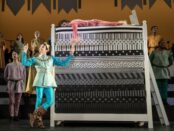
Once Upon a Mattress
Foster is a joy as the princess from the swamps who can swim, lift weights, dance all night, commit multiple contortions as she tries to get a good night sleep, and field any disaster that comes her way including the queen’s disdain. She is quick on her feet and in her tongue. She also stops the show with her rendition of the score’s most famous song “Shy” (used as the title to Mary Rodgers’ memoir published in 2022) but she is also memorable singing “The Swamps of Home” and “Happily Ever After,” with their witty lyrics by Barer, who often collaborated with Mary Rodgers. Is there anything she can’t do and anything she can’t make funny? [more]
ON THE TOWN WITH THE “LAST OF THE RED HOT MAMAS” AT BUCKS COUNTY PLAYHOUSE
I just got back from the Bucks County Playhouse, which I always enjoy visiting, to catch the world-premiere production of “Last of the Red Hot Mamas,” a new musical about Sophie Tucker. The show’s not ready for Broadway yet. It’s got lots of flaws which need fixing, and I’ll get to those flaws shortly. But—and this is rarer and much more important--it’s also got lots of vitality. [more]