News Ticker

Christopher Marlowe

The Life and Death of King John
September 1, 2025

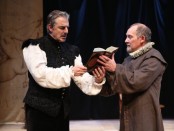
An element of the story is the behavior of the English noblemen. They switch allegiances depending on the behavior of either King John or King Philip II. It is not easy to follow these shifting loyalties in the context of the internecine conflict being played out, and this is made more difficult by the fact that many of the characters are portrayed by the same actors. Since some in the ensemble are tasked with playing two or three characters, this introduces an element of confusion in the production. Given the constraints imposed by the need to play multiple characters, the cast makes a solid effort to achieve a reasonable level of transparency. [more]
All the Devils Are Here: How Shakespeare Invented the Villain

October 25, 2023

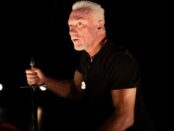
The subtitle of Patrick Page’s absorbing and informative one-man show "All the Devils Are Here: How Shakespeare Invented the Villain” is an actuate description of the content of his presentation. In a kind of lecture-performance it is Page’s credible contention that Shakespeare took the Vice character (the villain from the Middle Ages' Morality plays through Christopher Marlowe) and added psychological realism. Eventually in his last play, "The Tempest," Shakespeare was dealing with a character with a very worthy justification for revenge who finds compassion and empathy instead. [more]

The Shakespeare Conspiracy

April 28, 2018

"The Shakespeare Conspiracy" is based on Ted Bacino’s novel of the same title that he and Rufus Cadigan have adapted for the stage. Their effort is not in the league of such highly skilled dramatists as Peter Shaffer, Tom Stoppard and David Hare who used speculatively historical backgrounds for some of their esteemed works.  Instead, Mr. Bacino and Mr. Cadigan offer a choppy series of overheated episodes and vignettes spanning 40 years, from 1593 to 1633 chiefly taking place in England with plentiful and heavy-handed dialogue. [more]

Doctor Faustus

June 24, 2015

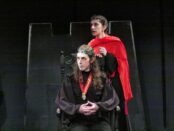
Much of the play is directed using Brecht’s so-called alienation effect in which the audience is constantly reminded that this is all a play, a poor choice for a tragedy that wants to put both awe and fear into the hearts of its listeners. Tony Strages’ set design resembles a circus or vaudeville and much of the performance is played on that level. What is sacrificed is the seriousness of the theological and moral issues. There are continual shifts in tone which simply draw attention to themselves, rather than add to the meaning. [more]