News Ticker

Alexander Harrington

Hans Litten: The Jew Who Cross-Examined Hitler
February 12, 2026

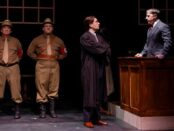
Despite the admirable commitment to historical accuracy, Lackey’s script is littered with flimsy side characters, muddled messages, and awkward dialogue. The result is a thematically incoherent mess that feels unaware of its own central tragedy. Hans says in Act 1 that he wants to force Hitler onto the witness stand in order to stop the Nazis from coming to power. The play seems unwilling to address that this did not work – that no amount of clever rhetoric would have been enough to stop the tide of Fascism. It would be wildly unfair to blame Hans Litten for failing to stop the Nazis, but it is a grievous omission for a play about him to explicitly frame the story that way and then refuse to grapple with the implications of him failing to do so, both for him as a character and for the ideas he is meant to represent and martyr himself for. Indeed, the play revels in the grace of Hans’ martyrdom. [more]
The Wayward Daughter of Judah the Prince

September 27, 2021

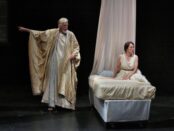
It is to the credit of the entire cast—dressed in Anthony Paul-Cavaretta’s period tunics and flowing robes—that Lackey’s sometimes over-the-top dialogue lands credibly. Two other elements elevate the play:  Michael Sirotta’s lovely, mood-enhancing score and Jon DeGaetano’s imaginative scenery which includes large, stage-spanning curtains that cleverly serve as entranceways, sails and even ancient columns.  Michael Redman’s moody projections enhance Sirotta’s contributions. [more]

Ludwig and Bertie

October 3, 2019

"Ludwig and Bertie," written by Douglas Lackey, gives us insight into the relationship of two of our greatest twentieth century philosophers, the younger Jewish Ludwig Wittgenstein and the 20-year-older atheist Bertrand Russell. Bertie, played smartly by Stan Buturla, is the wise old professor at Cambridge when he meets the almost half his age young student Ludwig, poignant, headstrong and hungry for more knowledge, insight and truth, played passionately by Connor Bond. [more]

End of Summer

October 22, 2016

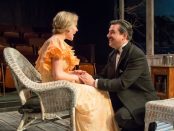
While S. N. Behrman was one of the leading Broadway playwrights from the twenties through the early sixties, he went into an eclipse after his death in 1973. Since 2000, however, there have been New York revivals of his major comedies "The Second Man," "Biography," "No Time for Comedy" and "Rain from Heaven." Set in the living room of a summer cottage on an estate in Northern Maine where the rich Frothinghams go to get away from the problems of the world, circa 1936, End of Summer resembles Chekhov’s "The Cherry Orchard" in that they both concern wealthy people refusing to recognize the changing social order. However, S. N. Behrman’s play is very much a comedy with its cool, urbane witticisms and very American in its outlook and content. [more]