
From Trinity to Trinity
Ako’s haunting solo performance is a powerful meditation on trauma, resilience, and remembrance, brought to life through image, sound, and quiet ferocity.
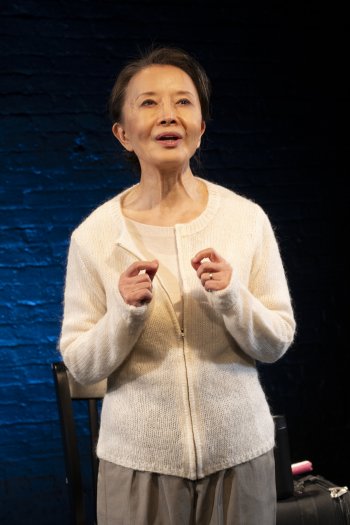
Ako in a scene from her adaptation of Kyoko Hayashi’s “From Trinity to Trinity” at HERE Arts Center (Photo credit: Russ Rowland)
It was on the grim morning of August 9th, 1945—a day seared into the annals of human history with the white-hot heat of devastation—that 14-year-old Kyoko Hayashi, a schoolgirl dispatched to labor at the Mitsubishi Munitions Factory in Nagasaki, bore witness to the unimaginable. By some twist of fate—divine, cosmic, or cruel—she survived the atomic inferno that engulfed her city, only to grapple with the slow, invisible poison of radiation sickness for the next 73 years of her life. But from the ashes of that annihilation emerged not only a survivor, but a voice—poised, precise, and profoundly necessary.
Hayashi began writing in 1962, and over the decades, ascended to become one of the most luminous literary voices among the Hibakusha—those shadowed yet unvanquished souls who lived through the atomic bombings of Hiroshima and Nagasaki. Her oeuvre—comprising novels, short stories, essays, and poetry—spoke not just of pain, but of memory, resilience, and the moral imperative of bearing witness. The accolades she received, numerous and prestigious, speak not only to her literary merit but to the aching need for her testimony in a world too quick to forget.
Among her most haunting and meditative works is the slim yet searing From Trinity to Trinity, an autobiographical pilgrimage undertaken in 1999 to the Trinity Site in New Mexico where the world’s first atomic bomb was tested. It is, in essence, a journey back to the beginning of the end. Published in 2000 and rendered into English by Eiko Otake—half of the hauntingly expressive performance duo Eiko & Koma—the work was later published in 2010, bringing Hayashi’s voice to new ears, and new hearts.
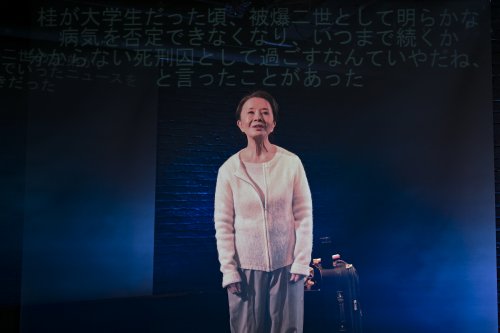
Ako in a scene from her adaptation of Kyoko Hayashi’s “From Trinity to Trinity” at HERE Arts Center (Photo credit: Russ Rowland)
But it was in 2009 that Eiko, recognizing the performative potential and piercing immediacy of Hayashi’s words, reached out to the accomplished New York-based actress Ako—known for her roles in Shogun, God Said This, and Snow Falling on Cedars, and the visionary founder of the Amaterasu Za theater company. Eiko posed a proposition: Could this text—so personal, so painful, so charged with historical weight—be embodied on stage as a one-person play? The answer, though tentative and reverent, was yes. It is Ako’s own adaptation for the stage that she performs today.
For what is art, if not the deliberate act of remembering? And whose memories do we choose to lift from the rubble of time? As we find ourselves now at the solemn threshold of the 80th anniversary of the atomic bombings—and, too, the liberation of the Nazi death camps—we confront, once again, the unbearable truth of our species’ capacity for cruelty, destruction, and, yes, forgetfulness.
In this present era—rife with headlines that echo past horrors, bristling with nationalism, violence, and the cold shrug of indifference—it becomes ever more urgent to listen to those who were there, to amplify their voices, not as museum relics but as clarion calls. Kyoko Hayashi’s life and words remind us that remembrance is not passive—it is an act of resistance. And when her story is spoken aloud—on a stage, before an audience—it becomes something even greater. It becomes a communion.
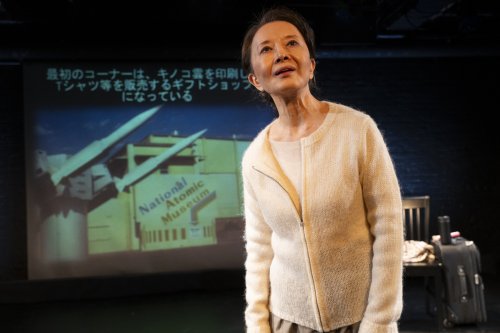
Ako in a scene from her adaptation of Kyoko Hayashi’s “From Trinity to Trinity” at HERE Arts Center (Photo credit: Russ Rowland)
Ako’s performance—anchored in quiet ferocity and elevated by Brittany Bland’s tapestry of evocative imagery and Chad Raines’ immersive, almost spectral soundscape—transcends the boundaries of conventional solo theater to become something far more profound: an intimate yet unflinching meditation on the long shadow of trauma, the defiant pulse of resilience, and the fragile, flickering act of remembrance.
Her journey—at once temporal and metaphysical—ushers her into a landscape as unfamiliar as it is fraught, a terrain that straddles the scorched expanses of both memory and geography. Traversing the high desert of New Mexico, where the atomic age first announced itself in a blinding flash of human ambition and moral ambivalence, she is compelled to confront not only the physical site of the bomb’s genesis but the unsettling emotional dissonance that lingers in its wake.
What she encounters is a uniquely American strain of detachment—a cultural posture curiously anesthetized to the cataclysmic suffering wrought by its own technological triumph. This emotional remove, this curated amnesia, is perhaps the most chilling echo of the bomb itself: invisible, pervasive, and insidiously enduring.
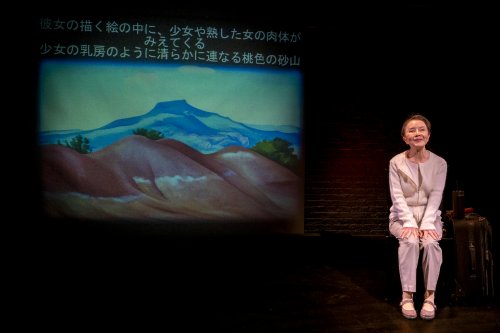
Ako in a scene from her adaptation of Kyoko Hayashi’s “From Trinity to Trinity” at HERE Arts Center (Photo credit: Russ Rowland)
Yet amid this alienation, something unexpected blossoms. In the silence of the desert—the very stage upon which this world-altering event first unfolded—she discovers an aching, almost sacred kinship with the non-human victims of that inaugural blast. The flora and fauna of the Trinity Site, rendered mute by time yet marked by the same violence, become unlikely companions in her pilgrimage. Their presence speaks not in language but in testimony: of endurance, of transformation, of bearing witness without words.
It is here, in the interplay between cultural oblivion and ecological intimacy, that the piece finds its most quietly devastating truth—that the bomb’s legacy is not confined to human suffering alone, but radiates outward in concentric circles of devastation and, improbably, connection.
With every gesture, every measured silence, Ako does not merely perform Kyoko Hayashi’s words—she inhabits them, channels them, and in so doing, blurs the line between personal testimony and collective memory. Complemented by Aaron Bowersox’s vivid lighting design, the result is a searing theatrical invocation that invites its audience not simply to watch, but to bear witness.
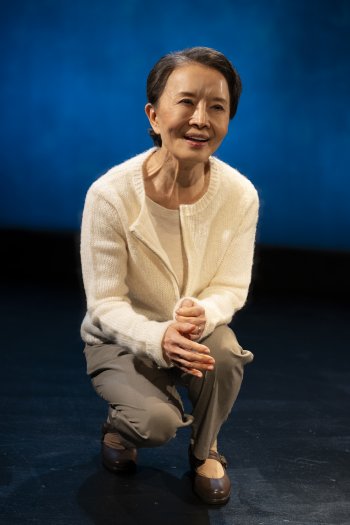
Ako in a scene from her adaptation of Kyoko Hayashi’s “From Trinity to Trinity” at HERE Arts Center (Photo credit: Russ Rowland)
In Ako’s hands, the stage of the Dorothy B. Williams Theatre at the HERE Arts Center becomes a space not just for narrative, but for reckoning. The histories we inherit—so often sanitized, reframed, or forgotten by the very nations that authored them—are laid bare, examined with the precision of a scalpel and the grace of a prayer. What emerges is a meditation not only on what happened, but on how it is remembered, by whom, and to what end.
From Trinity to Trinity (through October 5, 2025)
HERE Arts Center
Dorothy B. Williams Theatre, 145 Avenue of the Americas, in Manhattan
For tickets, visit http://www.here.org
Running time: 45 minutes without an intermission


Leave a comment