
Predictor
Jennifer Blackmer’s "Predictor" expands a single moment of insight into a sharp examination of authorship and agency. Anchored by Caitlin Kinnunen’s quietly compelling performance as Meg Crane, the production traces the birth of a home pregnancy test with clarity, momentum, and discipline—most persuasive when it trusts process over proclamation.

Caitlin Kinnunen in a scene from Jennifer Blackmer’s “Predictor” at the AMT Theater (Photo credit Valerie Terranova)
Jennifer Blackmer’s Predictor unfolds inside a compressed moment of thought — “approximately the three seconds it takes Meg to decide to sign a patent application” — and expands that instant into a fast-moving examination of authorship, agency, and intellectual ownership. Set between 1967 and 1971 and staged largely inside its protagonist’s mind, the play moves fluidly through corporate labs, domestic spaces, and cultural mythology, asking who gets credit for discovery and who gets written out of history.
The result is a smart, energetic production that leans heavily on performance and design to keep its ideas airborne. When the play trusts its central story — a woman realizing the scope of her own invention — it is sharp and persuasive. When it widens its scope, it occasionally diffuses its focus. Even then, the execution remains confident and assured.
At the center of the production is Caitlin Kinnunen as Meg Crane, a graphic designer at Organon Pharmaceuticals who stumbles onto a deceptively simple idea: a pregnancy test women could administer themselves, privately, without waiting weeks for lab results. Kinnunen plays Meg with clarity and restraint. She avoids grandstanding and lets the character’s intelligence surface through listening, recalibration, and quiet resolve. The performance builds steadily, never telegraphing its destination.
Blackmer’s script is most effective when it grounds its ideas in process. Early scenes walk Meg — and the audience — through the mechanics of pregnancy testing as it existed at the time: urine samples mailed in, weeks of waiting, scientific labor treated as mysterious rather than accessible. In one key sequence, Meg begins reading test results herself, easily and accurately, and asks the obvious question: why can’t women do this at home?
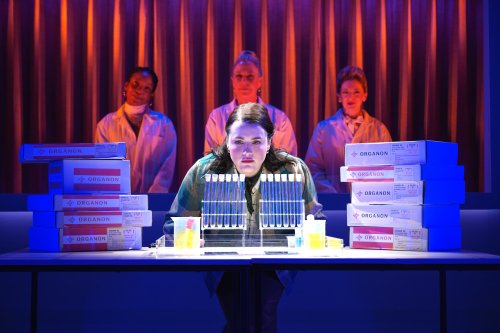
Jes Washington, April Ortiz, Lauren Molina and Caitlin Kinnunen in a scene from Jennifer Blackmer’s “Predictor” at the AMT Theater (Photo credit Valerie Terranova)
The moment lands because Kinnunen doesn’t sell it as revelation. She treats it as logic.
The six-member ensemble — Jes Washington, Lauren Molina, April Ortiz, John Leonard Thompson, Eric Tabach, and Nick Piacente — carries much of the play’s velocity and tonal variation, shifting rapidly between coworkers, parents, authority figures, and cultural voices. Transitions are clean and readable, even as identities blur.
Among them, Molina stands out repeatedly. Playing Meg’s mother, an office manager, and other figures, Molina brings striking physical specificity to each appearance. Her face is extraordinarily expressive — contorting, tightening, and releasing in ways that track thought as much as emotion. She delivers lines with sharply differentiated rhythms and mannerisms, often turning brief moments into something vivid. Even when she is not speaking, her presence pulls focus.
Washington brings steadiness to Chorus 1, grounding more heightened passages with clarity. Ortiz moves easily between warmth and authority, giving weight to roles that could read as shorthand. Thompson and Tabach handle male authority figures with a balance of charm and institutional blindness, never tipping into caricature. Piacente brings agility and wit, particularly in moments requiring quick tonal pivots.

Jes Washington and Caitlin Kinnunen in a scene from Jennifer Blackmer’s “Predictor” at the AMT Theater (Photo credit Valerie Terranova)
Alex Keegan’s direction keeps the production moving with confidence. Scenes bleed into one another without hesitation, and the staging trusts the audience to follow rapid shifts in time, place, and perspective. The pace is brisk — sometimes relentless — but largely effective.
Design is a major asset. Cat Raynor’s scenic and properties design uses minimal, precise elements to suggest labs, offices, and domestic interiors without clutter. Test tubes, drafting materials, and office furniture are deployed economically, keeping ideas foregrounded while giving actors something tactile to work with.
Alicia Austin’s costume design establishes period cleanly and supports rapid role-switching without fuss. Quick changes are handled smoothly, and costume language helps track shifts in function and authority.
Lighting is especially strong. Zach Blane’s lighting design gives the production much of its visual shape, moving between cool lab tones, saturated reds, and sudden intensity shifts that mark changes in psychological state. In scenes framed by a game-show motif, illuminated panels flash aggressively; elsewhere, disco-inflected lighting heightens the sense of cultural noise. The lighting does real dramaturgical work.
Sound design and original music by Uptown Works further sharpen the rhythm, underscoring transitions without overwhelming them.
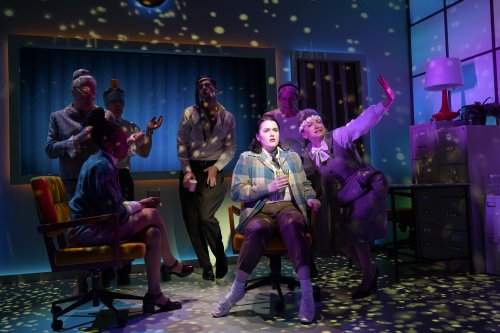
Jes Washington, Caitlin Kinnunen and Lauren Molina in a scene from Jennifer Blackmer’s “Predictor” at the AMT Theater (Photo credit Valerie Terranova)
Later in the play, Predictor briefly widens its scope to address abortion access and broader questions of bodily autonomy. While these ideas are historically adjacent, they feel less central to the play’s most compelling line — Meg’s agency as an inventor and her fight to be recognized. The shift slightly diffuses the focus, as the drama is strongest when it stays trained on the moment of creation and the institutional forces that attempt to redirect or erase it. Even so, the clarity of the performances and the confidence of the staging keep the production firmly on track.
The ensemble’s professionalism is notable. The performances are delivered with full commitment and precision, without any sense of pullback or accommodation. It is the kind of disciplined work that deserves a fuller house.
Ultimately, Predictor is an ambitious and thoughtfully staged production that largely earns its authority by grounding big questions in character, process, and craft. Anchored by Caitlin Kinnunen’s quietly compelling central performance and elevated by Lauren Molina’s electrifying versatility, the play makes its case most convincingly when it trusts specificity over insistence.
When it stays there, it is at its best.
Predictor (through January 18, 2026)
MT Theater, 354 W. 45th Street, in Manhattan
For tickets, visit https://www.predictorplay.com
Running time: two hours and 15 minutes including one intermission


Leave a comment