
Transgression
What do you do with your ethics when an artist you love transgress acceptable norms?
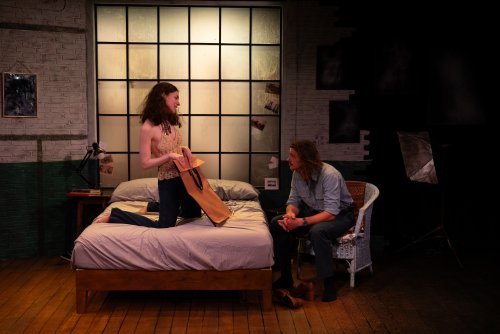
Ivy Rose Cort as young Robin Black and James Jelkin as Norman Stone in a scene from Terry Curtis Fox’s “Transgression” at Here Arts Center (Photo credit: Max Liebergall)
Terry Curtis Fox’s Transgression has an interesting premise: after world famous photographer Norman Stone dies, his wife Gina discovers a trove of his photographs no one has ever seen – and it is deemed his best work. Unfortunately, they are oversexualized, nude portraits of an under-aged girl. Complicating Gina’s decision as what to do about them is the fact that she had already announced she was giving all of the work in Norman’s studio to a museum and now the curator Martin Abel has some say in her decision. When he puts out a press release hoping to flush out the model from 40 years before, Robin Black shows up demanding that the newly discovered photos be destroyed as they were taken without her permission. How do you separate the work from the invasion of privacy as well as the charge of statutory rape as she was 15 at the time they were taken without her knowledge? And then Gina finds additional hidden material that is more shocking.
As directed by Avra-Fox Lerner and written by Curtis Fox, the production has many problems, the first being its leisurely slow pace which makes the play seem longer and less dramatic than it is. Written in 19 scenes and taking place on the same Soho loft set throughout, the play is more of a teleplay than a stage play, minus the camera angles and the set changes. Each scene only reveals one new piece of information, a dramaturgically dull way to tell a stage story. In spite of all this, the play might have worked if the acting was passionate and intense but the cool, unemotional style undercuts much of the tension.
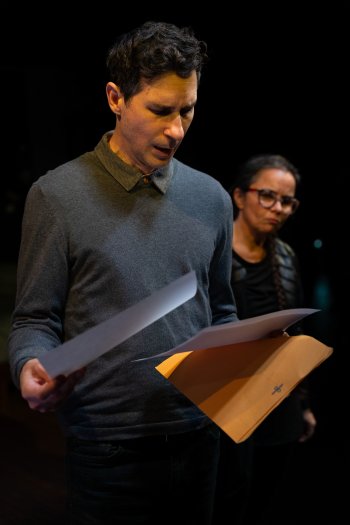
Yuval Boim as Norman Abel and Susan Bennett as adult Robin Black in a scene from Terry Curtis Fox’s “Transgression” at Here Arts Center (Photo credit: Max Liebergall)
The play mainly alternates between Gina’s first visit to her late husband’s studio (her first ever) in the present (2010) and Norman and Robin’s tryst in the studio in 1970 when he took the photos. This format becomes a little too schematic, leading us to expect the alternation between time frames. Occasionally this is interrupted by visits to Martin’s museum galleries but as the set does not change this is not always entirely clear when scenes begin. As we are never allowed to see any of Norman’s work or the photographs in the gallery, we have to take on faith that he is a major artist.
The play’s ethical questions are fascinating, but as written Transgression goes round and round covering the same points over and over: how do you separate the work from the artist when the artist has transgressed acceptable norms? And how does that change if the artist is deceased and can’t make reparations? The play seems to offer only two solutions: not showing the work until the model has died and can’t be affected by its showing or destroy the work so no one ever sees it again. There are, of course, other possibilities not covered.
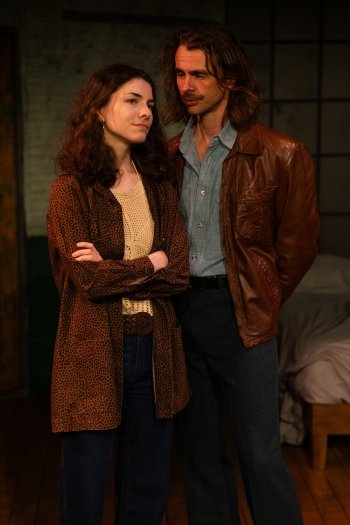
Ivy Rose Cort as young Robin Black and James Jelkin as Norman Stone in a scene from Terry Curtis Fox’s “Transgression” at Here Arts Center (Photo credit: Max Liebergall)
In this case, Norman’s working routine was to photograph his models after sleeping with them. Gina (who often posed for him in the nude) and he had an open relationship but she asked no questions and never visited his studio. Now she is having both guilt and remorse: she gave up her nascent career to tend to Norman’s needs and that of their children. Now she wonders if she made the right decision, it being too late for her to restart her aborted art career. And should she have protested his promiscuity though she had several affairs in those days herself?
Fox-Lerner’s direction is also deficient in terms of working with the actors. While one assumes that Norman must have been very charismatic to get all those women to sleep with him (unless they are simply dazzled by his fame), James Jelkin in this role is too arrogant and cold to explain his success with the opposite sex. Both Jane Ives’ Gina and Susan Bennett as the older Robin are nothing but angry all the time so that they seem one dimensional. More nuance would have made them more interesting. As young Robin, Ivy Rose Cort makes it clear that she seduced Norman when she was 15, a Lolita in the making, though this does not excuse a 35-year-old man sleeping with an underage girl in our society. Unfortunately, Cort looks to be in her twenties if not thirties so it is difficult to see her as the victim she is presented as. As the museum curator, Yuval Boim is too serene and detached until he reaches a similar fate with his own husband and then he goes to the opposite extreme.
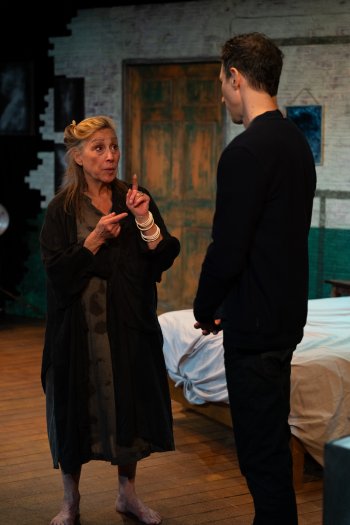
Jane Ives as Gina Stone and Yuval Boim as Martin Abel in a scene from Terry Curtis Fox’s “Transgression” at Here Arts Center (Photo credit: Max Liebergall)
Kate Rance’s Soho studio set with its white brick walls and obscured panes in a huge picture window is rather colorless and does not look lived in. All the photographs on the walls are either out of focus or blurred so that we get no idea of Norman’s work or surroundings. The monochromatic costumes by Annie Simon never suggest artists or models but much more sober professions. Lauren Parrish’s light design is more successful but all the scenes in the Soho studio tend to look alike, while the museum gallery scenes are lit differently.
Not surprisingly, Terry Curtis Fox’s career has mainly been in television where many of these problems would have been solved by the director. In this format, the play harps on the same themes continuously without arriving anywhere. While the play’s reference to Picasso’s treatment of women may be familiar to theatergoers, that of Carl André may not (in 1985 he was acquitted of pushing his wife out of the window of their 34th floor apartment.) Some judicious cuts and speeding up the pace might go a long way to solving the play’s problems. Transgression is intriguing without being entirely successful in this form.
Transgression (through August 2, 2025)
Here Arts Center Sublet Series
Here Mainstage Theater, 145 Sixth Avenue, south of Spring Street, in Manhattan
For tickets, call http://www.here.org/shows/transgression
Note: schedule changes weekly; check website for show times
Running time: two hours and ten minutes including one intermission


Leave a comment