
The Tragedy of Coriolanus (Theatre for a New Audience)
Modern dress version of Shakespeare's Roman history play fails to find the contemporary relevance in unsettled ancient times.

McKinley Belcher III as Coriolanus and Roslyn Ruff as Volumnia in a scene from William Shakespeare’s “The Tragedy of Coriolanus” at Theatre for a New Audience (Photo credit: Hollis King)
Too high a price for food. Mobs running through the streets. Martial law trying to keep order. The rules seem to keep changing on a daily basis. Demagogues attempting to influence the populace. Threat of foreign wars. Sound like today and tomorrow’s newspaper headlines? Actually, this is part of the plot of Willam Shakespeare’s 400-year-old historical The Tragedy of Coriolanus (set in ancient Rome) being given a modern dress production by Brooklyn’s Theatre for a New Audience. Unfortunately, director Ash K. Tata’s staging does not focus on the relevant political events. Instead, it focuses on a high-tech production that is at times distracting and at others meaningless. Modern dress of classics does not always mean relevance.
Tata’s staging is also problematic making almost every scene look like every other. The mob scenes have been reduced to five actors (other than the lead characters) which does not suggest any threat whatever. Afsoon Pajoufar’s unit set is an attempt to create a Roman building and then put scaffolding around it to suggest modern renovations. However, using it for almost every scene which is just under three hours becomes monotonous and uninspired. The acting doesn’t help much with each actor seemingly having chosen one single character trait so that all are one-note in this blank-verse drama. Only Roslyn Ruff as Volumnia, the title character’s mother, shows any variety or range. (Volumnia has always been the best role in the play.)

Jack Berenholtz, Pomme Koch, Mickey Sumner as Tullus Aufidius, McKinley Belcher III as Coriolanus, and Kevin Alicea in a scene from William Shakespeare’s “The Tragedy of Coriolanus” at Theatre for a New Audience (Photo credit: Gerry Goodstein)
Coriolanus is a very difficult play to stage because it has a totally unsympathetic title hero. As a result, we have to be shown his motivation, his backstory, his relationship to his loved ones in his life. Otherwise, the audience doesn’t much care about him or root for his triumph. The play opens after the expulsion of the Tarquin kings of Rome. The plebians are rioting because stores of grain have been withheld from the people, chief among those being blamed is Caius Marcius (later named Coriolanus for his defeat of the Volscians at Corioli) In public speech, patrician Caicus Marcius had made it clear that he has only contempt for the common people. The tribunes Brutus and Sicinius vow to bring him down.
News of a new threat by the Volscian army under its leader Tullus Aufidius, an Italian sect opposed to Roman rule, causes Martius to leave with the Roman army under General Cominius. Martius takes part of the Roman army to lay siege to the Volscian city of Corioli which is at first unsuccessful. However, Marcius himself forces open the gates and leads his men to conquer the city. Next joining up with Cominius’ troops, he fights Aufidius in single combat and wins. As a result, General Cominius gives him the nickname “Coriolanus” to honor his victory.

Zuzanna Szadkowski as Junius Brutus, Jason O’Connell as Menenius Agrippa and William DeMeritt as Sicinius Velutus in a scene from William Shakespeare’s “The Tragedy of Coriolanus” at Theatre for a New Audience (Photo credit: Hollis King)
Returning home a hero, Coriolanus’ mother Volumnia, as patrician as he but able to temper her feelings in public, encourages him to run for Consul of Rome. Winning the support of the Roman Senate, he is opposed by the tribunes Brutus and Sicinius who stir up the populace to riot against him. Insulting the rioters in a badly worded speech indicating his contempt for them, Coriolanus is exiled from Rome at the instigation of Brutus and Sicinius. He leaves to join the Volscians and this eventually leads to his downfall and death.
Like the majority of the cast, McKinley Belcher III’s Coriolanus is one-note, in this case proud and arrogant. He is unpleasant and angry from the beginning and never becomes any more sympathetic making his downfall inevitable. Played by a woman instead of the usual male counterpart, Mickey Sumner as Tullus Aufidius is rather bland; switching the gender takes away the masculine rivalry without adding anything new in its place. As the tribunes Brutus and Sicinius, Zuzanna Szadkowski and William DeMeritt, respectively, are ciphers rather than real threats to the Roman Senate. Coriolanus’ wife Virgilia played by Merdith Garrettson is given hardly anything to do, while his son Young Martius (Merlin McCormick) makes a fine impression in his few speeches. On the other hand. Jason O’Connell who has done excellent work in Jane Austen adaptations at various theaters around New York is amusing as the Senator Menenius Agrippa who is always trying to play peacemaker.
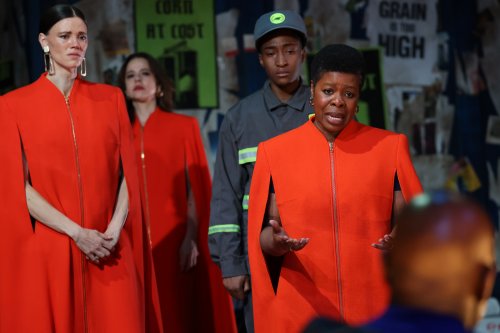
Meredith Garretson as Virgilia, Emma Ramos as Valeria, Merlin McCormick as Young Martius and Roslyn Ruff as Volumnia in a scene from William Shakespeare’s “The Tragedy of Coriolanus” at Theatre for a New Audience (Photo credit: Hollis King)
Part of the high-tech production includes a jumbotron cube hanging over the playing area which appears to have a live feed of the action on all four sides courtesy of projection designer Lisa Benkel and POSSIBLE. While the height of the device is too high to be of any use to theatergoers sitting in the orchestra, it might well be distracting for those in the balcony. At any rate, all it does is tell us the production is set in modern time when everything is taped and recorded (something we already know) but here without making any statement about it. So too costume designer Avery Reed’s grey outfits for the Romans and black and blue uniforms for the Volscians only suggest the regimentation of a militaristic society. Ruff is dressed first in all yellow and then in red orange, both color schemes seem to be out of another production. The Roman populace seems to be dressed in their own casual clothes, somewhat different from everyone else.
While The Tragedy of Coriolanus could have a great deal of relevance for our unsettled political times, Ash K. Tata’s production fails to draw those inferences. Simply as a revival of Shakespeare’s least revived tragedy, the acting in this Coriolanus is so one dimensional that it offers little dramatically. Only Rosalyn Ruff (mostly associated with contemporary plays) as the imperious Volumnia gives a layered, varied performance that commands attention. Dr. Sigmund Freud would probably say she is the root cause of all of Coriolanus’ psychological problems.
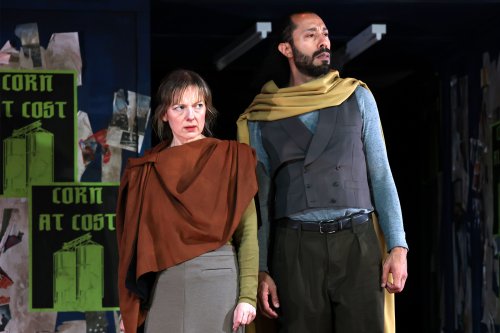
Zuzanna Szadkowski as Junius Brutus and William DeMeritt as Sicinius Velutus in a scene from William Shakespeare’s “The Tragedy of Coriolanus” at Theatre for a New Audience (Photo credit: Hollis King)
The Tragedy of Coriolanus (through March 1, 2026)
Theatre for a New Audience
Polonsky Shakespeare Center, 262 Ashland Place, in Brooklyn
For tickets, call 646-553-3880 or visit http://www.tfana.org
Running time: two hours and 50 minutes including one intermission


Leave a comment