
The Pushover
Shanley’s play aspires to a probing anatomy of power and moral blindness, yet curdles into an implausible piece that never coheres into a solid drama.

Di Zou as Pearl and Rebecca De Mornay as Evelyn in a scene from John Patrick Shanley’s “The Pushover” at the Chain Theater (Photo credit: Dan Wright Photography)
Encountering a John Patrick Shanley premiere is a cause for theatrical celebration…usually. One arrives expecting either a daring experiment or an intimate masterwork stripped to essentials. What one finds instead, in The Pushover, is something far less distinguished: a work that, for all its noise and velocity, has the unmistakable air of a minor effort, a sketch inflated to full length without acquiring the substance to sustain it.
Shanley, whose best plays braid theology, desire, and doubt into something approaching tragic inevitability, here appears to be circling familiar thematic terrain—good and evil, the masks we fashion for ourselves, the possibility (or impossibility) of moral redemption—without quite landing on a coherent dramatic spine. The play gestures, intermittently, toward noir, toward psychological excavation, toward a kind of jagged romantic farce; yet these modes never cohere. Instead, what dominates the evening is a shrill, almost punishing repetitiveness: three women, bound by a lattice of past and present intimacies, locked in cycles of accusation, seduction, and recrimination that grow less revealing the longer they persist.
The play begins with a promise it does not keep. Pearl, deftly played by Di Zhu, is introduced in a therapist’s office—a financially precarious chef, delicately sketched, whose white gloves become a point of fascination and irritation in equal measure. Opposite her, Christopher Sutton’s rumpled, nameless therapist offers a fleeting suggestion of tonal variation: a quieter register, an observational wit. Pearl’s defining trait—her near-pathological insistence on the goodness latent in every soul—positions her as the titular “pushover,” though the play never convincingly interrogates whether this belief is spiritual conviction, emotional self-deception, or merely a dramaturgical convenience.

Christina Toth as Soochi in a scene from John Patrick Shanley’s “The Pushover” at the Chain Theater (Photo credit: Dan Wright Photography)
From there, Shanley fractures the narrative into a series of flashbacks and confrontations, introducing Evelyn (Rebecca De Mornay), a spa impresario in New Mexico whose primary mode of communication is a kind of weaponized contempt. Evelyn is written, and played, as a study in sustained hostility: her authority asserted less through complexity than through volume and velocity, a barrage of insults that quickly exhaust their capacity to shock. De Mornay, who retains a striking physical presence moves with assurance, but is given little modulation to explore beyond the character’s single, blaring note.
Completing the triangle is Soochi (Christina Toth), a figure so overdetermined—addict, gambler, possible fabulist, emotional supplicant—that she begins to feel less like a character than an accumulation of afflictions. It is through Soochi that the play attempts to generate stakes: her arrival at Evelyn’s spa, bearing the detritus of a failed marriage and the residue of her relationship with Pearl, sets in motion a chain of betrayals and reversals that are meant to escalate into something like tragic farce. Yet the relationships themselves remain curiously opaque. That Pearl and Soochi were ever lovers is difficult to credit; that all possible romantic permutations among the trio should unfold, with diminishing plausibility, strains the play’s already tenuous grasp on emotional logic.
Shanley’s dialogue, so often his most reliable instrument, here flickers only intermittently to life. There are lines that arrest the ear—Pearl’s description of Soochi, “She walked in through the wound you left,” carries a ghost of the old precision—but they are islands in a sea of repetition. More often, the language settles into a blunt, declarative harshness, with characters shouting past one another in rhythms that flatten rather than illuminate. The effect is less one of escalating tension than of tonal stasis: everything is pitched at the same relentless volume, leaving the audience with nowhere to go.
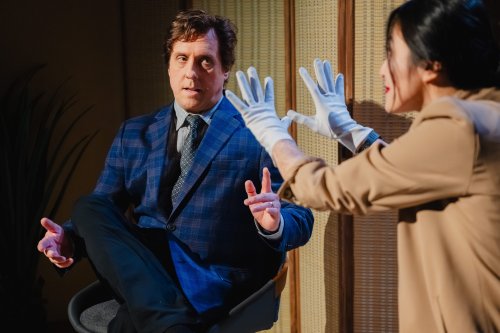
Christopher Sutton as the Therapist and Di Zou as Pearl in a scene from John Patrick Shanley’s “The Pushover” at the Chain Theater (Photo credit: Dan Wright Photography)
Under Kirk Gostkowski’s direction, this lack of modulation is compounded. Zhu and Toth, in particular, seem confined to narrow interpretive tracks, their performances circling a limited set of emotional beats without the shading that might render their characters legible, much less compelling. Sutton, by contrast, makes the most of his brief appearances, locating small pockets of humor and specificity; a secondary turn as a spa employee, achieved largely through physical business, provides one of the evening’s few genuine laughs.
Design elements, too, struggle to bridge the play’s conceptual gaps. Jackson Berkley’s set evokes Pearl’s modest kitchen with a degree of tactile credibility, yet proves far less persuasive when tasked with conjuring the supposed luxury of Evelyn’s New Mexico retreat and an analyst’s office that is too skeletal to ground the actors in a true setting. Where Debbi Hobson’s costumes are believably lived-in and Dariel Garcia’s lighting choices are sensitive to the palette on stage, the visual world, like the emotional one, feels only partially realized.
As the plot careens toward its would-be climax—treachery, a muddled murder scheme, the sudden appearance of a conspicuously pink firearm—the play’s internal logic grows increasingly difficult to parse. Characters behave not in accordance with any discernible psychology but in service of contrivance: Pearl, the ostensible moral center, proves oddly amenable to violence; Soochi oscillates between abjection and cunning without connective tissue; Evelyn remains, if nothing else, steadfast in her abrasiveness. A late attempt at erotic charge—Pearl, mid-argument, confessing sudden arousal—lands with a thud, emblematic of the play’s broader inability to make its emotional turns feel earned.

Di Zhu as Pearl and Rebecca De Mornay as Evelyn in a scene from John Patrick Shanley’s “The Pushover” at the Chain Theater (Photo credit: Dan Wright Photography)
In The Pushover, one glimpses, here and there, the remnants of Shanley’s earlier acuity, but they are obscured by a welter of noise, repetition, and narrative confusion. The evening reaches a kind of inadvertent nadir when Evelyn, in a fit of bullying, compels Soochi to repeat the epithet “Scumzilla,” a moment that aspires to savage absurdity but instead curdles into something merely embarrassing. One leaves the theatre less provoked than wearied, wondering not what the play has revealed, but how so formidable a dramatist has come to sound, for once, so insistently off-key.
The Pushover (through May 2, 2026)
Chain Theatre, 312 West 36th Street, in Manhattan
For tickets, visit www.chaintheatre.org
Running time: 90 minutes without an intermission


Leave a comment