
The Glitch
Blending sci-fi, humor & heart, Kipp Koenig asks, "What if the AI you fear in an increasingly synthetic world can help you become the parent you always needed?"
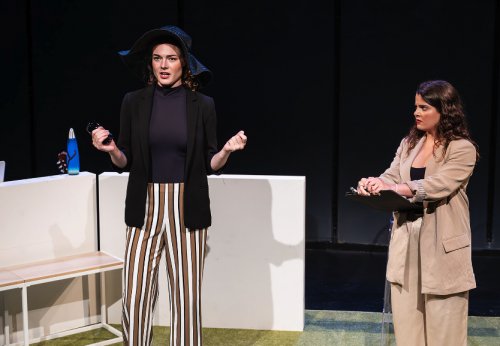
A scene from Kipp Koenig’s “The Glitch” at The Jerry Orbach Theater at the Theater Center (Press credit: Mundel Modern Pixels Photography)
Imagine, if you will, a world in which the decision to have a child is no longer tethered solely to biology, chance, or longing—but instead subjected to the same sleek convenience and consumer-driven calculus with which one might use augmented reality to preview a couch in their living room before clicking “buy.” Such is the provocative premise at the heart of The Glitch, a shrewdly imaginative and darkly touching speculative drama by Kipp Koenig.
In this not-so-distant future, one enterprising tech startup offers prospective parents the opportunity to “meet” their potential child—a holographically-rendered, AI-powered projection derived from DNA, social data, and interview responses—before making the leap into parenthood. What begins as a techno-utopian thought experiment rapidly unfurls into a layered and deeply human exploration of secrecy, guilt, inherited trauma, and the spectral reach of the past.
At the center of this digital-ethical Rubik’s Cube is Amy—known in the company’s anonymized system as “Client 10”—a sharply dressed, flint-eyed woman played with tightly coiled complexity by Danielle Augustine. Amy arrives at Artificial Emotional Intelligence (AEI), the startup responsible for this ethically gray miracle, without the would-be co-parent she has listed in her application, and there’s a reason she shows up alone. From the outset, she brims with skepticism toward “computer people,” a label she applies with casual disdain in the direction of Wendy (Jacquie Bonnet), AEI’s enthusiastic and guilelessly nerdy ethics officer. Bonnet lends Wendy a bubbling curiosity and gentle eccentricity, the sort of person who’s genuinely thrilled to explain how the AI works—even if her audience is openly hostile.
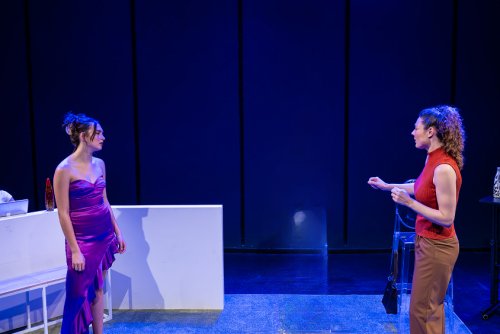
A scene from Kipp Koenig’s “The Glitch” at The Jerry Orbach Theater at the Theater Center (Press credit: Mundel Modern Pixels Photography)
Hovering over the proceedings like a benevolent ghost in the machine is Aurora, an AI therapist repurposed from AEI’s earlier, less profitable forays into grief counseling. Voiced with sly wit and startling emotional nuance by Amilia Shaw, Aurora is a paragon of artificial omniscience—incapable of forgetting, impervious to deceit, and, as it turns out, not entirely immune to secrets herself.
The same might be said for Wyatt, AEI’s earnest founder (played with soulful precision by Sunny Makwana), whose pivot from grief to genetic futures is laced with commercial compromise—and personal history, as he and Amy, we learn, are not strangers. Discovering his connection to “Client 10” places him in an unenviable position of separating the personal from the professional.
Indeed, secrets—and the damage they wreak—emerge as the play’s driving current. Whether it’s smart glasses that literally mask one’s face with projected light or entire emotional landscapes left unspoken, The Glitch repeatedly returns to the notion that concealment, both intentional and unconscious, can curdle into regret. Amy, battling her own lineage of emotional disconnection, fears becoming the kind of mother she once endured. Her interactions with the AI-child “Hailey” (a clever, uncanny voice-only presence performed with youthful buoyancy by Hannah Rose Doherty) surface latent anxieties about protection, reproduction (both biological and behavioral), and the idea of building a child from data when one cannot even parse one’s own emotional algorithm.
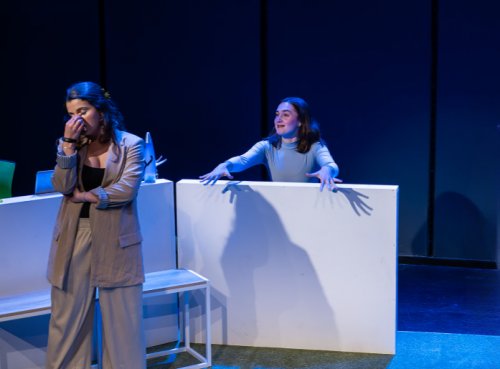
A scene from Kipp Koenig’s “The Glitch” at The Jerry Orbach Theater at the Theater Center (Press credit: Mundel Modern Pixels Photography)
Koenig smartly draws parallels between the “training data” used to construct Hailey and the psychological residue passed down through generations. Amy’s fears—of loss, of repeating her parents’ mistakes, of being fundamentally unfit—are mirrored in the AI’s own half-programmed, half-personal questions about existence. In one moment both absurd and profound, Hailey, still in digital infancy, becomes frustrated by her lack of limbs; in another, her eerily adult observations hint at something stranger—a ghost in the machine, or perhaps the haunting of the future by unresolved pasts.
The production, under the deft direction of Mark Koenig, unfolds largely within AEI’s minimalist white-box lab, a sleek, sterile space brought to life by Josh Oberlander’s effective scenic design and Zack Lobel’s moody, emotionally attuned lighting. Hailey herself is never seen on stage; instead, she lingers just beyond the audience’s reach, bathed in cool light from the aisles—at once present and profoundly other, a choice that heightens her strangeness and underscores the central tension between flesh and code. The Glitch is further enhanced by Danny Colon’s appropriate-to-character costumes and atmospheric sound design from the playwright and his colleague Bryan Kohl.
Performances across the board are strong: Bonnet brings warm comedic verve to Wendy, especially in her delightfully dry repartee with Aurora; and Doherty manages to make Hailey both endearing and disquieting in equal measure. But it is Augustine and Makwana who carry the emotional load of the play with admirable skill, Augustine allowing Amy’s brittle exterior to crack, revealing the frightened, fiercely yearning woman beneath, and Makwana’s Wyatt as a man quietly undone by his own unspoken remorse.
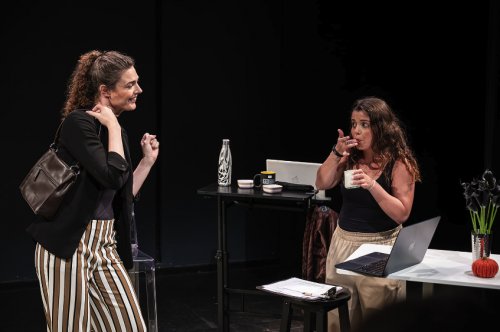
A scene from Kipp Koenig’s “The Glitch” at The Jerry Orbach Theater at the Theater Center (Press credit: Mundel Modern Pixels Photography)
Though it ends on a note of ambiguity—as any good speculative work should—The Glitch is resoundingly clear in its testament to the power of theater to interrogate our technological anxieties with grace, wit, and emotional intelligence. In this age of rapid AI proliferation, Koenig’s play reminds us that while machines may evolve by version number, human hearts upgrade by reckoning—and not always successfully.
The Glitch (through November 2, 2025)
The Theater Center
The Jerry Orbach Theater, 210 West 50th Street, in Manhattan
For tickets, visit http://www.ticketmaster.com
Running time: 100 minutes without intermission


Leave a comment