
Public Charge
Fascinating political play based on the author's own career as Deputy Assistant Secretary of State and Ambassador to Uruguay under President Obama.
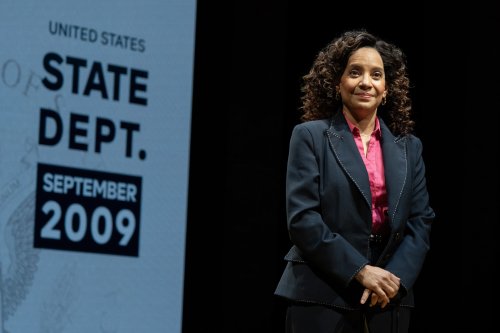
Zabryna Guevara as Deputy Assistant Secretary and later Ambassador Julissa Reynoso in a scene from Reynoso and Michael J. Chepiga’s “Public Charge” at The Public Theater (Photo credit: Joan Marcus)
If you ever wondered what it is really like to work in the corridors of power, Public Charge based on the political career of Julissa Reynoso, an idealistic diplomat who was Deputy Assistant Secretary of State for the Western Hemisphere under Secretary of State Hillary Rodham Clinton and Ambassador to Uruguay during President Obama’s second term, will give you an excellent idea. Written with playwright Michael J. Chepiga, the world premiere production of Public Charge now at The Public Theater is a fascinating account of attempting to make a change in a bureaucracy whose very policies keep anything from happening. Told by someone who lived it, it is all true as far as we know. Under Doug Hughes’ robust and forceful direction, the play is never didactic or too dense, making us feel we are living the events as Julissa encountered them.
The title has two meanings: as a six-year-old child in the Dominican Republic in 1981, Julissa tried to get a visa to join her mother in the Bronx and was turned down by the consular officer, who looking at her mother’s income, decided they would become a public charge on the welfare rolls and initially rejected her application. Jump to 2009 after working for Clinton’s political campaign (Harvard University, Wall Street law firm), she is recommended for a job in the State Department. We see her at her tenth interview, this time with career diplomat Ricardo Zuniga, Director of Cuban Affairs even though the U.S. government has no political relations with the Communist Cuban government. When Julissa points this out to him, he retorts “And it’s my job to see that doesn’t change.”
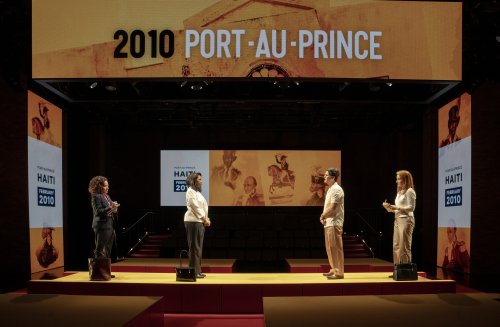
Zabryna Guevara as Deputy Assistant Secretary of State Julissa Reynoso, Marinda Anderson as Chief of Staff Cheryl Mills, Armando Riesco as Cuban Foreign Minister Bruno Rodriguez and Cuban Deputy Foreign Minister Maggie Bofill as Josefina Vidal in a scene from Julissa Reynoso and Michael J. Chepiga’s “Public Charge” at The Public Theater (Photo credit: Joan Marcus)
However, Secretary Clinton is interested in improving relations which is why she wants Julissa on her staff. After six months awaiting her security clearance, Julissa becomes Deputy Secretary of State for Caribbean and Latin American Affairs which she is eminently qualitied to handle having been born in the Dominican Republic and speaking fluent Spanish. Not only is she determined to make a difference, but is actually empowered with the public charge by virtue of her appointment.
She is immediately plunged into one crisis after another: USAID operative Alan Gross is arrested by the Cuban government for espionage, and Haiti has a devastating earthquake that requires immediate humanitarian aid. Cheryl Mills, Clinton’s counselor and chief of staff, is helpful, Ricardo is not. Along the way Julissa meets up with Cuban Ambassador Jorge Bolaños, Cuban Foreign Minster Bruno Rodriguez, his Deputy Josefina Vidal and has countless phone calls with Judy Gross, Alan’s perturbed wife. When Julissa feels she can’t take the Washington, D.C., bureaucracy any longer, she is appointed U.S. Ambassador to Uruguay where the State Dept. wants her to negotiate their taking five prisoners from Guantanamo in order to facilitate the closing of the prison. Now she finds out that President José “Pepe” Mujica and his assistant Jose “Chacha” Gonzalez are considered terrorists by the U.S. government and are on the no-fly list. Needless to say, in her five years at the State Dept., Julissa makes a great deal of difference.
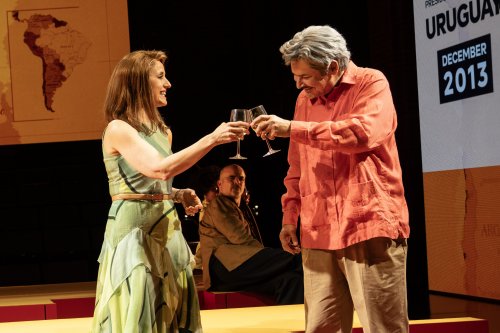
Maggie Bofill as Cuban Deputy Foreign Minister Vidal and Al Rodrigo as Uruguayan President José “Pepe” Mujica in a scene from Julissa Reynoso and Michael J. Chepiga’s “Public Charge” at The Public Theater (Photo credit: Joan Marcus)
The play leaves some gaps in information like what happened to Julissa between ages 6 and 34 and fails to identify several main characters. You won’t find out that Cheryl Mills is Clinton’s Chief of Staff even though it is obvious that Julissa reports to her. It is also not made clear how the U.S. government can consider the president of a foreign country a terrorist and forbid him from entering the United States. We also learn nothing about Julissa’s personal life. However, you can enjoy the play without any of this missing information. (It may make you want to do your own research.)
As the Secretary and later Ambassador Reynoso, Zabryna Guevara begins as naïve and idealistic and we watch as she learns the language of communication and how to get around the red tape she encounters. Always the sophisticated diplomat, Guevara matures and grows while we watch. She acquires the lingo and the chain of command as well as how to read the people she has to work with on a daily basis. We feel her compassion as well as her ability for her job. As her boss Chief of Staff, Cheryl Mills, Marinda Anderson is a no-nonsense bureaucrat who knows her way around red tape. She makes a very strong impression as a diplomat who gets things done. Dan Domingues is amusing as Director Ricardo Zuniga who begins as inflexible but who under Julissa’s leadership begins to weaken. Playing both Cuban Ambassador Bolaños as well as Uruguayan President Mujica, Al Rodrigo is suave and continental in the best manner. He is also feisty as Julissa’s Uncle Nelsido from the Bronx.
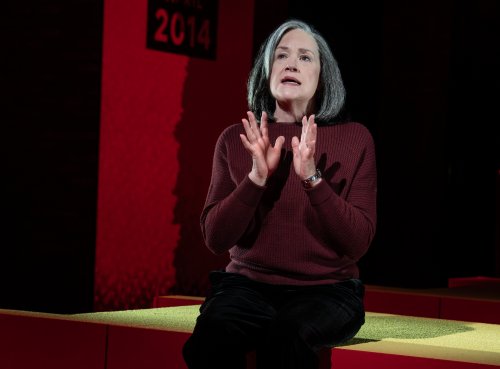
Deirdre Madigan as Judy Gross in a scene from Julissa Reynoso and Michael J. Chepiga’s “Public Charge” at The Public Theater (Photo credit: Joan Marcus)
As the other Caribbean diplomats, Cuban Foreign Minister Rodriguez and “ChaCha” Gonzalez, right hand assistant to Mujica, Armando Riesco is much more hard-edged and sinister. He also plays Julissa’s rather strict father Julio. As Alan Gross’ wife Judy, Deirdre Madigan is impassioned and emotional. Maggie Bofill is amusing as Cuban Deputy Vidal who always seems to turn up at whatever diplomatic event Julissa attends and seems to enjoy teasing her. Under Hughes’ direction, the actors who double other than Julissa, Cheryl, Ricardo and Judy, are excellent at playing more than one character differently.
The staging and set design for Public Charge is rather unique. With the audience sitting on two sides of the playing area, Arnulfo Maldonado’s set is a series of fixed red and yellow platforms like runways which allow for various scenes to take place in the Dominican Republic, New York City, Washington, D.C., Haiti, Uruguay and Cuba in different configurations. Drawers below neatly store the props managed by Samantha Llanes Gordon. This is enhanced by Lucy Mackinnon’s video design projected on several overhead screens that not only reveal the time and place but present the setting. Haydee Zelideth’s costumes are an attractive collection of business clothes as well as tropical wear. The ever changing lighting for the play’s 34 short scenes by Ben Stanton changes color depending on the location, lighting up the red and yellow platforms differently for each location.
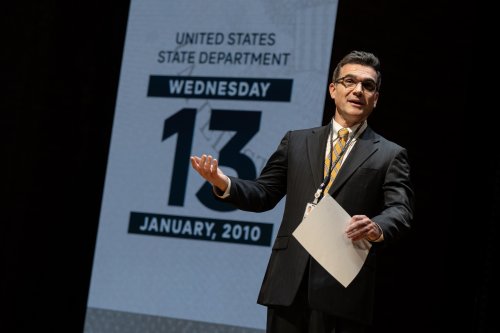
Dan Domingues as U.S. Director of Cuban Affairs Ricardo Zuniga in a scene from Julissa Reynoso and Michael J. Chepiga’s “Public Charge” at The Public Theater (Photo credit: Joan Marcus)
Julissa Reynoso and Michael J. Chepiga’s Public Charge is that rare political play: easy to follow but giving a great deal of information without overwhelming the viewer. Ironically, even though most theatergoers will have lived through the period of the play (2009 – 2014), it is remarkable how little one remembers of the facts depicted – or did our news media not give it much play? As Secretary and later Ambassador Reynoso, Zabryna Guevara gives an impressively modulated performance that demonstrates the various stages in a diplomat’s political education.
Public Charge (extended through April 12, 2026)
The Public Theater
Newman Theater, 425 Lafayette Street, in Manhattan
For tickets, visit http://www.publictheater.org
Running time: one hour and 40 minutes without an intermission


Leave a comment