
Mother Russia
Amid upheaval and rising capitalism, Evgeny must navigate love, loyalty, and identity in a new Russia reborn with glittering, uncertain promises, circa 1992.
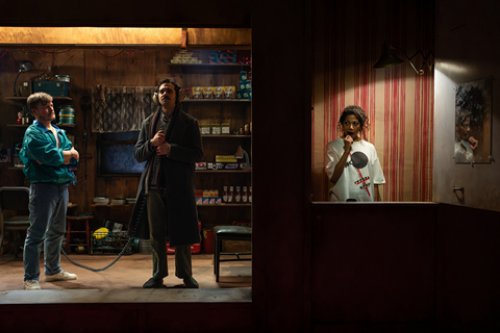
Steven Boyer, Adam Chanler-Berat and Rebecca Naomi Jones in a scene from Lauren Yee’s “Mother Russia” at the Pershing Square Signature Theatre Centre (Photo credit: HanJie Chow)
In Lauren Yee’s exuberant and stealthily devastating new comedy, Mother Russia, history arrives not with a bang but with an order of fast food. Two young men, perched at the lip of a new world order, cradle their first-ever Filet-O-Fish sandwich from McDonald’s as though it were a sacred relic. They tear into it with the devotional hunger of converts, pausing only to roll their eyes heavenward and lick tartar sauce from their fingers with an abandon that feels both comic and liturgical. Capitalism, Yee suggests, is best introduced as a condiment.
The friends—Dmitri and Evgeny, played with antic precision and bruised sweetness by Steven Boyer and Adam Chanler-Berat—treat the sandwich’s pallid bun and collapsing fillet as if they were sampling ambrosia. “The sauce is tangy, and the cheese is bright and lacking in sickly color,” Evgeny murmurs, in tones usually reserved for Turgenev. Dmitri, wide-eyed and wondering, asks, “Is this what capitalism tastes like?” In 1992 St. Petersburg, as the golden arches bloom like a secular annunciation over the rubble of the Soviet experiment, the question is less rhetorical than existential. This is your new land of opportunity. Would you like fries with that?
Yee, whose earlier plays—among them the searching, cross-cultural The Great Leap and the galvanic Cambodian Rock Band—have anatomized nations in ideological free fall, here turns her gaze to post-Soviet Russia with a wit so nimble it nearly conceals the blade. Mother Russia, which has opened at the Signature Theatre under the deft direction of Teddy Bergman, may be her most tonally assured work to date. It commits fully to the farce of sudden freedom—the dizzying rush of choice, money, Western slogans—and trusts that the tragedy will surface in the laughter’s wake.
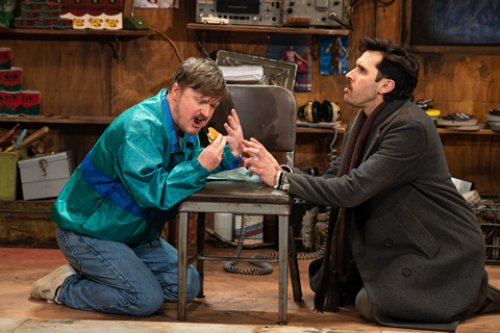
Steven Boyer and Adam Chanler-Berat in a scene from Lauren Yee’s “Mother Russia” at the Pershing Square Signature Theatre Centre (Photo credit: HanJie Chow)
Dmitri, exuberant and guileless, models himself on American gangster films, his vernacular stitched together from cultural imports and bravado. He runs a ramshackle shop that purports to sell “everything” – an empty Russian attempt at a bodega, but in fact serves as headquarters for a small-time pop-up surveillance scheme. Evgeny, the gentler son of a former Party apparatchik turned racketeer, drifts back to St. Petersburg after failing to make his fortune as an economist in Moscow. When he learns that the target of Dmitri’s operation is Katya—a smoky-voiced singer and former defector played with aching glamour by Rebecca Naomi Jones—he entangles himself in a deception born of love and naïveté. Their tentative romance, conducted on buses and in half-lit corners, glows with possibility and dread in equal measure. And no, he’s not telling her he’s spying on her.
A catastrophically inept spy, Evgeny allows his conscience—and then his heart—to derail the assignment. His infatuation with Katya imperils not merely a surveillance job but his father’s grand design: to hoard privatization vouchers, seize control of Russia’s state oil apparatus, and ascend as one of the newborn nation’s inaugural oligarchs. In this feral dawn of capitalism, ideology has been replaced by acquisition. The spoils go not to the thoughtful or the tender but to the brazen—to those sufficiently shameless to claim history’s fire sale as their own.
Yee’s great subject is disenchantment, but she handles it with a buoyant touch. Evgeny’s textbook fluency in Marxist economics proves useless in deciphering the so-called invisible hand; Katya discovers that America’s appetite for her novelty evaporated along with the Berlin Wall. (“No one wanted to hear me sing ‘tear down that wall’ once there was no wall left to tear,” she notes, in a line that lands like a rimshot.) Only Dmitri maintains an almost mystical faith that the system will, eventually, reward his hustle. He does not yet understand that capitalism, like communism before it, has its chosen few.
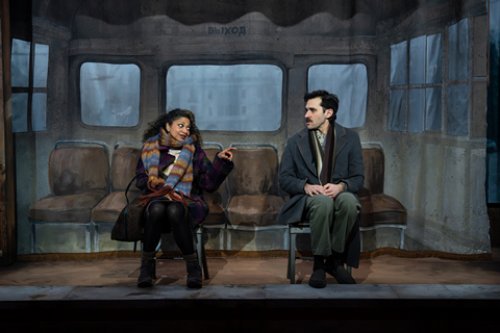
Rebecca Naomi Jones and Adam Chanler-Berat in a scene from Lauren Yee’s “Mother Russia” at the Pershing Square Signature Theatre Centre (Photo credit: HanJie Chow)
A Folgers advertisement—rendered in dutiful Cyrillic—looms above the proscenium like a capitalist iconostasis, presiding over a stage that proudly advertises its own artifice. The set, a delirious confection of sliding painted backdrops and a slamming corrugated-iron curtain, announces its mechanics with a wink; the scenic design by dots is gloriously synthetic, a toy theater for grown-up calamities. Scene changes arrive not with stealth but with a clang and a flourish, as if to remind us that history, too, is a series of conspicuous constructions.
The costumes, by Sophia Choi, clad Evgeny in a sumptuous winter coat over what he would have worn to his Marxist economic power breakfasts. Later Dmitri and Evgeny don neon-bright 90s warm-up jackets that make them resemble background players on the set of Marty Supreme. The effect is both affectionate and arch: these would-be capitalists dressed as children of globalized kitsch, strutting through the wreckage in color-blocked bravado. Their silhouettes pop against the painted flats, as if auditioning for a future that hasn’t quite finished rendering.
Lighting designer Stacey Derosier embraces the production’s high theatricality with unapologetic relish. Follow spots snap on like interrogations; moody gels bathe the stage in bruised violets and lurid ambers, turning moments of confession into cabaret turns. The illumination does not pretend to naturalism. Instead, it heightens the play’s sense that we are watching a nation perform itself—try on poses, rehearse identities, and step into the spotlight of Western fantasy.
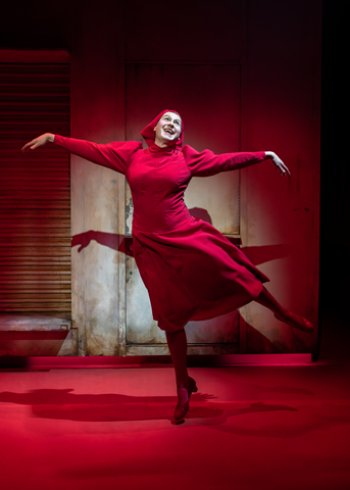
David Turner in a scene from Lauren Yee’s “Mother Russia” at the Pershing Square Signature Theatre Centre (Photo credit: HanJie Chow)
And then there is the sound. Mikhail Fiksel threads the evening together with an aural collage that evokes the brash, bewildering Russia of the 1990s: thumping techno, tinny pop, the synthetic optimism of a market economy scored in MIDI. Most inspired is his cheeky techno remix of the fourth act of Swan Lake, that most Russian of ballets, here reborn as club track. The transformation is both absurd and oddly apt—Tchaikovsky through a drum machine—suggesting a culture caught between grandeur and gimmick, tragedy and rave.
Hovering above the fray is the title character herself: Mother Russia, embodied with imperial hauteur and Borscht Belt brio by David Turner. Draped in a resplendent red dress and head scarf, she offers a sardonic running commentary that collapses centuries into punch lines. In a breathless, borderline stream of consciousness précis of national history—Perestroika rubbing shoulders with pop culture ephemera, the Chechen wars stacking up like sequels—she reminds us that what feels unprecedented is often merely cyclical. The joke, as always, is on the optimists.
Mother Russia seems to have swallowed an entire genre catalogue and emerged sleeker for it. It is, at once, a howling farce and a pulse-quickening espionage caper, the sort of historical thriller in which furtive glances and bungled stakeouts carry the charge of gunfire. Yet beneath its buoyant comic surface runs a far more searching current. The laughter is edged with inquiry. What begins as a tale of amateur spying unfolds into a shrewd examination of class stratification in a society abruptly stripped of its ideological scaffolding. The characters scramble not only for money and advantage but for footing—testing where they land in a hierarchy that has been detonated and reassembled overnight. The play studies the friction between old privilege and new-market opportunism, between those fluent in the language of Party loyalty and those quick to master the slang of profit.
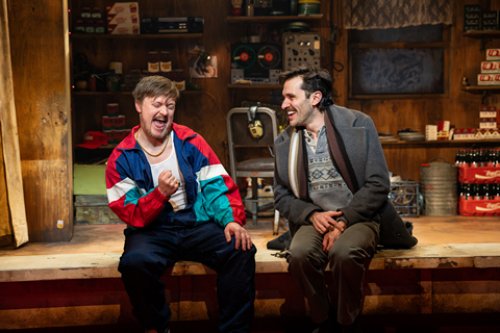
Steven Boyer and Adam Chanler-Berat in a scene from Lauren Yee’s “Mother Russia” at the Pershing Square Signature Theatre Centre (Photo credit: HanJie Chow)
At its core, the work stages a contest between governmental and economic systems as intimate drama. Communism’s collapse and the Soviet Union’s dissolution in the early 1990s are not treated as textbook milestones but as seismic shocks registered in friendships, romances, and family schemes. Policy becomes personal; privatization becomes betrayal. The invisible hand leaves visible bruises. And yet the miracle is tonal. Yee refuses solemnity as the sole register of historical reckoning. Instead, she trusts comedy—raucous, nimble, occasionally absurd—to expose the absurdities of power and the tragicomic ironies of transition. The result is a theatrical hybrid of rare assurance: a play that keeps us on the edge of our seats even as it asks us to consider who gets a seat at the table when the system changes, and who is left standing in the wings, waiting for a revolution that never quite arrives.
Yet what lingers after the laughter is not cynicism but a chastened tenderness. Yee understands that systems fail people in intimate ways—through hunger, humiliation, and thwarted love. By evening’s end, the characters have learned that capitalism tastes not only of Filet-O-Fish and possibility but of greed, violence, and betrayal. The wheel of history turns, and turns again, polishing the same old ruts.
Mother Russia (extended through March 29, 2026)
Signature Theatre
The Pershing Square Signature Center’s Romulus Linney Courtyard Theatre, 480 West 42nd Street, in Manhattan
For tickets, visit www.signaturetheatre.org
Running time: 90 minutes without an intermission


Leave a comment