
Hucka
A story of atonement and a choice of time and space inspired by Mark Twain’s novel.
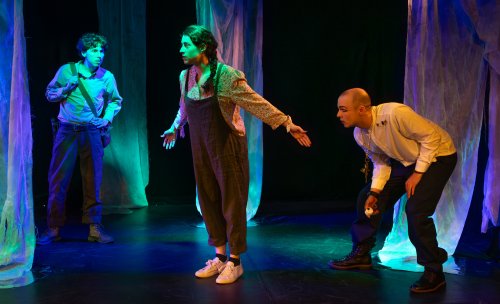
Carson Merrick, Brooke Elizabeth and Jayden Key in a scene from Suzanne Willett’s “Hucka” at The Players Theatre (Photo credit: Bjorn Bolinder)
Hucka, written and directed by Suzanne Willet, is intended to be about the idea of physical space and how that space is defined, either by collective agreement, as in public space, or as a private statement, such as a business office. It is also something carrying a personal dimension, as in one’s personal space. In the case of this play, the idea is focused on the personally defined space.
The story is one of time and space and how those things are defined. When one considers the meaning of space and time, rarely are the two combined as a unitary experience with one an inextricable part of the other.
The background on the story indicates that The Adventures of Huckleberry Finn by Mark Twain was an inspiration for the story, but the only connections to that book seem to be the idea of traveling on a river and speaking a dialect of English typically associated with poorly educated people. Two examples of the form are in the first two scenes. Hucka (Brooke Elizabeth) in the opening monologue says, “I don haf ta pay hardly pay no attention to ‘em.” And in the next scene, Cain (Carson Merrick) says, “Ya tol me ya war gointa finish this ‘fore sunup.”
The downside of this approach is the need for the audience to become comfortable with a particular manner of speech. Ideas that need to be clear can become muddy, and the expression of certain emotions can also be lost. A similar situation happens with plays that are spoken with strong British or Irish accents. It takes some time to make sense of what is being said, and in that time of adjustment, essential things in the foundation of the story may be lost.
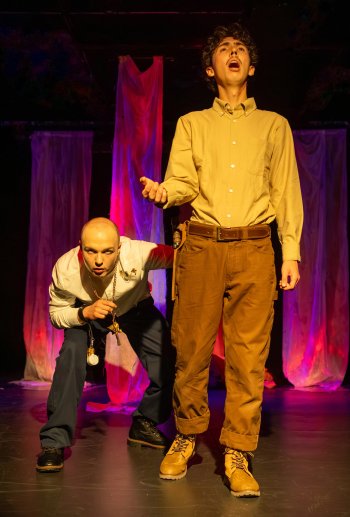
Jayden Key and Carson Merrick in a scene from Suzanne Willett’s “Hucka” at The Players Theatre (Photo credit: Bjorn Bolinder)
Hucka is a story built on the idea that someone, in this case a woman, is floating in a river located in a liminal space. It is the idea of a river existing in a dimensional space between life and death. It is a space that one can choose to stay in or move to a place entirely outside of the world of the living.
The characters of the story are taken from several cultural myths, the most prominent being Anubis of Egyptian mythology, who is the guide to the afterlife. He is depicted as a man with the head of a dog. In the show, the character is Godog (Jayden Key), the navigator on the river between life and death, hired by Hucka’s brother Cain. Cain is from the Biblical myth of Genesis, which makes Hucka a representation of Abel.
Cain is searching for his sister to convince her to return to the shore to be reincarnated into the living world. It is his way of making amends for being the cause of Hucka’s death. This connection to the Biblical story is played out in some of the details revealed about the lives of the characters; Cain raised grain and vegetables, and Hucka was a shepherd, and the favorite of their father.
Once Hucka is found and convinced to board the boat with Godog and Cain, she must now be convinced to go to the shore with them. It is in the exchanges concerning leaving the river that the passage of time and the meaning of physical space occur. As Godog navigates down the river, Cain tries to convince Hucka to return with him to the shore. The decision has to be made before sunrise.
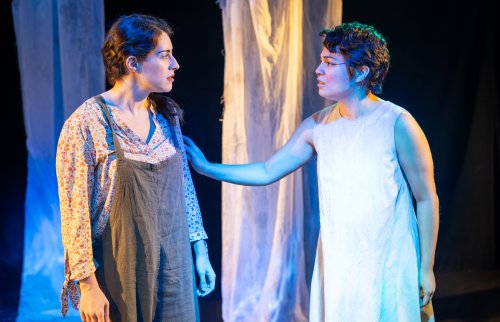
Brooke Elizabeth and Natalie Malia Figuracion in a scene from Suzanne Willett’s “Hucka” at The Players Theatre (Photo credit: Bjorn Bolinder)
As they travel down the river, other entities are encountered that represent Hucka’s memories. Those entities, Distance, Worth, Persis, and Vines, are all embodied by Natalie Malia Figuracion, who interacts with Hucka as she struggles with understanding the space she wants to inhabit.
Cain does not want Hucka to interact with the memories. He wants to control what she remembers so that when they return to the shore, he will control the narrative, and it will be his version of their history. It will give him control over who she is and where she is.
Ultimately, the play doesn’t work for several reasons. The venue is wrong for the depiction of a boat and river. The set has a white curtain-like material hanging from the ceiling, without it being clear what is being represented. The lack of a boat or a representation of a boat has the actors walking in single file around the hanging curtains without a clear idea of what is happening.
Godog walks as if he is crippled or deformed, which detracts from the idea that he is a focused and steadying influence for any journey on the river. He speaks with a conversational tone without the exaggerated accent of Hucka and Cain, which makes his movements seem incongruous. The characterization would be stronger if he walked upright in a formal manner with steady, clear articulation. He has been the navigator for all of time, so the character should reflect that steadiness.
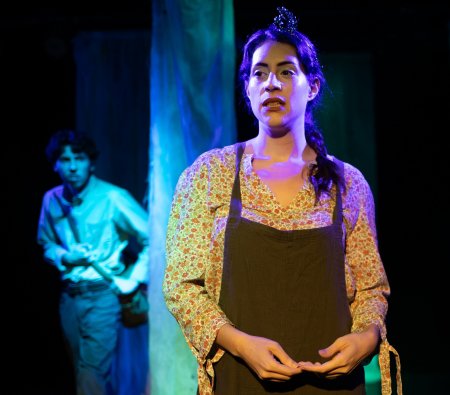
Carson Merrick and Brooke Elizabeth in a scene from Suzanne Willett’s “Hucka” at The Players Theatre (Photo credit: Bjorn Bolinder)
Figuracion’s portrayal of the memories attempts to give an ethereal quality to the various characters through movement and costume. The lack of a clear distinction between each of the memory characters makes it unclear whether what is being experienced is distinct characters. It is a place where costume and voice characterization, along with less movement, will help better define the characters.
While Merrick believably embodies Cain, his voice projection is out of balance with the setting and the actions of the other characters. It is loud with a strident quality that needs better modulation and balance to express the various emotional states of the character. Elizabeth’s delivery of Hucka’s lines is conversational in tone, making it more understandable and works well in helping define the character. Her presentation is the strongest of all the cast.
There is a series of small projections on a side wall of the theater space but they don’t seem clearly connected to the story. They need to be more central to the action to have an impact.
The production team includes Zach Dulny, lighting designer; Mira Turkewitz, costume designer; and Lara Knopf, set and prop designer.
Hucka (through September 21, 2025)
Silver Glass Productions
The Players Theatre, 115 MacDougal Street, in Manhattan.
For tickets, visit, http://www.silverglassprods.org
Running time: 85 minutes without an intermission


Leave a comment